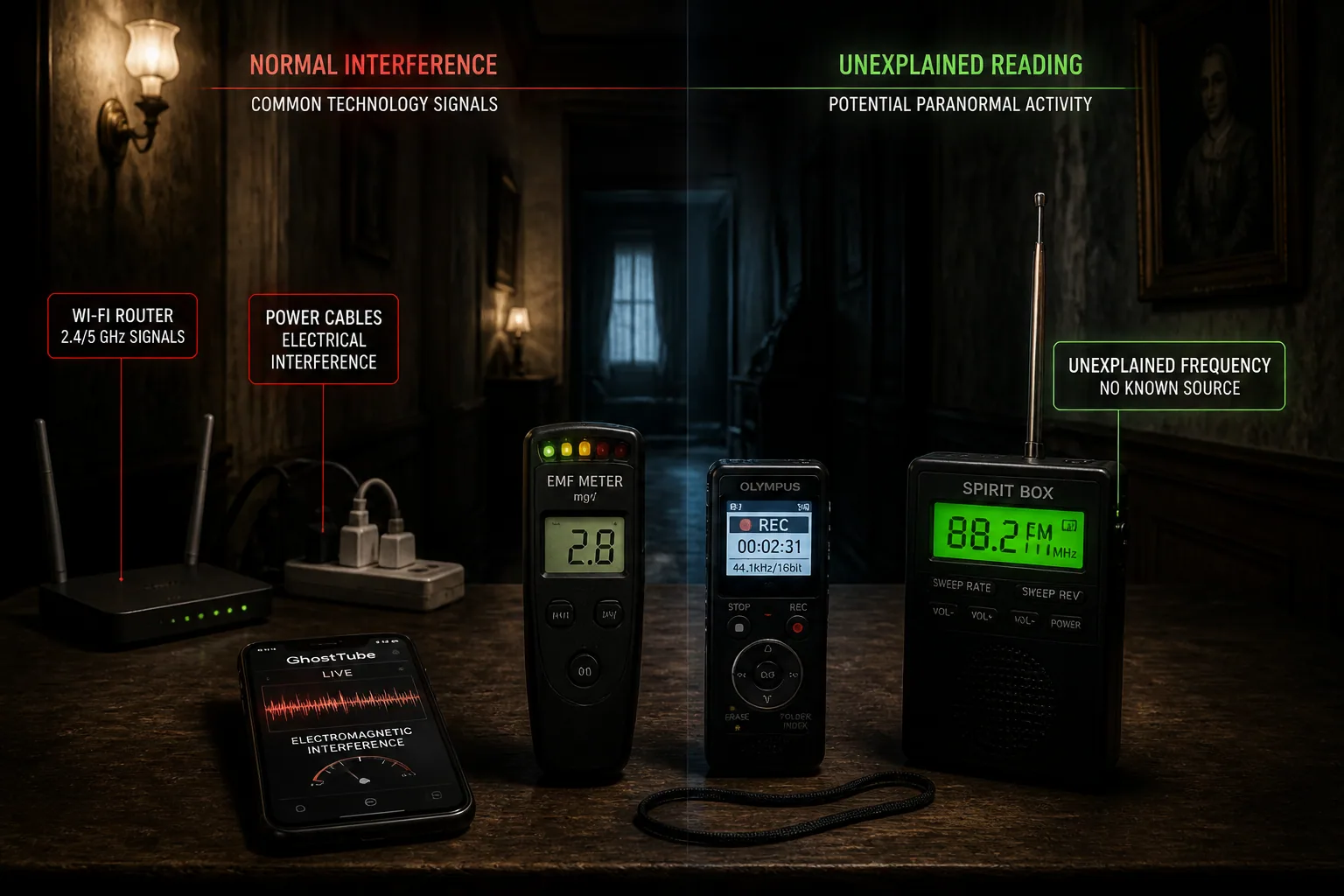
Ghost Detecting Tech vs. Fake-outs: How to Spot Real Paranormal Activity and Avoid Sensor Glitches
If you’ve ever watched an EMF meter jump, heard a strange reply from a spirit box, or caught a weird phrase on an EVP recording, you already know how quickly a ghost hunt can turn exciting. The problem is that paranormal gear is surprisingly easy to fool. Smartphones, EMF meters, spirit boxes, and audio recorders can all pick up ordinary environmental noise, electrical interference, and even your own expectations in ways that look mysterious in the moment.
That doesn’t mean your evidence is worthless. It means you need a cleaner process. The best investigators don’t just look for spikes or voices; they look for patterns that survive controls, repetition, and skeptical review. In other words, the goal is not to find more weirdness. The goal is to find the weirdness that keeps showing up after the obvious explanations are removed.
Why Ghost Hunting Tech Gets Tricked So Easily
Most ghost hunting devices were not designed to prove the paranormal. They were designed to detect physical signals such as magnetic fields, radio frequency noise, or sound. That makes them useful tools, but also highly vulnerable to contamination. A single loose wire, a nearby router, a Bluetooth speaker, or even the way you hold the meter can change the reading.
This is why paranormal investigations often produce dramatic-looking spikes in places that are completely ordinary. A recent multi-hour baseline study at a non-haunted control site found that time-varying magnetic fields there were just as complex and variable as in locations claimed to be haunted, which suggests that many “anomalous” EMF spikes may simply be normal environmental fluctuation rather than proof of a presence (Schumacher, Biddle & Vickers, 2023: https://journalofscientificexploration.org/index.php/jse/article/view/2725).
In practice, that means your equipment is usually doing exactly what it was built to do. The hard part is interpreting the data correctly.
What EMF Meters, Spirit Boxes, and EVP Recorders Actually Detect
EMF meters measure electromagnetic fields, but the exact behavior depends on the device. Many meters used in paranormal investigations are single-axis devices, so tilting or rotating them can cause large changes in the reading even when the environment has not changed. That means a dramatic spike can sometimes be nothing more than orientation, not a supernatural event.
For indoor settings, normal AC EMF background is often in the rough range of 0.0 to 1.5 milliGauss, and readings above that frequently have ordinary causes such as wiring, appliances, or routers. Hidden wiring in older buildings, mains power lines inside walls, phone chargers, and smart speakers are common sources of misleading readings (KASE Paranormal: https://www.kaseparanormal.co.uk/blog/emf-meters-what-they-actually-detect).
Smartphone EMF apps are even more limited. They usually rely on the phone’s magnetometer, which is mainly a compass sensor. According to EMF Protection Pros, that means they detect static magnetic fields better than AC magnetic fields, and they are not reliable for picking up Wi-Fi, Bluetooth, or other RF sources in the way many users assume (https://www.emfprotectionpros.com/can-i-use-my-phone-to-detect-emf/).
Spirit boxes and EVP tools are different, but the same caution applies. They generate or capture ambiguous audio, and ambiguity is exactly where pareidolia and expectation can take over. If the sound is fuzzy enough, the mind will try to complete the pattern.
The Most Common Causes of False Positives
The biggest source of false positives is simple environmental noise. Power lines, internal wiring, wireless access points, chargers, and active electronics all create electromagnetic or radio activity that can look unusual if you are not checking the context carefully.
Routers and Bluetooth devices are especially important because they operate in common ISM radio bands such as 2.4 GHz and can create constant low-level interference. Bluetooth also frequency-hops, which can make its signature seem erratic or intermittent rather than steady, adding to the sense that something is “appearing” and “disappearing” around your meter or recorder (Electronic Design / MetaGeek support overview: https://www.electronicdesign.com/technologies/analog/article/21180942/electronic-design-the-impact-of-emi-on-wi-fi).
In other words, a noisy old building is already full of signals that can fool your gear. You do not need a ghost for a reading to jump.
The same applies to audio. HVAC systems, wind, distant traffic, electrical hum, compressed digital noise, and poor microphone gain can all create odd fragments that sound meaningful after the fact. If you only listen once, or only listen after being told something strange happened, you are much more likely to hear a paranormal phrase than an unbiased observer would.
How Power Lines, Phones, Wi-Fi, and Wiring Can Mimic Paranormal Activity
If you want cleaner evidence, you have to think like an interference hunter. Start by identifying the strongest ordinary sources in the area. Power lines outside the building, electrical panels, old or unshielded wiring, extension cords, chargers, routers, smart home devices, and even nearby phones can all create the kind of field changes that an EMF meter will happily report.
A useful habit is to map the room before you start. Where are the outlets? Where is the router? Are people carrying phones or smartwatches? Is a Bluetooth speaker nearby? Is there a wall that could hide wiring? Is the meter reacting near one area only when you point it a certain way? These questions often solve the “mystery” before it becomes evidence.
Also remember that not all signals are equally visible to all tools. A smartphone app may show almost nothing even when there is real electrical activity, while a handheld meter may jump just because you turned your wrist. That mismatch can lead investigators to believe they are seeing different “entities,” when they are really seeing different instrument limitations.
Auditory Pareidolia: Why Your Brain Hears Patterns in Noise
EVP interpretation is where bias becomes especially powerful. Auditory pareidolia is the tendency to hear recognizable speech or structure in ambiguous noise. Once you know what you are supposed to be hearing, your brain fills in the blanks.
This is not just a theory. In experiments on auditory pareidolia, people who were primed by being told that recordings might contain paranormal voices reported significantly more voices in ambiguous audio than unprimed participants. That is strong evidence that expectation bias can dramatically change what people think they hear (Nees & Phillips, 2014: https://cir.nii.ac.jp/crid/1363951793267326976).
Research on paranormal experiences and pareidolia also found that agreement among listeners was very low, even among people who said they heard voices. Unless the content was already clear, different people often interpreted the same clip in completely different ways (PLOS One: https://journals.plos.org/plosone/article?id=10.1371%2Fjournal.pone.0274595).
A separate study on hearing EVP in random noise found that about 36% of participants reported EVP when primed, and paranormal belief shaped confidence in what they heard. That does not mean every EVP is false, but it does mean the human interpretation layer is highly vulnerable to suggestion (Dagnall et al., 2020: https://www.parapsychologypress.org/jparticle/jp-84-1-96-113).
How to Set a Clean Baseline Before Any Investigation
A baseline is your reference point. If you do not know what normal looks like, you cannot know whether a reading is unusual. This is one of the simplest and most overlooked habits in ghost hunting.
Before treating any spike as meaningful, spend time in the location with all your equipment running in the exact conditions you plan to investigate. Measure the room for several minutes, then repeat at different times if possible. Note where readings are stable, where they drift, and whether there are predictable patterns near walls, electrical fixtures, or devices.
Good baseline work should include time, place, device position, and environmental notes. If the reading rises every time someone walks near the meter, or only changes when a phone is active, that is not paranormal. That is your baseline teaching you how the space behaves.
The baseline study at the non-haunted control site is a good reminder that normal environments can be surprisingly dynamic. In other words, if you skip baselines, you may end up calling ordinary fluctuation “anomaly.”
Calibrating and Isolating Devices to Reduce False Triggers
Calibration is about making sure the device is behaving consistently. If your meter is sensitive to tilt, you need to know that before you start interpreting spikes. If your recorder is picking up handling noise, that matters too.
A good method is to isolate devices from each other. Do not place your phone, EMF meter, spirit box, and recorder in a tight cluster unless you are specifically testing interaction. Keep phones on airplane mode when possible, silence notifications, and remove unnecessary Bluetooth sources from the area. If one device is creating interference, you want to identify it quickly.
You should also take readings with the meter in more than one orientation. If a “hot spot” disappears when the meter is rotated, it is probably sensitivity to direction rather than a fixed field source. This is especially important with single-axis meters, where physical position can dramatically change the result.
If you want to make the process easier and more consistent, a dedicated tool like Ghost Detector: Ectify can help you organize sessions, capture audio, and review history in one place: https://findthe.app/ectify-fc72z0. The key is still disciplined use. The app may make the experience more immersive, but your evidence is only as good as your method.
Using Control Recordings and Repeat Tests to Check for Real Anomalies
Control recordings are essential because they let you compare “mysterious” results against normal conditions. For audio, record the same room when no investigation is happening. For EMF, take measurements when the room is empty, then repeat when known devices are on and off.
If a strange EVP only appears once and never returns, that is weak evidence. If a similar sound appears across multiple recordings under the same conditions, you have something more worth examining. Repeatability is one of the best filters for separating real signals from accidental noise.
A simple test is to run the same question or recording setup several times with the same distance, same room, same device placement, and same background conditions. If the result changes wildly every time, it is probably unstable data. If the result persists and can be captured again under controlled conditions, it deserves a closer look.
Repeat tests also help expose expectation effects. If you know what happened during the first run, you may unconsciously “hear” or “see” it again during the second. That is why blind or semi-blind review is so valuable when possible.
Red-Flag Readings You Should Treat With Skepticism
Some patterns should make you pause immediately. A sudden EMF spike near a wall with hidden wiring is not strong evidence. A reading that changes because you turned the meter slightly is not strong evidence. A voice that only sounds like a word after you were told what to listen for is not strong evidence.
Other warning signs include recordings made too close to phones or wireless devices, unexplained audio that coincides with handling noise, and EVPs that only become “clear” after repeated suggestions from the group. If a claim depends on imagination doing a lot of work, the evidence is probably weak.
Be especially skeptical of anything that is not repeatable, not documented, and not isolated from obvious sources. One-off spikes can be interesting, but they should never be treated as proof on their own.
Signals That May Be Worth Further Investigation
Not every unusual result should be dismissed. Some readings are worth following up when they are persistent, location-specific, and hard to reproduce from obvious causes. A consistent field change in the same spot, across multiple runs, after electronics are removed, is more interesting than a random blip.
The same is true for audio. If a phrase appears on a recording in the same segment across repeated captures, and independent listeners agree on what they hear without being primed, that is more notable than a vague sound that everyone interprets differently.
Some haunted-site studies, including work by Laythe & Owen, reported EMF and geomagnetic variability even in the absence of electricity-generating fields, with serial spikes and drops associated with reported phenomena. Those findings remain contentious, but they show why careful documentation and repetition matter: unusual patterns are only valuable if they survive scrutiny (https://www.parapsychologypress.org/jparticle/jp-77-2-212-236).
The best approach is not immediate belief or immediate dismissal. It is disciplined follow-up.
How to Document Evidence So Others Take It Seriously
Good documentation turns a spooky story into something people can actually evaluate. Record the time, exact location, device model, meter settings, room conditions, nearby electronics, weather if relevant, and who was present. If possible, note when phones were off, when lights were on, and whether anything in the room changed during the session.
When you share evidence, include the context around the anomaly, not just the anomaly itself. A clip with no baseline, no notes, and no explanation of the setup will almost always be met with skepticism. A clip with timestamps, environmental notes, and repeat tests is much more persuasive, even if the result is still inconclusive.
You should also keep the original file intact. Edited clips can be useful for presentation, but the uncut recording matters most if someone wants to verify what happened. The more transparent you are, the more credible your findings become.
A Practical Checklist for Smarter, More Credible Ghost Hunts
Before the investigation: identify nearby power sources, routers, chargers, Bluetooth devices, and hidden wiring if you can; test your meter and recorder; and take a baseline reading in the same conditions you expect to investigate.
During the investigation: keep phones away or on airplane mode, isolate devices from each other, watch for tilt and handling noise, and note every environmental change as it happens. If something odd occurs, repeat the test before you assume it means anything.
After the investigation: compare the anomaly to your baseline, look for possible electrical or audio explanations, and ask whether an independent listener or observer would interpret the evidence the same way. If the answer is no, you probably do not have a strong claim yet.
The most credible ghost hunters are not the ones who find the most activity. They are the ones who can show that what they found still looks unusual after the easy explanations have been removed. That is how you separate real investigation from fake-outs, and how you make your evidence worth sharing.
