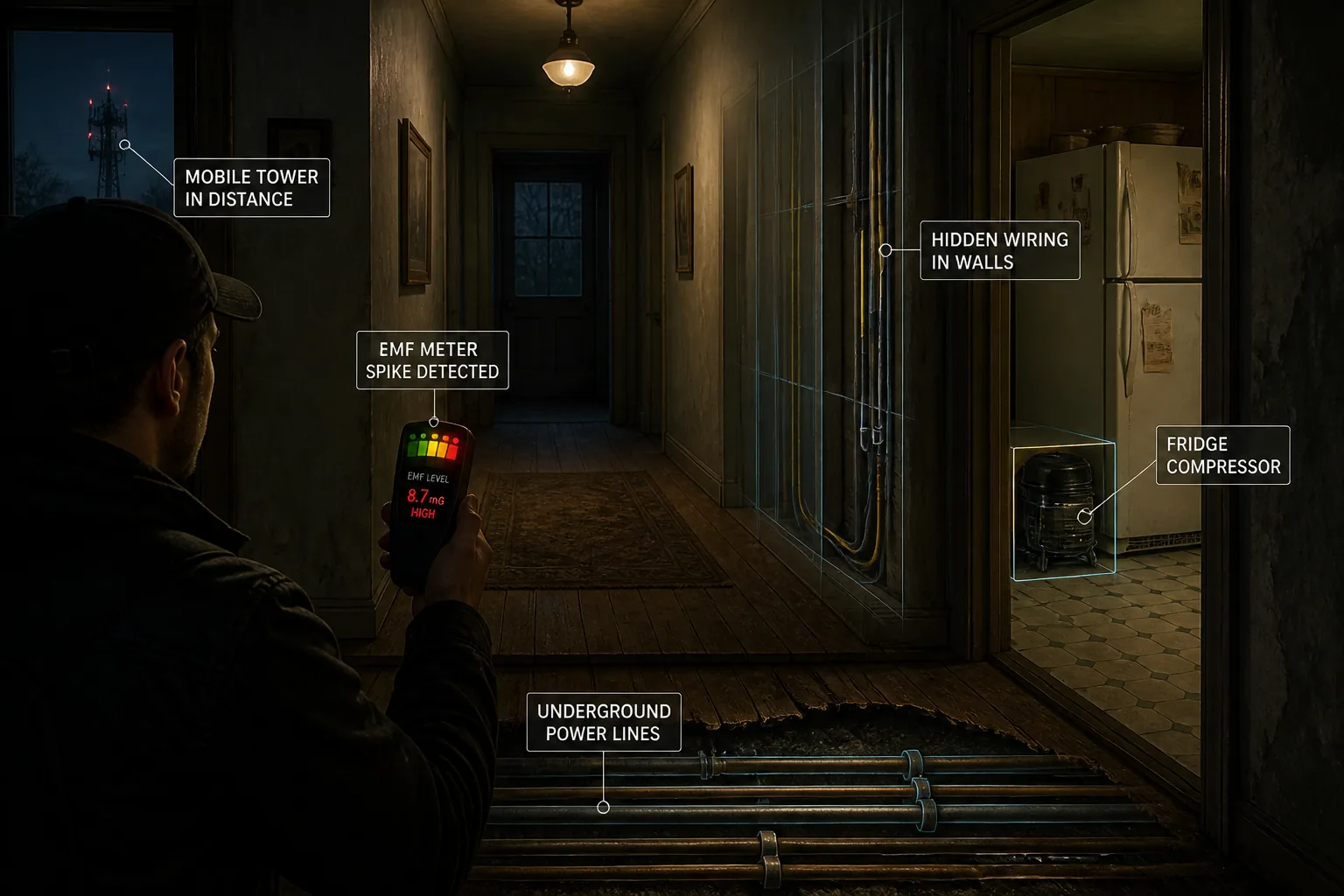
10 Unusual Signal Sources That Can Cause EMF Spikes and How to Tell If They’re Paranormal
If you are new to ghost hunting, EMF readings can feel exciting very quickly. A spike on a meter, a sudden jump on your phone, or a hotspot in one room can seem like the kind of thing people talk about in haunting stories. The problem is that EMF is also one of the easiest things to misread. Ordinary appliances, wiring issues, nearby infrastructure, and even the way a building is wired can create patterns that look strange at first glance but have completely normal explanations.
That does not mean EMF is useless. It means it works best when you treat it like evidence instead of a thrill button. A good investigator looks at pattern, distance, timing, and repeatability. In this guide, we will walk through 10 often-missed signal sources, explain what their readings usually look like, and show you how to tell whether a spike is likely mundane, questionable, or worth a second look.
Why EMF False Positives Frustrate New Ghost Hunters
The biggest reason beginners get frustrated is that EMF readings rarely behave like people expect. They do not simply rise when something paranormal is present and stay flat when nothing is there. They can jump because a compressor kicked on, because a router is transmitting, because a breaker box is loaded, or because a wire hidden behind drywall is carrying current. Some sources create sharp spikes, while others create broad zones of elevated field strength.
Another challenge is that EMF is not one thing. Electric fields, magnetic fields, and radio frequency energy behave differently. A phone magnetometer can help with magnetic mapping, but it is not a full-spectrum EMF detector. Research and field guides caution that smartphone magnetometers mainly measure magnetic field changes, are not calibrated for RF, and may under-report compared with professional meters near appliances or WiFi hotspots. That is why the smartest ghost hunters use the phone as a secondary tool, not the final word. For an easy way to keep sessions organized while you test hotspots, log spikes, and review old takes, a tool like Ghost Detector: Ectify can help structure your investigations with real-time magnetometer feedback, session history, and recording features: https://findthe.app/ectify-fc72z0
What Normal EMF Readings Usually Look Like Indoors and Outdoors
Before you decide whether a spike is unusual, you need a rough sense of normal. In U.S. homes, background magnetic fields away from appliances commonly sit around 0.6 to 3 milliGauss, or about 0.06 to 0.30 microTesla. Near operating appliances, readings of 5 to 20 mG, or 0.5 to 2 microTesla, are common and not automatically suspicious. Indoors, wiring in walls can also create electric fields whenever a circuit is energized, even if the device at the end of the circuit is not actively doing much.
Outdoors, nearby transmission lines, cell infrastructure, metal structures, vehicles, and utility equipment can all create stronger or broader field patterns than a beginner expects. The key point is that a normal reading is not always a low reading. It is often a reading that matches the environment around it in a predictable way.
1. Fridge and Freezer Compressors
Fridges and freezers are some of the most common EMF troublemakers in a home, especially in kitchens, basements, and break areas where investigators tend to linger. Compressor motors cycle on and off, so the reading may jump suddenly, hold for a short period, then drop again. That on-off behavior is one of the strongest clues that you are dealing with an appliance instead of anything anomalous.
Research from EMF-Portal notes that a refrigerator’s magnetic flux density at 30 cm can reach about 0.25 microTesla, and at 1 meter it usually drops to roughly 0.01 to 0.04 microTesla. In practical terms, that means the spike is often strongest when you are close to the appliance and weaker a few steps away. If your reading rises when the compressor kicks in, then repeats after a few minutes, that pattern is very likely ordinary. If you want to verify it, stand in the same spot while the fridge turns on and off several times. A true environmental source will usually show the same timing pattern again and again.
2. Hidden Wiring Behind Walls and Near Outlets
Hidden wiring is one of the easiest sources to overlook because there is nothing visible to blame. A wall can look empty, yet still produce a measurable magnetic field if the circuit behind it is active. Faults such as neutral-ground shorts or improperly paired neutrals can make the reading stronger and more persistent, especially near outlets, switches, or electrical panels. Field documentation from EMF Services notes that problem wiring can produce readings in the 5 to 20 mG range near walls or panels when the circuit is in use.
A useful clue is geometry. Wiring tends to create a line or band of elevated readings rather than a single isolated dot. If you move the meter a foot left or right and the field still follows the wall, that is a wiring pattern. If the reading changes when someone turns on a light, plugs in a device, or starts a load on the same circuit, that also points to an electrical explanation. A paranormal source would not usually track neatly along a wire path or shift when the circuit load changes.
3. Extension Cords, Power Strips, and Poor Grounding
Extension cords and power strips are classic false positive generators because they gather multiple devices into one place and often run under rugs, along baseboards, or behind furniture where no one thinks to check. Poor grounding can add more noise to the picture, especially if several components share a strip or if the strip is overloaded. The field can become stronger where cords bend, cross, or bunch together.
This kind of source tends to create a close-range spike with a clear physical anchor. If you trace the cord with your meter, the reading often rises along its length and falls off as soon as you move away. Because the effect is tied to current flow, the spike may get worse when more devices are drawing power. That makes the pattern repeatable, which is exactly what you want to test before calling it unusual. If the hotspot disappears when the strip is unplugged, the case is over.
4. Smart Devices, Routers, and Bluetooth Accessories
Modern homes are full of always-on electronics: WiFi routers, smart speakers, phones on charge, Bluetooth accessories, cameras, hubs, and automation devices. Many of these do not produce huge magnetic fields, but they can create confusing electromagnetic activity because they are constantly communicating. In an investigation, that can look like a spike that seems to appear for no reason, especially if the source is hidden behind a TV stand or tucked into another room.
The main clue here is consistency. Smart devices usually create a persistent or periodically repeating pattern instead of a single random burst. A router may stay active all night. A smart plug may pulse at intervals. A charging cable may create a small but stable reading near the device. Because these sources are tied to network activity or charging behavior, they often become obvious if you switch them off one by one and watch whether the hotspot disappears. If the reading vanishes after you mute, unplug, or isolate the device, that is a strong mundane explanation.
5. Mobile Towers and Nearby Radio Frequency Congestion
Cell towers do not need to be right next to a building to influence what investigators think they are seeing. Nearby radio frequency congestion can make an area feel active, especially outdoors where several transmitters, reflective surfaces, and device signals overlap. Field assessments near towers have found outdoor RF power density readings around 0.05 to 0.30 mW/m² at 300 to 600 feet, rising to about 1 to 2 mW/m² at 100 to 150 feet, with higher hotspots possible under certain beam and reflection conditions.
The shape of the reading matters here. RF interference is often broad, not point-like. It can seem stronger in open spaces, on rooftops, near windows, or in locations with line-of-sight to a tower. Guidance on tower distances also suggests that a macro cell tower is best kept roughly 400 meters away for reduced concern, while small cells may influence spaces from about 15 to 30 meters away because they are installed much closer to people. If your signal changes mainly with position relative to the horizon, rooftops, streetlights, or a visible tower, the source is probably infrastructure, not a spirit.
6. Electrical Panels, Breaker Boxes, and Meter Cabinets
Breaker boxes and meter cabinets are among the strongest ordinary sources in a building, and they can fool people because the effect may seem to come from a wall rather than a visible machine. When a lot of current is passing through a panel, nearby magnetic fields can climb enough to trigger consumer-grade meters and phone apps. This is especially true if multiple circuits are drawing load at once.
The pattern clue here is proximity to the service entrance. If the reading is strongest beside the panel and quickly weakens as you step away, that is expected. In many cases, the field will change with household activity, such as an oven heating up, laundry starting, or HVAC cycling. A paranormal hotspot usually does not behave like a utility node. If the spike is tied to the electric heart of the building, treat it as normal until proven otherwise.
7. High-Voltage Underground Cables
Underground power cables can create puzzling readings because the field may seem to rise in broad zones across floors or yards rather than around a visible object. Research summaries note that underground utility cables beneath homes may produce elevated magnetic fields that are more uniform than sharp spikes, and they tend to persist unless the load changes. That broad-area behavior is exactly why they can confuse a first-time investigator.
If you suspect an underground cable, look for a wide area of elevated readings instead of a single hotspot. The field may stay relatively stable across a hallway, yard edge, or section of flooring. A magnetic field produced by buried infrastructure does not normally vanish a few inches away the way an object-based anomaly might. It also may remain present over long periods, especially if demand on the line is steady. A repeated map of the same zone is the clue that points to utility infrastructure.
8. HVAC Systems, Fans, and Motors You Forgot Were Running
HVAC systems, ceiling fans, vent blowers, sump pumps, and other motors are easy to forget because they are often tucked into mechanical spaces or running quietly in the background. Yet motor-driven equipment is a very common source of EMF fluctuations. Utility measurements show that appliances like ovens, microwave ranges, and hair dryers can produce tens to hundreds of milligauss at about 6 inches, dropping to single digits or below 10 mG at around 1 to 2 feet. The same general rule applies to many motors: close-range readings can be surprisingly high, but they fall off quickly with distance.
The strongest clue is mechanical rhythm. Motors often produce a rising and falling pattern that matches a fan starting, a compressor engaging, or an airflow change. If the spike appears whenever a room gets warmer, colder, or more humid, HVAC is a likely suspect. Investigators often misread this because the motor is not visible, but the field still has a physical origin and a timing pattern tied to the system cycle.
9. Elevators, Transit Lines, and Large Metal Structures
Large metal structures can influence readings in two different ways. First, they can concentrate or redirect fields. Second, when they are part of powered infrastructure like elevators or transit lines, they can add their own magnetic activity. The WHO notes that electric trains and trams can generate magnetic flux density around 50 microTesla directly beneath vehicles or tracks, with exposure dropping quickly as distance increases. That is far above the range most beginners expect from an ordinary urban environment.
Elevators are especially important in hotels, offices, and apartment buildings. A person may think they have discovered a recurring hotspot in a hallway, when in fact the reading is linked to the elevator motor, cables, or passing car on the other side of the wall. The pattern is often positional and rhythmic. If the reading rises when the elevator moves, when a train passes, or when you stand near a large steel frame, you are seeing infrastructure behavior. That is a useful clue, not a failure of the investigation.
10. Cars, Generators, and Portable Power Stations Outside the Building
Outdoor parking areas, idling cars, backup generators, and portable power stations can all affect readings near the edge of a building. A car running outside a window may create a spike that seems to come from inside the room. A generator on a neighboring property may raise ambient levels around a yard or porch. Portable power units can also create localized magnetic activity if they are charging or powering equipment nearby.
These sources are usually directional. If you walk toward the parking lot, driveway, or curb and the reading gets stronger, the explanation is probably external. If the spike disappears when the vehicle moves, the generator shuts down, or you change sides of the building, you have found a natural cause. Outdoor investigation is especially vulnerable to this kind of confusion because sound, vibration, and EMF can all overlap and make the experience feel more dramatic than it is.
Spatial Clues: How Distance and Direction Reveal a Mundane Source
One of the most reliable ways to identify a normal source is to map how the field changes in space. Paranormal claims often focus on the spike itself, but investigators should focus on the shape of the spike. Does it sit tightly around one object, spread along a wall, increase near a floor or ceiling, or point toward a known utility area? Spatial clues are often more useful than the peak number.
A mundane source usually has a logical origin point and a predictable falloff. Appliances get weaker with distance. Wiring follows a line. Underground cables create broad zones. Towers and outside infrastructure often show directionality. If you can move just a few feet and the effect changes in a way that matches nearby hardware, you probably have an explanation. If the signal seems to follow the building rather than a point in the room, that is a major hint that the environment is responsible.
Temporal Clues: Cycles, Repetition, and Triggered Spikes vs. Random Events
Time is just as important as space. A compressor cycles. A fan turns on. A circuit gets loaded. A tower transmits continuously. A smart device wakes up at intervals. These repeating patterns are normal, and they are one of the best ways to separate background activity from something that deserves more study.
True anomalies are often discussed as if they appear randomly, but the honest answer is that randomness alone is not enough to prove anything. Instead, you want to know whether the spike repeats under the same conditions. If you can reproduce the spike by turning on a device, standing in the same place, or waiting for a cycle, then the source is likely mundane. If the reading remains after the expected cause is removed, or if it appears in a way that cannot be tied to load, timing, or movement, then the case becomes more interesting.
How to Use Your Phone’s Magnetometer to Check a Hotspot
A phone magnetometer is a useful secondary tool because it gives you a quick way to map a room and compare one spot with another. It is not a replacement for a proper meter, and it will not help you identify RF in a calibrated way, but it can still show whether a hotspot is stable, directional, or tied to movement. That makes it handy for sketching the field before you bring in better equipment.
The best approach is simple. Hold the phone steadily, keep it at the same height, and move slowly through the area. Compare one wall to another. Step back several feet and see whether the reading falls off. Then return to the exact same spot and test again. If the hotspot disappears when the phone rotates, the readings are erratic, or the values shift wildly with hand position, you may be seeing sensor noise instead of a true environmental pattern. Remember that phone sensors can under-report compared with professional meters, so use them for mapping, not for final judgment.
A Simple Process for Isolating Reliable EMF Spikes
Start with a baseline. Walk the space when appliances are off as much as possible, and write down the normal background reading. Then test one zone at a time. Do not wave the meter around randomly and call the highest number a hotspot. Instead, approach slowly, hold position, and note whether the reading is repeatable. Remove or silence one likely source at a time if you can safely do so.
Next, test from more than one angle. A real source will usually keep some form of spatial logic. It may get stronger near a wall, below a floor, around a machine, or along a cable path. If it only spikes when you make a dramatic motion or if the reading changes each time you reposition your hand, that is not strong evidence. Simple, controlled testing beats dramatic behavior every time.
How to Record, Log, and Present EMF Evidence Clearly
Good evidence is easy to review later. That means logging time, location, reading, device used, and what else was happening in the room. If possible, film the meter while you describe the environment aloud. Mention whether a fridge was running, a fan was on, or someone used a phone nearby. This gives you context that makes the recording credible instead of mysterious for the wrong reasons.
When you present the evidence, show the sequence. Start with the baseline, then the spike, then the control test that removed or changed the likely source. If the spike repeats under the same condition, say so. If it disappears when an appliance is unplugged or when you move away from a wall, say that too. That kind of honesty strengthens your investigation because it demonstrates that you are separating ordinary interference from the genuinely unusual.
When an EMF Spike Is Actually Worth Further Investigation
An EMF spike becomes more interesting when it resists easy explanation. You should pay closer attention if the reading appears in a place with no obvious appliance, does not align with wiring or infrastructure, does not repeat with any obvious cycle, and remains after you test the surrounding environment. A spike is also more worthy of attention if it occurs alongside other independent observations, such as matching audio, visual, thermal, or behavioral anomalies.
Even then, the goal is not to jump to paranormal conclusions. The goal is to narrow the possibilities carefully. A good investigator can say, with confidence, that a signal was normal, likely caused by infrastructure, or still unresolved. That is more useful than claiming every spike is a haunting. If you can rule out the obvious 10 sources in this article, your remaining cases will be cleaner, stronger, and much easier to defend.
