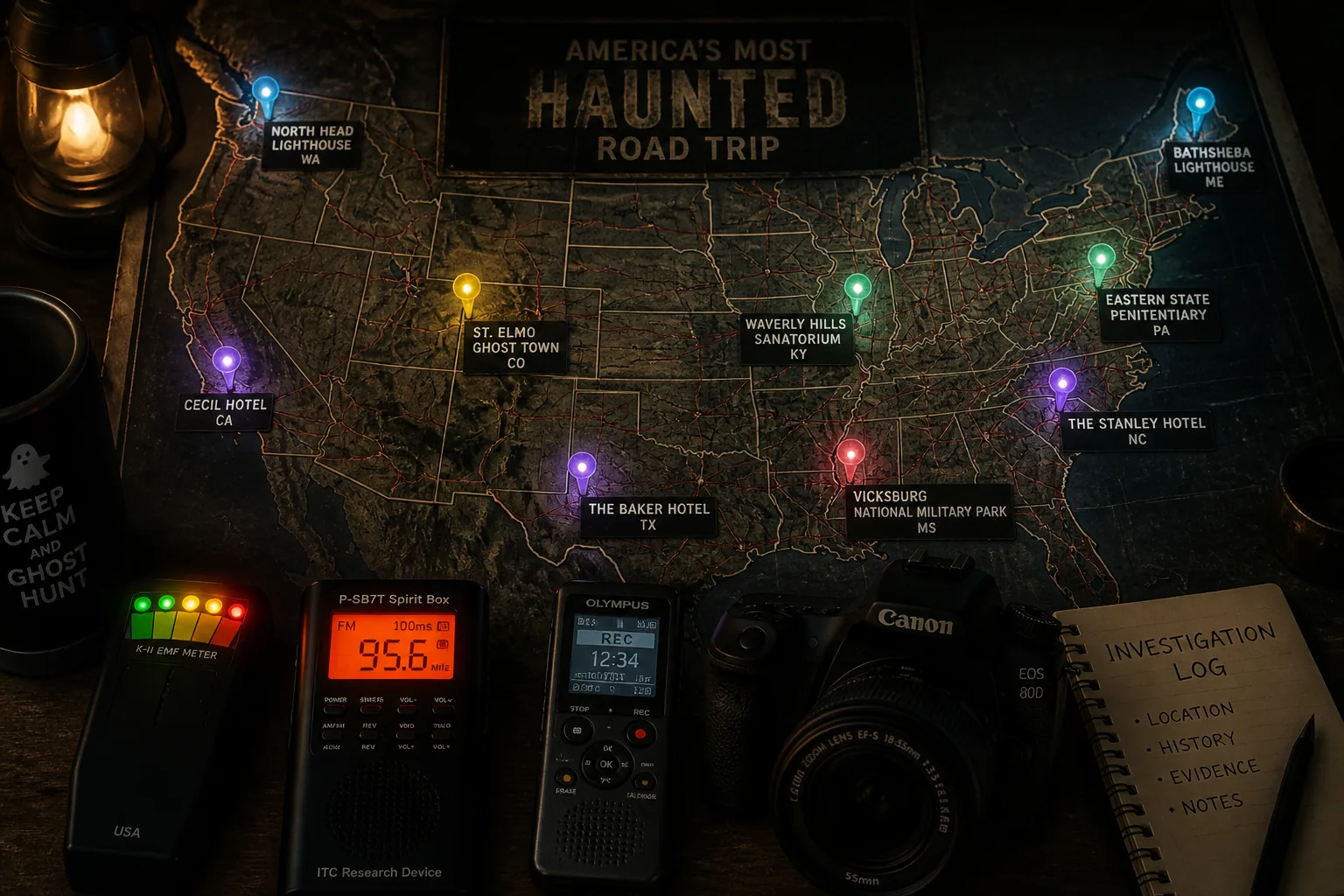
Best Ghost Hunting Routes Across the U.S. to Test and Improve Your Gear
If you want to get better at ghost hunting, one of the smartest things you can do is stop treating every investigation like a one-off event. A haunted road trip gives you something much more useful: repeated field conditions. Different buildings, climates, materials, and noise levels can reveal whether your EMF meter is truly reacting to a source, whether your spirit box is fighting radio interference, and whether your recorder is actually capturing clean audio or just environmental clutter. In other words, the best haunted routes are not only fun. They are practical gear tests that help you learn what your setup can really do.
This approach matters because real-world conditions change everything. Historic buildings may still contain active wiring and external electromagnetic sources, so EMF readings may never fall to zero. Building materials also affect what your devices pick up. Concrete and brick can provide significant EMF shielding, while wood and foam offer much less. Add in wind, humidity, tourist traffic, temperature shifts, and echo-heavy interiors, and you suddenly have a much better understanding of why paranormal evidence is often inconsistent from site to site. That is exactly why multi-location travel is so valuable for beginners and intermediate investigators.
What to Pack: Essential Tools for Beginner and Intermediate Investigators
Before you hit the road, keep your kit focused and repeatable. A good travel setup should be light enough to carry, but consistent enough to compare results across locations. At minimum, bring an EMF meter, a digital audio recorder, a flashlight or headlamp, spare batteries, a phone charger, a notebook or standardized log sheets, and a camera or night-vision capable device. If you use motion sensors, pack them in a way that allows you to set them up the same way every time so your results can be compared fairly.
You should also include backup power and redundant recording options. One of the most common mistakes ghost hunters notice only after a multi-site trip is losing data because a battery died halfway through a session or a device was left recording in the wrong mode. If you want an easy way to keep a session log and capture EMF changes directly on your phone, Ghost Detector: Ectify can be a useful travel companion. It turns your smartphone into a ghost hunting tool and lets you review sessions later, which is especially helpful when you are comparing different sites back to back. You can check it out here: https://findthe.app/ectify-fc72z0
How to Build a Multi-Location Ghost Hunting Trip Without Wasting Time
A good haunted route is not just a list of famous places. It is a route with enough variety to teach you something new at every stop. The goal is to compare environments, not simply collect more destinations. Try planning a trip that moves from isolated coastal locations to dense historic buildings, then to larger institutional spaces, and finally to outdoor sites with noise, weather, and crowd variables. That gives you a natural progression of environmental stress on your gear.
Keep travel time realistic and sessions structured. One late-night investigation at a difficult site can produce more useful data than three rushed stops where you never establish a baseline. Build in time for setup, control tests, and post-session review. If possible, revisit a similar location later in the trip to see whether the same device behaves consistently. That is how you start separating gear quirks from possible anomalies.
Route 1: New England Lighthouses and Coastal Hauntings
New England lighthouses are excellent first stops because they combine isolation, strong wind exposure, changing weather, and often a lot of open space. These locations are ideal for testing how your recorder handles ambient movement, whether your camera maintains clarity in salt air and fog, and how your EMF device behaves when there are fewer obvious indoor sources nearby. The isolation can also help you understand how much of your usual evidence is being influenced by crowds or nearby infrastructure elsewhere.
This type of route is especially useful for learning how your gear responds to the absence of obvious interference. If your EMF readings remain active in a lighthouse with no visible electrical activity, that is worth documenting carefully. But do not jump to paranormal conclusions too quickly. Verify whether there are hidden power lines, metal structures, or even portable electronics in your team’s pockets that could affect the results. Coastal haunts are great for controlled observation because the environment itself often feels dramatic without being electronically busy.
What Salt Air, Wind, and Isolation Can Teach You About Your Equipment
Salt air can be surprisingly hard on equipment, especially on contacts, microphones, and camera housings. Wind noise also makes EVPs and spirit box sessions harder to interpret. That means coastal sites are ideal for testing how well your audio workflow holds up under less-than-perfect conditions. If you can hear a voice clearly in a windy lighthouse stairwell, you will know your setup is performing well under stress.
Isolation is equally valuable. In a remote setting, you can establish a cleaner baseline and identify when a reading is tied to your own equipment rather than the environment. Start by taking measurements before any team member enters the space, then repeat the test after everyone is inside. Compare the results. If the numbers shift sharply when people move closer to the device, you have learned something practical about proximity effects, not necessarily paranormal activity.
Route 2: Northeast Inns, Cemeteries, and Colonial Hotspots
The Northeast is packed with historic inns, colonial buildings, and older cemeteries that can teach you how age and construction affect your data. These sites often include thick walls, narrow hallways, wooden floors, and rooms that have been renovated in uneven ways over time. That makes them perfect for testing audio, temperature patterns, and EMF responses in spaces that are not electrically uniform.
Historic buildings may never give you a perfect zero baseline because ambient fields from old wiring, nearby transformers, or external sources can linger. That is why baseline work is essential. Before you start asking questions or running a spirit box, walk the location and record your normal readings in several rooms. You are looking for patterns, not magic numbers. If one hallway spikes every time you pass a certain wall and another room stays stable, you have a much clearer map of the property.
How Historic Buildings Affect Audio, EMF, and Temperature Readings
Old buildings are often acoustically complex. Wood floors creak, plaster reflects sound differently than drywall, and narrow corridors can create echoes that make a word sound more dramatic than it is. Temperature readings can also shift quickly near drafty windows, old stone, or areas close to exterior walls. That is why the Northeast route is so useful for learning the difference between atmosphere and evidence.
Spirit box sessions deserve extra caution in these settings. Because spirit box use can be distorted by radio frequency interference, it is best to pair it with audio recording and environmental notes. If you hear something meaningful, check whether it lines up with movement, background radio bleed, or a change in the room. Combining multiple sources of data is the only reliable way to strengthen your interpretation.
Route 3: Midwest Asylums, Prisons, and Industrial Haunts
The Midwest gives you some of the best large-scale indoor environments for equipment testing. Abandoned asylums, prisons, mills, and industrial buildings offer wide hallways, multiple floors, dense construction materials, and frequent interference from metal, concrete, and old wiring. A place like the Trans-Allegheny Lunatic Asylum in Weston, West Virginia, is especially useful because large enclosed spaces can challenge both your EMF readings and your audio clarity. It is one of the country’s best-known reportedly haunted locations, and it offers the kind of environment where careful documentation matters even more than usual.
These sites are not just about atmosphere. They are about scale. In a large building, it becomes much harder to track where a reading started and why it changed. That is good news for learning. You can test whether a motion sensor reacts differently in a tight cell block versus an open ward, or whether your camera performs worse under low light in a corridor with lots of reflective surfaces. Large indoor haunts make it easier to see how your gear behaves when the environment is structurally complicated.
Testing Gear in High-Interference and Large Indoor Environments
Concrete, brick, and steel structures can influence EMF behavior more than many beginners expect. Research on building materials shows that concrete and brick can provide significant electromagnetic shielding, roughly in the 16 to 20 dB range in the 1 to 9 GHz spectrum, while wood and foam provide much less shielding. That does not automatically mean your device is wrong. It means the building itself may be part of the reading. In a prison or asylum, that distinction becomes especially important because metal reinforcement, old electrical systems, and neighboring infrastructure can all affect the results.
The best method in these locations is to run control tests at different times and in different rooms. Record a baseline in a non-investigation area, then compare it with a room that has a different construction profile. If possible, repeat the same scan with the same device position. Consistency matters more than drama. The more structured your process, the more likely you are to identify meaningful shifts instead of random noise.
Route 4: Southern Hotels, Plantations, and Battlefield Sites
Southern ghost routes bring in a different set of variables. Historic hotels, plantations, and battlefield sites often combine outdoor heat, heavy foot traffic, and mixed indoor-outdoor conditions. That makes them ideal for testing how well your equipment performs when the environment is less controlled. If you are serious about improving your gear, you want places where you can see how crowd noise, weather, and open-air acoustics affect your evidence collection.
This route also gives you a more realistic sense of how your team operates under pressure. In a crowded hotel or a popular battlefield site, conversations, footsteps, and passing vehicles can contaminate audio quickly. That is not a reason to avoid the location. It is a reason to document carefully and compare what happens when the environment becomes busy versus when it quiets down.
Using Crowd Noise, Heat, and Outdoor Conditions as Real-World Control Tests
Crowd noise is one of the best natural control conditions you can use. If your spirit box or recorder seems to produce more unclear phrases in a busy area, you now know why. Heat and humidity can also affect battery performance, night-vision clarity, and how long you can comfortably stay on site. Outdoor locations are useful because they force your equipment to operate without the crutch of stable indoor conditions.
A battlefield or plantation property is a strong reminder that not every “spike” is paranormal. Wind moving through trees, insects near microphones, distant traffic, and temperature swings can all look dramatic if you are not recording the environment alongside the reading. The more you train yourself to observe these factors, the better your investigations will become over time.
How to Run Baseline and Control Tests at Every Haunted Stop
Baseline testing is the habit that separates casual ghost hunting from serious investigation. Before any session, check your device in a neutral area, note the time, and record the environmental context. Then compare those results with the readings you get in the location you are exploring. If you can, repeat the same test after moving to a different room, floor, or outdoor section. That makes your data easier to trust.
Control tests should be simple. Keep the device in one place, ask the same questions, and change only one variable at a time. For example, move from a brick room to a wooden room, or from a quiet courtyard to a corridor near guests. This kind of structure helps you understand whether the device is responding to the building, the people, or the conditions themselves. Without it, you are mostly collecting impressions.
Best Ways to Document Sessions for Side-by-Side Comparison
Documentation is where a lot of good investigations become useful. Standardized log sheets should track the time, device used, raw observations, interpretations, environmental context, and team positions. If you later review several locations, this format makes it much easier to compare results side by side. It also prevents memory from doing too much of the work after the trip is over.
Redundancy helps too. Use more than one recording method whenever possible, and keep a backup battery ready. If one device fails, you do not want the whole session to become unusable. Take notes on where each person stood, where the sound sources were, and what changed before the reading appeared. Small details often explain big results.
How to Review Your Evidence and Calibrate Your Setup
After the trip, review your evidence with the same discipline you used in the field. Start by separating clean data from questionable material. Then compare similar moments across different locations. Did your recorder perform worse in windy spaces? Did your EMF meter behave differently in concrete buildings than in wooden ones? Did the spirit box become noisier near crowds or active wiring? These questions are what help you calibrate your setup.
Calibration is less about making the gear perfect and more about understanding its personality. Every device has limitations. Once you know those limitations, you can adjust placement, timing, and technique. A more informed investigator will get better results even without buying a completely new kit, because the improvement comes from process, not just hardware.
Turning Investigation Results Into Better Social Media Content
One of the most practical benefits of a multi-site trip is content creation. When you have organized clips, log notes, and clearly documented results, it becomes much easier to build social posts, short videos, and comparison reels. A side-by-side look at different haunted routes can be far more engaging than a random highlight from a single night. You are not just showing scares. You are showing progress.
This is another area where session history is useful. If you keep a record of past investigations, you can tell a story about how your gear improved over time and how your methods changed from one environment to another. That makes your content feel more credible and more interesting. Viewers usually respond well to evidence, context, and the learning process.
Common Gear Mistakes Ghost Hunters Notice Only After Multi-Site Trips
The biggest mistakes are usually the easiest to miss until you compare multiple locations. Many hunters assume every EMF spike is meaningful, when it may simply be a hidden source, nearby wiring, or a team member standing too close. Others trust spirit box responses without considering radio interference or background bleed. Some discover only after reviewing footage that their night-vision camera was pointed into reflective glare or that their microphone was picking up wind more than voices.
Another common issue is inconsistent setup. If the recorder sits in a different location at every site, your comparisons are less useful. If one investigation starts with a full battery and the next begins at 40 percent, your results are harder to trust. Multi-site trips are excellent teachers because they expose bad habits quickly. That is uncomfortable in the moment, but extremely valuable in the long run.
Final Route Planning Tips for Safer, Smarter Paranormal Travel
No investigation is worth taking unnecessary risks. Always investigate with at least one other person, secure permission for private property, and know your exit routes before entering a site. Wear proper lighting and protective clothing, especially at locations with uneven ground, dust, or structural hazards. Safety should be built into the trip from the start, not added as an afterthought.
If you want to expand beyond the four core routes in this guide, there are plenty of other famous haunted roads and transit-style stops worth considering. Route 66 has several reputedly haunted segments, including Dead Man’s Curve at the Illinois entrance to Beaver Creek Bridge and the Old Bloody stretch near Plano, Missouri. Clinton Road in New Jersey is also often cited as one of the most haunted roads in the country. Places like these can add variety to your itinerary, especially if you want to test how your gear performs in moving, roadside, and high-traffic environments.
The best ghost hunting trips are the ones that teach you something every time you go out. Coastal lighthouses show you how wind and isolation affect your audio. Old inns and cemeteries teach you about historic construction and baseline drift. Asylums and prisons reveal how structure and interference shape your readings. Hotels, plantations, and battlefield sites show you what happens when crowds, heat, and open spaces get involved. If you document carefully, compare results honestly, and refine your methods after each stop, you will come home with better evidence and better gear sense than you had when you left.
