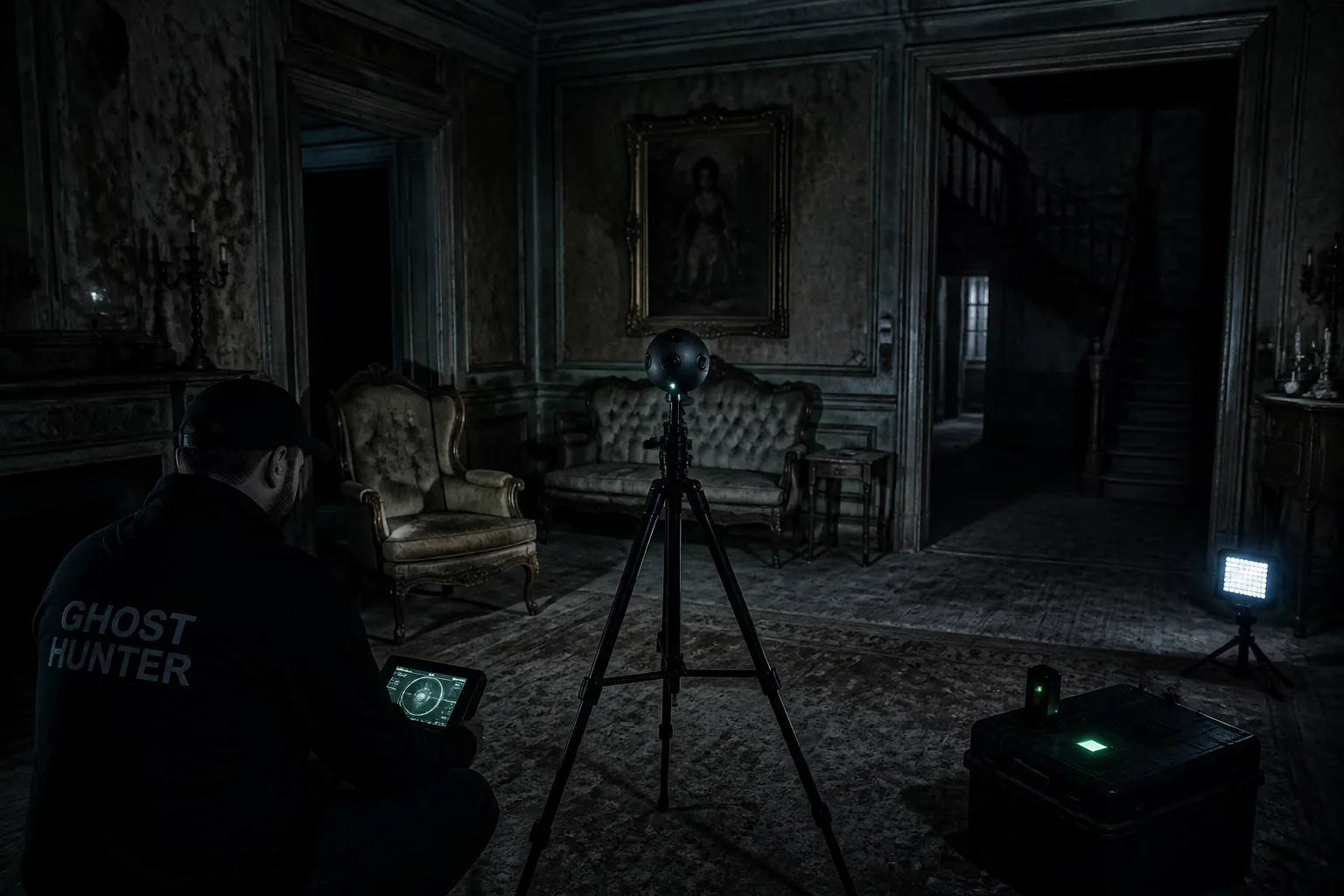
Best Ways to Use 360° & Panoramic Cameras in Paranormal Investigations
360° and panoramic cameras can change the way paranormal investigations are filmed, reviewed, and shared. Instead of capturing only what is directly in front of the lens, these cameras document the entire room, including corners, doorways, ceilings, and the space behind the investigator. That wider perspective is especially useful in haunted locations, where investigators often want to know not only what was seen, but what was happening everywhere else at the same time.
Used well, immersive cameras can make a ghost hunt feel more transparent and more credible. They help establish context, reduce blind spots, and give viewers a stronger sense of place. Used poorly, they can introduce stitching errors, noise, flare, compression artifacts, and motion blur that look mysterious but are really just technical problems. The goal is not only to capture more footage, but to capture better evidence.
Why 360° and Panoramic Cameras Matter in Paranormal Investigations
A traditional camera creates a narrow slice of reality. In paranormal work, that limitation matters. A sound from behind the camera operator, a shadow in a doorway, or movement at the edge of a room can be missed completely if the lens is pointed elsewhere. 360° and panoramic cameras reduce that problem by preserving the full environment in one recording.
This matters for both investigators and audiences. Investigators can review a full scene afterward instead of relying on memory or fragmented clips. Viewers can explore the location more freely, which makes the evidence feel more immersive and, in many cases, more convincing. A full-room recording also helps separate environmental causes from possible anomalies, because the investigator can check whether someone walked past, whether a reflection appeared, or whether a light source changed at the same moment.
There is also a storytelling advantage. Paranormal audiences tend to be highly engaged when they feel they are part of the search. Wide-angle footage makes it easier to show the layout of a haunted space, explain where investigators were standing, and build a stronger narrative around a location’s history and activity.
Best Camera Types for Ghost Hunting: 360° vs Panoramic Setups
Not every immersive camera serves the same purpose. A true 360° camera is ideal when you want the full sphere of the scene captured in a single shot. That is especially useful in rooms where something could happen behind, above, or beside the team without warning. Panoramic setups, by contrast, are often better when you want a wider field of view without the heavier editing and stitching demands of full spherical footage.
For ghost hunting, a 360° camera makes the most sense for fixed monitoring, evidence recording, and final event recap footage. Panoramic rigs can be a smart middle ground if you want extra coverage but prefer simpler workflows, especially in low-light conditions where cleaner image quality may matter more than complete immersion. The right choice depends on whether your priority is total coverage, better image fidelity, or easier post-production.
When comparing models, low-light behavior should be near the top of your list. According to a low-light performance guide on the DJI Osmo 360, its dual 1-inch sensors and f/1.9 aperture help maintain clean, usable image quality up to about ISO 3,200 before noise becomes a major issue https://www.studiosport.fr/guides/dji-osmo-360/performances-basse-luminosite.html That kind of performance is important in dark buildings, basements, and abandoned sites where investigators often cannot use bright lighting.
The Insta360 X5 is another relevant benchmark, but a low-light review noted that noise becomes visible in shadow areas at ISO 800 and above, and recommended locking shutter speed at 1/120s or faster to reduce motion blur in action scenes https://lensandshutter.com/reviews/insta360-x5-review/amp/ For paranormal work, that kind of guidance is useful because ghost hunts often involve movement, quick turns, and handheld adjustments that can easily soften footage.
Choosing Lenses, Tripods, Power Banks, and Low-Light Accessories
Accessory choice matters just as much as the camera itself. In low-light environments, a stable tripod or monopod is often the best way to avoid motion blur and stitching issues. A camera that moves too quickly between frames can create blur, misalignment, and seam problems that may later be mistaken for unusual activity.
Power is another practical concern. Paranormal investigations can last for hours, and many of the best moments happen late in a session rather than at the start. A reliable power bank or external battery setup helps prevent the camera from shutting down before the session is over. If you are filming long overnight investigations, battery management should be treated as part of your evidence strategy, not just a convenience.
For low-light scenes, it is usually better to prioritize a camera with strong sensor performance over trying to compensate with heavy artificial light. If your camera offers manual controls, lock exposure and white balance when possible. That helps keep stitched frames consistent and reduces the chance of exposure shifts becoming false positives later.
You should also think carefully about any infrared accessories. IR lighting can extend visibility in dark locations, but it can also create reflections, especially on dust, glass, glossy surfaces, or nearby walls. Guidance on IR camera placement and reflection mitigation recommends directing IR lights away from walls and using non-reflective materials where possible https://s3.amazonaws.com/geovision_downloads/TechNotice/IPCAM/IR_reflection_in_Dusty_Environment.pdf
How to Position 360 Cameras in Haunted Rooms for Maximum Coverage
Positioning is one of the biggest advantages of immersive cameras. Because they capture everything around them, placement should be chosen with intent. In a haunted room, a camera in the center of the space often provides the best overall coverage, but that is not always the best choice if the room has a lot of foot traffic, fragile objects, or reflective surfaces.
A practical approach is to place the camera where it can see the investigator, the room entry points, and the most active corners while staying out of the way. In a long hallway, that might mean positioning the camera slightly off-center to capture both ends. In a basement, it might mean placing the camera high enough to avoid accidental bumps while still recording floor-level movement and shadows.
You should also remember that 360 footage can still have blind spots near the camera body itself. If an investigator stands too close, sits directly beside the rig, or blocks a lens with gear, you may lose useful context. The best placement is usually the one that balances visibility, protection of the equipment, and a clean view of movement paths.
For fixed evidence setups, it can help to mark the camera location in your notes or floor plan. That way, if something happens at a distance, you can later judge whether the object was inside a true activity zone or just a result of angle distortion. This is especially important when reviewing footage for subtle movement or changes in light.
Lighting Strategies for Dark Locations Without Contaminating Evidence
Lighting in paranormal investigations is always a compromise. Too little light makes footage hard to interpret. Too much light can ruin the atmosphere, alter behavior, and introduce reflections or shadows that create new confusion. The aim is to light just enough to preserve interpretability without changing the environment too much.
When possible, use low-output, diffused lighting placed outside the main field of view. Avoid pointing bright lamps directly into the camera lens or toward reflective surfaces, because flare and hot spots can create glowing streaks near stitch borders. A real example discussed in community footage shows how sun flare crossing stitch borders can look like a strange anomaly when it is really just lens interaction with a bright source https://www.reddit.com/r/Insta360/comments/17dquat
If you need infrared illumination, test it before the investigation. IR can be very helpful, but it also makes dust, glass, and glossy paint much more visible. In some rooms, this can create a constant shimmer of false movement. If that happens, reposition the light or reduce the IR intensity instead of assuming every bright speck is significant.
The most useful habit is consistency. Use the same lighting style from one location to the next whenever possible. That makes it easier to compare sessions and identify what is normal for a space versus what is genuinely unusual.
How to Capture Activity Behind the Investigator and Add Context
One of the strongest arguments for 360 footage in ghost hunting is simple: it shows what happens when the investigator is facing the wrong direction. Many alleged paranormal moments occur just outside the operator’s line of sight. A camera behind the team can catch footsteps, movement at a doorway, objects shifting on shelves, or people accidentally entering the frame.
That extra context is also valuable during reaction shots. If an investigator jumps, turns, or steps back, viewers can see whether there was actually something in the environment that prompted the reaction. If there was nothing visible, that does not prove a paranormal event, but it does create a stronger case for reviewing the moment carefully.
Some of the most compelling footage comes from simple, unmoving camera placement. When the camera stays still, the audience can better judge whether a sound, shadow, or light change came from within the environment or from the operator’s movement. Stability makes everything easier to evaluate.
This is also where narrative value improves. When the audience can see the whole room, they can follow the investigation more naturally, even if the camera operator is not speaking. That makes immersive footage especially useful for long-form content and evidence summaries.
Common Stitching Errors and Camera Artifacts That Look Paranormal
Many of the strangest-looking moments in 360 footage are not paranormal at all. Stitching errors can create split objects, warped edges, weird floating lines, or sudden shape changes near the join between lenses. One common cause is parallax error, which happens when the camera is not rotated around the lens nodal point, causing nearby objects to misalign across stitch lines https://www.vorlago.com/blog/2025/6/4/expanded-guide-on-errors-in-panorama-amp-spherical-photography-and-how-to-fix-them
Motion blur can also make a normal scene look eerie. Travvir’s guidance on 360 mistakes notes that fast camera movement during multi-frame capture leads to blurry frames and misaligned stitching seams, and recommends using a tripod, slowing rotation, and keeping shutter speed high https://travvir.com/blog/en/360-photography-mistakes-to-avoid In paranormal settings, where investigators often pivot quickly toward a sound, this becomes a real issue.
Dynamic range problems can create more confusion. If the camera auto-exposure shifts between stitched images, you may see visible seam lines or radial banding. That can look like a strange glow or energetic pulse, especially in dark rooms with one bright source in the corner. Locking exposure and white balance is one of the simplest ways to reduce those false impressions.
Noise and compression artifacts are another common trap. In darker areas of a frame, especially at higher ISO values, fine grain can break into blocks or speckles that seem to move on their own. That is why low-light testing matters so much before you trust a camera in the field.
How to Tell Technical Glitches Apart from Possible Anomalies
The key difference between a glitch and a possible anomaly is repeatability. A technical issue usually appears in the same kind of condition again and again. If a bright object is close to the stitch line, if the camera is moving quickly, or if IR is reflecting off glass, the result is likely a camera artifact rather than unexplained activity.
A good review process starts by checking the raw footage first. Ask basic questions: Was the camera stable? Was the exposure locked? Was there a bright source nearby? Did someone walk behind the camera? Did the sound coincide with a physical movement in the room? The more those questions can be answered with certainty, the easier it is to rule out common causes.
If a moment remains interesting after technical checks, then it is worth classifying as a possible anomaly rather than a confirmed event. That distinction matters. Credibility in paranormal content comes from restraint, not from claiming every glitch is a spirit. Skeptical viewers are far more likely to trust evidence when the investigator clearly separates artifact from unexplained behavior.
Best Software for Reviewing, Stabilizing, and Tagging Immersive Footage
The review stage is where immersive footage becomes useful. Good software should let you inspect the spherical recording, zoom into moments of interest, stabilize shakier clips, and mark timestamps for later comparison. You want a workflow that makes it easy to locate changes in light, movement, sound, and object placement without rewatching everything from scratch every time.
A strong review workflow usually includes three steps. First, import and back up the original files before editing anything. Second, sort footage by location, time, and activity level. Third, tag moments that deserve a second look, especially if several investigators react at once or if the event lines up with a temperature, EMF, or audio change.
If you are publishing often, consistency matters more than complicated editing tricks. Use the same naming system for files and the same method for highlighting evidence so your audience can follow the chain of events. That also makes it easier to compare one haunted site to another over time.
For investigators who also want to supplement their visual footage with audio, a tool like Ghost Detector: Ectify can fit naturally into the workflow. It lets you record and share session audio, track EMF changes through your phone’s magnetometer, and keep a session history for later review, which can help you line up audio moments with what the 360 camera captured https://findthe.app/ectify-fc72z0.
Editing 360° Paranormal Content for YouTube, TikTok, and Social Media
Editing immersive footage for social platforms is different from editing a normal ghost-hunt recap. YouTube can support full 360 playback, but many viewers still focus on the front of the frame first. Digital Trends reported that about 75% of viewer attention in 360 videos tends to stay in the front 90 degrees of the initial orientation, which means creators should place key action where viewers are most likely to look first https://www.digitaltrends.com/photography/youtube-360-heatmaps/
That does not mean the rest of the sphere is unimportant. It means your thumbnail, opening orientation, and first few seconds need to guide attention effectively. If the interesting movement is behind the investigator, consider starting with a visual cue or text prompt that encourages viewers to explore the scene more fully.
For short-form platforms like TikTok and Instagram, the best strategy is usually to extract the most dramatic segment and pair it with a clear explanation. Wide-angle content can be powerful there, but it works best when the clip immediately shows why the full room matters. Since many viewers are watching quickly, your caption and on-screen labels should help them understand what they are seeing.
Engagement goals should stay realistic. A 2026 benchmark article from OneTube notes that an engagement rate of 2 to 4 percent is average to good on YouTube, while large channels often see lower rates around 1 to 2 percent https://onetube.io/blog/youtube-engagement-rate For niche paranormal creators, that means quality comments, saves, and shares may matter more than raw view count alone.
Legal and Privacy Issues When Filming Wide-Angle Content in Haunted Places
Wide-angle and 360 filming creates legal and ethical responsibilities, especially in locations that are privately owned, rented, or open to the public after hours. In the United States, filming on private property without the owner’s permission generally constitutes trespass, even if you are only recording and not entering with bad intent. Audio recording can also trigger wiretap laws, and many states require one-party or all-party consent https://legalclarity.org/can-you-legally-film-on-private-property/
Privacy law is just as important. Under federal law, intentionally capturing a person’s private areas without consent can be a crime, and many states prohibit recording in places where people have a reasonable expectation of privacy, such as bathrooms or bedrooms https://www.recordinglaw.com/is-it-illegal-to-video-record-someone-without-their-consent/ That means paranormal investigators should be careful not to assume that a haunted site is automatically open to unrestricted filming.
The practical rule is simple: get permission in writing when you can, disclose how footage will be used, and avoid filming sensitive spaces unless you are fully authorized. If visitors, staff, or other investigators appear in the frame, let them know when appropriate and respect requests not to be recorded. Good evidence is never worth creating a privacy problem.
Best Practices for Presenting Evidence Credibly to Skeptical Audiences
Skeptical viewers do not usually reject paranormal content because it is immersive. They reject it when it is vague, overclaimed, or poorly documented. Credibility comes from process. Show the camera setup. Explain where the device was placed. Point out known technical limitations. And when something unusual happens, walk the audience through why it is interesting without pretending uncertainty is proof.
A strong presentation also includes context from the environment. If a sound occurred near a vent, a loose door, or a reflective surface, mention that. If the camera was at a difficult angle or the light source was changing, say so. The more honest the explanation, the more persuasive the final conclusion becomes.
When possible, compare the same location across multiple sessions. Repetition is one of the best ways to identify patterns. If a movement appears once and never again under similar conditions, that might support a case for unexplained activity. If it happens every time the same door closes or the same fan turns on, you have likely found a natural cause.
Future Trends: AI Review Tools, Spatial Video, and Interactive Ghost Hunts
The future of paranormal filming is likely to become more immersive and more analytical at the same time. AI review tools may help investigators scan hours of footage for motion, sound spikes, and environmental shifts. Spatial video and improved immersive playback will make evidence feel even more present, especially for audiences who want to explore the scene themselves.
Interactive ghost hunts are another likely direction. Instead of passively watching a recap, audiences may be able to choose camera angles, jump between rooms, or follow investigator movement in real time. That kind of participation would be a natural fit for 360 content because the format already encourages exploration rather than passive viewing.
For paranormal creators, the real opportunity is not just better visuals. It is better documentation. A well-placed 360 camera, paired with careful setup, patient review, and transparent reporting, can make investigations feel more legitimate and more engaging at the same time. That is the kind of content that keeps both believers and skeptics watching.
