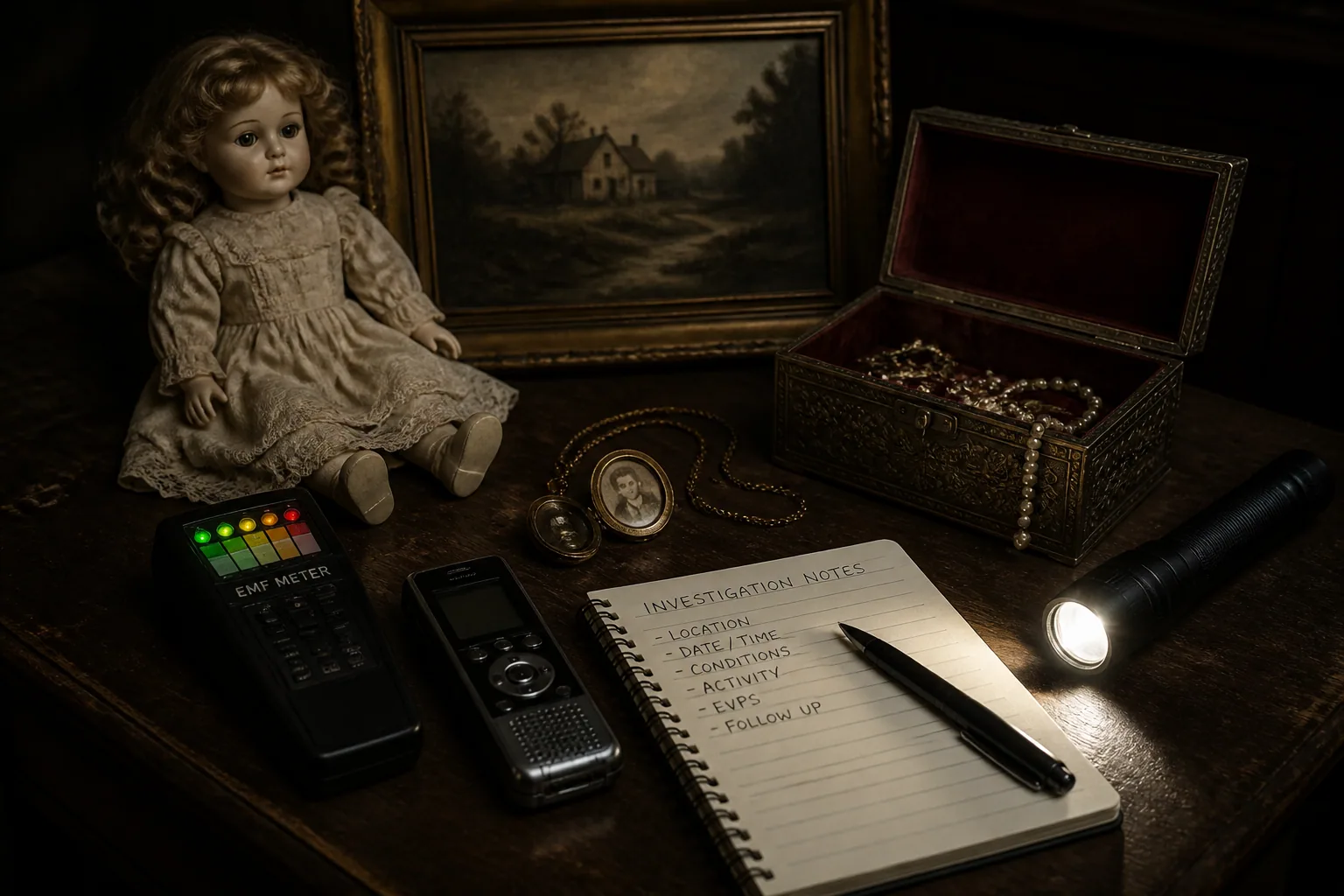
Can Haunted Objects Be Real? Understanding Attachments, Energies, and Evidence
Haunted objects sit at a strange intersection of folklore, memory, fear, and investigation. They can be ordinary things, like dolls, rings, paintings, or old toys, but once a story attaches to them, they become something else in the public imagination. People report bad luck, unexplained sounds, sudden emotions, moving shadows, or a sense that the object is watching them. For believers, these are signs of a spirit attachment or lingering energy. For skeptics, they are often the result of suggestion, coincidence, environmental effects, or a story that grew larger with time. The interesting part is that both sides are responding to the same human experience: an object that seems to carry more than its material form.
Why Haunted Objects Fascinate Us
Part of the appeal is simple. Objects are personal. We give them meaning, we inherit them, we keep them close, and we attach memories to them. A wedding ring is not just metal. A child’s doll is not just plastic or cloth. An antique mirror is not just glass and frame. When something already feels emotionally charged, it becomes easier to imagine that it could also hold a trace of the people or events connected to it. That is why haunted-object stories spread so quickly. They turn an everyday thing into a vessel for mystery, grief, and unresolved history.
Haunted objects also offer a very contained form of the paranormal. Instead of needing to investigate a whole house, cemetery, or battlefield, the claim becomes focused on one item. That makes the story more portable, easier to sell, and easier to test. It also makes it more emotionally powerful, especially when the object is an heirloom or a piece tied to a tragedy.
What Defines a Haunted Object?
In paranormal terms, a haunted object is usually an item believed to be associated with recurring unexplained activity. That activity might include sounds, temperature changes, apparitions, movement, dreams, emotional disturbance, or events that people interpret as meaningful. The object may be said to be “cursed,” “attached,” “infested,” or “charged,” depending on the belief system behind the claim.
There is an important difference between a spooky object and a haunted object. A spooky object merely has a frightening reputation. A haunted object is said to produce experiences that recur over time and seem to follow the object rather than the place alone. That distinction matters because it shapes the kind of evidence people think they are collecting.
Attachment vs Residual Energy vs Intelligent Presence
One of the clearest ways to discuss haunted objects is to separate three common ideas: attachment, residual energy, and intelligent presence. Paraghosts describes intelligent hauntings as spirits that are aware of their surroundings and can respond to people, while residual hauntings are more like energy echoes, repetitive and non-interactive, with no consciousness. https://www.paraghosts.com/intelligent-haunting-vs-residual-haunting-key-differences/
Attachment is usually the broadest claim. It suggests that a spirit, emotional imprint, or other force has latched onto the item and may move with it. In some traditions, the object is believed to belong to, or be linked with, a person whose energy remains active. In other cases, the item is thought to have absorbed distress, trauma, or attention over time.
Residual energy is different. The idea is that an object can behave like a recording medium, replaying events without awareness. The phenomenon is not responding to observers so much as repeating a pattern. If someone experiences a cold spot every time they open a box, a residual explanation would suggest the pattern is fixed and non-interactive.
Intelligent presence is the most dramatic explanation. In that model, the object is not merely storing energy. It is serving as a point of contact for a conscious entity that can react, communicate, or influence what happens around it. Most of the famous haunted-object stories become much more compelling when people believe this is what is happening.
The Most Common Types of Allegedly Haunted Items
The list of supposed haunted objects is long, but some categories appear again and again. Dolls are probably the most famous because their human-like faces and bodies make them naturally unsettling. Paintings are another major category, especially portraits and images with eyes that seem to follow viewers. Jewelry, antiques, mirrors, toys, musical instruments, and heirlooms also come up often because they are intimate, old, and linked to previous owners.
Everyday items can become haunted too. A chair, a book, a locket, a photo frame, or a keyring can all gain a paranormal reputation if enough people report strange experiences around them. The object itself is often less important than the story surrounding it. Once a narrative takes hold, every creak, reflection, or coincidence can seem like confirmation.
Famous Historical Case Studies and What Made Them Convincing
The fame of haunted objects usually comes from a combination of media attention, compelling anecdotes, and a visually memorable item. Robert the Doll is one of the best-known examples in the United States. The doll, now kept behind glass at the Fort East Martello Museum in Key West, has become associated with accidents, illness, and bad luck for those who allegedly disrespect it. Its reputation is powerful because it combines a physical object, local legend, and years of repeated storytelling. https://www.stayspooked.com/robert-the-doll-the-complete-history-of-americas-most-cursed-toy/
Another famous case is The Hands Resist Him, the 1972 painting by Bill Stoneham. It became widely discussed online after being listed on eBay in 2000 with claims that it was haunted. Reports included faces moving and figures threatening one another in the image. Whether or not those experiences were paranormal, the story shows how a single artwork can acquire an entire mythology once it is framed as dangerous. https://en.wikipedia.org/wiki/The_Hands_Resist_Him
Haunted paintings in general tend to gain their reputations from the same pattern. A portrait is said to change expression, people feel watched, photos fail mysteriously, or visitors report emotional discomfort. One frequently cited example is the Portrait of Bernardo de Gálvez at Hotel Galvez, where local lore says flash photography reveals a skull and that guests are supposed to ask permission before taking photos. These stories are convincing because they create rituals around the object, and rituals tend to strengthen belief. https://en.wikipedia.org/wiki/List_of_reportedly_haunted_paintings
What makes these stories especially sticky is that they are testable in everyday life. Anyone can stand in front of a painting, hold a doll, or visit a museum display and compare their own reaction to the legend. That immediacy is part of why haunted-object claims are so enduring.
How Paranormal Investigators Approach a Haunted Object Claim
A serious investigation should start with skepticism, patience, and documentation. The first question is not, “Is it haunted?” The first question is, “What exactly is being reported, by whom, when, and under what conditions?” Without that, investigators are left with atmosphere instead of evidence.
The next step is to establish whether the phenomenon follows the object or the setting. If the same item causes reports in multiple locations, that is more interesting than if the experiences stop when a person leaves a particular room. Investigators should also ask whether the item was ever exposed to intense attention, a tragic event, rumors, or a prior owner who may have promoted the haunting story.
It also helps to compare witness accounts over time. If one person reports a voice, another reports a feeling, and a third reports a shadow, the story may be genuine as an experience but still not point to a paranormal cause. Patterns matter, but only if they are consistent and observable.
Setting a Baseline: Environment, Materials, and Context
Before using any equipment, you need a baseline. That means measuring the space and the object under normal conditions so you know what is ordinary for that environment. EMF sources, wiring, appliances, wireless devices, drafts, humidity, temperature changes, and light reflections can all influence what people experience. UK Paranormal eXperience specifically warns that EMF anomalies are usually linked to normal sources like electrical wiring, appliances, and wireless signals, and recommends controlling for drafts, infrasound, and body-generated interference. https://ukpx.org/2025/10/12/emf-and-ghost-detection-a-technical-guide-for-serious-investigators/
Material properties matter too. Metal objects can interact with electromagnetic fields. Glass can reflect light in ways that seem unnatural in low-light conditions. Old varnish, warped wood, fibers, dust, and aging adhesives can create noises or visual effects that feel eerie but have ordinary causes. Even the way an object is displayed can change how people perceive it.
Context is equally important. Who owned the item? Was it associated with a death, a fire, a crime, or a rumor? Was it repaired, damaged, altered, or moved recently? A haunted-object claim is much easier to interpret when the history of the object is fully documented rather than reconstructed from fragments of lore.
Using EMF Readings, EVP Sessions, and Spirit Box Experiments
EMF meters are commonly used in ghost hunting, but they are often misunderstood. A study published in the Journal of Parapsychology found that in a site with no electricity-generating sources, EMF and GMF readings were significantly higher and more variable inside than outside, and some anomalous phenomena correlated with spikes. That does not prove a spirit cause, but it does show that environmental variability can be real and worth measuring carefully. Source: Laythe & Owen, A Critical Test of the EMF-Paranormal Phenomena Theory, https://www.parapsychologypress.org/jparticle/jp-77-2-212-236
At the same time, the popular K-II or K2 EMF meter has been tested under controlled conditions and found to respond like a normal EMF meter, meaning it reacts to known electromagnetic variation rather than anything supernatural. JREF concluded that there was no evidence it communicates with spirits. https://web.randi.org/swift/testing-the-k-ii-emf-meter-does-it-communicate-with-spirits-no
EVP sessions are even more complicated. Research on EVP has been criticized for weak controls, ambiguous audio, and confirmation bias. A summary of Imants Barušs’s work reports that paranormal origins for EVPs were not replicated under controlled conditions, while Benjamin Radford has pointed to methodological flaws in much of the field. https://en.wikipedia.org/wiki/Electronic_voice_phenomenon and https://skepticalinquirer.org/2023/02/examining-sciencey-evp-research/
Spirit box experiments should therefore be treated as exploratory, not confirmatory. If you use one, record the room tone, note the station sweep or word bank behavior, and compare responses against silence, background noise, and the investigator’s own expectations. A meaningful result is not a word that sounds spooky. It is a response that survives scrutiny, repeats under controlled conditions, and cannot be explained by chance or pattern matching.
This is where a product like Ghost Detector: Ectify can fit naturally into a casual investigation. If you want a smartphone-based way to record sessions, track EMF fluctuations, and review past attempts, it offers a convenient all-in-one setup for documenting an object-centered experiment rather than just relying on memory. https://findthe.app/ectify-fc72z0
How to Document Patterns, Triggers, and Witness Testimony
Good documentation is often the difference between a story and a case. Write down the date, location, object description, who was present, what happened, and the exact time of each event. If the object appears to react to a trigger, such as a name being spoken, a flashlight, a question, or a specific person entering the room, note that carefully and try to repeat the condition later.
Witness testimony should be collected separately if possible. People influence each other easily, especially in high-emotion settings. One person’s certainty can shape another person’s memory. That does not mean anyone is lying. It means memory is social, and paranormal claims are especially vulnerable to contagion and reinterpretation.
Whenever possible, create a timeline. If the object was silent for weeks and then several people became aware of its story, that matters. If reports stop when the object is placed in storage or when electronics are removed from the area, that also matters. Documentation should not just capture the dramatic moment. It should capture the surrounding conditions that give the dramatic moment meaning.
Common False Positives: Psychology, Suggestion, and Misinterpretation
Many haunted-object reports are shaped by psychology before they are shaped by anything else. Once people expect an object to behave strangely, they become more likely to notice ambiguous sounds, vague movements, or emotionally charged sensations. A creak that would be ignored in daylight can become eerie at midnight. A random word in static can feel like a direct message if someone has already decided that the object is listening.
Suggestion is especially powerful in groups. If one person says they feel cold near an object, others may begin to notice a chill they would have otherwise ignored. This does not mean the experience is fake. It means the interpretation is unstable and may be reinforced by social cues.
Misinterpretation also plays a big role. Humans are extremely good at finding faces in patterns, voices in noise, and intention in randomness. That is why haunted-object legends can feel so persuasive even when the evidence is weak. We are wired to look for agency.
Environmental Causes That Can Mimic Paranormal Activity
Environmental factors are among the biggest sources of false positives. Light, optics, temperature, and camera artifacts can create effects that seem supernatural. Paranormal Response Network notes that low-light vision can misperceive shapes, cameras can produce orbs from dust, and thermal imagers may show false heat signatures from reflective surfaces. https://www.paranormalresponsenetwork.org/research/environmental-intelligence/light-optics-temperature
Electrical wiring can trigger EMF readings. Drafts can move lightweight objects or cause curtains, papers, and hanging items to shift. Infrasound can create unease, pressure, or a sense that something is present. Humidity and temperature changes can make wood expand and contract, producing pops and knocks. Even small vibrations from traffic, HVAC systems, or footsteps can travel through a building and affect fragile items.
In other words, an object does not have to be alive to feel active. It only has to exist inside a complicated environment, and humans are very good at turning environmental noise into narrative.
Can Objects Hold Energy? Theories, Beliefs, and Skeptical Views
This is the central philosophical question behind haunted objects. Many belief systems say yes, objects can hold energy. Sometimes that energy is emotional, sometimes spiritual, sometimes tied to trauma, ritual, or death. In that view, objects are not passive. They absorb, store, and sometimes release impressions from the people and events around them.
Skeptical views usually offer more conservative explanations. The object may not hold energy in any paranormal sense, but it can hold meaning. It can also hold history, contamination, residue, or a chain of suggestion. A frightening object can become a container for expectations, and expectations can shape perception in powerful ways. That can make the experience real to the person without requiring a supernatural cause.
A balanced position is to admit that objects can absolutely carry human significance, while also admitting that significance is not the same as proof of haunting. The burden of evidence remains on the claim that something beyond known processes is happening.
Safety Practices When Handling Suspected Haunted Items
Whether or not you believe in the paranormal, suspected haunted objects should be handled with care. Some are fragile antiques. Some may contain mold, lead paint, broken glass, rust, or other hazards. Others may have emotional value to the owner or family. Use gloves if appropriate, avoid rough handling, and document condition before and after any inspection.
If an object is linked to fear or distress, avoid encouraging reckless behavior. Do not leave people alone with an item if they are already anxious, and do not perform provocative rituals just to intensify a story. If someone believes an heirloom is spiritually charged, their emotional response should be treated respectfully even if you remain skeptical.
Never assume a haunted object is a toy. It may be an archive of family history, grief, or loss. Respect matters whether the explanation is paranormal or not.
Ethical and Legal Issues With Heirlooms and Private Collections
Haunted-object stories can create real-world problems when ownership, consent, and reputation are involved. If an object belongs to a private family, it should not be sensationalized without permission. A supposedly haunted heirloom may be tied to a painful event, and publicizing it carelessly can cause harm.
There is also a legal dimension. In the U.S. case Stambovsky v. Ackley, the New York Appellate Division ruled in 1991 that because a homeowner had publicly promoted her house as haunted, she could not refuse to disclose that status when selling, and the buyer was allowed to rescind the contract. The case is famous because it shows that ghost stories can affect real estate law when they become part of the official narrative. https://legalclarity.org/stambovsky-v-ackley-the-haunted-house-ruling/
That same principle applies more broadly to objects in private collections. If a seller markets an item as haunted, there may be reputational and disclosure issues. If a museum displays an object with paranormal claims, it should distinguish folklore from verified history. If a family keeps an object because of spiritual belief, outsiders should not turn it into content without consent.
What Counts as Evidence, and What Still Doesn’t
Good evidence should be repeatable, documented, and explainable only after alternatives are ruled out. A single EMF spike is not enough. A voice-like sound on an EVP recording is not enough. A creepy feeling is not enough. Even multiple anecdotes do not automatically become proof if they can be explained by expectation, environmental variation, or story reinforcement.
Stronger evidence would include independent witnesses, controlled conditions, environmental baselines, clear chain of custody for the object, and repeatable effects that occur beyond chance or suggestion. Even then, the evidence would still need to be interpreted carefully. Paranormal research is difficult precisely because the claims sit at the edge of measurement, interpretation, and belief.
That does not mean curiosity is pointless. It means curiosity works best when it is disciplined. A haunted object can be a fascinating case study in psychology, folklore, and field investigation even if no ghost is ever proven.
A Balanced Conclusion: Curiosity, Caution, and Critical Thinking
So, can haunted objects be real? The honest answer is that people can have very real experiences around objects, and those experiences can feel deeply convincing. Some may interpret them as attachments, residual energy, or intelligent presence. Others will see a mix of expectation, environmental causes, and human pattern recognition. The truth in a given case depends on the quality of the evidence, not the drama of the story.
The best approach is not cynicism and not blind belief. It is curiosity with guardrails. Set baselines, control the environment, document carefully, and stay aware of how easily ordinary things can seem extraordinary. That way, if something truly unusual is happening, you are much more likely to notice it. And if it is not, you are much less likely to fool yourself.
