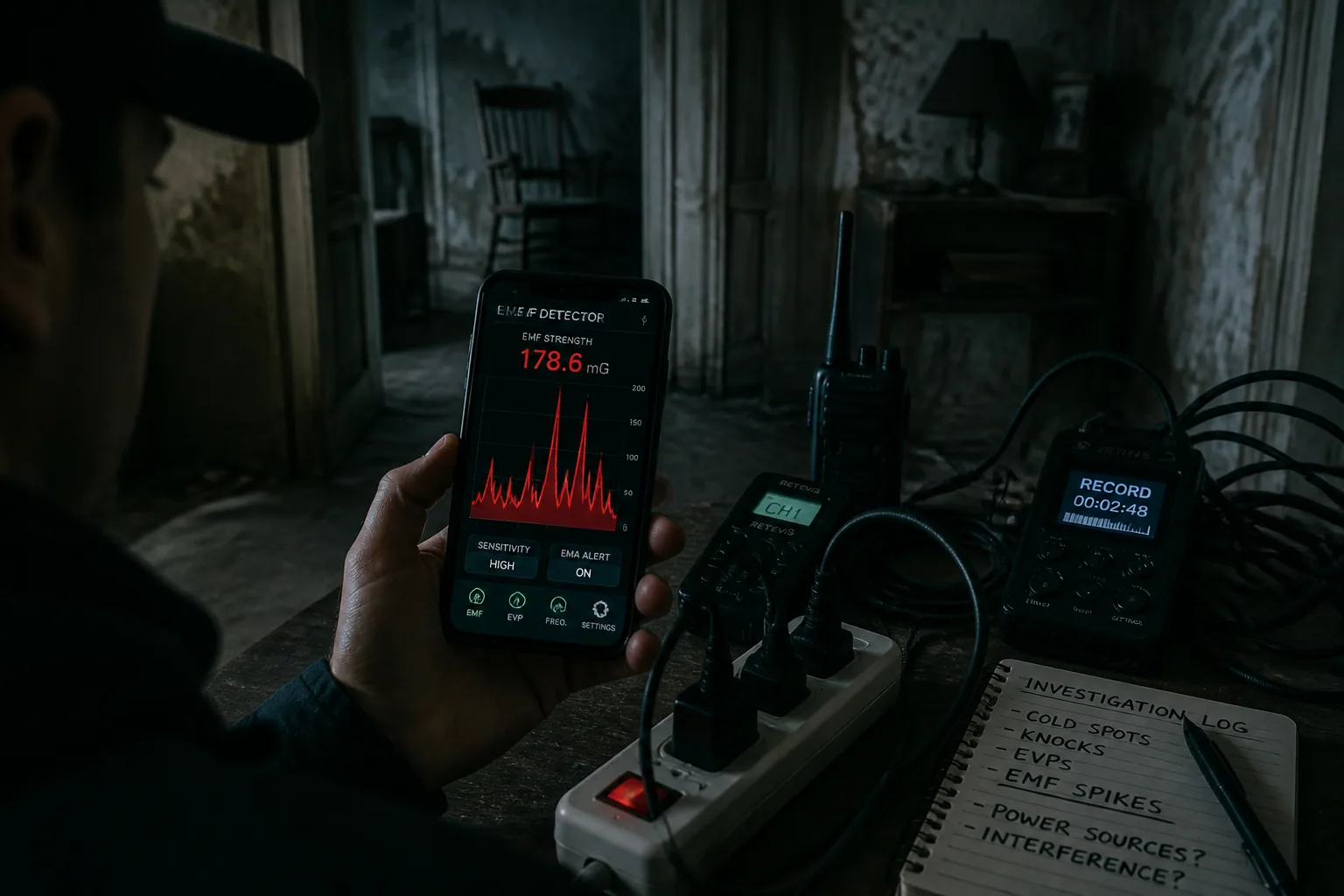
Debunking the Ghost Detector: How Common Sensor Glitches Mislead Investigators - And How to Tell the Difference
Ghost hunting tech can be exciting, especially when a spike, whisper, or strange response seems to happen right when the room goes quiet. But the truth is that a lot of “paranormal” evidence starts as ordinary sensor behavior, environmental interference, or simple pattern matching. If you know how these tools actually work, you can separate a real anomaly from a glitch, and you can do it without ruining the fun of the investigation.
That matters because credibility is everything. A strong investigator does not treat every beep, blur, or fragment of audio as proof. Instead, they ask a better question: what else could have caused this? Once you start looking at ghost hunting gear the same way you would any other measurement tool, false positives become much easier to spot, and genuine oddities become more valuable.
Why Ghost Hunting Tech Often Gets Misunderstood
A lot of paranormal equipment feels more scientific than it really is. EMF apps, spirit boxes, EVP recorders, and motion sensors can all create the impression that they are detecting hidden intelligence. In reality, many of these tools are simply collecting environmental data, and that data is easy to misread if you do not understand the limits of the device.
This is especially true in amateur investigations, where the goal is often to capture something dramatic. When expectations are high, people tend to connect dots that are not really connected. A small click becomes a message. A sudden EMF jump becomes a presence. A scrambled syllable becomes a full sentence. That does not mean investigators are careless. It means the human brain is excellent at finding meaning, even in messy signals.
How Smartphone EMF and Motion Sensors Actually Work
Many smartphone EMF apps rely on the device’s built-in magnetometer, which is really a digital compass sensor. According to emfprotectionpros.com, that means many phone apps detect static magnetic fields, but not electric fields, alternating magnetic fields like 50/60 Hz mains AC, radio frequency fields such as WiFi or cellular signals, or dirty electricity. In other words, the phone may be reacting to only one narrow slice of the environment, while missing the very thing the user thinks they are measuring. Source: https://www.emfprotectionpros.com/can-i-use-my-phone-to-detect-emf/
That limitation is a big deal. If someone waves a phone near a router, a power cable, or a nearby appliance, the reading may change in ways that look mysterious but are simply caused by the sensor’s calibration and sensitivity profile. Most EMF meters are also tuned around 50/60 Hz alternating current fields, which are common in household wiring. They may not accurately represent higher frequency fields unless the device was specifically designed for that purpose. Source: https://en.wikipedia.org/wiki/EMF_measurement
Motion sensors can be misleading too. A phone placed on a shaky surface, near a speaker, or on an uneven floor can pick up tiny vibrations from footsteps, HVAC systems, or even a passing truck. If the app labels that movement as unusual, it is easy to imagine an unseen force when the real cause is much less dramatic.
The Most Common Causes of False Positives
False positives usually come from the same few categories. The first is interference. The second is poor calibration. The third is environmental noise. The fourth is human interpretation. Together, those four factors explain a huge percentage of strange readings in the field.
EMF meters and sensors can drift over time. Calibration drift and zero offset shifts can turn a normal baseline into an apparently unusual one, especially if the device is not checked regularly. A study on correction of drift in EMI survey data shows that small systematic errors can build up when calibration is neglected. Source: https://www.sciencedirect.com/science/article/pii/S0926985114002651
Meanwhile, everyday electronics create strong spikes all the time. Faulty wiring, switching power supplies, fluorescent lights, appliances turning on and off, nearby phones, and routers can all produce sudden changes. Ghostly Activities and TVI Show both note that these sources are frequent causes of EMF readings that seem paranormal when the environment has not been controlled properly. Sources: https://ghostlyactivities.com/ghost-hunting-with-electromagnetic-fields/ and https://www.tvi.show/ghost-gear/emf-spikes-paranormal-presence-or-electrical-interference-explained-for-investigators
When Power Lines, Appliances, and Phones Create Haunted Readings
This is one of the easiest traps to fall into because the results feel meaningful. Imagine you are standing in a hallway with a meter in your hand. The reading climbs for two seconds, drops, then rises again when someone in another room turns on a microwave. If you are not tracking the house environment, that looks like a classic paranormal hotspot.
The same thing happens with phones. A cell phone in your pocket, a smartwatch, Bluetooth earbuds, a router in the next room, or even a charging cable can all influence readings. If you are investigating near power lines or older electrical systems, the background field may already be elevated before you begin. Without a baseline, the meter has nothing to compare against, and the “spike” becomes more storytelling than science.
A good investigator treats these conditions like contamination in a lab. If you cannot explain the electrical layout, nearby appliances, and device placement, then you cannot confidently call the reading anomalous.
Spirit Box Responses That May Be Radio Bleed or Pattern Matching
Spirit boxes are one of the most misunderstood tools in ghost hunting. They work by rapidly sweeping across AM and FM radio bands, and in the process they emit short fragments of demodulated audio from different stations. Haunted Hosts explains that adjacent station bleed and overlapping fragments can combine into sounds that listeners interpret as words or answers. Source: https://hauntedhosts.com/library/explainers/what-is-a-spirit-box-and-how-does-it-work
That means the tool is not producing speech from nothing. It is sampling bits of broadcast content at high speed, and the human brain then tries to organize the noise into meaning. If someone asks, “What is your name?” and hears something that sounds vaguely like a name, it can feel astonishing. But because the radio fragments are constantly changing, the answer may be little more than coincidence plus expectation.
This is why repeated testing matters so much. If a phrase appears only once, in one noisy session, and cannot be reproduced under similar conditions, it is much more likely to be bleed, overlap, or pattern matching than an intelligent response.
EVP Mistakes: Pareidolia, Background Noise, and Digital Artifacts
EVP recordings are especially vulnerable to audio pareidolia, which is the tendency to hear speech or meaningful structure in vague sound. Paranormal-101 and the Nees and Phillips research both point to the same problem: when listeners expect ghostly voices, they report hearing them far more often, even in degraded speech or plain noise. Source: https://hauntedsilence.com/paranormal-101/evp-electronic-voice-phenomena-explained/ and https://pmc.ncbi.nlm.nih.gov/articles/PMC9473424/
That means a convincing EVP is not convincing just because it sounds human. People disagree on what they hear all the time. In fact, independent listeners often transcribe the same clip in very different ways, and agreement with the original claim can be very low. The more ambiguous the recording, the easier it is for expectation to fill in the blanks.
Background noise makes this even worse. Haunted Hosts notes that when audio is amplified to reveal faint sounds, signal-to-noise ratio becomes critical. Wind, distant traffic, HVAC systems, and wildlife can dominate the recording, while boosting gain also boosts the noise that creates false voices. Source: https://hauntedhosts.com/library/explainers/evp-electronic-voice-phenomena-can-we-really-hear-the-dead/
Digital artifacts add another layer of confusion. Aggressive compression can create warbling, metallic shimmer, pre-echo, clipping, drop-outs, and hissing that sound speech-like or at least suggestive. QuickAudioConvert and Higgypop both describe how these distortions can mimic familiar patterns, especially in low bitrate files. Sources: https://www.quickaudioconvert.com/wiki/what-is-audio-artifacting/ and https://www.higgypop.com/news/evp-melodic-warbling/
Real-World Examples of Glitches That Look Paranormal
Picture a small team in an old building. The EMF app stays calm until someone opens a door, which activates a hallway light circuit and changes the ambient field. The group calls it a “cold spot reaction,” but the real cause is simply a switch turning on down the hall.
Or imagine a spirit box session in a location close to a broadcast tower. The device sweeps radio channels, and one station leaks into the next. A few clipped syllables line up just enough to sound like a name. The group freezes because the timing feels eerie, but the response is really just the side effect of scanning radio noise.
Now think about an EVP recorded in a room with a humming fan. A faint, distorted segment gets amplified during editing. Once compressed and re-exported, the sound warbles into something that resembles a whisper. If two listeners hear different words, that is not proof of a spirit disagreement. It is a sign the clip is too ambiguous to trust on its own.
Control Tests You Should Run Before Trusting a Reading
The simplest way to reduce false positives is to use control tests. Start with a baseline. Leave the device in the location for several minutes before the session begins and record what normal looks like. If the meter already jumps when the refrigerator cycles or the HVAC kicks on, then you have identified a repeatable environmental factor.
Next, run a control experiment. Repeat the same test in a different room, at a different time, and with the device placed in the same way. If the anomaly follows the location, you may have something worth exploring. If it follows the device, the operator, or a specific appliance, then the reading is probably instrumental rather than paranormal.
It also helps to compare against a known quiet space. If the same app, recorder, or spirit box behaves differently only in one location, that is useful. But if you see similar spikes everywhere, the problem may be the equipment itself, not the environment.
How to Cross-Check Evidence With Multiple Tools and Locations
One device should never be enough. Cross-checking is one of the best habits an investigator can build. If an EMF app spikes, does a dedicated meter also spike? If a voice appears on an EVP, does another recorder capture a similar sound from a different angle? If a motion sensor triggers, can a second sensor confirm the same movement?
Using different tools matters because different devices fail in different ways. A phone app can be fooled by its magnetometer limits. A recorder can be contaminated by internal electronics or nearby RF signals. A spirit box can generate apparent communication through radio bleed and overlap. If every tool agrees under the same conditions, the case becomes stronger. If only one tool reacts, you probably have a device-specific issue.
Location also matters. A reading that appears in one corner of a room but disappears when you move two feet away may be linked to wiring, appliances, or reflections in the physical environment. The more consistent the result is across repeated sessions, the more attention it deserves.
What to Look for When Reviewing Audio, Video, and Sensor Logs
When you review evidence, focus on context first and interpretation second. Check the timestamp. Look for what happened immediately before and after the event. Was someone talking? Was there a door opening? Did a light switch click? Did a nearby device connect to WiFi? Small details often explain a huge amount.
For audio, listen to the unedited clip before touching gain or filters. Then compare it to the processed version. If the sound only becomes intelligible after heavy enhancement, that is a warning sign. Real evidence should not depend entirely on aggressive editing to exist.
For video and sensor logs, look for consistency. Did the EMF spike happen at the same moment as a visible movement, an audio pop, or a known electrical event? If not, it may still be interesting, but it is not yet strong evidence. A good log tells a story that can be checked later, not just a story that sounds dramatic in the moment.
How to Document Anomalies So They Hold Up Later
Good documentation is what turns a spooky moment into usable evidence. Write down the date, time, location, device model, settings, battery level, environmental conditions, and who was present. If possible, note nearby electronics, weather, building noise, and whether any appliances were active.
This kind of detail may feel excessive in the field, but it is exactly what makes later review possible. Without it, a clip becomes impossible to audit. With it, you can revisit the event and compare it against other sessions, other devices, and the physical setup of the location.
If you want a simple way to keep track of sessions without losing your notes, a tool like Ghost Detector: Ectify can help organize recordings and session history in one place: https://findthe.app/ectify-fc72z0
How to Share Uncertain Evidence Without Losing Credibility
You do not need to overclaim to make your work interesting. In fact, the opposite is usually better. If a clip is uncertain, say so. If an EMF spike may have been caused by wiring, say that too. People trust investigators who separate what they observed from what they think it might mean.
A strong post or social media caption can be honest and still compelling. For example: “We captured an unexpected spike near the hallway, but nearby electrical equipment may have played a role. We are running repeat tests.” That kind of wording shows maturity. It also invites other people to help test the claim rather than just argue about it.
Credibility grows when your audience sees that you are not forcing every anomaly into a paranormal conclusion. Careful language makes your best evidence more powerful, because readers know you are not inflating the weak stuff.
A Simple Checklist for Telling Glitches From Genuine Anomalies
Before you call something paranormal, ask these questions: Did I take a baseline? Could nearby electronics explain it? Did I repeat the test under similar conditions? Did more than one device show the same thing? Does the evidence still make sense without heavy editing or interpretation?
If the answer to most of those questions is no, then you probably have a glitch, not a ghost. But if the anomaly survives control testing, appears across multiple tools, remains consistent across sessions, and still cannot be explained by the environment, then you have something worth studying further.
That is the real skill in ghost investigation. It is not about believing everything or dismissing everything. It is about learning how to tell the difference, staying curious, and being honest about what your tools can and cannot prove.
