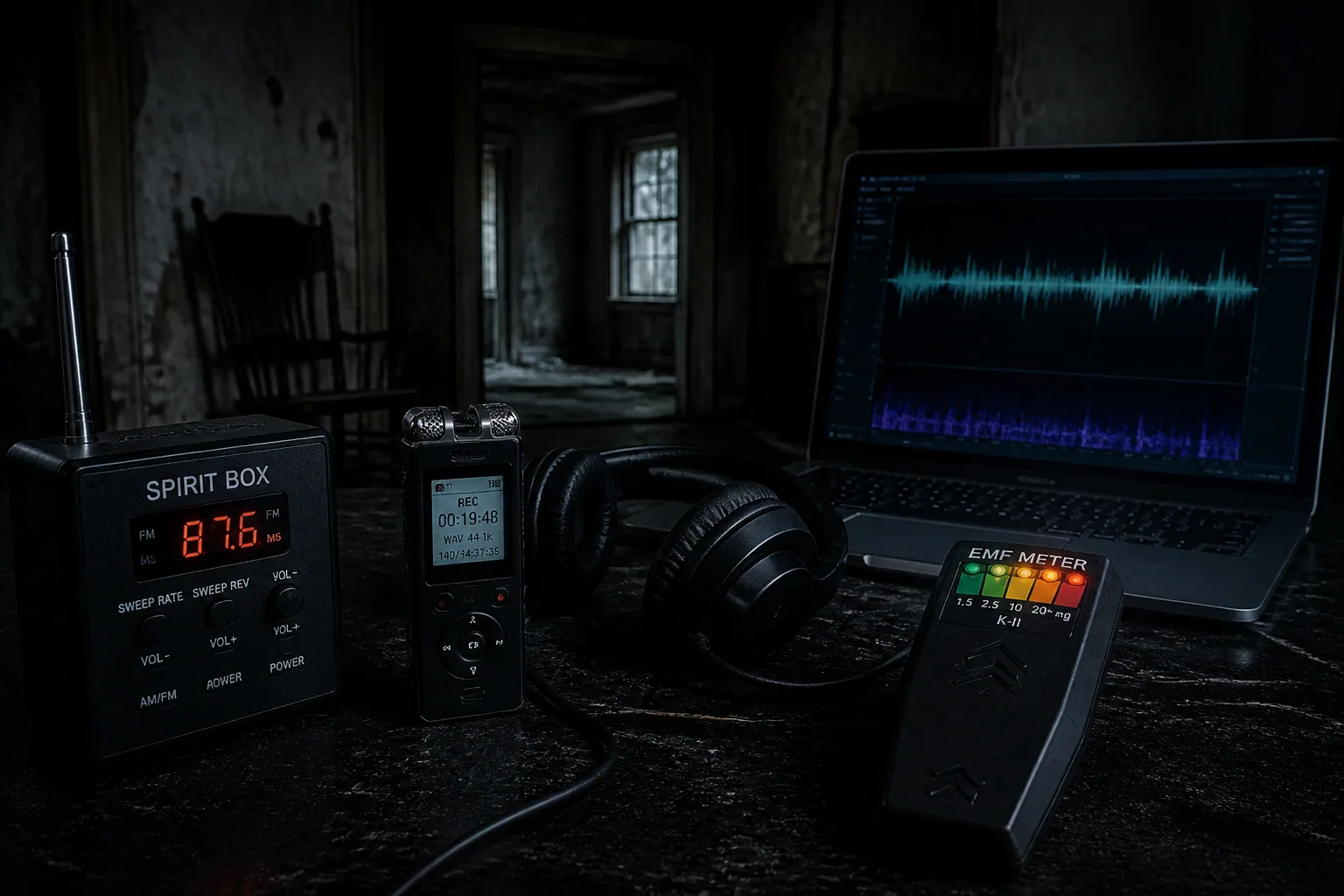
EVP & Spirit Box Sessions Demystified: What Makes Some Sessions Truly Credible and Others Not
Electronic voice phenomena and spirit box sessions can feel compelling for a simple reason: when a sound seems to answer a question at the right moment, our minds immediately look for meaning. For beginners, that moment can feel like proof. For seasoned investigators, it can still be enough to raise eyebrows. But credibility in EVP and spirit box work does not come from how eerie a session feels. It comes from whether the recording can survive careful scrutiny.
That means looking beyond the atmosphere and asking harder questions. Was there radio bleed? Could the microphone have introduced artifacts? Was the room reverberant, noisy, or electronically contaminated? Were the questions clear, the pauses long enough, and the playback reviewed without over-editing? In other words, a strong session is not just one that seems active. It is one that is designed, documented, and analyzed in a way that makes false positives less likely.
Why Some EVP and Spirit Box Sessions Feel Convincing
A convincing session usually has three qualities: timing, clarity, and context. Timing matters because a response that lands right after a question naturally stands out. Clarity matters because a distinct word or phrase is easier to interpret than a vague murmur. Context matters because a response that fits the question can feel far more meaningful than random noise.
The problem is that these same qualities can appear in non-paranormal audio. A radio sweep can create fragments that sound word-like. A room with reflective surfaces can smear consonants into something voice-like. A listener who already expects a reply may hear one even when the signal is weak. So the sense of credibility often begins as a perceptual experience, not an evidential one.
Research on auditory pareidolia helps explain why. When sounds are ambiguous, unstable across repeated listening, or presented under expectation, the brain becomes more likely to impose structure and meaning. That does not mean every EVP is false. It means our first impression is not enough by itself. The most credible sessions are the ones where the impression still holds up after replay, comparison, and controlled review.
What EVP and Spirit Box Devices Actually Capture
At the simplest level, EVP recordings capture audio, while spirit boxes capture rapid audio snippets by scanning radio frequencies or cycling through preloaded content. Neither device is automatically paranormal. They are just tools that collect signals from the environment, the room, and the device itself.
This matters because the source of a sound may be much more ordinary than it first appears. A voice-like fragment could come from a broadcast station, a nearby electronic device, a reflected sound in the room, or the recorder’s own limitations. In spirit box work, the device is intentionally generating a stream of changing audio, which makes it especially easy for the human ear to assemble fragments into recognizable speech.
There is also a key distinction between what the device is designed to do and what it is being used to infer. A recorder is not a truth machine. It is an input device with its own sensitivity curve, self-noise, and susceptibility to interference. A spirit box is not a direct line to an intelligence. It is a structured source of fluctuating audio that investigators interpret through timing and pattern recognition. That interpretive step is where rigor becomes essential.
The Biggest Sources of False Positives: Radio, EMF, and Environmental Noise
One of the most common explanations for suspicious audio is radio-frequency contamination. EVP practitioners have long warned that equipment can pick up stray broadcasts or unintended signals, especially in environments with weak shielding or close proximity to RF sources. The concern is not theoretical. An engineering study on audio recording devices found that analog tape recorders, webcams, and wired or wireless microphones can all be affected by electromagnetic stimulation across a broad RF range, depending on orientation and distance from the source. Source: https://scholarsmine.mst.edu/ele_comeng_facwork/2391/
EMF-related interference can be especially confusing because it may not sound like an obvious radio station. It can show up as bursts, clicks, tone shifts, or fragments that resemble speech. In large paranormal data sets, perceived EVPs have also been reported to correlate with fluctuations in EMF readings and high humidity, which suggests that environmental conditions can shape both the recording and the interpretation of the recording. Source: https://centerpri.org/perceived-electronic-voice-phenomenon-evps-and-environmental-correlation-statistical-analysis-of-a-large-longitudinal-data-set/
Environmental noise is the third major problem. Fans, HVAC systems, traffic, distant speech, electrical hum, and handling noise all create a noisy backdrop that can be misread as a voice. Even in controlled acoustic settings, researchers have reported that extra voices or voice-like events can appear under conditions where background sound exists but no obvious external speaker does. A two-year investigation in professional studios with acoustic shielding and background radio noise reported anomalous voices that could not be explained by overt environmental sounds. Source: https://www.researchgate.net/publication/260321447_A_Two-Year_Investigation_of_the_Allegedly_Anomalous_Electronic_Voices_or_EVP
The practical takeaway is simple: a session is only as credible as its noise control. If the environment is uncontrolled, then any claim of a clear response has to clear a much higher bar.
How Microphone Quality and Recording Settings Affect Results
Microphone choice matters, but not always in the way people assume. A common mistake is believing that a more expensive microphone automatically means better paranormal evidence. In reality, room acoustics and recording conditions can matter more than the microphone brand itself. A study on reproducibility of voice parameters found that room acoustics had a stronger effect on measures such as jitter, shimmer, and harmonic-noise ratio than the microphone used. Source: https://pmc.ncbi.nlm.nih.gov/articles/PMC6529301/
That makes sense when you think about what EVP work is trying to catch. Many alleged responses are faint, partial, or barely present. In that situation, microphone frequency response, off-axis pickup, sensitivity, and self-noise become critical. A microphone with poor high-frequency response may dull consonants. A microphone with noticeable self-noise may turn subtle details into hiss. Off-axis pickup can make a distant sound seem oddly localized or distorted. Source: https://mynewmicrophone.com/complete-guide-to-microphone-frequency-response-with-mic-examples/
Recording settings can also create problems. Aggressive gain can amplify background noise until it resembles structure. Heavy compression can flatten dynamic differences and make weak artifacts more noticeable than they should be. Low sample rates or overly processed audio can hide context. If you want a session to be meaningful, the recorder should preserve the rawest version of the sound possible, not the most dramatic one.
Building a Better Session: Location Control, Baselines, and Documentation
A credible EVP session starts before you press record. Location control is one of the most important steps because a good environment reduces the number of alternative explanations. That means checking for nearby radios, Bluetooth devices, HVAC systems, fans, refrigerators, open windows, and other active noise sources. If possible, use the quietest room available and note the conditions before you begin.
Baselines matter just as much. Record a few minutes of silence, room tone, and environmental noise before asking any questions. This gives you a reference point for later playback analysis. If a suspected voice occurs, you can compare it to the baseline to see whether it shares the same texture, hum, or acoustic signature as the room. A session without a baseline is harder to evaluate because you have no control sample.
Documentation is what separates a story from evidence. Write down the time, place, weather, EMF observations if you are using a meter, who was present, what devices were active, and exactly what questions were asked. If a sound seems important later, those notes help determine whether it could have been caused by a coincidental event, a known source, or a moment when the room changed. Clear documentation also makes it easier for other investigators to review your session without inheriting your assumptions.
If you want a more organized way to capture and revisit sessions, a tool like Ghost Detector: Ectify can help you record the whole process, track session history, and keep timestamps aligned with EMF changes and spirit box activity. You can find it here: https://findthe.app/ectify-fc72z0
How to Ask Questions That Encourage Clearer Responses
Question design is one of the easiest places to improve credibility. The goal is not to force an answer. The goal is to create clean conditions where any response can be evaluated fairly. That means asking one question at a time, using simple language, and avoiding compound prompts that are hard to interpret.
For example, asking “What is your name?” is cleaner than asking “Can you tell us your name and why you are here?” The first allows for a shorter response and reduces ambiguity. The second invites a multi-part answer that can be interpreted almost any way you want. Similarly, yes-or-no questions are easier to analyze than open-ended prompts when the environment is noisy.
Leading questions are a major trap. If you ask, “Is your name John?” then a response that sounds like “John” is less meaningful because you introduced the target yourself. Better practice is to ask neutral questions, leave room for silence, and avoid narrating your expectations out loud. The less you steer the answer, the more useful the response becomes if something unusual does occur.
Timing Matters: Pauses, Response Windows, and Session Pace
Timing is one of the biggest reasons sessions feel convincing. Human beings are good at recognizing conversational turn-taking, so when a noise appears during a pause, our brains immediately classify it as a reply. That is exactly why the pacing of a session matters.
After each question, leave a clear response window. Do not speak over the device. Do not rush to fill the silence. Give enough time for a real answer to emerge, but also enough separation that the listener can tell when the question ended and the response began. A rushed session creates overlap, and overlap is where misinterpretation thrives.
The best investigators treat silence as data. A pause that contains only room noise is useful. It gives structure to the session and makes it easier to identify anything that truly stands out. If every moment is filled with talking, movement, or device noise, then later analysis becomes much less reliable.
Playback and Analysis Techniques That Help Spot Real Anomalies
Good analysis begins with restraint. The first rule is to listen to the raw file before any enhancement. Ask what is actually present, not what might be present after filtering. Then review the same clip multiple times at normal speed, slowed down, and with attention to both left and right channels if applicable.
Waveform review can help identify whether a suspicious sound is a true audio event or simply a texture in the noise floor. Look for onset, duration, and consistency. A genuine anomaly should usually have some measurable shape or structure. If it disappears every time you change playback speed or vanishes when you compare it against neighboring audio, caution is warranted.
Comparison is also useful. If you have multiple recordings from the same location, compare similar sounds across sessions. Does the “voice” appear only when the HVAC is on? Does it coincide with handling noise or a certain device setting? Does it resemble a known environmental sound from the room? Pattern matching across sessions can quickly separate repeatable environmental artifacts from one-off anomalies.
Spectral analysis can sometimes help too, especially when a suspected voice needs to be distinguished from broadband noise or interference. But analysis tools are not proof by themselves. A graph can make a sound look scientific while hiding the fact that the underlying clip is still ambiguous. The point of analysis is not to decorate a claim. It is to test it.
When Audio Cleaning Helps and When It Creates Misleading Evidence
Noise reduction can be useful, but only if it is used conservatively. Mild filtering may improve intelligibility enough to reveal whether a sound is actually speech-like. However, aggressive cleanup can manufacture the appearance of a response by removing the very noise that showed the clip was ambiguous in the first place.
This is where over-editing becomes a real problem. Compression, EQ boosts, drastic noise gates, and selective clipping can make a vague artifact seem clearer than it truly is. If a sound only becomes understandable after heavy processing, that should lower confidence, not raise it.
A good rule is to keep a raw copy untouched and compare every edit against it. If enhancement changes the meaning of the sound rather than simply improving audibility, then the edited version should not be presented as better evidence. The most trustworthy analysis is transparent about what was changed and why.
Pareidolia, Confirmation Bias, and Other Interpretation Traps
Pareidolia is the tendency to hear patterns, especially voices, in ambiguous sound. It is one of the biggest reasons EVP work can feel persuasive. When the audio is noisy or incomplete, the brain fills in gaps with familiar speech patterns. Once a listener locks onto a candidate word, every replay can reinforce that impression.
Confirmation bias adds another layer. If you expect a spirit box to answer, you are more likely to notice matches than misses. You may also unconsciously privilege the clip that sounds best while ignoring the others that did not line up. This does not mean investigators are dishonest. It means humans are naturally selective when something feels important.
A disciplined approach helps counter that. Try blind review when possible. Ask another person to listen without context. Compare interpretations from different listeners before revealing what you thought it said. If the same clip yields very different words, confidence should drop. The less stable the perception, the weaker the claim.
Red Flags That Often Get Mistaken for Paranormal Proof
Several warning signs should make you pause before treating a clip as paranormal evidence. One is a response that only seems clear after you tell someone what to hear. Another is a voice that fits too perfectly because the question was leading. A third is a sound that appears only after aggressive editing or repeated enhancement.
Unusual timing is another red flag. If a response occurs during your own speech, during device handling, or while a radio sweep is actively changing, interpretation becomes much less reliable. So does a clip that cannot be reproduced under similar conditions. Repeatability is not required for every anomaly, but a complete lack of repeatable features should make anyone cautious.
Finally, watch for selective framing. If only the seemingly meaningful moments are saved and the rest of the session disappears, the evidence base is already biased. A credible investigator keeps the full context, not just the exciting fragments.
What Makes Evidence More Credible to Skeptics and Investigators Alike
Skeptics and believers often disagree on conclusions, but they can still agree on standards. The most credible evidence is collected in a way that minimizes alternative explanations and leaves a clear audit trail. That means controlled environments, documented conditions, raw and unedited files, neutral questions, and enough context for independent review.
Credibility also rises when multiple forms of evidence align without being forced together. If an audio anomaly coincides with a documented environmental change, a consistent EMF fluctuation, and a recording setup that was otherwise stable, the clip deserves more attention. If it only becomes impressive after interpretation, it deserves less.
In practical terms, the best evidence is not the most dramatic evidence. It is the evidence that remains understandable even after someone else reviews it with no stake in the result. That is the standard that makes a session persuasive beyond the room in which it was recorded.
A Practical Checklist for Running More Trustworthy EVP Sessions
Before the session, check the room for obvious noise sources, note the conditions, and record a short baseline. Make sure your device is charged, your settings are stable, and your microphones are positioned consistently. If you are using a spirit box, note the scan mode and any nearby electronics that may affect it.
During the session, ask one clear question at a time, avoid leading phrasing, and leave a proper response gap. Keep your own speech and movement to a minimum. Mark any obvious environmental events, like a door closing or a passing vehicle, so they can be excluded later.
After the session, preserve the original file, review it raw first, and only use light enhancement if it genuinely helps analysis. Compare the suspected clip to nearby audio, listen with different playback methods, and invite another listener to review it without being told what to expect. If the result still seems unusual after all that, then you may have something worth further study.
Final Thoughts: Seeking Better Evidence, Not Just Better Stories
EVP and spirit box sessions can be fascinating, but fascination is not the same as credibility. The strongest work comes from careful setup, honest documentation, and a willingness to reject weak evidence even when it sounds exciting. That discipline is what separates a compelling story from a persuasive case.
If you want better results, focus less on chasing dramatic reactions and more on controlling the variables that can fool you. Clean rooms, clear questions, transparent analysis, and a skeptical eye are not obstacles to paranormal investigation. They are what make the results worth discussing at all.
