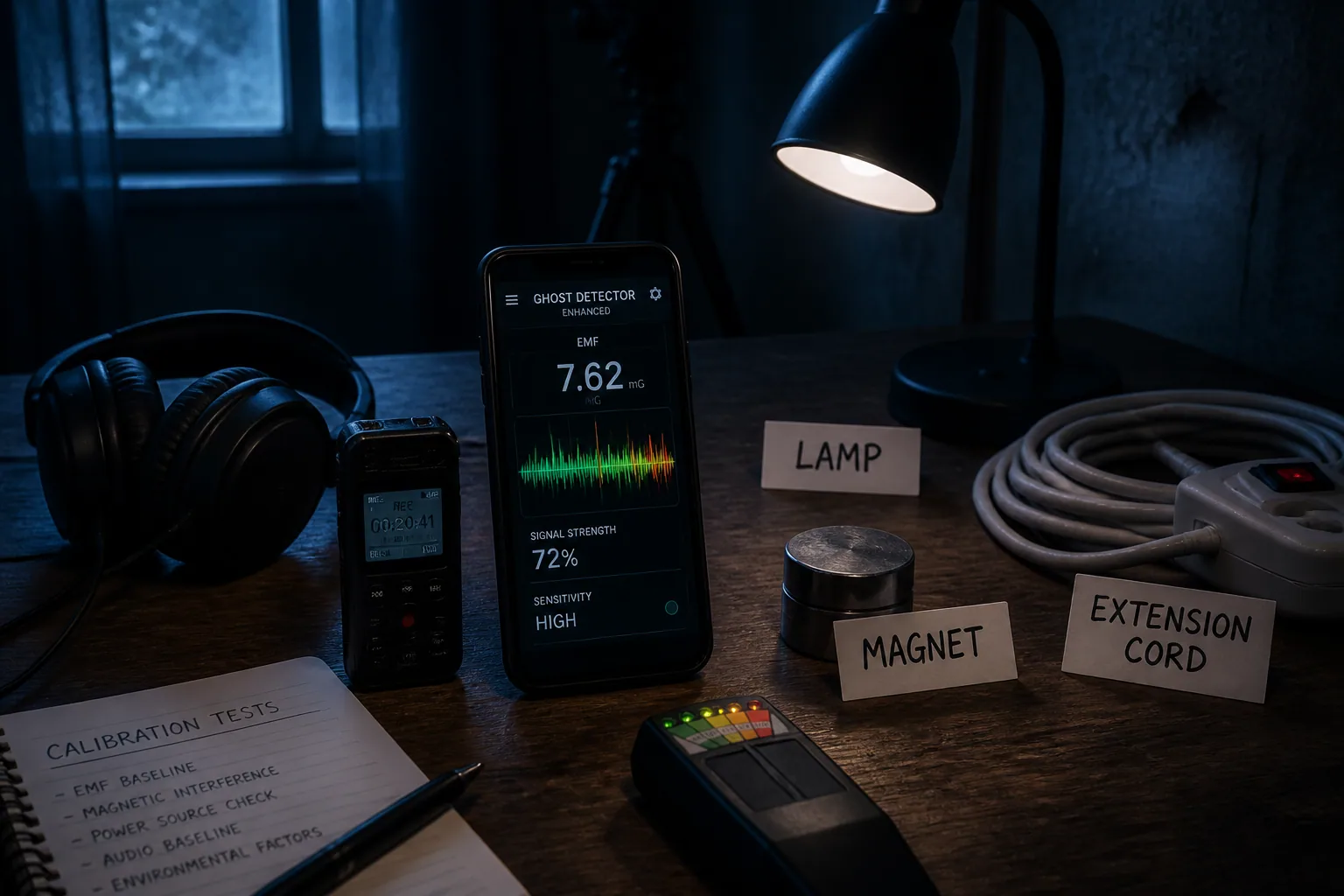
Ghost Detector App Calibration: How to Train Yourself to Spot Real Paranormal Signals
If you want more credible paranormal investigations, calibration matters as much as the app itself. A ghost detector app can be entertaining, but the real skill is learning how your phone reacts in ordinary places before you ever step into a supposedly haunted one. That means building a baseline, understanding false alarms, and training your own judgment so you do not treat every spike, buzz, or fragment of audio as proof of something supernatural.
The goal is not to dismiss every unusual result. It is to separate repeatable environmental noise from the moments that actually deserve attention. When you know how your EMF readings behave in a bedroom, a kitchen, a car, or outdoors, you become much better at spotting what is normal, what is questionable, and what might be genuinely interesting.
Why Ghost Detector Apps Trigger So Many False Alarms
Most ghost detector apps are sensitive to the same messy environment we all live in. Modern buildings are full of wiring, switching power supplies, routers, Bluetooth devices, appliances, smart meters, HVAC systems, and radio signals. Paranormal Response Network notes that many meter spikes come from everyday sources like in-wall wiring, breaker panels, power lines, large appliances, and HVAC systems cycling on and off rather than anything paranormal: https://www.paranormalresponsenetwork.org/evidence-guides/meters
That is why a sudden reading is not automatically meaningful. A microwave can produce maximum magnetic fields over 70 µT at the surface, and a washing machine can exceed 30 µT, with the field dropping rapidly as you move away from the source. In other words, proximity alone can create dramatic changes that look mysterious if you do not know what is nearby: https://www.emfs.info/electricity-system-and-sources/household-wiring-and-appliances
This is also why a beginner can get excited too quickly. The app is not lying, but it is responding to the environment with no context. Calibration is how you give that context back to yourself.
What Your Phone’s Sensors Can and Can’t Actually Detect
A phone-based EMF app usually relies on the magnetometer, which is designed to help the device understand magnetic orientation. That means it may detect some magnetic field changes, but it cannot reliably measure the full range of what ghost hunters often think of as EMF. EMF Protection Pros explains that smartphone EMF apps cannot reliably measure AC magnetic fields from power lines and appliances, electric fields from wiring, or RF radiation, which is why dedicated meters are needed for serious measurement: https://www.emfprotectionpros.com/can-i-use-my-phone-to-detect-emf/
This distinction matters because a phone app can still be useful as an atmospheric tool, but it should not be treated like a scientific instrument by default. If you are using it during an investigation, think of it as a signal awareness aid, not proof. It can help you notice changes, but not automatically explain them.
The same principle applies to spirit box and EVP-style features. These tools can create compelling sessions, but they also operate in noisy environments where radio bleed, static, and speech fragments can appear naturally. Calibration is about learning the sound of the tool itself before you start asking questions of the location.
Building a Personal Baseline in Everyday Environments
The fastest way to improve your investigations is to test your app in places that are boring, familiar, and repeatable. Try your bedroom, kitchen, car, hallway, backyard, and a room with a lot of electronics. Do the same with the phone in your hand position, at the same height, and with the same app settings each time.
Paranormal Response Network recommends establishing a baseline in the location under various conditions, turning off non-essential electrical devices, repeating readings in the same spot and orientation, and documenting the environment and time. That approach gives you a reference point so you know what is normal before you chase anomalies: https://www.paranormalresponsenetwork.org/evidence-guides/meters
A good baseline is simple but detailed. Note whether the room is quiet or active, whether lights are on, whether appliances are running, whether your phone is on airplane mode, and whether anyone else is nearby using wireless devices. Repeat the test at different times of day, because background activity in a home can change dramatically between morning, afternoon, and night.
Once you have enough sessions, patterns start to appear. Maybe your kitchen spikes whenever the refrigerator compressor kicks in. Maybe your car produces a consistent reading near the dash because of electronics and wiring. Maybe outdoors is quieter except near power lines or parked vehicles. Those observations are not disappointing. They are the foundation of good paranormal judgment.
How to Test EMF Readings Around Wires, Appliances, and Magnets
One of the best calibration exercises is to deliberately expose your app to known sources. Start near wall outlets, breaker boxes, lamps, chargers, Wi-Fi routers, refrigerators, and appliances with motors. Then slowly move away and watch how the reading changes. The point is not to find a perfect number, but to learn how your phone behaves in a controlled setup.
Keep in mind that distance changes everything. EMF near a surface can look dramatic, but a small step away may drop the reading sharply. That is why a reading taken inches from a microwave or washing machine is not comparable to a reading in the center of a room. If you can reproduce the same spike by returning to the same spot and orientation, you are probably seeing a real environmental source rather than a random event.
It also helps to understand common measurement mistakes. EMF Defender warns that investigators often use the wrong measurement mode, ignore pulsed emissions from smart meters or Wi-Fi, hold the meter too close to sources, or handle it incorrectly. Those habits can create confusing results that look paranormal when they are simply procedural errors: https://emfdefender.com/Common-EMF-Meter-Mistakes-and-How-to-Avoid-Them.php
If your app allows it, compare readings while rotating the phone, changing your grip, and moving it through the same path several times. A real environmental source should often show a pattern. A random spike that disappears when you repeat the same movement is much less persuasive.
Calibrating Spirit Box and Audio Tools for Cleaner Sessions
Spirit box and EVP tools need calibration too, because audio ambiguity is one of the biggest sources of self-deception in ghost hunting. Before asking questions, run a control sweep with no prompts at all. HauntGears recommends this kind of baseline sweep so you can hear the ambient station bleed, radio fragments, and static present in the location: https://hauntgears.com/spirit-box-device/
This matters because your brain is very good at turning fragments into meaning. If you already know the session is a ghost hunt, you are more likely to hear responses in places where there may only be clipped radio, white noise, or environmental interference. A clean control sweep gives you something to compare against later.
Settings also change the character of the audio. HauntGears notes that sweep speed, band selection, and direction affect how much recognizable content appears. Faster sweeps tend to sound more fragmented and noise-like, while slower sweeps preserve more context but can allow station leakage and other artifacts to come through: https://hauntgears.com/spirit-box-frequencies-explained/
For better sessions, keep the settings consistent. Change only one variable at a time and write it down. If a response seems interesting, you will want to know whether it came from the environment, the device configuration, or your own expectations.
Common Sources of Ambient Noise and Signal Contamination
A reliable investigation depends on understanding contamination. Radio transmitters or nearby RF sources can leak into non-wireless recording equipment and cause voices, crackling, humming, or clicking that sound paranormal. The research cited by PRN and Innovation, Science and Economic Development Canada points out that shielding, grounding, and awareness of nearby transmitters can reduce this problem: https://www.paranormalresponsenetwork.org/research/document/6c509bd2-9037-44c5-a2f8-82e48c653ad8
Other common sources include clocks, fans, vents, pipes, distant traffic, footsteps, building creaks, and the noise floor of the recording device itself. If you do not document those sounds, you may later mistake them for EVP. Best practice guidance from UK Paranormal eXperience and PRN recommends identifying consistent ambient sounds, preserving raw files, timestamping recordings, and noting the exact settings used: https://ukpx.org/2025/10/12/electronic-voice-phenomena-evp-best-practices-and-technical-guidance/
The more ordinary noise you can account for, the stronger your remaining evidence becomes. In a good investigation, you are not trying to eliminate every sound. You are trying to know what every sound is likely to be.
How to Train Your Ears Without Hearing What You Want to Hear
Audio perception is especially vulnerable to expectation. PRN Research Desk notes that people primed with paranormal expectations report hearing voices in ambiguous sounds more often, yet listener agreement is very low, which suggests that bias and pareidolia play a major role in EVP interpretation: https://www.paranormalresponsenetwork.org/research/document/6c509bd2-9037-44c5-a2f8-82e48c653ad8
The best defense is to listen like a skeptic first and an investigator second. Ask yourself whether the sound could be a cough, a door movement, a nearby vehicle, a passing radio fragment, or simply noise shaped by the room. If you can explain a clip in a normal way, you should consider that explanation seriously before labeling it paranormal.
A useful exercise is to listen to several recordings without telling yourself what to expect. Then compare your impressions with someone else’s, or better yet, with a blind listener who has no context. If different people disagree strongly on what was said, that is a sign the clip may be too ambiguous to count as strong evidence.
Training your ears is really training your restraint. The investigators who get the best evidence are often the ones who are most willing to say, “I do not know what this is yet.”
Using Double-Blind Tests to Reduce Paranormal Confirmation Bias
If you want to reduce confirmation bias, use double-blind or near-blind procedures whenever possible. That can be as simple as having one person handle prompts while another records without knowing what was asked, or reviewing clips later without looking at the live readings first. The less your expectations shape what you think you heard or saw, the better.
You can also repeat the same session at different times and in different rooms. If a “response” only appears when everyone is excited, or only happens after a leading question, it is less convincing. If it repeats under similar conditions without prompting, it becomes more interesting.
This is where a tool like Ghost Detector: Ectify can fit naturally into a smarter workflow, especially because it records and saves sessions for later review. You can use it to capture the full experience, then compare what seemed active in the moment with what is actually present on replay: https://findthe.app/ectify-fc72z0
That kind of after-the-fact review is powerful because live investigations are emotionally charged. When you slow down later, you are less likely to let adrenaline decide what counts.
Why Recording Multiple Sessions Leads to Better Evidence
One session rarely proves much on its own. Multiple sessions create context. If the same reading, sound, or pattern appears across different nights, different weather conditions, or different rooms, you can start to evaluate whether it has a repeatable cause. Repeatability is one of the most important marks of credible evidence.
Recording multiple sessions also helps you identify what is normal for a location. The first time you investigate a house, everything can feel strange. By the fifth session, you may discover that the “activity” was actually a heat cycle, a radio source down the street, or a recurring appliance noise. That does not ruin the investigation. It makes the next one better.
Good records also help when you share evidence with others. People are far more likely to trust a clip if you can show that you tested the same room several times, documented the setup, and kept the raw files untouched. In paranormal work, credibility grows when the investigation process is visible.
How to Compare Live Readings With Recorded Events Afterward
One of the most valuable habits you can build is comparing what you felt in the moment with what the recording actually shows later. During a live session, it is easy to become convinced that a spike happened right before a question was answered, or that a noise matched something spoken in the room. Later playback often reveals a different story.
That is why timestamping matters so much. If your device stores session history, use it. Note the exact time of spikes, the question being asked, and any visible environmental changes. UKPX guidance emphasizes preserving raw files, using uncompressed formats when possible, and noting recording settings so the evidence can be checked against the conditions in which it was captured: https://ukpx.org/2025/10/12/electronic-voice-phenomena-evp-best-practices-and-technical-guidance/
When you review later, ask three questions. First, was the event real and measurable? Second, was it repeatable? Third, is there a normal explanation that fits the timing and setting? If the answer to all three is unclear, the clip may still be interesting, but it should not be treated as strong proof.
Documenting Results So Your Evidence Looks More Credible
Documentation is what turns a fun ghost hunt into something people can actually assess. Write down the location, date, time, weather, room conditions, device settings, and anything unusual in the environment. Include what you turned off, what you left on, and who was present. The more complete the record, the easier it is to evaluate the session later.
You should also label your evidence clearly. Separate raw recordings from edited clips. If you highlight an interesting moment for social media, keep the original file too. This protects your work from the common criticism that something was trimmed, amplified, or framed in a misleading way.
A strong evidence log does not need to be fancy. It just needs to be honest, organized, and consistent. Over time, your notes will show patterns that your memory would otherwise miss.
A Simple Calibration Routine to Use Before Every Investigation
A short routine can save you from hours of confusion later. Before a paranormal session, test your app in a normal room, then near one known source like a charger or appliance, then again in the investigation area. Run a quick control sweep with no questions. Check that your phone settings have not changed. Confirm that you know where the nearest electronics, power sources, and possible radio interference are located.
Then start your session with a calm baseline, not with leading questions. Repeat the same area a few times if something unusual appears. If the effect vanishes when you repeat it, document that too. If it remains consistent, make a note and compare it against the rest of your evidence later.
Calibration is not about making paranormal activity disappear. It is about giving yourself a better way to recognize it if it is really there. The more you understand your app, your environment, and your own biases, the more useful every investigation becomes.
