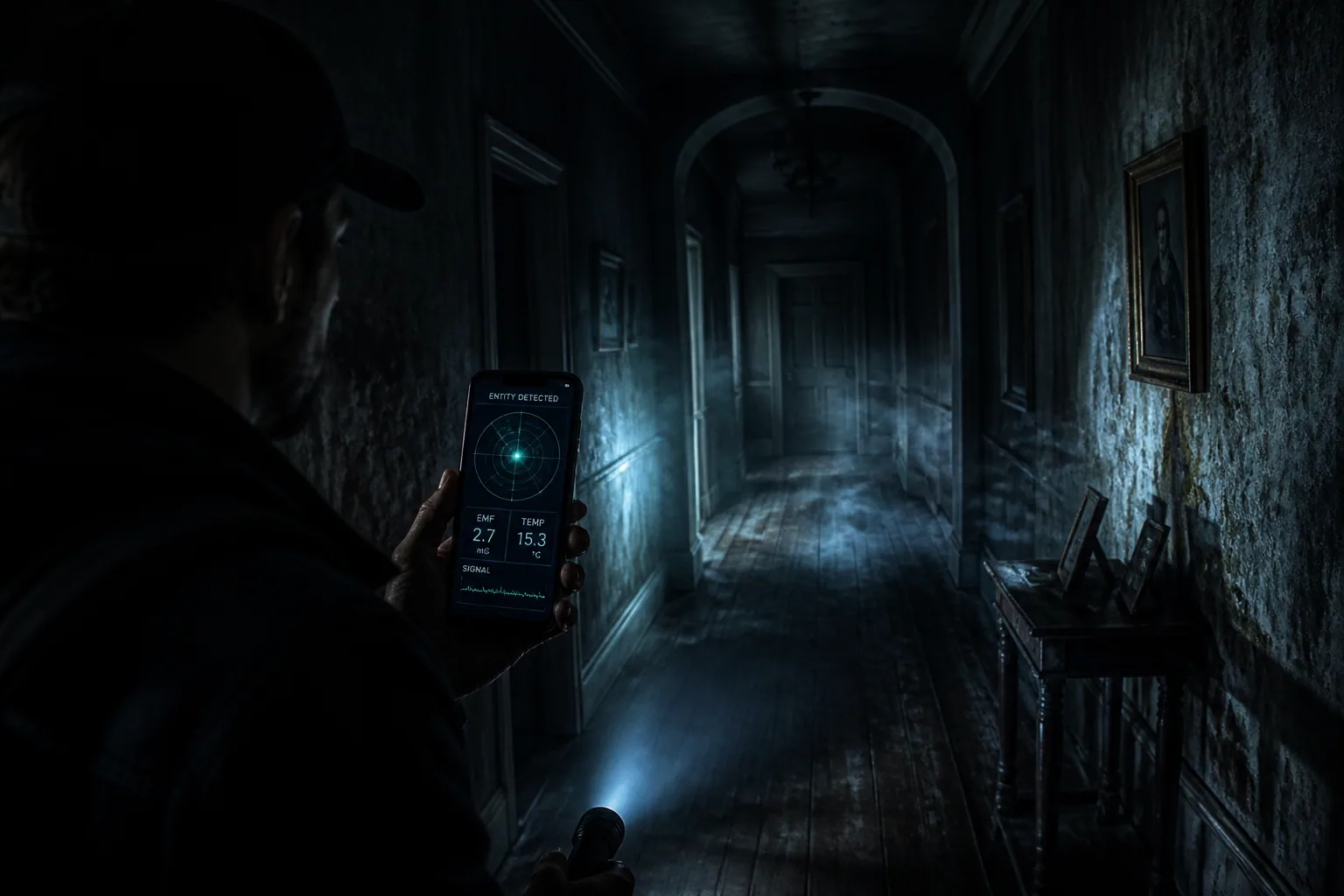
Ghost Hunters’ Question Time: What Paranormal Investigators Really Want Answered
Paranormal investigation sits in a strange place between curiosity, folklore, psychology, and technology. People want answers, but they also want the thrill of not knowing. That tension is exactly why the best ghost hunters do not just ask whether something is haunted. They ask when, where, how, and under what conditions a report becomes more or less believable.
This is where a practical mindset matters. If you are using your smartphone during a ghost hunt, you are not just filming for atmosphere. You are collecting data, checking for patterns, and trying to separate experience from expectation. The questions below are the ones serious investigators keep returning to, because they help turn a spooky night into something closer to an actual inquiry.
Why Do Some People Never Experience Anything Paranormal?
One of the most common questions in ghost hunting is also one of the hardest to answer: why do some people report hauntings often, while others never report anything at all? Part of the answer may be simple exposure. Some people spend more time in settings where stories are already circulating, or they are more willing to interpret a strange moment as paranormal. Others may be more skeptical, more distracted, or simply less likely to remember ambiguous events as meaningful.
There is also a major belief factor. In one study of scientists, engineers, enthusiasts, and the general public, belief in the paranormal was strongly correlated with having had an anomalous experience, with a reported correlation of r = 0.61. That does not prove belief causes experiences, or that experiences prove belief. It does suggest that what people expect to find can shape what they notice and how they label it. Research on extraordinary experiences also shows how common these reports can be: in a large study, 54% of American respondents reported telepathy, 25% clairvoyance, and 30% contact with the dead, while in a British adult cohort about 37% reported at least one paranormal experience. Source: https://pmc.ncbi.nlm.nih.gov/articles/PMC7256471/ and https://www.sciencedirect.com/science/article/pii/S1550830718300119
For investigators, the useful question is not whether somebody is lying. It is whether the environment, the person, and the method together make an experience more or less likely. If one person in a group keeps reporting activity and everyone else does not, that is worth noting. It may reflect sensitivity, suggestion, stress, prior belief, or simply a different vantage point.
Do Ghosts Prefer Certain Times, Weather, or Conditions?
Many ghost stories are tied to late-night hours, stormy weather, old buildings, or cold spots. That does not automatically mean ghosts are choosing those conditions. It may mean those are the conditions in which humans are most likely to notice unusual sensations, hear creaks, or feel uneasy enough to interpret normal stimuli as evidence.
A useful clue comes from environmental research. A literature review known as “Things That Go Bump in the Literature” identified six variables repeatedly linked to haunt-type experiences: static physical cues, lighting levels, air quality, temperature, infrasound, and electromagnetic fields. Source: https://pmc.ncbi.nlm.nih.gov/articles/PMC7304295/
That matters because so-called haunted locations often have a very specific sensory profile. They may be dim, damp, drafty, noisy, and full of old wiring or vibrating machinery. In historic investigations such as Hampton Court Palace and the Edinburgh Vaults, participants reported more anomalous experiences in places rumored to be haunted, and environmental factors like magnetic field fluctuations, damp lighting, and humidity were correlated with those reports. Source: https://arstechnica.com/science/2026/04/that-spooky-sensation-likely-due-to-rumbling-pipes-not-spirits/
So do ghosts prefer certain conditions? Maybe, if you are talking about the kinds of settings where people are primed to feel something unusual. As an investigator, the better approach is to log the weather, time, temperature, humidity, lighting, and room activity every time you investigate. That way, if something repeats, you can at least see whether it repeats with the same environmental pattern.
What Natural Causes Commonly Mimic a Haunting?
A surprising number of paranormal reports can be reproduced by normal causes. Drafts can move doors and curtains. Old houses settle and crack. Pipes knock. Phones interfere with meters. And infrasound can create physical unease even when people cannot consciously hear it.
That last point is especially important. Infrasound, which is below roughly 20 Hz, has been shown in experiments to increase stress responses. In one study summary, people exposed to hidden infrasound reported feeling more irritated and unsettled, and their cortisol levels rose, even though they could not consciously detect the sound. Source: https://arstechnica.com/science/2026/04/that-spooky-sensation-likely-due-to-rumbling-pipes-not-spirits/
Electromagnetic sources are another frequent culprit. The same review of haunt-type experiences noted electromagnetic fields among the repeated environmental variables associated with reports. In practice, this can mean nearby wiring, outlets, routers, power strips, or even the investigator’s own phone hardware. A location may feel active simply because it is full of invisible infrastructure doing ordinary work.
If you want a smart approach, start by asking what else could explain the sensation. Was there a ventilation system cycling on? Was someone moving in another room? Was a strong radio frequency source nearby? Ghost hunting becomes much more credible when you can eliminate the obvious before reaching for the extraordinary.
How Belief, Expectation, and Fear Shape What We Perceive
Perception is not a camera. It is a system that fills in gaps, predicts patterns, and reacts to emotion. If you already believe a place is haunted, a small noise may feel loaded with meaning. If you are tense, you may scan faster, misread shadows, and notice ambiguous cues that you would normally ignore.
This is why some studies find that people report more anomalies in haunted locations even when they do not know they are supposed to be haunted. In the historic investigations mentioned earlier, rumors alone were not the whole story, which suggests that the environment itself can affect experience. Still, expectation is powerful. Once a person suspects they are in a haunted room, harmless sensations can become evidence in their mind very quickly.
There is also a clinical angle sometimes discussed in the literature. A 2022 Frontiers in Psychology case study on “Haunted People Syndrome” described individuals who frequently report supernatural encounters and linked those reports to elevated, though subclinical, distress and somatic-sensory sensitivities, together with belief systems and reinforcement of anomalies. Source: https://www.frontiersin.org/journals/psychology/articles/10.3389/fpsyg.2022.879163/pdf
For investigators, this does not mean dismissing people. It means treating testimony with context. Ask what the person expected, what they feared, what they had heard about the location, and what was happening physically at the time. The goal is not to win an argument. It is to build a cleaner picture of what the person actually experienced.
How to Set Up a Controlled Ghost Hunting Session With Your Smartphone
If you are using your smartphone, the first rule is simple: control what you can control. Pick one room or one section of a location. Decide in advance what counts as a meaningful event. Then make sure your phone is not changing the conditions you are trying to observe.
Start with a baseline session. Record 5 to 10 minutes of the room before you begin asking questions. Note the time, exact location, number of people present, and any active devices nearby. Then keep the phone in one position if possible, because moving it around changes what the sensors and microphone are picking up.
A practical phone-based session should include three layers. First, a visual record for context. Second, an audio record for knocks, voices, and room tone. Third, sensor data, but only if you understand what the sensor is actually measuring. The point is not to collect more spooky material. It is to collect material you can later compare against the rest of the session.
This is also where a dedicated app can be useful if you want session history and easy recording in one place. Ghost Detector: Ectify lets you use your phone’s hardware sensors, record sessions, and review past investigations in one app, which can help keep your notes and recordings organized during a long night of testing. You can find it here: https://findthe.app/ectify-fc72z0
How to Spot False Positives in Audio, Video, and Sensor Readings
False positives are the backbone of bad paranormal evidence. They are also incredibly common. Smartphone apps marketed as EMF detectors, EVP tools, or spirit communication devices often trigger on nearby electronics, WiFi, or the phone’s own hardware. Audio can be contaminated by room noise, and floating lights can turn into “orbs” when dust passes close to the lens. Source: https://www.tvi.show/ghost-gear/paranormal-phone-apps
With video, check the obvious first. Is the light source changing? Is dust near the lens? Is there a reflective surface? Is the camera auto-adjusting exposure? A tiny shift in brightness can make ordinary particles look like moving spheres or faces in the dark.
With audio, isolate the environment. What sounded like a whisper might be HVAC noise, a distant voice from outside, or the microphone overamplifying a crackle. If possible, listen again with headphones and compare the suspected event against the room tone before and after it. A real anomaly should survive scrutiny better than a convenient coincidence.
With sensor readings, assume interference until proven otherwise. Phone-based magnetometers can react to metal objects, nearby cables, and other electronics. If a reading spikes every time you put your phone on the same table, you may have found the table, not a spirit.
How to Calibrate Your Smartphone Sensors for Better Investigation Clarity
Calibration is one of the most overlooked parts of phone-based ghost hunting. If your sensors are not understood, your readings are hard to trust. The same is true for traditional gear, but phone users often assume the app is making the data scientific when it is really just displaying numbers.
A technical guide on EMF and ghost detection notes that devices like K2 and K-II meters are not scientific instruments, can be distorted by RF sources and metal, and may behave differently depending on orientation. It also points out that many of these devices do not log timestamps, which makes it difficult to correlate readings with video, temperature shifts, or human activity. Source: https://ukpx.org/2025/10/12/emf-and-ghost-detection-a-technical-guide-for-serious-investigators/
The same caution applies to your phone. Before a session, test the magnetometer in a known environment. Move it slowly around a stable room and see whether it reacts to wiring, speakers, or other electronics. If you are using an audio recorder, test its noise floor in silence. If you are using the camera, test it in the same lighting you expect at the location.
Calibration is less about making the phone perfect and more about understanding its personality. Once you know how it behaves, you can interpret a sudden change more intelligently. Without that baseline, every spike looks exciting and nothing looks conclusive.
The Best Questions to Ask During a Paranormal Session
A good paranormal session is not a performance. It is a conversation with uncertainty. The best questions are simple, specific, and easy to timestamp. Instead of asking broad dramatic questions, ask ones that create clear moments to examine later.
Useful questions include: Is anyone here? Can you move closer to the recorder? Can you repeat that? What is your name? How many people are in the room? Can you show us where you are? These are not magic words. They are prompts that create pauses, responses, and a structure you can review afterward.
You can also ask control questions that help reveal pattern versus coincidence. For example, ask the same question several times with silence in between. Or ask a question after changing the room condition, such as opening a window or switching off a light, and then compare the response. If something only happens when the group is already on edge, that tells you something too.
The point is to avoid vague prompts that encourage pareidolia, suggestion, and interpretation. A good question creates a measurable moment. A bad question creates a story before the evidence is even checked.
How to Log Evidence So It Holds Up to Scrutiny
Evidence that cannot be reviewed later is mostly a memory, not evidence. If you want your findings to stand up to scrutiny, you need a record that allows another person to follow your steps and challenge your conclusion.
Every note should include the date, time, exact location, names of everyone present, environmental conditions, and what device was used. If your phone captures a sound or a spike in sensor data, mark the time immediately and write down what else was happening. Was someone speaking? Did a door open? Was another device active? The more detail you preserve, the easier it is to test your interpretation later.
It helps to organize sessions into clear categories: baseline, question period, anomaly, and review. Keep the original file untouched if possible, then create a separate working copy for analysis. That makes it easier to show that the evidence was not edited into a better story.
This is another place where session history can help. When your app or recording system stores timestamps and previous investigations, patterns become easier to spot. You may notice that the same room only seems active when the crowd is large, the humidity is high, or the building is under mechanical strain.
What Smart Paranormal Investigators Still Can’t Fully Explain
Even the most skeptical investigators have to admit that not every report is easy to dismiss. Some experiences are consistent across people, repeat under similar conditions, or happen in ways that do not immediately point to one simple cause. That does not prove ghosts, but it does keep the question alive.
This is the real appeal of paranormal investigation. The field is full of ordinary explanations, but it is also full of people who are genuinely convinced they experienced something beyond them. Studies show that extraordinary experiences and beliefs are widespread, and research continues to find that environment, expectation, and individual sensitivity all play a role. Source: https://pmc.ncbi.nlm.nih.gov/articles/PMC7256471/
What remains unresolved is not whether people feel something. They clearly do. The unresolved part is how to distinguish between a strange environment, a strange mind state, and a truly unexplained event. That is why the best ghost hunters stay curious without becoming careless.
If you approach each session like an investigator, your phone becomes more than a prop. It becomes a tool for observation, comparison, and restraint. And in paranormal work, restraint is often the difference between a fun story and a useful discovery.
