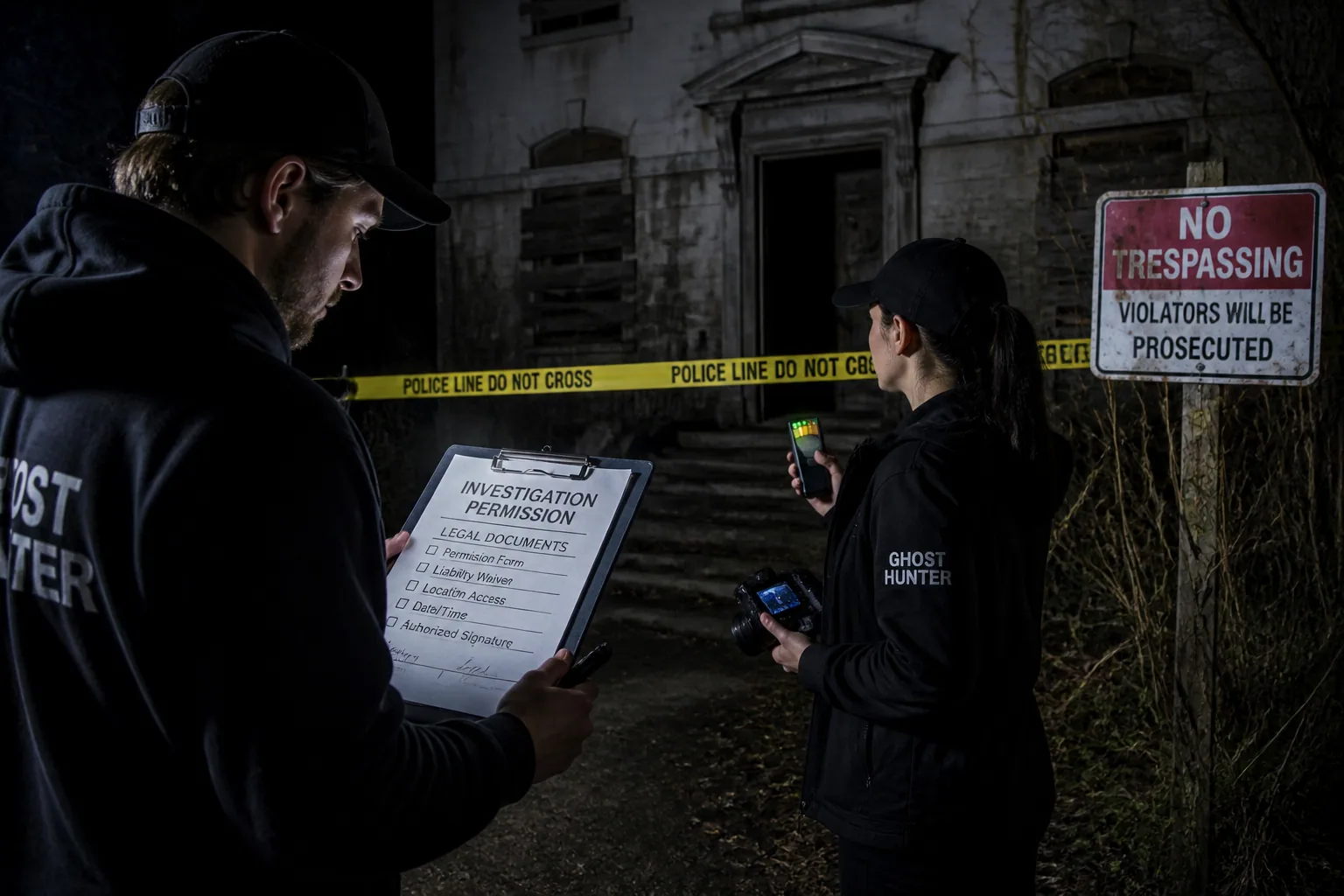
Ghost Hunting & the Law: What Every Investigator Should Know About Recording and Exploring Legally
Ghost hunting can be exciting, creative, and even a little addictive. But once you start filming, recording audio, bringing guests, or posting investigations online, the legal side matters just as much as the equipment in your bag. A lot of investigators assume that if a place looks abandoned, or if the session is “just for YouTube,” the rules are looser. In reality, recording laws, trespass rules, privacy rights, and liability concerns can turn a fun investigation into a legal headache very quickly.
The good news is that most of the risk is manageable once you understand the basics. If you know when consent is required, what counts as private property, how state recording laws differ, and where insurance fits into the picture, you can protect yourself, your team, and your guests without losing the thrill of the hunt.
Why Legal Knowledge Matters in Ghost Hunting
Modern paranormal work is not just wandering around with a flashlight anymore. Many teams now record EVP sessions, use spirit boxes, livestream investigations, interview witnesses, and publish edited clips across social media. That changes the legal profile of what you are doing. You are no longer simply exploring a place. You may be creating media, capturing other people’s voices, documenting private property, or bringing the public into a location that comes with rules and restrictions.
That means the legal stakes are broader than many hobbyists expect. You could face a trespass issue, a recording issue, a privacy complaint, or even an injury claim if someone gets hurt during the investigation. A careful approach is not about being fearful. It is about being professional.
Federal vs. State Recording Laws: The Basics
When people talk about recording laws in the U.S., they usually mean consent rules for conversations. Federal law under the Wiretap Act, 18 U.S.C. § 2511, sets a one-party consent floor, meaning a participant in a wire, oral, or electronic communication can generally record it without telling the others, as long as the recording is otherwise lawful. That is the baseline, not the whole story.
States can be stricter than federal law. In practice, that means you always need to check the state where the investigation happens. According to RecordingLaw, 38 U.S. states plus the District of Columbia are one-party consent jurisdictions, while 12 states require all-party consent for conversations, including states such as California, Florida, Illinois, Pennsylvania, Washington, Maryland, Massachusetts, New Hampshire, and Montana among others. There are also split-rule states like Oregon, Hawaii, and Maine, where the rules can differ depending on whether the communication is in person or electronic. https://www.recordinglaw.com/united-states-recording-laws/one-party-consent-states/
For ghost hunters, that means the legal answer changes depending on where you are standing, what you are recording, and whether you are part of the conversation yourself.
One-Party Consent vs. All-Party Consent States
In one-party consent states, if you are a participant in the conversation, you may generally record it without obtaining permission from everyone else. That sounds simple, but it only applies when you are actually a party to the communication. If you are secretly recording strangers from a distance, or capturing audio in a way that does not involve you as a participant, the analysis becomes more complicated.
In all-party consent states, everyone involved in the conversation typically must agree before recording. These are the places where investigators need to be especially cautious during interviews, team discussions, or any session where multiple voices may be captured. Even a casual chat with a property owner, a tour guide, or a witness can create problems if you record without clear consent.
This matters because paranormal teams often record in informal settings. A quick pre-investigation conversation, a reaction during an event, or a spontaneous comment from a guest may all count as communication. If you are in a stricter state, the safest practice is to obtain clear verbal or written consent first, and to keep that consent documented.
How Recording Laws Apply to EVP, Spirit Box Sessions, and Team Audio
EVP sessions and spirit box recordings are where many investigators get tripped up. From a legal perspective, there are two separate issues. First, are you recording a conversation or communication involving identifiable people? Second, are you recording in a place where someone has a reasonable expectation of privacy?
If a team is chatting during a session and that audio is captured, consent rules may apply. If a guest, guide, or owner is speaking and you later publish that audio, the risk goes up again, especially in all-party consent states. Even if your intention is paranormal research, the law does not usually care whether the recording is for entertainment, evidence gathering, or social media content.
Ambient audio is also important. Background chatter, off-camera comments, and reactions can create a consent issue even when the main purpose of the recording is not to capture people talking. The simplest rule is this: if your audio device may capture identifiable voices, assume consent matters.
For teams that use tools like an EVP recorder or a spirit box app, keeping sessions clean helps. Announce that recording is starting, get explicit permission from everyone present, and avoid recording anyone who has not agreed to be included. If you want a streamlined way to document sessions, the Ghost Detector: Ectify app can help you organize and record paranormal work while keeping your investigation history in one place: https://findthe.app/ectify-fc72z0
When a Haunted Location Is Still Private Property
A place can look abandoned and still be private property. That is one of the biggest myths in ghost hunting. Legal ownership does not disappear just because a building is empty, neglected, or falling apart. In many cases, title remains in effect even when a structure appears forgotten.
This is why the phrase “abandoned” can be dangerous if you treat it like permission. Unless you have a legal right to enter, you may still be trespassing. And if a property owner, caretaker, or agent tells you to leave, staying can escalate the situation quickly.
In practical terms, the fact that a location has paranormal rumors, broken windows, or no obvious daily activity does not make it open to the public. The legal status of the property is separate from its spooky reputation.
Trespass, Abandoned Buildings, and the Written Permission Rule
Trespass does not usually require damage. As Cornell notes, entering or remaining on another person’s property without authority can be enough for criminal trespass, and civil trespass can also expose you to damages even if nothing was broken. https://www.law.cornell.edu/wex/trespass
That means ghost hunters should not assume that “we didn’t damage anything” is a defense. Simply walking into a building without consent may be enough to create legal trouble. If entry involves forcing a lock, breaking a window, or going past a clear barrier, the risk can become much more serious.
Written permission is the safest route. If you are investigating a private location, get a location release or written authorization that spells out who can enter, when, for what purpose, and whether photography or filming is allowed. If a location is open for events, read the rules carefully, because access permission does not always equal media permission.
Abandoned buildings deserve special caution because the legal penalties can be harsher than people expect. LegalClarity notes that owners can still pursue trespass claims, and that breaking in may raise the situation to burglary or breaking and entering in some circumstances. https://legalclarity.org/is-it-legal-to-explore-abandoned-buildings/
Public Spaces, Private Spaces, and Reasonable Expectation of Privacy
Not every spooky location is private. Public sidewalks, parks, and roadways often allow filming of what is visible in plain view, and public recording can be protected in many situations. But that protection does not mean you can ignore privacy rules or local restrictions. Special places like military bases, secure facilities, or areas with restricted access can have additional limits.
The other key concept is reasonable expectation of privacy. Bathrooms, bedrooms, changing areas, and similar locations are highly sensitive. Even if a state’s audio rules might allow certain recordings, voyeurism and unlawful surveillance laws can still make secret video recording criminal in every state. Recording someone in a private space where they reasonably expect privacy is very different from filming in an open public area. https://www.recordinglaw.com/is-it-illegal-to-video-record-someone-without-their-consent/
For investigators, that means location matters as much as consent. A hallway in a public museum is not the same as a locked staff room. A public tour area is not the same as a restroom or private office. When in doubt, do not record in spaces where privacy rights are obvious.
Posting Your Investigation Online Without Crossing Legal Lines
Even if a recording was made during the investigation, publishing it online can create a new set of risks. A clip that includes bystanders, owners, guests, or team members who did not know they were being recorded may trigger complaints, takedown requests, or legal claims. That is especially true if the footage is used commercially or attached to monetized content.
Owners may object if you film on private property without a release, and the risk is not limited to video. Audio can also create problems if voices are identifiable and consent was not clearly obtained. The safest habit is to review your footage before posting, remove anything sensitive, and make sure your rights to use the content are clear.
If your content includes other people, it is smart to treat publication as a separate permission step. Just because someone attended the investigation does not automatically mean they consented to being featured in your final edit, thumbnails, clips, or livestream highlights.
How to Handle Consent, Releases, and Guest Appearances
Consent should be simple, explicit, and documented. Before the investigation starts, tell guests, team members, owners, and guides whether you will be recording audio, video, still photos, or livestreams. Make sure they understand where the content may appear, whether it may be monetized, and whether their image or voice could be included in public posts.
For anything beyond a casual one-off session, a written release is a strong idea. A release protects you by showing that the participant knew what they were agreeing to. This is especially important for tour operators, event hosts, and creators who regularly publish investigations.
If someone does not want to be recorded, respect that boundary. Use separate audio channels if possible, keep them out of frame, or adjust the session plan. Legal caution is not a weakness in ghost hunting. It is part of building trust with clients, collaborators, and audiences.
Liability Risks: Injuries, Equipment Damage, and Property Damage
Recording laws are only part of the picture. Paranormal investigations also create ordinary liability risks. Someone can trip on uneven flooring, fall in poor lighting, get cut on broken material, or damage expensive gear in a cramped or unstable environment. If you are hosting an event, you may also be responsible for guests who do not know the site as well as you do.
Property damage is another issue. A flashlight knocked over, a door left open, a broken latch, or accidental damage during setup can lead to claims. Even if the damage was unintentional, someone may still expect reimbursement or legal defense.
That is why operators should think like event organizers, not just explorers. If you invite people onto a site, you should know the site’s hazards, establish rules, brief participants, and have a plan for emergencies.
Insurance Options for Paranormal Investigators and Tour Operators
Insurance can be a practical safety net for ghost hunts, events, and tours. According to Direct Event Insurance, special event and general liability policies are available for investigations and ghost-hunting events, with standard coverage often including third-party bodily injury, property damage, and legal defense. They also note that venues often require $1,000,000 per occurrence and $2,000,000 aggregate liability coverage, and that some policies may cover setup and teardown periods, medical payments, or damage to rental equipment. https://www.directeventinsurance.com/coverage/special-event-liability
For operators, that can make a real difference. If you are charging for access, bringing in guests, or coordinating access to a location, insurance may be the line between a manageable incident and a business-threatening one. It also signals professionalism to venues and property owners, which can make it easier to secure future bookings.
The right policy depends on what you do. A solo creator, a tour host, and a large event organizer may need different coverage. The key is to ask questions before the event, not after something goes wrong.
A Practical Legal Checklist Before Your Next Investigation
Before you head out, it helps to run through a simple checklist. Confirm the state’s recording law and whether one-party or all-party consent applies. Get written permission for private property. Make sure your team knows when recording starts and stops. Do not assume abandoned means ownerless. Avoid spaces where people have a clear expectation of privacy. Review footage before posting. Keep releases for guests and participants. And if you are running events, consider liability coverage that fits the scale of your work.
The most successful paranormal investigators are not just the ones with the best stories. They are the ones who can keep investigating year after year without lawsuits, fines, or unnecessary drama. If you treat the legal side as part of the craft, you give yourself more freedom to focus on the mystery itself.
