Ghost Hunting Audio Mastery: How Ambient Sounds, Frequencies & Binaural Beats Can Transform Your EVP Results
If you want better EVP recordings, the first upgrade is not always a fancier recorder. It is a better understanding of sound itself. A lot of ghost hunters spend time chasing voices while overlooking the fact that HVAC systems, pipes, wind, insects, traffic, and even the way a microphone responds to certain frequencies can completely change what ends up on the recording. Once you start treating audio like evidence instead of atmosphere, your results can become much cleaner, more repeatable, and far easier to defend.
That does not mean every strange sound has a normal explanation. It means you should know how to separate real anomalies from environmental contamination, perception traps, and recording artifacts. In paranormal investigations, that difference matters more than almost anything else.
Why Better EVP Audio Starts With Understanding Sound
EVP work is often discussed as if the recorder simply captures whatever is present in the room. In reality, every device has limits. Microphones do not hear exactly like people do. They favor certain frequency ranges, suppress others, and can introduce their own coloration. Even the best recorder is still interpreting the world through a sensor design, not a human ear.
That is why understanding basic audio behavior gives you a real advantage. Human hearing drops off sharply below about 20 Hz, while many microphones aim for something like 20 Hz to 20 kHz if they are designed for full audible coverage. As the research notes, microphones that capture very low frequencies often need larger diaphragms or specialized sensors, and not every mic that claims wide response will do it equally well. Sources discussing microphone frequency response, including MyNewMicrophone and MediCollege, note that response specs such as 20 Hz to 20 kHz are common targets for full-range sound capture: https://mynewmicrophone.com/complete-guide-to-microphone-frequency-response-with-mic-examples/ and https://www.mediacollege.com/audio/microphones/frequency-response.html
Once you understand that, the logic of EVP work changes. You stop asking only, ‘What did I hear?’ and start asking, ‘What did the room produce, what did the microphone emphasize, and what did the filters reveal or hide?’ That is the mindset that leads to better evidence.
The Hidden Impact of Ambient Noise on Paranormal Recordings
Ambient noise is one of the biggest reasons EVP sessions become unreliable. The frustrating part is that much of it does not feel loud in the moment. A room can seem quiet to your ears while still containing a steady layer of low-frequency rumble, mechanical vibration, or intermittent sound that lands right in the range where voices become hard to interpret.
Researchers and audio guides regularly point out that HVAC systems, air handling units, large fans, ductwork, and plumbing can create low-frequency rumble and near-infrasound below 20 to 30 Hz. That kind of energy may not be consciously obvious, but if the microphone responds to it, it can still show up in the recording. Reviews of infrasound sources also mention duct systems and large machinery as common contributors, which is exactly why unfinished basements, older buildings, and industrial spaces can be so tricky for EVP work.
The practical problem is not just noise. It is masking. Low-frequency rumble can sit under a voice and make the voice harder to detect. Midrange clutter can blur speech clarity. High-frequency hiss, insects, and birds can distract from subtle details. In the 1 to 5 kHz range, which is especially important for speech intelligibility, even modest environmental noise can make an apparent word sound more convincing than it really is.
HVAC, Pipes, Wind, Wildlife and Other Everyday EVP Saboteurs
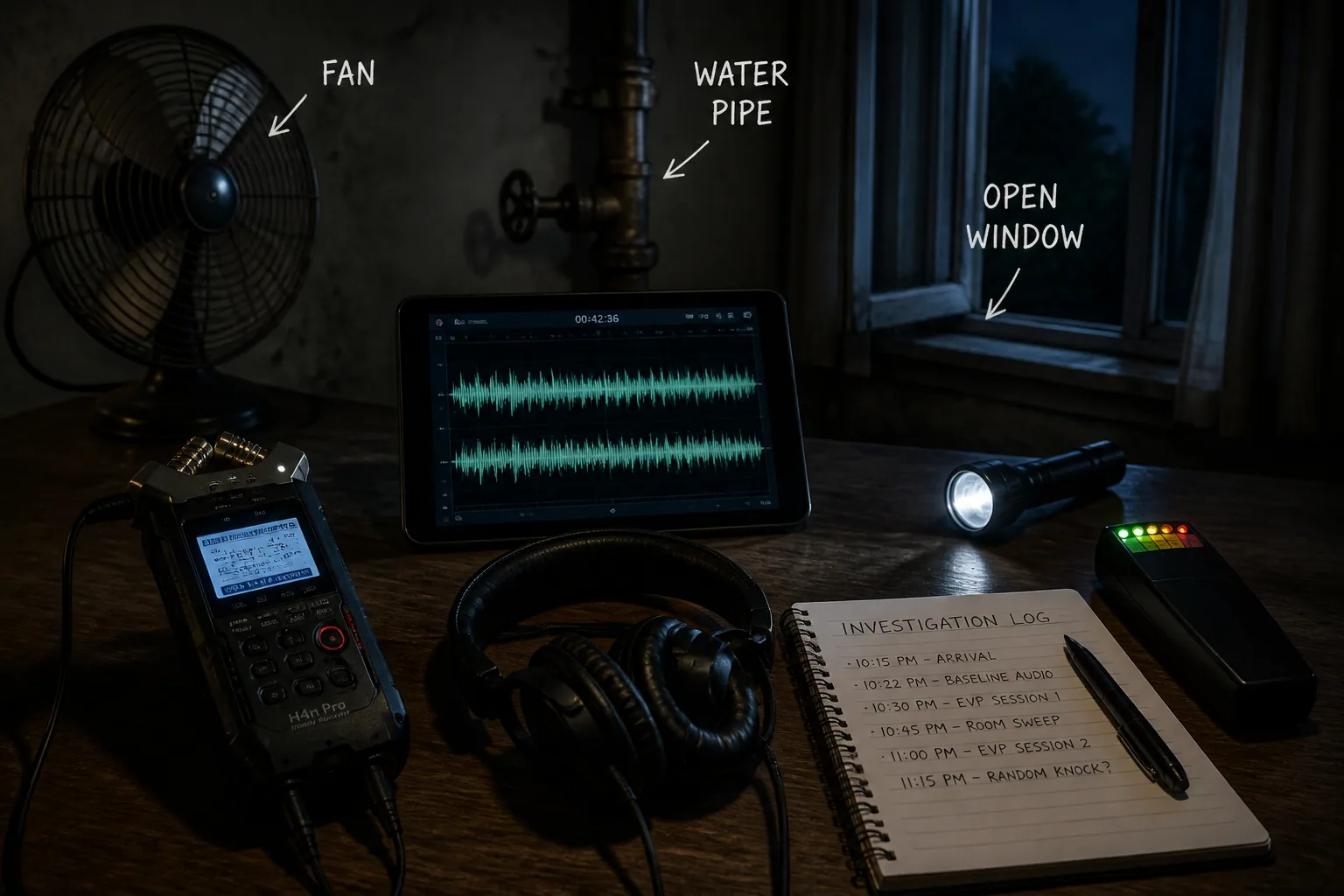
If you have ever investigated a building and found the audio full of hums, rattles, and intermittent bumps, you already know how ordinary systems can sabotage an EVP session. HVAC units can cycle on and off. Pipes can creak, knock, or transmit vibration through walls. Large fans can create broad-spectrum turbulence. Outdoors, wind hitting a mic or a structure can produce rumble and intermittent bursts that sound much stranger on playback than they did in the moment.
Traffic is another major offender. Depending on distance and surface conditions, it often lands in the low-frequency band from roughly 10 to 100 Hz, where it can create a constant pressure-like bed of sound. That bed may make a location feel eerie, but it can also contaminate a recording with low-end movement that hides subtle voices. Wildlife adds its own challenge. Birds often live in the several-kilohertz range, insects can chirp at frequencies that cut through a mix, and small rodents or other animals can create faint but very misleading clicks and scratches.
The point is not that these sounds destroy every investigation. The point is that they need to be identified, documented, and ideally tested before you decide anything is paranormal. If a repeated anomaly only appears when the furnace is active or when a particular wall vibrates, then the environment is part of the story.
Low, High and Ultrasonic Frequencies: What Your Recorder Really Hears
In EVP work, the word frequency gets thrown around a lot, but it helps to break it into practical ranges. Low frequencies are the deep rumbles, hums, and pressure-like sounds below about 200 Hz. High frequencies are the crisp, detailed sounds where hiss, clicks, and many consonants live. Ultrasonic frequencies are above human hearing, typically above 20 kHz, and most consumer gear will not capture them well if at all.
The research is especially important here. Infrasound is defined as sound below about 20 Hz. While generally inaudible, it can still influence people and environments. A controlled study summarized by Boczar et al. in Frontiers in Behavioral Neuroscience reported that exposure around 17 to 19 Hz was associated with elevated salivary cortisol and self-reported irritability, disinterest, and sadness, even when participants were not consciously aware of the sound. That does not prove paranormal activity, but it does show why low-frequency sound can affect a session in ways investigators might not immediately notice: https://pmc.ncbi.nlm.nih.gov/articles/PMC13158192/
There is also a longstanding discussion about claims that very low frequencies can create eerie perceptions. Tandy and Lawrence famously suggested that around 19 Hz might contribute to visual distortions in haunted locations, but later measurements at the site found sound more in the 20 Hz to 2 Hz range with a peak near 5.7 Hz and levels over 30 dB SPL. The broader takeaway is simple: low-frequency environments can feel unsettling and can shape reports of strange events, even if the original explanation is more ordinary than supernatural: https://pmc.ncbi.nlm.nih.gov/articles/PMC7304295/
For microphones, the practical limit matters. A mic that claims wide response may still roll off substantially at the extremes. Directional microphones can reduce off-axis noise, but they may also color the sound differently. Omnidirectional microphones can preserve low-frequency energy better, but they also let in more room noise. Condenser microphones usually offer wider frequency response than dynamics, which can be useful for EVP capture, but that also means they may be more sensitive to unwanted environmental detail.
When Sound Helps and When It Hides Possible EVPs
Sometimes a sound environment can actually help you evaluate an EVP claim, as long as you know what you are testing. A steady HVAC tone can serve as a reference point for a room’s acoustic character. Repeating mechanical sounds can reveal resonance patterns. A controlled low-frequency bed can make it easier to compare how different microphones behave in the same space.
But the same sound can also hide evidence. A voice that is barely present may disappear under a low-frequency rumble or a midrange mechanical wash. This is especially true if you are using aggressive noise reduction or filtering. A filter that cleans up one issue may erase another. That is why recording a raw version and a processed version is so important. You need both the untouched evidence and the enhanced interpretation.
There is also a psychological side to this. A room that sounds active can prime the listener to hear more than is there. This is why investigators should resist the urge to let atmosphere become proof. The goal is not to make the recording spooky. The goal is to make it readable.
How to Build a Simple Test Environment at Home or On Location
You do not need expensive gear to start testing audio more scientifically. In fact, some of the best work begins with a simple controlled setup. At home, pick a quiet room and record a short baseline session with no intentional sound sources. Then repeat the same recording with the HVAC on, with a fan nearby, and with the recorder placed at different distances from walls, vents, and plumbing fixtures. The idea is to map how the environment changes the signal.
On location, use the same logic. Pick one room or hallway and keep as many variables constant as possible. Record at the same time of night. Use the same recorder settings. Keep the mic in the same position. Note whether doors are open, whether the building system is running, and whether weather conditions may affect wind, rain, or wildlife activity. The more repeatable your setup, the easier it becomes to compare results.
You can also use a phone-based helper tool for session tracking and live monitoring. A good example is Ghost Detector: Ectify, which turns a smartphone into an investigative companion with real-time EMF detection, a spirit box and EVP generator, session recording, and history tracking. It will not replace careful audio testing, but it can help you keep better logs and capture session context in one place: https://findthe.app/ectify-fc72z0
Easy Recording Experiments to Isolate Ambient Interference
The easiest experiments are often the most useful. Try recording the same 60-second room tone from three positions: near the floor, at ear height, and near the ceiling. Low-frequency energy often builds differently at each point. Then repeat the test with the mic facing a vent, away from the vent, and beside a wall that may carry vibration.
You can also test one variable at a time. For example, record with the door open and closed. Record before and after an HVAC cycle. Record with and without a standing fan. Outside, compare a sheltered area, an exposed area, and a place near trees or brush where wind and insects may be active. If possible, use two recorders at the same time to see whether both devices capture the same anomaly. If only one recorder catches it, the issue may be sensitivity, placement, or an artifact in that device’s response.
Another useful approach is playback testing. If you suspect a sound might be caused by a pipe, speaker, or mechanical resonance, reproduce the suspected condition and compare the waveform or spectrogram. The point is not to force a mundane explanation onto everything. It is to see whether the anomaly repeats under controlled conditions. Repetition is one of the strongest tools investigators have.
Using Frequency Filters During Recording and in Post-Processing
Filters can be incredibly useful, but they are also easy to misuse. High-pass filters can remove low-frequency rumble from traffic, HVAC, and handling noise. Low-pass filters can reduce hiss and high-end clutter. Notch filters can remove a narrow hum from power systems or electrical interference. But every filter also changes the evidence.
If you filter too aggressively during recording, you may permanently remove the very detail you later want to inspect. That is why many investigators prefer to capture a clean raw track first and apply filtering only in post-production, where settings can be compared and reversed. If you do use real-time filtering, document exactly what was applied and why.
This matters because filtered audio can fool the ear. Removing bass can make a whisper sound clearer, but it can also make a random artifact appear like language. Boosting a narrow band can make a faint noise seem more intentional. In EVP analysis, enhancement is not the same thing as confirmation.
How to Read Spectrograms Without Fooling Yourself
Spectrograms are one of the best tools for ghost hunters who want a more objective look at their recordings. They show frequency content over time, making it easier to spot repeated tones, bursts, harmonics, and patterns that may not be obvious in the waveform alone. Used well, they can help you identify wind bursts, electrical hums, mechanical cycles, and even speech-like structures.
Used badly, they can create confirmation bias. A bright line on a spectrogram does not automatically mean paranormal activity. It may be a machine, a harmonic, a bird call, or a clip caused by the microphone. The best practice is to compare the spectrogram with the raw waveform, the listening test, and your environmental notes. If a shape looks unusual but cannot be repeated, contextualized, or independently captured, treat it as uncertain rather than extraordinary.
A simple discipline helps here: annotate your findings. Mark the time, the room conditions, the equipment used, and any known sources of noise. The more you document, the less likely you are to mistake a visual pattern for evidence.
Binaural Beats, Infrasound and the Psychology of Haunted Audio
Binaural beats get mentioned often in paranormal circles, but the science is narrower than the claims. For a binaural beat to occur, two pure tones must be presented separately to each ear. The perceived beat difference is usually under about 30 to 35 Hz, and the carrier tones are typically below 1000 Hz, often around 400 to 500 Hz for clear perception. Research summarized by Schwarz and Taylor, and supported by work like Pratt et al., shows that the perceptual effect depends on careful presentation conditions: https://pmc.ncbi.nlm.nih.gov/articles/PMC7082494/ and https://pmc.ncbi.nlm.nih.gov/articles/PMC2741401/
What matters for investigators is that binaural beats are easy to misunderstand. If both ears are not receiving the tones separately, you are not really dealing with a binaural beat in the strict sense. If the carriers are too high, the beat may not be perceived clearly. And if the tones are played through speakers in a room, it may be something else entirely, not a true binaural effect.
Claims that binaural beats reliably heighten paranormal sensitivity should also be treated carefully. A systematic review by López-Caballero and Escera found no significant enhancement in EEG power or emotional arousal across multiple beat bands, which suggests the effects are not as dramatic or consistent as fringe claims often imply: https://pmc.ncbi.nlm.nih.gov/articles/PMC5694826/
Infrasound is another area where psychology and acoustics get mixed together. The Haunt Project reported that participants exposed to infrasound and or EMFs reported more anomalous experiences than controls, suggesting that poorly controlled environmental conditions can increase ghost-type reports. That does not mean the experiences are fake. It means the environment itself can shape what people think they perceived: https://www.sciencedirect.com/science/article/pii/S0010945208001299
How to Spot Perception Traps and Debunk False Positives
One of the easiest ways to avoid false positives is to assume that the room is trying to trick you. That sounds dramatic, but it is just good science. Our brains are excellent at finding speech in noise, especially when we are expecting a message. This is why pareidolia is such a powerful force in EVP interpretation.
To reduce perception traps, listen blind when possible. Have one team member mark timestamps without telling the listeners what they expect to hear. Compare multiple listeners’ interpretations. If everyone hears different words, the clip is probably ambiguous. If the same phrase appears across multiple devices and can be tied to the same environmental condition, it deserves more attention.
Also be careful with silence. A silent stretch that suddenly seems to contain a whisper may simply be noise floor behavior, compression artifacts, or a breath-like texture in the room. When in doubt, go back to the raw file and compare it against the spectrogram and the original scene notes. The best investigators do not rush to label a sound. They test it.
Creative EVP Experiments Investigators Are Trying Right Now
Modern EVP work is getting more experimental, and that is a good thing when it stays controlled. Some investigators now run multi-recorder comparisons, placing different microphones in the same space to see whether the same anomaly appears across devices. Others use spectral analysis apps to monitor how the room changes in real time, or they run controlled playback tests to determine whether a sound is genuinely external or just a recording artifact.
A few teams are also experimenting with intentional source comparison, such as recording the same room under different sound conditions, then examining whether certain anomalies only occur when the frequency profile changes. This approach is useful because it turns a subjective investigation into a repeatable series of tests. That is exactly the direction paranormal audio needs to move in if it wants stronger credibility.
If you are trying to build better evidence, creativity is valuable, but only when it is paired with control. The best experiment is the one you can repeat and explain.
Budget-Friendly Tools That Improve Results Without Expensive Gear
You do not need to buy a huge equipment package to improve your EVP quality. A solid phone app for note-taking and session logging, a reliable external recorder, a simple pair of headphones, and a basic audio editor can take you surprisingly far. What matters more is consistency than price.
For microphones, a flat or near-flat response is often more useful than a flashy spec sheet. Condenser microphones can provide wide response and better detail, while directional models can help isolate a target area. Omnidirectional mics can be valuable when you want fuller room capture, especially for testing low-frequency behavior. The key is knowing what each mic does well and where it introduces tradeoffs.
If you can only buy one new thing, consider something that helps you record better context, not just louder sound. Better documentation, better placement, and better repeatability will usually improve your results more than a high-cost upgrade bought without a plan.
A Practical Workflow for Capturing Cleaner, More Credible EVPs
A strong EVP workflow starts before the first recording. First, survey the location for obvious noise sources: vents, pipes, traffic exposure, fans, wildlife, and loose objects that can rattle. Second, choose the mic type and placement that best match the environment. Third, record a short baseline room tone so you know what the space sounds like when nothing intentional is happening.
During the session, keep your notes detailed. Record time, location, equipment, weather, nearby activity, and any changes in sound. If you hear something strange, mark the timestamp immediately. After the session, listen once for general context and then revisit the clip with headphones, waveform inspection, and spectrogram analysis. Compare the raw recording against any filtered versions to make sure enhancement did not create the effect you think you found.
Finally, be willing to rule things out. That is not failure. It is part of building credibility. The more anomalies you can eliminate as environmental or technical, the more meaningful the remaining evidence becomes.
Final Checklist: What to Test Before Your Next Investigation
Before your next ghost hunt, test the room, test the mic, and test your assumptions. Check for HVAC cycles, pipe vibration, wind exposure, traffic rumble, insect noise, and wildlife activity. Compare how your recorder handles low frequencies, midrange speech, and high-frequency noise. Make a baseline recording, then repeat it with one variable changed at a time.
If you suspect a binaural or infrasound effect, document the playback conditions carefully and do not assume every eerie feeling is evidence of a paranormal event. If a spectrogram looks unusual, verify it with a second capture or a second recorder. If a filtered clip sounds like a voice, confirm that the voice is still present in the raw file and not just a product of enhancement.
The most important habit is simple: treat EVP as audio science first and mystery second. That mindset will not remove the excitement from ghost hunting. It will make your results sharper, cleaner, and much more credible when you finally do catch something truly unusual.
