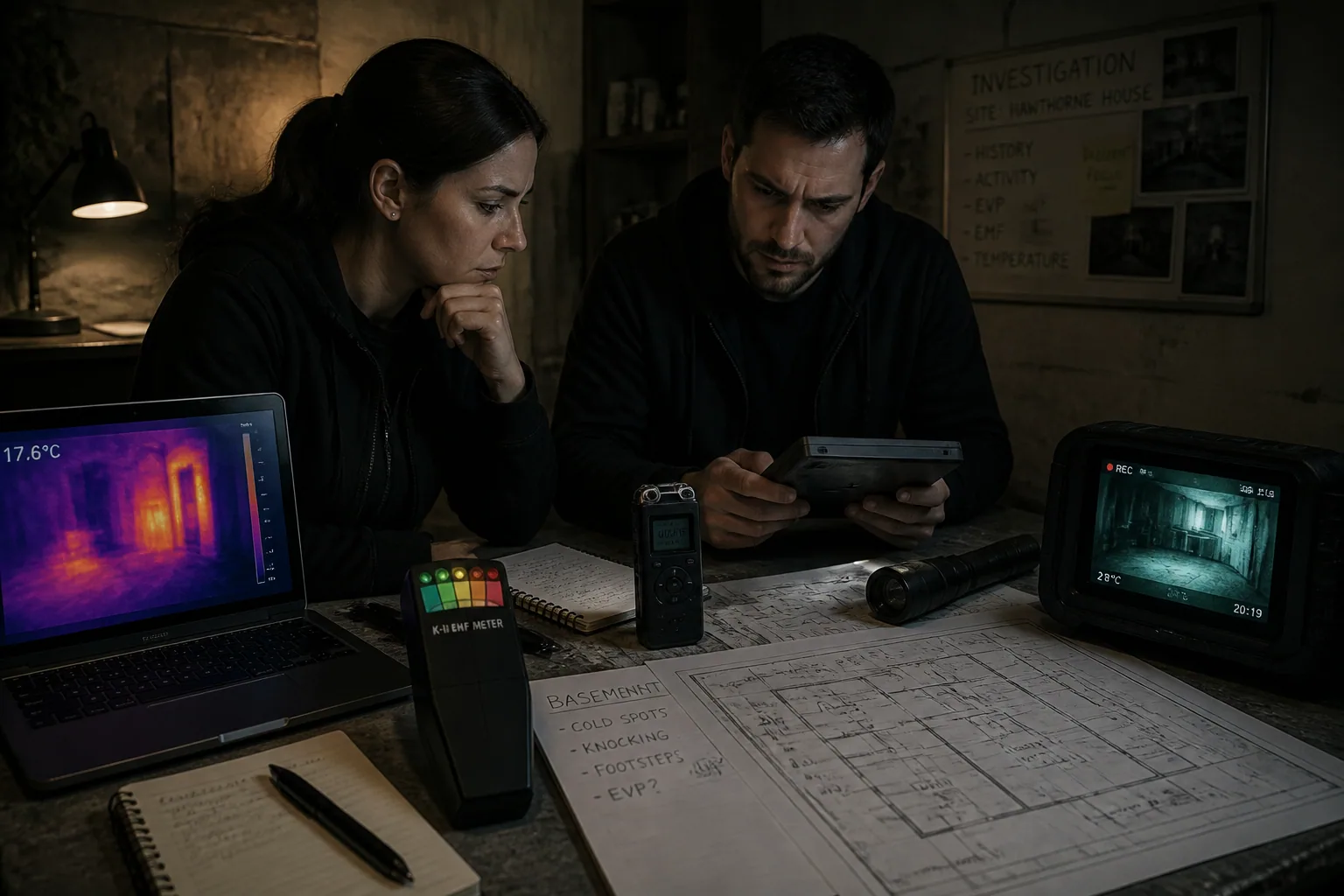
Ghost Hunting Case Studies: What Real Investigations Can Actually Teach You
Ghost hunting is often sold as a thrill ride, but the most useful investigations are not the loudest or the spookiest. They are the ones that show you how evidence behaves in the real world. When you look closely at well-documented cases, a pattern appears: credible work is usually less about proving ghosts and more about testing claims carefully, ruling out normal explanations, and being honest about uncertainty.
That is why case studies matter more than ghost stories. Stories can be entertaining, but case studies let you compare methods, environmental readings, witness accounts, and investigator conclusions. They show where people jump too quickly to a paranormal explanation, and they also show what careful fieldwork looks like when the data is incomplete.
Why Case Studies Matter More Than Ghost Stories
A ghost story usually begins with a conclusion already in place. Something strange happened, therefore it must have been paranormal. A case study works differently. It begins with a claim, then asks what was observed, how it was measured, what alternatives were checked, and whether the conclusion is actually supported by the evidence.
That distinction matters because haunt-type experiences are not rare in the literature, but they are messy. A comprehensive review of 66 studies dealing with haunt-type or ghostly experiences found that 55% appeared in parapsychology or niche journals, while 45% were published in mainstream journals. The same review identified six environmental variables commonly studied in haunt-type experiences: static built-in cues, lighting levels, air quality, temperature, infrasound, and electromagnetic fields. Source: https://pmc.ncbi.nlm.nih.gov/articles/PMC7304295/
In other words, the best investigations do not treat a strange feeling as proof of a spirit. They ask whether the room layout, the lighting, the air, the temperature, or the electromagnetic environment might explain what people experienced.
What Makes a Ghost Investigation Credible Enough to Analyze
Not every paranormal investigation is worth analyzing in depth. Some are built on assumptions from the start, such as “ghosts are spirits,” “ghosts can be detected with EMF meters,” or “photographic orbs are paranormal.” As one overview of scientific ghost research notes, assumption-led methods tend to push investigators toward confirming what they already believe rather than testing a neutral hypothesis. Source: https://www.assap.ac.uk/articles/detail/scientific-ghost-research
A credible case is not one that guarantees a supernatural result. It is one that gives you enough structure to evaluate the evidence. That usually means clear location notes, time stamps, equipment descriptions, environmental context, witness separation where possible, and a willingness to note ordinary causes before extraordinary ones.
It also means understanding the limits of witness testimony. Psychological research shows strong links between paranormal belief and confirmation bias, and other studies note that memory is reconstructive. Under even good conditions, witnesses may remember the same event very differently. Source: https://pmc.ncbi.nlm.nih.gov/articles/PMC9067702/
Case Study 1: A Well-Documented Investigation with Useful Controls
One of the most useful patterns in ghost research is not the discovery of a ghost, but the discovery of how much can be explained once conditions are measured properly. A good example is the kind of field work discussed in the Harper’s Mansion Ghost Study, where investigators recorded ambient sound levels and found no unexplained disturbances despite frequent reports of EVPs, light and dark anomalies, and temperature changes. Source: https://skepticalinquirer.org/newsletter/the-harpers-mansion-ghost-study/
That kind of result is valuable because it separates the sensation of anomaly from actual measured anomaly. People may report a voice on a recorder, a cold spot in a hallway, or a shadow near a doorway, but if sound levels, temperature variation, and environmental conditions are stable or explainable, the paranormal interpretation becomes much weaker.
The lesson here is not that every unexplained report is false. The lesson is that a report alone is not enough. Good investigations compare testimony to measurement, and measurement to the setting. If a room is drafty, has unstable wiring, or has a lot of reflective surfaces, those facts matter.
This is also where environmental baselines become important. A room that is noisy, thermally unstable, or full of electrical activity can generate many false impressions. Without a baseline, investigators may mistake ordinary variation for a meaningful spike.
Case Study 2: A Popular Haunting Case with Ambiguous Evidence
Popular hauntings often survive because they are emotionally compelling, not because they are methodologically strong. In many famous cases, the evidence is a mixture of witness stories, atmosphere, and a few ambiguous events that sound stronger in retelling than they are in real time.
The Winchester Mystery House is a classic example of how investigators like Joe Nickell approached such locations. Many reported ghost phenomena, including cold spots and strange sounds, were explained by natural causes such as drafts, structural settling, faulty wiring, or external environmental variations. Source: https://skepticalinquirer.org/newsletter/scientific-investigation-vs-ghost-hunters/
That does not make the location boring. It makes it instructive. A haunting becomes more convincing when every ordinary explanation has been checked and ruled out. But in many popular cases, the evidence is still floating in ambiguity. A cold hallway may feel eerie, but unless airflow, insulation, occupancy, and building mechanics are examined, the cold spot says more about the environment than about a ghost.
These cases teach a hard but important lesson: the more famous the story, the more carefully you should separate cultural expectations from physical evidence.
Case Study 3: When Equipment Readings Look Paranormal but Aren’t
Ghost hunters often trust devices because numbers feel objective. But numbers only become evidence when you know what they mean. EMF meters, infrared thermometers, motion sensors, and audio recorders can all register real changes while still pointing to mundane causes. Electrical wiring, appliances, reflective heat sources, draft patterns, and ambient noise can all create readings that look dramatic on camera. Source: https://skepticalinquirer.org/newsletter/scientific-investigation-vs-ghost-hunters/
This is one reason equipment-only conclusions are so fragile. An EMF spike near an outlet does not indicate a spirit. A temperature dip near a doorway does not automatically mean a presence. A noise on an audio track does not become an EVP just because it is hard to hear by ear.
The best case studies show that instrumentation is useful only when paired with controls. If a meter spikes, ask what else was active nearby. If an audio recording contains a strange whisper, compare it with room acoustics, neighboring sounds, and device handling noise. If a motion sensor triggers, check for airflow, insects, pets, or vibration.
This is also where newer app-based tools can be used more responsibly. For example, Ghost Detector: Ectify can help you record sessions, track EMF-like fluctuations from your phone’s sensors, and review past investigations in one place, which is useful for keeping a cleaner log of what happened and when. The key is to treat it as part of a documentation workflow, not as proof by itself: https://findthe.app/ectify-fc72z0
Comparing Methods: What Skilled Investigators Do Differently
Skilled investigators do not just bring better equipment. They ask better questions. Instead of starting with “What ghost caused this?” they ask “What changed in the environment, and what would a normal explanation look like?” That single shift changes everything.
Good investigators separate observation from interpretation. They write down what was seen, heard, or measured before they explain it. They also compare accounts from multiple witnesses without assuming that matching stories prove truth. Sometimes people converge because the environment is genuinely unusual. Other times they converge because they influence one another.
Another difference is patience. Weak investigations rush to conclusions after one unexplained moment. Stronger investigations look for patterns across time. Is the reading repeatable? Does it happen in the same place? Does it change when the room is empty, occupied, heated, cooled, or electrically quiet? Repeatability is one of the biggest dividing lines between anecdote and evidence.
EMF, Temperature, Audio, and Light: How Environmental Data Gets Misread
Environmental measurements are often the most misread part of a ghost hunt. That is partly because they are easy to collect and hard to interpret. A meter gives you a number, but the number does not interpret itself.
EMF readings can be affected by electrical systems, charging cables, appliances, and structural wiring. Temperature changes can come from drafts, insulation differences, human bodies, open doors, HVAC flow, and radiant surfaces. Audio recordings may capture distant traffic, pipe noise, radio bleed, and handling artifacts. Light anomalies can come from camera sensors, exposure changes, lens flare, reflections, or dust in the beam.
The literature on haunt-type experiences makes it clear that these are not side issues. The review of 66 studies identified lighting, air quality, temperature, infrasound, and electromagnetic fields as recurring variables, which means environmental context is central to interpretation, not optional. Source: https://pmc.ncbi.nlm.nih.gov/articles/PMC7304295/
That is why the most responsible method is simple: measure the environment first, then interpret the anomaly. If you do not know the baseline, every fluctuation feels special.
The Role of Bias, Expectation, and Group Dynamics in the Field
A ghost hunt is never just about the building. It is also about the people in it. Expectation changes perception. Once a group believes a room is haunted, ambiguous sounds become footsteps, shadows become figures, and random fluctuations become messages.
Psychological research connects paranormal belief with confirmation bias, meaning people are more likely to interpret incomplete or ambiguous evidence as confirming what they already believe. That does not mean they are lying. It means their minds are doing what human minds naturally do: searching for patterns and filling gaps. Source: https://pmc.ncbi.nlm.nih.gov/articles/PMC9067702/
Group dynamics can strengthen this effect. If one person reacts strongly, others often reframe the same event through that emotional lens. Over time, the group can create an echo chamber where uncertainty feels like certainty. That is why separating witnesses during interviews and collecting independent notes can matter so much.
Even memory can shift after the fact. Reports from paranormal settings often become more detailed after repeated discussion, which is one reason why early documentation is so important. Write first, discuss later.
Patterns in Stronger Evidence vs Weaker Evidence
When you compare case studies, the pattern becomes clear. Stronger evidence usually has context, controls, and restraint. Weaker evidence usually has excitement, gaps, and overinterpretation.
Stronger evidence often includes: clear time stamps, room maps, environmental baselines, multiple possible explanations, and cautious conclusions. Weaker evidence often includes: isolated photos, edited audio clips, “mystery” meter spikes, and claims that exceed what the data can support.
Another major difference is language. Strong investigators say things like “unexplained so far,” “possible cause,” or “needs further testing.” Weak investigators say “proof,” “definitely paranormal,” or “the ghost responded.” In real fieldwork, humility is usually a sign of rigor.
How to Document Your Own Investigation Responsibly
If you want your own ghost hunt to be useful, treat it like a documentation exercise first and an interpretation exercise second. Start with the location’s layout, known history, electrical sources, heating and cooling patterns, and expected human traffic. Those details matter before a single reading is taken.
Use a simple log that records time, location, device, settings, people present, and notable environmental changes. If something odd happens, note exactly what happened and what else was happening at the same moment. Was a door opened? Did someone speak? Did the HVAC turn on? Was there vibration from outside?
If possible, use more than one method at once. Pair audio with video. Pair temperature readings with notes on airflow. Pair EMF observations with knowledge of wiring and nearby devices. The goal is not to collect more spooky moments. The goal is to reduce the number of unknowns.
Most importantly, preserve original files. Do not only keep the edited clip that looks the most dramatic. The full recording is what allows later review and honest comparison.
What Beginners, Skeptics, and Amateur Investigators Should Learn from These Cases
Beginners should learn that ghost hunting is not really about chasing proof. It is about learning how to spot weak evidence, how to avoid self-deception, and how to tell a good mystery from a bad conclusion.
Skeptics should learn that not every claim can be dismissed instantly. People do experience genuinely strange events, and a careful investigator should take reports seriously enough to test them properly. But taking a report seriously is not the same thing as accepting the paranormal explanation.
Amateur investigators should learn that the best cases are often the least dramatic on first glance. A case with good notes, clear controls, and measured uncertainty may be more valuable than a viral clip with shaky audio and a lot of hype.
In practice, everyone benefits from the same habit: slow down before you conclude.
How to Make Careful Claims Without Killing the Mystery
Being careful does not ruin the experience. It improves it. Mystery becomes more interesting when you know what has been ruled out and what still remains unresolved. If a hallway is cold, say it is cold. If the source is unknown, say it is unknown. If a sound cannot be identified, say so without claiming a spirit made it.
That approach preserves wonder while protecting your credibility. It also reflects the state of the field. As noted in the research, there is no widely accepted modern ghost investigation that fully meets rigorous scientific standards such as controlled environments, repeatable results, and neutral hypotheses. Some investigations approximate parts of that ideal, but the standard itself remains out of reach in most real-world cases. Source: https://skepticalinquirer.org/newsletter/the-harpers-mansion-ghost-study/
So the best lesson from ghost hunting case studies is not that ghosts are real or fake. It is that evidence needs context, equipment needs interpretation, testimony needs caution, and conclusions need restraint. If you can hold onto those four habits, you will be much better at spotting what a case actually teaches you, whether the mystery survives or not.
