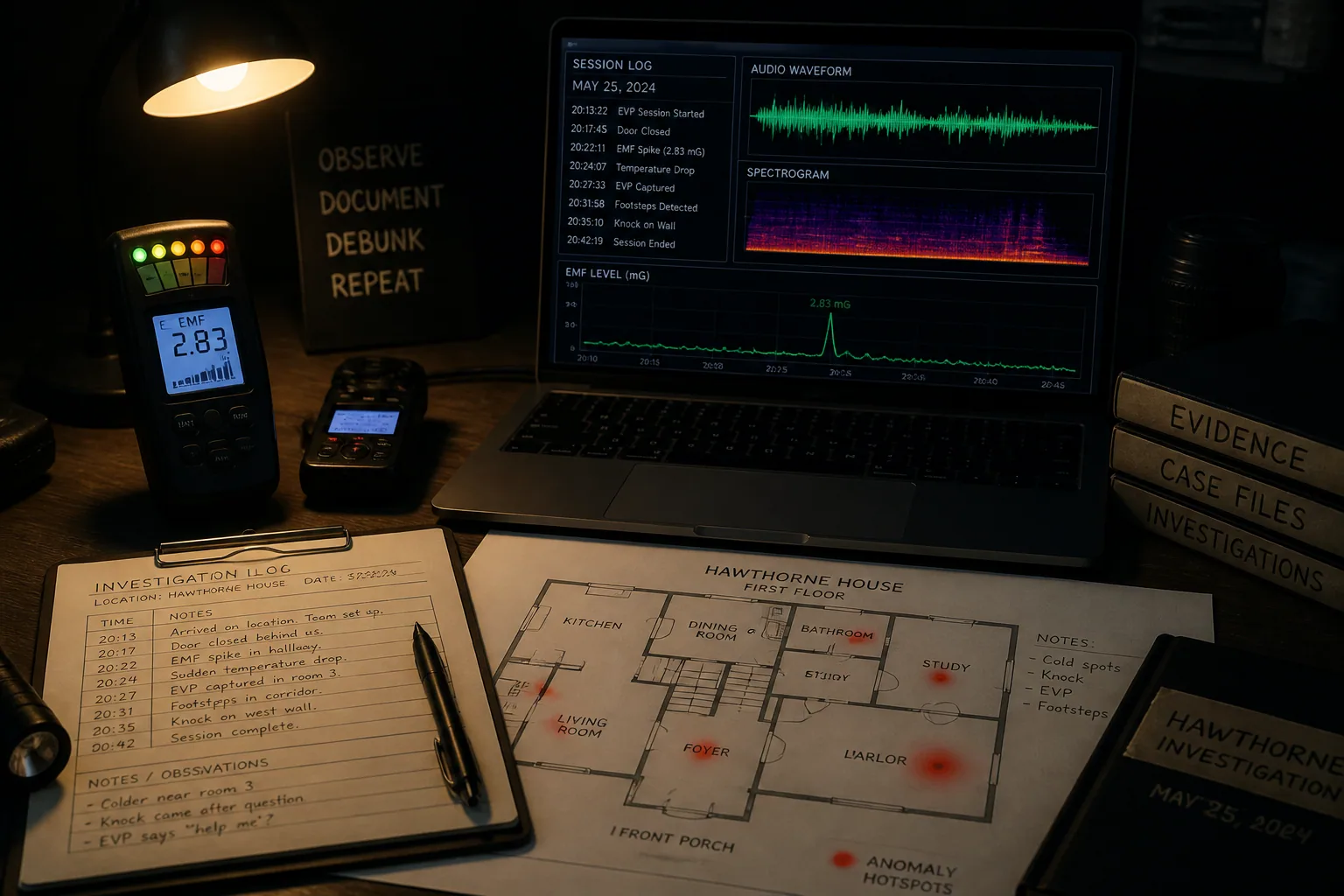
Ghost Hunting Data Deep Dive: What Your Investigation Logs Really Reveal
Most ghost hunters collect more data than they realize, but far too much of it never becomes useful. A notebook full of half-finished observations, a camera roll with no timestamps, an audio folder with unnamed clips, and a handful of EMF readings written down in the dark can feel like evidence in the moment. Later, though, it is hard to compare one session to another, harder still to separate interesting patterns from coincidence, and almost impossible to defend your conclusions with confidence. The real value of investigation logs is not in the volume of notes. It is in consistency, context, and repeatability.
If you want your hunts to become more credible over time, you need a system that captures the same core information every session and lets you compare sessions cleanly. That means logging EMF readings, EVP timestamps, environmental conditions, location details, movement events, and anything else that might help explain why something happened when it did. It also means being honest about the limits of your tools. Research from the Psi Encyclopedia notes that EMF meters are widely used in ghost hunting, but the common assumption that spikes or fluctuations prove paranormal activity runs far ahead of the evidence: https://psi-encyclopedia.spr.ac.uk/articles/electromagnetism-and-paranormal-phenomena/
In other words, better logs do not just make your sessions more organized. They make your judgment better. And once you learn how to review multiple investigations side by side, patterns start to emerge that are far more useful than isolated anomalies.
Why Most Ghost Hunting Data Goes Unused
The biggest reason ghost hunting data gets ignored is that it is captured in the wrong form. A quick note like “cold spot near doorway” or “heard voice in hallway” may feel meaningful in the field, but without a time, a room label, a baseline reading, and a note about nearby conditions, that observation cannot be compared against anything else. It becomes a story instead of a data point.
Another common issue is overconfidence in exciting moments. A sudden EMF spike, a strange audio artifact, or a brief temperature drop can be compelling, but if you do not know what the environment was doing at the same time, you cannot rule out more ordinary explanations. As Haunted Hosts points out, correlation is not causation, and a temperature drop that appears alongside an EMF spike and an EVP-style sound may simply be a coincidence if the session was not logged rigorously: https://hauntedhosts.com/library/explainers/beginners-guide-ghost-hunting-equipment/
There is also a tooling problem. Serious investigators are often warned that popular EMF meters like the K-II are not ideal for rigorous comparison because they usually have LED bars without calibration, respond broadly rather than selectively, can be influenced by nearby RF sources, and do not log timestamps or numeric data well enough for deeper review. That does not make them useless for atmosphere or rough field awareness, but it does limit their value when you want evidence you can analyze later: https://ukpx.org/2025/10/12/emf-and-ghost-detection-a-technical-guide-for-serious-investigators/
So if most data goes unused, the solution is not collecting more of it at random. The solution is creating a system that captures what matters in a format you can actually review.
What to Log During Every Investigation
A good investigation log should answer five basic questions: where were you, when did it happen, what was observed, what conditions were present, and what changed just before or after the event. If you can answer those consistently, you can start comparing sessions in a meaningful way.
At minimum, every hunt should record the date, start and end time, exact location, room or zone names, investigator names, weather conditions, and any known sources of interference. That includes power status, nearby electronics, open doors and windows, HVAC activity, traffic noise, radio chatter, cell phone use, and anything else that could influence readings or audio. Many EMF false positives come from ordinary sources like wiring in walls, motors, chargers, wireless signals, and phones, so these details are not optional if you want a clean review later.
You should also log the equipment used. A result is only as useful as the tool that produced it, and different devices have different limitations. If you use a magnetometer app, a consumer EMF meter, an audio recorder, a thermal camera, or motion sensors, note the model, settings, battery level, and whether the device was calibrated or tested before the session. Devices that look impressive often produce data that is difficult to verify later, especially when they do not provide reliable numeric logging.
A strong log also records investigator behavior. Were questions being asked at that moment? Was someone moving through the room? Was there talking, whispering, laughter, or a burst of excitement? Psychological variables matter more than many teams admit. Research discussed by Scientific American on French and colleagues’ work suggests that expectation and suggestion can shape what people think they experience, even when field generators are off: https://www.scientificamerican.com/article/ghost-lusters-if-you-want/
The more complete your basic record is, the easier it becomes to identify which moments deserve attention and which ones are just noise.
Building a Consistent Logging System You Can Reuse
The best logging system is the one you can repeat under pressure. In a haunted basement, a noisy hallway, or a late-night outdoor site, nobody wants to build a new template from scratch. That is why the system should be standardized before you enter the field.
A reusable template should have the same columns or sections every time. For spreadsheet users, this might include timestamp, room, investigator, observation type, device name, reading, baseline reading, environmental note, possible explanation, and confidence level. For notebook users, it might mean pre-printed pages with the same headings on every sheet. Consistency matters more than design.
You should also define your event categories in advance. For example, EMF event, temperature shift, EVP candidate, visual anomaly, motion trigger, audio cue, and environmental change. If every team member uses the same labels, your logs become easier to sort and compare. A temperature drop should not be called a cold spot in one session, a chill in another, and a drop in a third unless you are also standardizing what those terms mean.
One useful approach is to separate raw notes from interpreted notes. Raw notes capture exactly what was observed. Interpreted notes capture what you think it might mean. This prevents the common problem of opinion being mistaken for evidence. For instance, “audio peak at 00:14:32” is raw. “Possibly a response” is interpretation. Keeping them distinct makes your review more honest.
If your team uses shared files, add a simple session ID to every investigation so each clip, photo, and note can be tied back to one hunt. That single habit can save hours of confusion later.
How to Record EMF, EVP, Environmental, and Location Data
EMF logs should be specific. Write down the exact time, the room or position, the reading observed, the device used, and what else was happening nearby. If your meter shows a spike, note whether it was sustained, intermittent, or a single brief jump. Also record if anyone had a phone on them, if there was a light switch, if an appliance was running, or if you were near visible wiring. Without these context notes, an EMF spike is nearly meaningless on its own.
This matters because EMF data can be deceptive. Controlled work by Chris French and colleagues found that when volunteers were exposed to electromagnetic fields and infrasound in a “haunted room,” whether the fields were on or off had no effect on whether people reported anomalous experiences. That does not prove every EMF event is mundane, but it does show that an EMF reading alone is not a reliable shortcut to a paranormal conclusion: https://www.howtogeek.com/ghost-hunting-gadgets-and-why-they-dont-work/
EVP logging should be even more disciplined. Write down the exact time of the recording, the room, the prompt or question that was asked, who was speaking, whether anyone else was moving, and what ambient sounds were present. If a voice-like sound appears, mark the timestamp first and interpret later. Recent reviews in Skeptical Inquirer emphasize that many EVP candidates can be explained by ambient noise, stray radio signals, or apophenia, especially when investigators expect a reply: https://skepticalinquirer.org/2023/02/examining-sciencey-evp-research/
Environmental logging should include temperature, humidity if available, air movement, weather, and any building systems that could affect the room. If you are indoors, note HVAC cycles, vents, and doors opening or closing. If you are outdoors or in a place with poor insulation, weather changes can create real fluctuations that look unusual if you do not account for them.
Location data should go beyond just the name of the site. Record which floor, wing, hallway, corner, doorway, or piece of furniture the event occurred near. Room-specific information is what allows you to compare one investigation with the next. A pattern that keeps appearing in the same room is much more interesting than a random event scattered across a whole building.
Cleaning Up Messy Logs and Standardizing Your Notes
Most teams do not begin with perfect logs. They begin with messy ones. That is normal. The trick is to clean them up after the session in a way that preserves the original meaning while making the data usable for analysis.
Start by normalizing your timestamps. Convert everything to one time zone, use the same date format throughout, and make sure all devices are aligned as closely as possible. Even a small mismatch between an audio recorder and an EMF meter can make it look like one event caused another when the timing was actually off.
Next, standardize room names and event labels. If you have notes for “main hall,” “front hall,” and “entrance hallway,” decide whether those are separate zones or the same area. The same goes for labels like “spike,” “blip,” and “jump.” Choose one vocabulary and stick with it.
Then remove ambiguity from subjective notes where possible. Instead of “felt weird,” try “reported pressure sensation,” “heard footstep-like sound,” or “observed sudden quiet after group movement stopped.” This is not about stripping away human experience. It is about describing it in a way that can be reviewed later without guesswork.
Finally, separate confirmed facts from tentative leads. A note can say that a sound occurred and that it may deserve review without claiming it was paranormal. That discipline helps protect you from overreading weak evidence and gives stronger evidence room to stand out.
Finding Patterns Across Multiple Sessions
A single investigation can be interesting. Multiple investigations can be revealing. Once you have consistent logs, you can look for repetition rather than one-off drama. This is where investigation data starts becoming genuinely useful.
One of the first things to compare is time. Do the same kinds of events cluster around certain hours, such as late evening, just after the building quiets down, or during transitions in staffing and activity? Time windows can matter because environmental and human conditions change predictably. If the same room only seems active when the HVAC shifts, for example, that is a clue worth documenting, not a mystery to ignore.
Another useful comparison is room-based activity. If one basement stairwell repeatedly produces EMF anomalies while other rooms do not, that may indicate wiring, structural interference, or a real site-specific pattern that deserves a closer look. Research from Laythe and Owen found that at a haunted site without electricity, both the magnitude and variability of EMF and geomagnetic field measurements inside the location were higher than baseline outside the location, and reported phenomena correlated with serial EMF and GMF spikes. The point is not that every spike is paranormal. The point is that repeated, localized patterning is more informative than isolated readings: https://www.parapsychologypress.org/jparticle/jp-77-2-212-236
You can also look for weather-linked changes. Temperature, humidity, wind, and atmospheric conditions can affect how a building feels and how sensors behave. If activity only appears when humidity is high or when the temperature drops suddenly outdoors, that may be environmental rather than supernatural. But it is still a meaningful pattern if logged correctly.
The same is true for investigator sensitivity. A University of Edinburgh study on environmental sensitivity and paranormal experiences found that high-EMF rooms produced more reports of feeling sensitive to paranormal phenomena, with statistically significant differences across subjects. Whether you view that as psychological or environmental, it shows that people and place interact in ways a good log can help reveal: https://era.ed.ac.uk/bitstream/handle/1842/2851/EnvironmentalSensitivity.pdf?isAllowed=y&sequence=1
Recurring Times, Trigger Conditions, and Room-Specific Activity
Once your sessions are organized, start asking three simple questions. When does it happen? What happens right before it? Where does it happen most often?
Recurring times are useful because they can expose routine influences. Maybe your best EVPs always occur after the building becomes quiet. Maybe motion alerts only fire when outside traffic dies down and subtle vibration becomes noticeable. Maybe temperature changes line up with the same evening HVAC cycle every time. Patterns like these do not kill a paranormal hypothesis. They help you rule in or rule out ordinary causes.
Trigger conditions are just as important. Does an event tend to happen after a question is asked? After a flashlight is turned on? When the team moves into a corridor? When everyone stops talking? If so, you may be seeing a response to human behavior, not an independent anomaly. That can still be valuable, because it tells you how the environment and the group are interacting.
Room-specific activity deserves special attention. A single hotspot may indicate localized wiring, RF bleed, drafts, hidden machinery, building geometry, or a place where people naturally pay more attention. The key is to compare that room with similar spaces in the same building. If one room repeatedly produces notes, audio events, and sensor spikes while neighboring rooms stay quiet, it becomes a priority for re-testing under controlled conditions.
Good investigators do not chase every strange detail equally. They rank patterns by repetition, independence, and explainability. A repeated anomaly in the same location under similar conditions is much more important than a one-time thrill with no context.
Using Spreadsheets to Visualize Trends and Compare Sessions
Spreadsheets are one of the most underrated ghost hunting tools because they turn scattered notes into something you can actually see. Once your data is entered cleanly, you can sort by room, filter by date, group by event type, and build simple charts that reveal patterns the eye might miss in handwritten notes.
A basic spreadsheet can track EMF readings against time, map EVP events to their timestamps, and compare environmental conditions across multiple investigations. You can add color coding for confidence level, separate confirmed interference from unexplained events, and generate counts of incidents by room or by hour. Even simple bar charts can show whether one area is consistently more active than the rest.
If you are comparing sessions, create one tab for each investigation and one master tab that summarizes all hunts. That lets you see both the details and the bigger picture. A master sheet can show how often certain rooms appear in your logs, whether activity increases in bad weather, or whether particular devices tend to trigger false alarms.
You can also use line charts for timelines. If you plot EMF readings, temperature changes, and EVP timestamps on one shared timeline, you may notice that events cluster or drift in recognizable ways. Just remember that visual overlap is not proof of causation. It is a cue for deeper review.
The real strength of spreadsheet analysis is discipline. It forces you to ask whether a pattern is repeated, measurable, and separated from the team’s expectations. That alone improves the quality of your field decisions.
Helpful Apps for Audio, Video, and Timeline Analysis
You do not need expensive lab software to improve your reviews. A handful of simple tools can make a huge difference if you use them consistently. Audio spectrogram apps help you inspect EVP candidates more carefully by showing frequency over time, which can make it easier to separate a genuine voice-shaped artifact from a burst of background noise or a radio-like interference pattern.
Timeline trackers are also valuable. If your recorder, camera, motion sensor, and notebook can all be aligned to the same clock, you can match incidents across devices far more accurately. A motion trigger that occurs five seconds before an audio anomaly is more interesting than one that appears half an hour later, but only if you know the timestamps are trustworthy.
For video review, simple frame-by-frame playback can help you identify reflections, IR contamination, insect movement, autofocus shifts, and heat-related artifacts that look mysterious in real time. For audio, isolating channels and comparing waveforms can expose clipped noise, footsteps, talking, or outside interference.
If you are using a session history app, keep in mind that its greatest value is not the thrill of the live experience. It is the ability to revisit the session later with structure. A tool like Ghost Detector: Ectify can be useful here because it gives you a built-in session history and recording workflow, making it easier to review timestamps and compare your investigations over time: https://findthe.app/ectify-fc72z0
The better your review tools, the less likely you are to mistake a dramatic moment for meaningful evidence.
How to Spot False Positives Before They Fool You
False positives are the biggest threat to believable ghost hunting data. They are also the easiest thing to miss when you are excited, tired, or already expecting something to happen. The best defense is to develop a habit of asking, “What else could cause this?” before you write down a conclusion.
For EMF, check for wiring, appliances, motors, chargers, phones, radio transmitters, metal fixtures, and hidden electronics. For EVP candidates, look for ambient voices, compressed audio artifacts, radio bleed, human expectation, and environmental sounds like creaks or pipe noises. For temperature changes, inspect drafts, vents, door movement, and body heat from the team. For motion alerts, consider reflections, insects, vibration, and sensor sensitivity.
Psychology matters too. If the group expects a response, it is easier to interpret ambiguous noise as meaningful. This is why emotional context should be logged alongside technical data. If the entire team is tense, joking, whispering, or asking leading questions, that matters when reviewing the evidence.
Good investigators do not assume that a weak explanation ruins an interesting event. They test whether the event survives scrutiny. If it does, it moves up the list. If it does not, it becomes a useful lesson instead of a misleading highlight.
Examples of Weak Correlations vs. Strong Investigative Leads
A weak correlation is usually a single overlap with no supporting context. For example, an EMF spike appears at the same time someone says they felt cold, but the hallway HVAC had just turned on and another investigator walked through the doorway with a phone in hand. That may be worth noting, but it is not strong evidence.
Another weak example is an EVP-like sound heard once on a noisy recording with no baseline comparison and no second capture under similar conditions. If you cannot repeat the event or identify the source of interference, the result is probably too fragile to support a conclusion.
A strong investigative lead looks different. It might be the same room producing repeated anomalies across separate nights, under similar conditions, with clean timestamps and no obvious source of interference. It might be an EMF fluctuation that appears only in one corner of a location and repeats when the same path is walked. It might be a series of audio candidates that survive spectrogram review and line up with a documented trigger condition, like the team entering a sealed room after the building has been empty for hours.
The difference is repetition, controls, and clarity. Strong leads are not just strange. They are strange in a way that can be revisited and checked again.
Turning Raw Session Data Into Better Field Decisions
The goal of review is not to create a prettier archive. It is to make better decisions in the field. Once you know which rooms, times, and conditions deserve attention, you can plan smarter next steps.
That might mean returning to a hotspot at the same time of night, repeating a test with fewer people in the room, swapping out one piece of equipment, or controlling for a suspected source of interference. If a particular hallway only shows activity when a motorized device is nearby, you can test that directly instead of guessing. If a room repeatedly produces interesting audio, you can isolate it and record it in silence for comparison.
Data also helps you avoid wasting time. If your logs show that a certain type of reading is always linked to a known appliance or structural feature, you can move on faster and focus on stronger leads. That makes every future hunt more efficient.
And perhaps most importantly, raw data protects your credibility. A team that can explain what was observed, what was controlled, and what remains uncertain is much more convincing than one that relies on dramatic stories alone.
A Simple Review Workflow for Your Next Ghost Hunt
If you want a practical way to start, use this basic workflow after every investigation. First, sync all timestamps as soon as possible. Second, transfer all notes, audio, and video into one folder structure with consistent file names. Third, enter the key events into a spreadsheet or timeline tracker. Fourth, flag anything that needs a second look, especially EMF spikes, EVP candidates, motion events, and temperature changes. Fifth, review each flagged item against the environmental context before you decide whether it is interesting, explainable, or unresolved.
Then compare the new session with at least one previous hunt from the same location. Look for repeated rooms, repeated times, repeated conditions, and repeated equipment behavior. If a pattern keeps showing up, it deserves follow-up. If it does not repeat, it may still be worth keeping, but it should be labeled as tentative rather than conclusive.
Over time, this workflow turns ghost hunting from a collection of memorable moments into a disciplined process. You begin to see which observations are supported by context and which ones are only impressive in the moment. That is how investigation logs become more than notes. They become your best tool for learning what your sessions really reveal.
