Ghost Hunting FAQs: What Everyone Asks Before Their First Paranormal Investigation
If you are planning your first paranormal investigation, it is normal to have a lot of questions. What do you actually need? How do you avoid trespassing? Is all that expensive gear really worth it? And how do you look at possible evidence without convincing yourself that every weird noise is a ghost?
The truth is that beginner ghost hunting is less about buying every gadget on the market and more about preparation, permission, patience, and documentation. The best first investigations are usually the ones that are legal, safe, respectful, and recorded well enough that you can review them later with a clear head.
This guide walks through the most common beginner questions so you can save time, money, and embarrassment before you head out for your first session.
Why Beginner Ghost Hunters Have So Many Questions
Ghost hunting sits in a strange place between entertainment, folklore, skepticism, and personal experience. That is exactly why beginners feel overwhelmed. On one side, you see highly produced videos with dramatic reactions, expensive equipment, and bold claims. On the other, you will find skeptical investigators who insist that most anomalies have ordinary explanations. Both can be useful, but neither is a shortcut to good fieldwork.
Belief is not rare. A 2025 Gallup poll found that Americans still hold mixed views about paranormal phenomena, and roughly 39% of U.S. adults believe in ghosts. That means many first-timers arrive with curiosity, prior belief, or a mix of excitement and doubt. Source: https://news.gallup.com/poll/692738/paranormal-phenomena-met-skepticism.aspx
The problem is that curiosity can make people rush. They buy gear before learning the basics, investigate without permission, and interpret every anomaly as proof. A better approach is to learn the process first, then add tools only when they solve a real problem.
What You Actually Need for a First Investigation
For a first investigation, your goal is not to look professional. Your goal is to gather useful, reviewable information while staying safe and respectful. The baseline kit is simpler than most people expect.
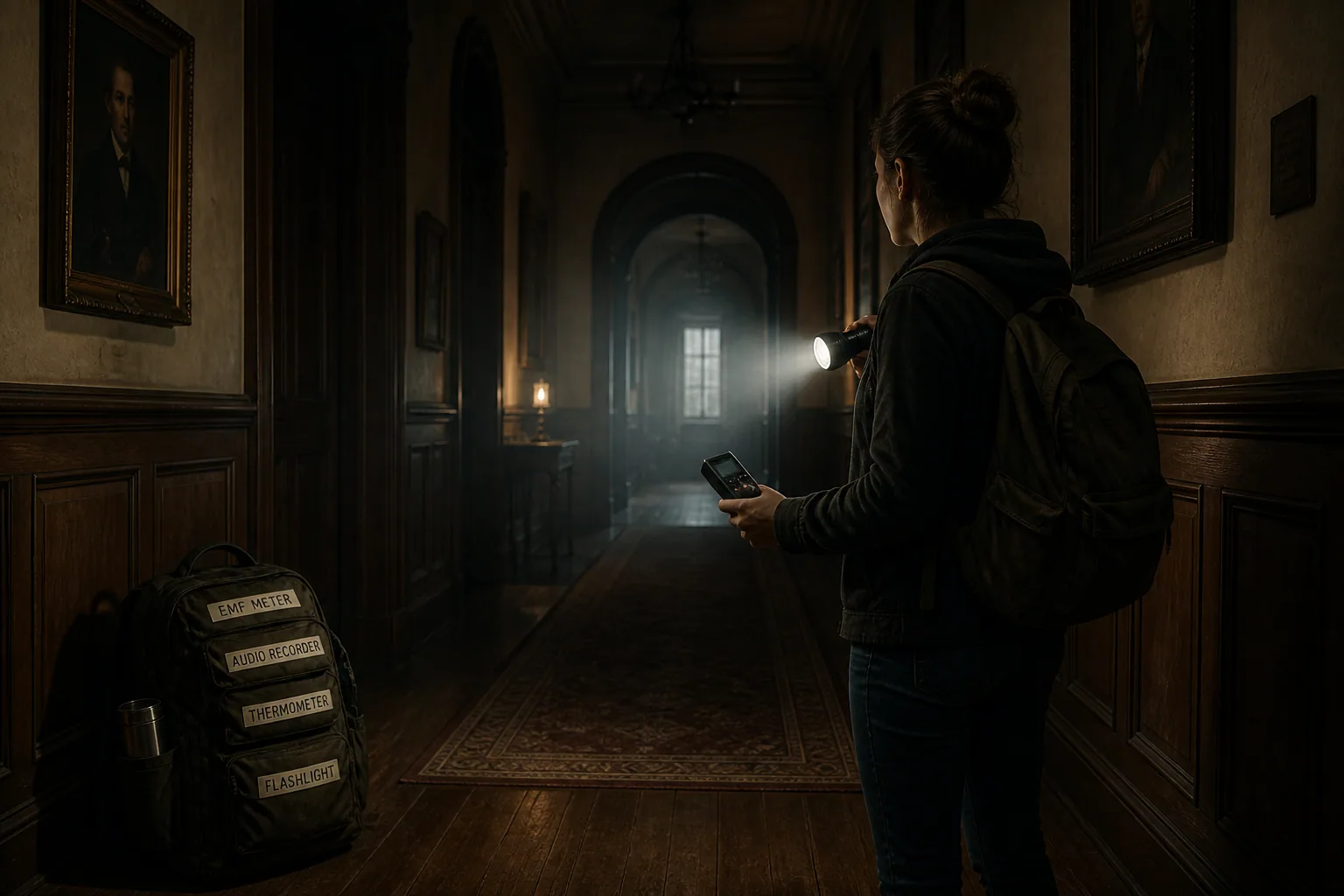
A beginner-friendly setup can include a flashlight or headlamp, a phone camera or dedicated camera, a digital audio recorder for EVPs, an EMF meter, a notebook and pen, spare batteries or a power bank, a trigger object, a first aid kit, and warm clothing with sturdy footwear. That is enough to document what happens, note conditions, and avoid getting stranded because your phone dies halfway through the night.
Research suggests that a solid beginner’s ghost hunting kit can cost around $200 to $400 if you buy legitimate equipment rather than novelty gadgets. Source: https://hauntpedia.com/ghost-hunting-equipment-guide/
That price range is useful because it keeps expectations realistic. You do not need a drawer full of blinking devices to do a serious first investigation. You need tools that help you observe, record, and review without distortion.
Essential Gear vs Flashy Extras
One of the fastest ways beginners waste money is by buying tools before understanding what those tools actually measure. A flashlight helps you move safely. A recorder captures audio you can review later. An EMF meter may help you note environmental changes. A notebook gives context to everything else.
By contrast, many specialty tools are better saved for later. Spirit boxes, REM pods, thermal cameras, night-vision cameras, motion sensors, and laser grids can be interesting, but they also add complexity and more opportunities for false positives or misinterpretation. Sources: https://www.hauntscout.com/articles/ghost-hunting-equipment-checklist/ and https://mysticrealmblog.com/ghost-hunting-equipment-checklist/
That does not mean those tools are useless. It means they are not essential for your first night out. If you cannot yet explain how to control for drafts, battery interference, reflections, background radio bleed, or human error, adding more gadgets will not automatically improve your evidence.
If you want a practical rule, buy the gear that helps you answer three questions: What happened? When did it happen? What else could have caused it?
If you later decide to expand into a more advanced kit, costs can rise quickly. HauntPedia estimates that intermediate gear can push a setup to roughly $800 to $1,200 with additions like motion sensors, full-spectrum or modified cameras, spirit boxes, REM pods, night-vision equipment, and nighttime audio accessories. Source: https://hauntpedia.com/ghost-hunting-equipment-guide/
How to Choose a Location and Get Permission Legally
Choosing a location is not just about atmosphere. It is about access, legality, and expectations. The first question should always be: who owns the property?
The safest route is to identify the owner through public records or GIS information and ask directly. Written consent is strongly preferred because it protects both sides and makes the rules clear. You should confirm what areas you can enter, what hours are allowed, whether you may use equipment, and whether you can record audio or video. Source: https://national-paranormal-society.org/lets-get-started/
This matters even more for abandoned buildings, historic sites, and publicly owned properties. Those places may require extra permission from a municipality, historical society, or another agency. In some cases, special use permits, time limits, insurance, or restricted activity rules may apply. If the answer is unclear, do not assume permission exists just because a location looks empty or forgotten.
A good beginner location is one where you can legally stay, clearly define boundaries, and investigate without worrying about being removed by security or cited for trespass. Good permission beats great rumors every time.
Liability, Waivers, and Trespassing Risks Explained
A lot of new investigators think liability is only a concern for organizations. It is not. If someone trips, falls, gets hurt, damages a wall, or breaks equipment, the legal and financial consequences can become messy very quickly.
That is why clear agreements or waivers are important. They help protect both property owners and investigators by spelling out responsibility, access terms, and basic expectations. They are not magic shields, but they are far better than a handshake and a vague text message.
Safety is also a liability issue. Investigators should do a basic risk assessment before and during the session. Look for loose boards, unstable flooring, exposed wiring, mold, asbestos, poor lighting, and other hazards. Bring a first aid kit, wear gloves when needed, and choose sturdy footwear. Source: https://www.bprsparanormal.com/
Trespassing is the easiest way to turn a hobby into a problem. If you do not have permission, do not enter. If access rules change, stop. Respecting boundaries is not only ethical, it also protects the credibility of everything you later report.
Safe and Respectful Investigation Protocols
Good on-site behavior is one of the clearest signs of a serious investigator. That means moving carefully, minimizing disturbance, and treating the location with respect. Do not damage property, alter the environment, or create dramatic conditions just to force activity.
Respect also applies to the people involved. Explain what you are doing, what you are not doing, and what you will not claim. Avoid sensationalizing the location or making medical, religious, or spiritual claims as if they were verified facts. Ethical paranormal work is observational, not exploitative. Source: https://www.bprsparanormal.com/
If you are working in a group, set expectations before you begin. Decide who is leading, who is logging, who is recording, and what the group will do if someone feels uncomfortable. Fear can spread quickly in a dark building, so it helps to have a simple plan for pausing or ending the session if needed.
Recording Audio, Video, and Photos the Right Way
A lot of “evidence” becomes useless because it was recorded badly. If you want a reviewable investigation, your recording habits matter as much as the equipment itself.
Before you start, note the time, location, device settings, and environmental conditions. Sync the time across devices if possible, then label files clearly afterward with the site, time, and device used. This makes it much easier to compare events later and detect whether something happened on more than one recording at the same moment. Source: https://www.paranormalresponsenetwork.org/evidence-guides/meters
Keep your devices stable and consistent. If you change settings mid-session and do not note it, your later review becomes much less reliable. The same is true for audio glitches, clipped sounds, and overprocessed images. The more you alter the original file, the less confidence anyone should have in what they are seeing.
That is one reason why many investigators keep original files untouched and document any edits separately. It preserves integrity and helps you avoid accidental self-deception.
What Not to Post: Privacy, Consent, and Sharing Etiquette
Once people find interesting footage, they often want to post it immediately. That is understandable, but it can create ethical and legal problems if you are careless with privacy and consent.
If you record other people, get their consent when possible. If you are at a private location, be careful not to expose details the owner did not agree to share. Also, avoid making claims you cannot support just because they will perform better online.
When you publish evidence, disclose your methods and limitations. Say what equipment was used, what conditions existed, and what possibilities you ruled out. Do not heavily edit clips in a way that changes their meaning. Do not crop out context if the context matters. And do not present speculation as certainty. Source: https://www.bprsparanormal.com/
The standard is simple: if someone else watched your session from start to finish, would they feel misled by your post? If the answer might be yes, rework it before publishing.
How to Evaluate Possible Evidence Without Bias
This is where many first-time investigations go wrong. A strange sound is not automatically an EVP. A temperature drop is not automatically a haunting. A blinking meter is not automatically paranormal.
The best investigators start with the assumption that ordinary causes are more likely than extraordinary ones. They log baseline environmental data, test conditions, repeat observations, and try to rule out drafts, insects, reflections, electronics, and human error before drawing conclusions. Source: https://www.bprsparanormal.com/
This is also where critical thinking matters. Skeptical evaluation does not mean mocking the experience. It means using the scientific method where possible: make a claim, test it, look for falsification, and stay willing to say “I do not know.” As Skeptical Inquirer notes, practical tactics like questioning assumptions and avoiding overreach help unravel the uncanny. Source: https://skepticalinquirer.org/2017/01/ten-practical-tactics-to-unravel-the-uncanny/
It also helps to watch for confirmation bias and pareidolia, which is the tendency to see patterns in random noise. If multiple devices captured the same event, if the event is reproducible, and if interference has been ruled out, then you have something worth discussing. Even then, the right conclusion may still be “interesting, but unexplained,” not “proof of ghosts.”
Managing Fear, Expectations, and Group Dynamics
The emotional side of ghost hunting is real. Darkness, silence, unfamiliar buildings, and group tension can make ordinary sensations feel intense. That does not mean the experience is fake. It means you should expect adrenaline to play a role.
If you are nervous, start with a small, well-briefed group and a short investigation window. Do not let one person dominate the session with dramatic commentary. A calm, organized group records better, argues less, and leaves fewer gaps in the evidence log.
Managing expectations matters too. Many first investigations do not produce anything dramatic. That is normal. A quiet night is not a failure. In fact, a quiet night can still be useful because it helps establish a baseline and teaches you what normal sounds, vibrations, and environmental changes look like in that location.
Common First-Investigation Mistakes to Avoid
Most beginner mistakes are surprisingly avoidable. The biggest one is showing up underprepared and hoping the location will do the work for you. It will not.
Other common mistakes include buying flashy gear before learning the basics, entering locations without permission, failing to log times and settings, reacting emotionally to every noise, posting evidence before reviewing it carefully, and ignoring obvious environmental causes. Another frequent problem is talking over recordings so much that the audio becomes unusable.
A very practical mistake is forgetting comfort and safety gear. If you are cold, thirsty, tired, or in pain, your judgment gets worse. Bring water, wear proper shoes, and pack for the actual conditions rather than the mood of the photos you saw online.
If you want one simple standard, ask yourself before, during, and after the session: can I explain what I did, what I observed, and what I ruled out?
Beginner Ghost Hunting FAQ
Do I need expensive equipment for my first ghost hunt?
No. A flashlight, recorder, camera, notebook, EMF meter, batteries, and basic safety gear are enough to begin. Many beginners overspend before learning how to document a location properly. A solid starter setup often falls around $200 to $400. Source: https://hauntpedia.com/ghost-hunting-equipment-guide/
What is the most important thing to bring besides gear?
Permission. If you do not have clear authorization to enter and investigate, do not go. Legal access matters more than the equipment list.
How do I know if something is really paranormal?
You usually do not know right away. Compare recordings, check for repeatability, rule out ordinary explanations, and avoid jumping from anomaly to conclusion. In many cases, the most honest answer is that the evidence is interesting but inconclusive.
Should I use a spirit box or other advanced tools right away?
You can, but it is usually better to learn the basics first. Advanced tools can create more noise, more ambiguity, and more false positives if you do not already have a disciplined method.
Can I post my investigation online?
Yes, but do it responsibly. Get consent where needed, protect privacy, describe your methods, keep original files intact, and avoid editing clips in a misleading way.
What if I get scared during an investigation?
Pause, regroup, and communicate. Fear is normal. A good team has a plan for stopping if someone is overwhelmed or if conditions feel unsafe.
A Practical Next Step for New Investigators
If you want to keep your first session simple and organized, start with a basic kit, secure written permission, and use a tool that helps you document the night without turning the experience into a mess of gadgets. If you are curious about a smartphone-based option for recording sessions, EMF readings, and sharing your investigation, Ghost Detector: Ectify can be a natural fit: https://findthe.app/ectify-fc72z0
The best beginner ghost hunting is not about proving everything on the first try. It is about building good habits, protecting yourself and the location, and learning how to separate an interesting story from solid evidence. That way, when something genuinely unusual happens, you will actually be ready to notice it.
