Ghost Hunting for Skeptics: How to Differentiate Genuine Paranormal Evidence from Everyday Illusions
If you want to become a better ghost hunter, skepticism is not a weakness. It is one of your best tools. A skeptical investigator does not assume every bump, flicker, or whisper is paranormal. Instead, they ask a better question: what else could explain this?
That mindset matters because humans are extremely good at finding patterns, even when none are really there. Research has shown that paranormal believers are more likely to recognize meaning in randomness, especially faces and human forms, and that they often do so with higher confidence than skeptics even when real signals are detected at the same rate. https://www.sciencedirect.com/science/article/abs/pii/S1053810014000907
That does not mean strange experiences are always fake. It means good investigation begins by separating strong evidence from common false positives. In practice, that means knowing how pareidolia, infrasound, EMF contamination, acoustics, camera artifacts, and expectation bias can create convincing experiences that feel supernatural in the moment.
Why Skepticism Makes You a Better Ghost Hunter
A skeptical approach improves your fieldwork because it protects you from the most common investigation trap: deciding what happened before you collect enough data. Once a person believes a location is haunted, every sound becomes a clue, every shadow becomes a figure, and every random coincidence starts looking like confirmation.
This is not just a philosophical concern. A 2022 review discussed how paranormal belief is linked with confirmation bias, illusion of control, and perceptual errors, especially when people try to identify human agents in ambiguous stimuli. In other words, the brain is primed to turn uncertainty into something meaningful. https://pmc.ncbi.nlm.nih.gov/articles/PMC9067702/
Skepticism also helps you share better evidence. If you can rule out the ordinary causes first, the remaining case becomes much more interesting to other investigators, and much harder to dismiss.
The Most Common Everyday Illusions Mistaken for Paranormal Activity
Most ghost stories start with a real experience. A figure in the corner. A cold spot. A strange sound. A recording that seems to say a name. The mistake is not usually that the experience was invented. The mistake is assuming the first explanation that feels spooky is the right one.
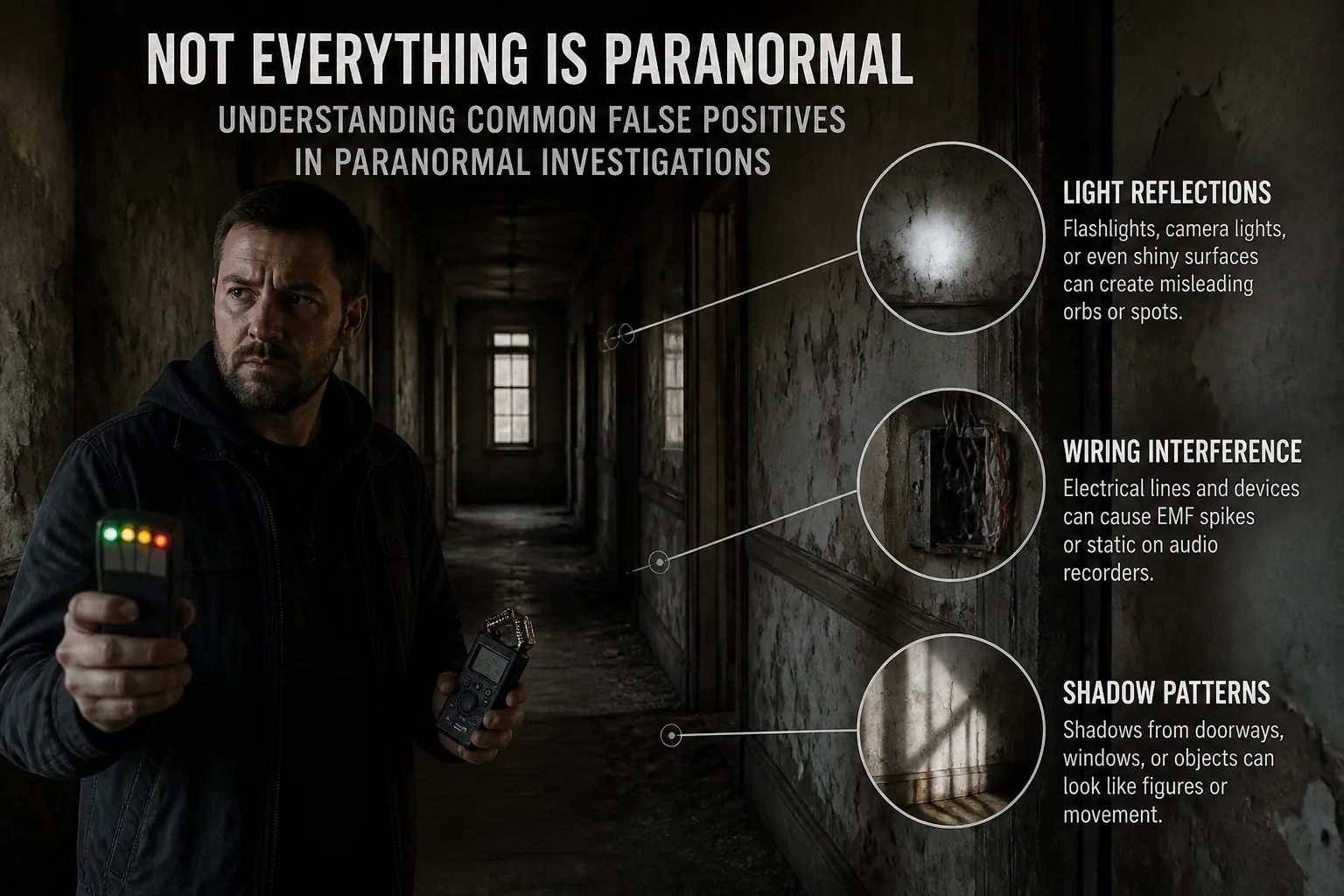
The most common everyday illusions include pareidolia, infrasound effects, EMF contamination, drafts, poor acoustics, lens flare, dust backscatter, thermal reflections, and expectation bias. Each of these can create an experience that is vivid, emotional, and easy to misread in a haunted environment.
The key is to treat every suspected event like a lead, not a conclusion. Good investigators compare the event to the environment, the equipment, and the behavior of the people present before deciding whether it is truly unusual.
Pareidolia: Why We See Faces, Figures, and Meaning in Noise
Pareidolia is the tendency to perceive recognizable patterns in ambiguous data. It is one of the most important concepts for anyone who wants to investigate hauntings critically, because human beings are especially sensitive to faces, bodies, and agency.
A neurological study of pareidolia found that over 70% of pareidolic perceptions were animals, humans, faces, or body parts. That is a huge clue about what the brain is trying to do when information is incomplete: it fills in the gaps with the most socially important patterns it knows. https://pmc.ncbi.nlm.nih.gov/articles/PMC10926141/
This is why a dark hallway can look like a person standing still, why a stain can resemble a face, and why noisy audio can sound like a name if you already expect a voice. The brain is not being foolish. It is doing fast pattern recognition under uncertainty.
The practical solution is simple but powerful: when you think you saw a figure, ask what the figure looked like from different angles, under different lighting, and at different distances. If the shape only becomes a person when you are already primed to expect one, pareidolia is a strong candidate.
Infrasound, EMF, Drafts, and Other Environmental Triggers
Some haunting sensations come from the body rather than the supernatural. Infrasound, which is sound below 20 Hz, can produce physiological and emotional effects even when people do not consciously detect it. Research has found elevated cortisol, increased irritability and sadness, and more negative appraisal after infrasound exposure. https://pmc.ncbi.nlm.nih.gov/articles/PMC13158192/
That matters because a person who feels uneasy, anxious, or suddenly sad in a location may assume the emotion has a paranormal cause. It may not. It could be vibration, airflow, machinery, nearby traffic, or some other environmental factor affecting the nervous system.
Expectation matters too. In a double-blind study, people who were told infrasound causes certain symptoms reported those symptoms whether they were exposed to real infrasound or a sham version. That means suggestion alone can produce very real experiences. https://pubmed.ncbi.nlm.nih.gov/23477573/
EMF is another common culprit. EMF meters often detect fields from ordinary sources like wiring, appliances, radio-frequency interference, and high-voltage lines. Without careful baseline measurements, a meter spike tells you only that something electromagnetic is present, not that something paranormal is. https://www.paranormalresponsenetwork.org/research/environmental-intelligence/emf-rf-interference
Drafts, HVAC systems, old insulation, loose windows, and pressure changes can also explain sudden chills, door movement, or the sensation that something passed by. In a good investigation, these are not afterthoughts. They are part of the evidence review.
Camera, Audio, and Sensor Artifacts That Fool Investigators
Technology can make a case look stronger than it really is. A blurry image, a crackling audio file, or a thermal hotspot can feel objective because it is recorded. But all recording devices have weaknesses, and ghosts tend to appear most often where the equipment is least reliable.
A classic example is the orb photo. Many so-called orbs are just backscatter, which is light reflecting off dust, moisture, or insects near the lens. This happens especially with compact cameras, where flash and lens alignment make the artifact more likely. https://en.wikipedia.org/wiki/Backscatter_(photography)
Thermal cameras can also mislead investigators. Warm or cold shapes may simply be reflections off glass or polished surfaces, or even reflections of the investigator themselves. A thermal anomaly only becomes interesting if it survives comparison against the room geometry and reflective surfaces. https://www.paranormalresponsenetwork.org/research/environmental-intelligence/light-optics-temperature
Audio is equally tricky. Room acoustics, compression artifacts, electrical interference, and background voices can create the impression of words in noise. If a recording seems to say something remarkable, the best question is not only what it sounds like, but what else was happening in the room and what the waveform or raw file shows.
The Role of Bias, Suggestion, and Group Psychology in the Field
Ghost hunting rarely happens in a vacuum. It often happens in groups, late at night, in emotionally charged spaces, with people already primed for unusual experiences. That combination is perfect for suggestion to spread from one person to another.
Studies have shown that believers can overestimate successful matches and false correlations, even experiencing higher physiological arousal when interpreting ambiguous outcomes as meaningful. This helps explain why two people can witness the same event and leave with the same mistaken conclusion. https://journals.sagepub.com/doi/10.2466/pr0.1996.78.1.291
Once one person says, ‘Did you hear that?’ or ‘I felt something touch me,’ the group may begin scanning for confirmation. This does not mean they are lying. It means attention is contagious, and once a spooky interpretation takes hold, it can shape what everyone notices next.
A strong investigator keeps notes on who said what first, what everyone knew beforehand, and whether the experience was independent or influenced by others. Separate witness accounts are much more valuable than a story that becomes shared in real time.
What Strong Paranormal Evidence Actually Looks Like
Strong paranormal evidence is not just strange. It is unusual in a way that remains unusual after ordinary explanations are tested. That is a very high bar, and it should be.
The best evidence usually has several layers. It is not a single orb, one EMF spike, or a voice in noisy audio. It is a repeatable pattern that appears across different tools, different times, and ideally different witnesses, while also resisting normal environmental explanations.
Good evidence also has context. You should know what the room was like before the event, what baseline readings looked like, what equipment was in use, and who was present. Without that, a strange moment is interesting, but not very informative.
That is why careful investigators focus on documentation, not drama. The goal is not to prove a haunting at all costs. The goal is to identify what is genuinely unexplained after ordinary causes have been responsibly checked.
How to Build Corroboration: Matching Witnesses, Audio, Video, and Sensor Data
Corroboration means more than having multiple clips from the same event. It means that different kinds of evidence independently point to the same unusual moment.
For example, if a witness reports a figure in a doorway, and at the same time an audio recorder captures an unexplained footstep, and a motion sensor activates, and a camera shows movement that cannot be explained by lighting or reflection, the case becomes more interesting. Not because one tool is perfect, but because several imperfect tools agree.
The key word is independently. If one event triggers all the others through human expectation, that is not corroboration. If a person announces something and everyone else starts checking the same spot, the result may be synchronized attention rather than synchronized evidence.
When possible, document the exact timing of each observation. Time stamps help determine whether the event happened simultaneously or whether later reports were shaped by what someone else noticed first.
Baseline Scanning and Environmental Audits Before Any Investigation
One of the smartest things a paranormal team can do is learn what normal looks like before the investigation starts. That way, you are not treating ordinary changes as if they were extraordinary.
A useful example comes from the Harper’s Mansion ghost study, where investigators kept continuous environmental baseline records, including temperature, humidity, air pressure, and motion-activated cameras, for weeks before the live investigation. That gave them a reference for normal fluctuations, which is exactly what serious evidence work needs. https://skepticalinquirer.org/newsletter/the-harpers-mansion-ghost-study/
An environmental audit should include lighting, reflective surfaces, known sound sources, electrical systems, HVAC, draft patterns, nearby machinery, and any wireless or radio noise. If you are using sensors, test them in the location before you begin and note where they respond to normal conditions.
This baseline approach turns an investigation from guesswork into comparison. You are no longer asking only whether something happened. You are asking whether it happened outside the range of what usually happens there.
A Practical Checklist for Ruling Out False Positives
Before you label something paranormal, run through a simple checklist. First, ask whether the event could be explained by pareidolia, reflection, vibration, airflow, poor acoustics, or electronic interference.
Second, check whether the event is repeatable. If it happened once, can it happen again under similar conditions? If not, it may still be interesting, but it is harder to interpret.
Third, compare against baseline data. Did the EMF spike occur in a known electrical zone? Did the sound coincide with HVAC activation? Did the temperature drop match a draft path or open doorway?
Fourth, separate independent observations from group influence. Who saw or heard it before anyone else mentioned it? Did the story change as people discussed it?
Fifth, preserve the raw evidence. Keep original audio, video, sensor logs, and notes. The more you edit, summarize, or compress too early, the easier it is to lose context.
When a Case Is Interesting Enough to Share Publicly
Not every unusual case deserves a big claim. Some cases are only interesting because they are unresolved, and that is fine. Good investigators know the difference between ‘unexplained so far’ and ‘evidence of a ghost.’
A case is more shareable when it has multiple layers of support, a documented baseline, a clear chain of events, and reasonable attempts to rule out common causes. Even then, the best language is careful. Say what you observed, what you tested, and what remains uncertain.
That approach builds credibility. It also protects the field from becoming a collection of dramatic but weak stories that collapse under basic scrutiny.
If you enjoy recording and reviewing sessions in a more structured way, a tool like Ghost Detector: Ectify can help you capture sessions, keep a history, and review your recordings later. You can explore it here: https://findthe.app/ectify-fc72z0
How Better Standards Can Improve Paranormal Research
Better standards do not make ghost hunting less exciting. They make it more useful. When investigators use baselines, document carefully, and stay alert to bias and environmental triggers, the cases that remain unexplained become more meaningful.
That is the real value of skepticism. It does not shut down wonder. It filters out the noise so that if something genuinely unusual is happening, you have a better chance of seeing it clearly.
In a field full of ambiguity, the investigators who win trust are not the ones who believe the fastest. They are the ones who ask the best questions, compare against the best controls, and accept uncertainty when the evidence does not yet justify a stronger claim.
