Ghost Hunting Gadgets of the Future: How LiDAR, Thermal Drones & AI Are Redefining Paranormal Investigation
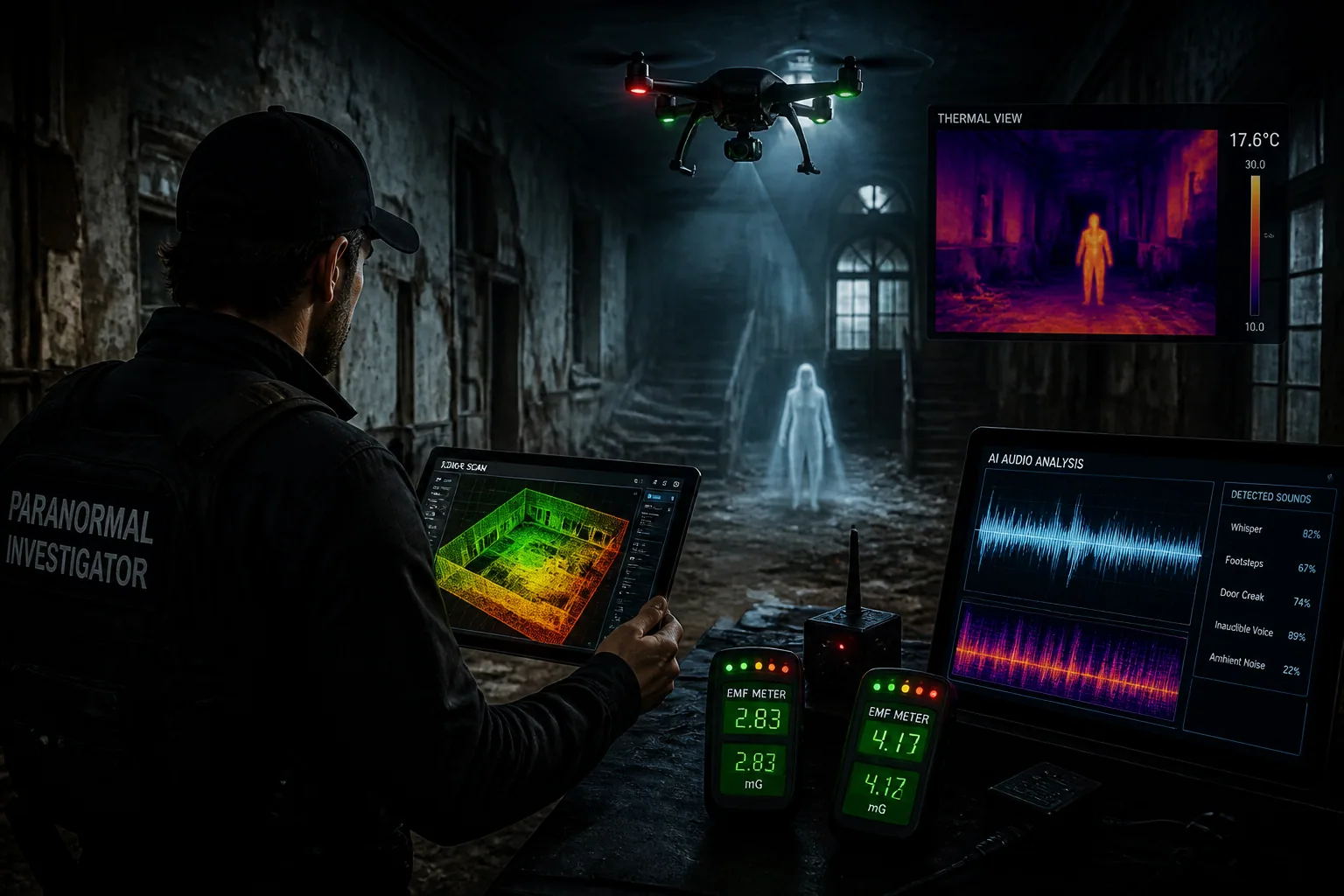
Ghost hunting has always lived in an interesting space between folklore, fieldwork, and technology. For years, the toolkit was fairly recognizable: EMF meters, digital recorders, cameras, and a lot of patience. But the next wave of paranormal investigation is looking very different. Consumer LiDAR, thermal imaging drones, AI audio cleanup, and machine learning-based review tools are starting to move from novelty into practical support tools for serious investigators.
That does not mean the old methods are obsolete. In fact, the most useful future setup may be one where advanced sensors improve your workflow instead of replacing it. The real question is not whether futuristic gear can detect ghosts. It is whether it can help you document environments more clearly, reduce noise, spot patterns faster, and rule out ordinary causes with more confidence. That is where these tools become interesting.
Why Futuristic Ghost Hunting Tech Is Gaining Attention Now
A big reason this topic is heating up is simple: the hardware has finally become accessible. A phone with LiDAR used to sound like sci-fi. Now it is sitting in a pocket. Drones with thermal cameras are no longer reserved for expensive industrial use cases. And AI tools that once belonged to research labs are now being used by everyday creators to clean audio, analyze images, and sort through large volumes of data.
That matters for paranormal work because investigations often produce a lot of messy evidence. You get low-light footage, background hum, radio interference, random bumps in old buildings, and hours of recordings with maybe one useful moment. Any technology that helps investigators map spaces, isolate signals, or review anomalies more efficiently will naturally attract attention.
There is also a cultural factor. People are increasingly comfortable trusting sensor data, overlays, and automated analysis in other areas of life. So it makes sense that tech-forward investigators want the same advantages in the field. But as with any emerging tool, the promise is often bigger than the reality if you do not understand the limits.
From EMF Meters to LiDAR: How the Toolkit Is Evolving
Traditional ghost hunting tools are mostly about detection and interpretation. EMF meters look for electromagnetic fluctuations. Audio recorders capture possible EVPs. Spirit boxes create rapid radio-based sound for possible communication. These tools can be interesting, but they are also vulnerable to environmental interference, user expectation, and confirmation bias.
The newer toolkit is different because it is less about asking “is something there” and more about answering “what exactly is happening in this space?” LiDAR can map a room. Thermal cameras can show heat patterns. AI can help clean and categorize recordings. Machine learning can sort through data at a scale that would be painful to do manually.
This does not automatically make the results more paranormal. It simply makes the investigation more instrumented. That is a good thing if your goal is to reduce guesswork. A well-documented room scan, a temperature map, or a time-synced audio log can be much more useful than a vague feeling that something felt off.
The best investigators will probably be the ones who combine both worlds. Use EMF meters, EVP sessions, and spirit-box experiments if they fit your method, but layer in tools that give you a stronger environmental baseline.
Consumer LiDAR Sensors: Mapping Spaces and Spotting Movement
Consumer LiDAR is one of the most practical upgrades available right now. On recent iPhones and iPad Pros, LiDAR can provide depth accuracy of roughly 1 to 3 centimeters within about 3 meters, with accuracy dropping to around 5 to 10 centimeters beyond 4 to 5 meters, according to SimplyWise. Effective indoor range is usually about 3 to 4 meters for clean, usable scans, and Apple’s practical indoor operating range is around 5 meters, though performance drops in strong sunlight or on reflective or very dark surfaces. Source: https://www.simplywise.com/blog/iphone-lidar-construction-accuracy/
For paranormal work, that matters because LiDAR is excellent at answering structural questions. Did the object move? Was there someone in the frame? Is the hallway geometry changing in a way your eye missed in the dark? A LiDAR scan can help you build a 3D reference of a room before and after a session, which is useful for checking whether a door opened, a tripod shifted, or someone stepped into a blind corner.
More interestingly, recent research suggests low-cost consumer LiDARs contain time-resolved light-return histograms that can encode non-line-of-sight information, meaning hidden objects can sometimes be reconstructed from the data under certain conditions. The DENALI dataset explores this in more detail, and another 2026 study on motion-induced sampling showed that off-the-shelf smartphone LiDAR can support multi-frame fusion for NLOS imaging and tracking hidden objects, though it still struggles with low laser power, low spatial resolution, and motion. Sources: https://arxiv.org/abs/2604.16201 and https://arxiv.org/abs/2605.17865
That is not a ghost detector, and it should not be treated like one. But it does suggest that the gap between consumer hardware and advanced spatial analysis is shrinking. In practice, LiDAR can be a very strong support tool for documenting a location, spotting movement, and creating repeatable scans that make later review more objective.
Thermal Imaging Drones: A New Eye on Hard-to-Reach Locations
Thermal drones sound dramatic, and in some settings they really are useful. If you are investigating an abandoned property, a large outdoor site, a rooftop, or a dangerous structure where access is limited, a drone can give you an angle that handheld tools simply cannot. You can inspect windows, rooflines, upper walls, and inaccessible spaces without sending a person into unsafe conditions.
The major caveat is that thermal imaging has hard limits. Prosumer thermal drones often start around $3,500 to $4,000, while enterprise platforms can climb above $9,000 to $25,000, according to Black Bastion Systems. Common thermal resolutions include 160×120 for basic short-range use, 320×256 for entry to mid-level applications, and 640×512 for professional-grade detail. Source: https://www.blackbastionsystems.com/articles/best-thermal-camera-drones
Resolution matters because thermal images are easy to over-interpret. A low-resolution sensor may show a vague heat blob that looks mysterious but says very little. Sensitivity also matters. Consumer thermal sensors often have a NETD of 100 mK or more, while professional hardware may reach 30 to 50 mK. That difference affects whether you can detect small temperature variations or just broad warm and cool zones. Source: https://aerialaccuracy.com/resources/uav-thermal-imaging-guide
For paranormal investigation, that means thermal drones are best used for context, not conclusions. They can help you identify airflow, insulation issues, heat leakage, human presence, or hidden access points. They can also be very useful for clearing an exterior location before or after an investigation. But they are not proof of an entity, and low-quality thermal footage can become a visual Rorschach test if you are already expecting something strange.
AI Audio Analyzers: Cleaning Up EVP and Separating Noise from Voice
Audio has always been central to ghost hunting, especially EVP sessions. The problem is that audio is also one of the easiest places for false positives to sneak in. Wind, rustling clothing, distant traffic, reverb, electronic hiss, and even the human brain’s tendency to turn noise into language can all create misleading interpretations.
AI-based audio cleanup tools can help here, but only if used carefully. In forensic-style testing, overly aggressive enhancement can introduce artifacts, distortions, or speech-like features that were not actually present. The American Academy of Forensic Sciences has warned that AI-based enhancement may create false evidence if it is used too aggressively. Source: https://www.aafs.org/research/ai-based-audio-enhancement-may-cause-false-evidence
That is a serious warning for paranormal work. If you enhance an EVP clip too much, you may accidentally create the very voice-like pattern you wanted to find. This is why AI audio should be treated as a cleanup assistant, not as a truth machine. Use it to reduce noise, separate channels, or make a waveform easier to inspect, but always preserve the original recording and document every processing step.
There is also a human factor. A study from UCL found that people correctly identified deepfake audio only about 73% of the time, which means even trained listeners can be fooled by synthetic or manipulated speech. Source: https://pmc.ncbi.nlm.nih.gov/articles/PMC10395974/
For investigators, the lesson is simple. If a cleaned clip suddenly sounds clearer, do not assume it is more authentic. It may just be more convincing. The safest approach is to compare the raw file, the cleaned version, and the session conditions side by side before making any claim.
Machine Learning for Image, Video, and Environmental Data Review
Machine learning is quietly becoming one of the most valuable parts of the future ghost hunting workflow. Not because it will identify spirits, but because it can help investigators process large amounts of data more intelligently. This includes finding motion in video, clustering similar events, identifying repeated environmental changes, and flagging moments worth human review.
Imagine a long overnight session with multiple cameras, temperature sensors, and audio tracks. Instead of manually scrubbing through everything, software can mark sudden changes, unusual spikes, or frames where something in the scene changed. That does not solve the mystery, but it helps you focus your attention where it matters.
This is one of the biggest benefits of AI in paranormal work: it reduces the amount of time spent on busywork. If you have ever reviewed hours of nothing and then found one 10-second anomaly, you already know the value of smart filtering. The challenge is that machine learning systems are only as useful as the data and settings behind them. Bad inputs still create bad outputs.
Environmental tracking can also benefit from pattern analysis. Temperature, humidity, pressure, and magnetic fluctuations often look random in isolation, but data aggregation can reveal whether a spike lines up with human movement, HVAC activity, weather changes, or electrical interference. That kind of review is much more persuasive than a single isolated reading.
What Emerging Paranormal Tech Can Do Well, and Where It Falls Short
The strongest case for futuristic ghost hunting tech is not that it proves paranormal activity. It is that it improves the quality of your investigation. LiDAR can document room geometry. Thermal drones can inspect inaccessible areas. AI audio tools can make recordings easier to review. Machine learning can help surface patterns faster.
Where these tools fall short is in interpretation. A thermal hotspot may be a heater, a mouse, or a person behind a wall. A LiDAR anomaly may be motion blur, reflective clutter, or sensor limitations. An AI-cleaned EVP may be a processing artifact. In other words, the tool may be accurate while your conclusion is not.
This is where many investigations go wrong. New technology can create an illusion of precision, and precision can feel like truth. But a detailed false positive is still a false positive. The more advanced the tool, the more disciplined the user needs to be.
How New Tools Can Complement Apps Like Ectify
Not every investigation needs a full hardware overhaul. Sometimes the smartest move is to add a light software layer to what you already use. A good example is Ghost Detector: Ectify, which turns your smartphone into a simple ghost hunting companion with real-time EMF detection, a spirit box and EVP generator, session recording, and history tracking. It is available here: https://findthe.app/ectify-fc72z0
That kind of app can fit nicely into a larger workflow. For example, you could use Ectify during a session to log EMF activity, capture audio, and keep a timestamped record of events, then compare those notes against LiDAR scans, drone footage, or AI-processed audio later. The app becomes part of the evidence trail rather than the entire investigation method.
This hybrid approach is probably the most realistic future for serious paranormal teams. Smartphone-based tools provide accessibility and convenience, while advanced hardware adds deeper context when the location or budget justifies it. The result is a more layered investigation without making the setup too complicated.
The more tools you add, the more disciplined you need to be. False positives do not disappear just because the equipment looks more advanced. In fact, they can become harder to spot because tech output feels authoritative. That is especially true with EMF readings, which are easy to over-interpret.
Research on electromagnetic hypersensitivity has found no convincing evidence linking short-term EMF exposure to symptoms, and many studies that appear to show effects suffer from methodological flaws such as poor blinding, small sample sizes, and selection bias. That points to a high risk of false positives in EMF-based interpretations. Source: https://pmc.ncbi.nlm.nih.gov/articles/PMC6805477/
The practical lesson is that all data should be cross-checked. If the EMF meter spikes, ask what else changed. If a thermal image looks strange, verify the environment. If a voice appears in a cleaned track, compare the original. Avoid building conclusions around one tool or one moment, especially when you are already expecting something paranormal.
Tech dependence is another risk. If your team only feels confident when the gear is blinking, scanning, or analyzing, you may lose the observational skills that actually matter in the field. The best investigators still know how to listen to a room, note access points, understand building systems, and keep clean records.
Practical Setup Tips for Integrating Advanced Gear into Real Investigations
If you want to introduce advanced gear without turning the session into a tech circus, start small. Pick one new tool per investigation and define exactly what it is supposed to answer. For example, LiDAR might be used only to establish baseline geometry. A thermal drone might be used only for exterior inspection. AI audio might be used only after the session for cleanup and review.
Keep a strict log. Note device settings, time stamps, location details, weather, occupancy, and any known sources of interference. If you cannot explain how a reading was captured, it will be hard to trust it later. Documentation is what turns a cool clip into useful evidence.
Also, make sure the crew understands what each tool can and cannot do. A thermal drone operator needs to know about resolution and NETD. A LiDAR user needs to know range limits and how surfaces affect performance. An audio reviewer needs to understand the risk of enhancement artifacts. Training matters just as much as the gear itself.
Cost, Accessibility, and Learning Curve: What’s Worth Buying First
Not every investigator should rush into enterprise hardware. The price jump is steep, and the learning curve can be just as expensive if you waste time on gear you do not fully understand. In most cases, the first upgrade should be the one that improves documentation at the lowest cost.
For many people, that means starting with smartphone-based tools, better audio workflow, and stronger logging habits before buying a drone or specialized sensor suite. A LiDAR-capable phone, a solid recorder, and careful review software may offer more immediate value than a high-end thermal platform that you barely know how to use.
If your investigations involve large outdoor locations, inaccessible structures, or recurring team work, a thermal drone can become worth the investment. If your focus is indoor evidence review and session documentation, AI audio and environmental logging may give you more practical returns sooner.
Privacy, Consent, and Ethical Questions Around Smart Ghost Hunting
As paranormal gear becomes smarter, the privacy questions get bigger. Drones collect footage from nearby areas. LiDAR scans can capture layout details. Session recordings may include voices, conversations, and identifying information. If you are investigating with a group, or in a space where others could be present, consent and data handling matter.
You should always be clear about what is being recorded, where it is stored, and who can access it. If you plan to publish clips online, make sure you are not exposing private spaces or personal information by accident. In an age where evidence can be edited, copied, and reposted instantly, ethical handling is part of credibility.
This is also where authenticity becomes important. The more you rely on AI, the more careful you need to be about preserving original files and metadata. If your evidence can be challenged, you want a clean record of how it was captured and processed.
The Future of Paranormal Investigation: Smart Upgrade or Overhyped Trend?
The future of ghost hunting is probably not a fully automated AI ghost detector, and it is probably not a return to old-school methods alone. It is more likely to be a blended workflow where better sensors, smarter software, and stronger investigation habits work together.
That is the most realistic takeaway from all of this. LiDAR can help you map. Thermal drones can expand your reach. AI can reduce noise and speed up review. Machine learning can help you see patterns sooner. But none of these tools should be treated as proof by themselves. They are only as good as the investigator using them.
So is this smart upgrade or overhyped trend? The honest answer is both, depending on how you use it. If you buy gear expecting it to tell you whether a place is haunted, you will probably be disappointed. If you use it to document better, eliminate more ordinary explanations, and build a cleaner evidence trail, then these tools can genuinely improve the quality of your work.
In that sense, the future of paranormal investigation is not about chasing shinier gadgets. It is about using better tools to become a more careful investigator.
