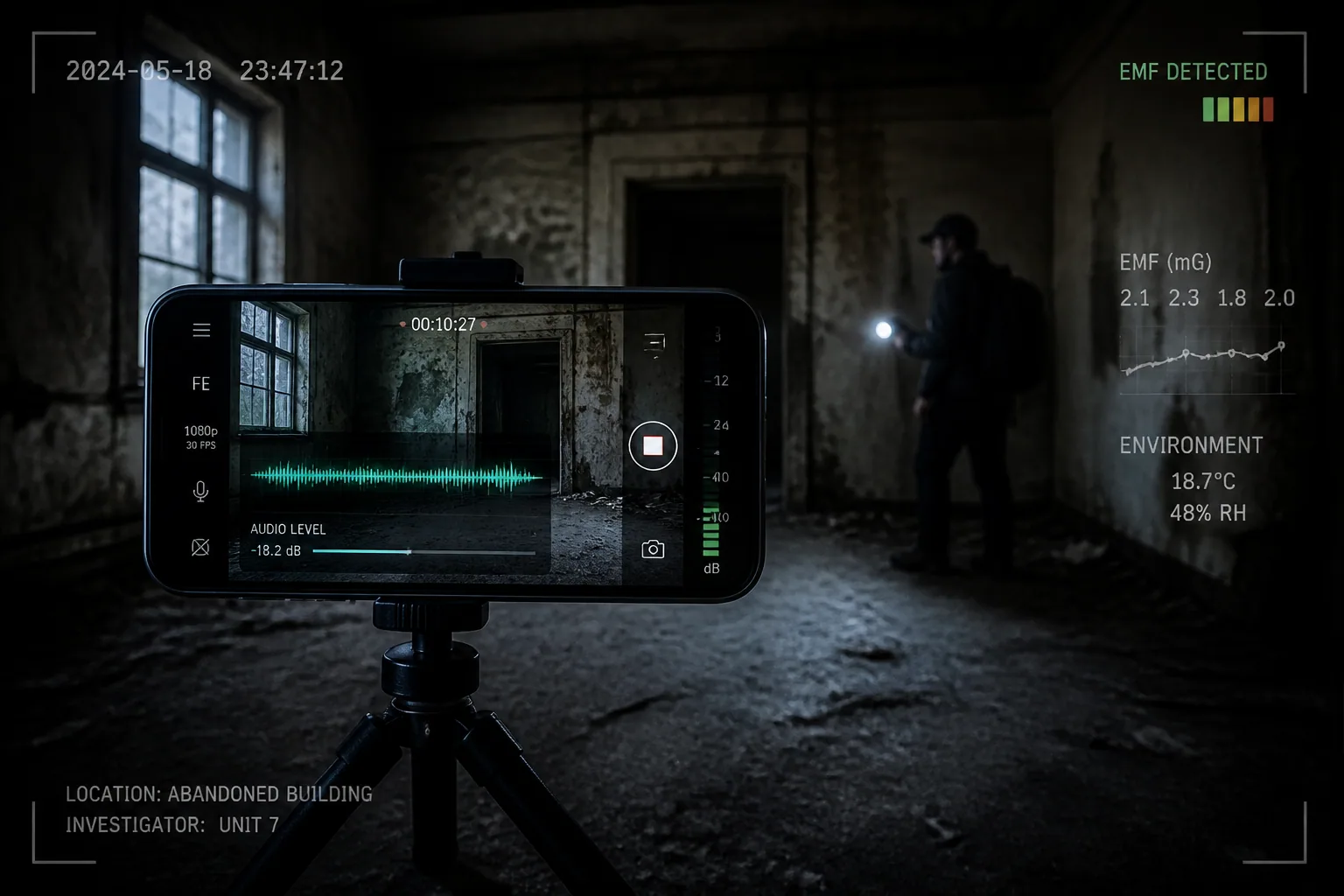
Ghost Hunting in the Digital Age: How Smartphones Are Changing What Credible Paranormal Evidence Looks Like
Smartphones have quietly become the default toolkit for a new generation of ghost hunters. They are always on hand, easy to use, and packed with hardware that can record sound, video, timestamps, location data, and even some environmental readings. That combination makes them incredibly useful for paranormal investigations, but it also raises the bar for what counts as credible evidence. A blurry clip, a noisy audio file, or a dramatic app screenshot is no longer enough on its own. Today, if you want mobile-based evidence to be taken seriously, you need to understand what your phone can actually capture, what it cannot, and how to document a session in a way that survives scrutiny.
Why Smartphones Are Becoming the Go-To Tool for Paranormal Investigators
The appeal is obvious. A smartphone gives you a camera, microphone, GPS, clock, storage device, and sharing tool in one pocket-sized package. For hobbyists, that lowers the barrier to entry dramatically. You can walk into a reportedly haunted location and begin recording immediately, without carrying a bag full of separate devices. You also gain a built-in record of the session if you handle the files correctly, which is one reason phones are increasingly used in casual investigations and social media ghost content.
There is another reason smartphones matter: they create evidence that can be cross-checked. A timestamped video, a geo-tagged image, or a WAV audio file with preserved metadata is more defensible than a story told after the fact. Modern forensic guidance also emphasizes preserving original metadata, avoiding on-device edits, and documenting capture conditions. SWGDE recommends keeping original files intact, avoiding digital zoom, and recording device details and capture conditions for comparative analysis: https://www.swgde.org/documents/published-complete-listing/23-p-002-recommendations-for-mobile-device-photography-for-comparative-analysis/
That said, smartphones do not automatically make paranormal evidence better. They make it more traceable. That is an important difference. If the claim is weak, a phone will not rescue it. If the capture process is sloppy, a phone may actually expose the weakness faster than older analog gear ever did.
What Your Phone Can Actually Detect, and What It Cannot
A smartphone can detect certain physical signals very well, but only within the limits of its hardware and software. Its camera can record light, but not every lighting condition equally. Its microphone can record sound, but compression, gain control, and environmental noise can all distort the result. Its magnetometer can measure changes in magnetic fields, but that does not mean it can identify spirits, entities, or paranormal sources. The sensor is real. The interpretation is the issue.
This distinction matters because a lot of paranormal marketing blurs the line between detection and explanation. A phone might register a magnetic fluctuation, but that fluctuation could come from a power cable, a speaker, a vehicle, a device in your pocket, or a structural element in the building. Likewise, a strange-looking reflection is far more likely to be a lens artifact than a supernatural apparition. The device can report a signal. It cannot tell you why the signal happened without context.
The research on smartphone voice recording is a good reminder of both the strengths and the limits of phones. In clinical settings, smartphone recordings can be highly reliable for some acoustic measures, with correlations above r > 0.93 to 0.99 for fundamental frequency and cepstral peak prominence when compared with professional equipment. But measures such as jitter, shimmer, and harmonic-to-noise ratio are not reliable from standard smartphone recordings because of random error. In other words, a phone can be excellent for some kinds of sound capture, but not every subtle analysis survives the journey through consumer hardware and software. Source: https://www.phonalab.com/en/guides/posts/smartphone-recording-voice-assessment
The Truth About EMF Apps, Night Vision Modes, Infrared Claims, and Built-In Sensors
One of the biggest misconceptions in mobile ghost hunting is that an app can turn a phone into a full paranormal lab. In reality, most apps only visualize data from sensors already inside the device. That can be useful for immersion and for spotting environmental changes, but it is not the same as specialized field instrumentation. If an app says it detects EMF, it is usually reading from the phone’s magnetometer or another hardware sensor, not discovering ghost activity.
EMF apps can still be interesting when used carefully. They may help you notice changes in the magnetic environment as you move through a space, and that can be a good clue for further checking. But the reading is only meaningful if you eliminate obvious interference first. Nearby electronics, metal structures, power lines, elevators, chargers, and even the phone itself can influence the sensor. Treat the reading as a prompt for investigation, not a conclusion.
Night vision claims deserve similar caution. A phone does not become truly infrared just because an app adds a green filter or boosts brightness. True infrared imaging depends on actual IR-sensitive hardware or external accessories, not just software styling. Many ghost photos that look impressive in a phone app are being processed aggressively under low light, which can create noise, blooming, false highlights, and soft ghostly edges that seem paranormal but are really computational photography doing its thing.
Skeptical reviews have also pointed out that so-called ghost apps often use the same composited images repeatedly, meaning the same apparition can show up in multiple apps or alleged captures. These app-generated fakes, sometimes called app-aritions, have caused a lot of misinformation in the paranormal community. See Skeptical Inquirer: https://skepticalinquirer.org/exclusive/app-aritions-are-still-causing-trouble/
Using Your Smartphone for EVP and Spirit Box Sessions
For many hobbyists, the phone is most valuable as an EVP recorder. If you want audio that can be reviewed later, the goal is to capture as much of the original sound environment as possible without adding too much distortion. That means choosing the right format and settings, then controlling the room as much as you can. A common recommendation in ghost-hunting communities is to record in WAV format at 44.1 kHz or higher, ideally with 24-bit depth, instead of compressed formats like MP3. Compression can remove subtle cues, smear quiet sounds, and create artifacts that complicate interpretation.
If you are using a spirit box or EVP generator app, remember that the app itself may become part of the evidence problem. Spirit box sessions can be compelling, but they are also vulnerable to radio bleed, word-bank bias, and pattern matching. If your app cycles through audio fragments or uses a curated word bank, it may produce convincing-seeming responses that are actually generated by the software design. That does not make the experience useless, but it does mean you should label it correctly as an interactive session rather than independent proof.
For a more credible EVP session, keep your narration minimal but clear. Say the date, location, time, and what you are attempting to ask before the session begins. Then leave quiet gaps. Afterward, preserve the original file. If you need an easy way to keep sessions organized while still documenting them in a more polished format, a tool like Ghost Detector: Ectify can help centralize recording and session history, and you can learn more here: https://findthe.app/ectify-fc72z0
Best Phone Settings for Clearer Audio and Video Evidence
Better evidence often starts with simpler settings. For audio, disable automatic gain control and noise cancellation if your phone or recording app allows it. Those features are designed to make everyday calls sound cleaner, but in paranormal work they can flatten the very details you want to preserve. Fixed gain is usually preferable because it keeps the recording behavior more consistent across the session.
For video, avoid digital zoom whenever possible. Digital zoom does not add detail, it just enlarges pixels and can create a softer image that is easier to misread. Use the native camera framing and get physically closer when safe. Also resist the temptation to rely on beauty modes, HDR overprocessing, or dramatic low-light enhancement if your goal is evidentiary value. These features can make footage more cinematic while making it less trustworthy.
It also helps to test your device before the actual investigation. Record a few sample clips in the kind of environment you expect to encounter. Check how your phone handles dim light, background noise, and movement. Some devices and apps preserve much more useful metadata than others. Research comparing mobile devices found that iOS images and videos often preserve more detailed and structured metadata than Android captures, while some Android devices or third-party apps omit fields like GPS or lens model. Source: https://gaexcellence.com/jistm/article/view/7420
A large share of alleged paranormal audio is really environmental contamination. HVAC systems, distant traffic, radio stations, neighboring rooms, clothing rustle, footsteps, and even handling noise can all end up in a recording. The cleaner the environment, the easier it is to assess whether a sound is truly unusual. Before you start, identify obvious noise sources and turn off what you can. If possible, record in a stable location away from fans, vents, and active electronics.
Movement is another common problem. A phone held in the hand will pick up taps, friction, and small bumps that can sound mysterious later. Use a tripod or place the device on a stable surface. If you need to carry it, move slowly and keep the microphone unobstructed. Avoid talking over the session except for deliberate narration points, because later listeners need to know what was happening when a sound appeared.
Community advice from ghost-hunting practitioners also points to the value of external microphones when possible, along with fixed gain, no AGC, and minimal ambient noise. These are not magical settings, but they do reduce the chance that a false positive is created by the recording process itself. The more you can isolate the session from ordinary noise, the more meaningful any unusual voice or sound will be when reviewed later.
Understanding Metadata: Timestamps, Location Data, Device Info, and Why They Matter
Metadata is one of the biggest advantages smartphones bring to paranormal documentation. A photo or video can tell you what was captured, but metadata can tell you when, where, and sometimes how it was captured. EXIF data may include camera make and model, lens information, shutter speed, aperture, exposure, timestamps, and GPS coordinates. That can be useful for corroborating a claim and for showing that the file matches the story being told.
But metadata is fragile. Messaging apps and social platforms often strip it, compress it, or alter it during upload. Once that happens, the file becomes much less useful from a credibility standpoint. A 2025 analysis of transfer methods found that metadata integrity can be undermined by common image transfer workflows, while legal and forensic discussions consistently emphasize the value of preserving original files. Sources: https://www.sciepublish.com/article/pii/567 and https://legalclarity.org/how-exif-metadata-in-photos-is-used-as-legal-evidence/
If your goal is evidentiary value, keep the original file on the device or transfer it carefully in a way that preserves the file structure. Record the device model, app used, date, time, and location as soon as possible after capture. That way, even if metadata is incomplete or stripped later, your notes still establish a chain of custody that supports the file.
How Compression, Auto-Enhancement, and Low-Light Processing Can Mislead You
Smartphone cameras are impressive because they do a lot behind the scenes. They combine frames, reduce noise, sharpen edges, brighten shadows, and smooth out motion. For casual photography, that is great. For ghost hunting, it can be a trap. Auto-enhancement can create halos, blur motion into translucent shapes, and exaggerate light sources into something that looks like an orb or figure.
Low-light processing is especially tricky. In dark environments, cameras often raise exposure and blend multiple frames to make the scene visible. That can produce ghostly trails, smeared reflections, and color shifts that are easy to misinterpret. Human vision has its own weaknesses too. Under scotopic, or very dim, conditions, we become more prone to seeing patterns where none exist. Visual ambiguity plus expectation is a recipe for paranormal misreads.
The Paranormal Response Network has noted that many common visual claims, including orbs, apparitions, and ghostly reflections, can be traced to lens flare, reflections, optical distortion, thermal false positives, and low-light perception effects. Source: https://www.paranormalresponsenetwork.org/research/environmental-intelligence/light-optics-temperature
Analyzing Mobile Evidence: Separating Paranormal Claims From Technical Artifacts
Good analysis starts with skepticism, not cynicism. The question is not whether something looks strange. The question is whether the strange appearance survives technical checks. Start by asking what device captured the file, what settings were active, whether the file is original, and whether anything in the environment could explain the result. Then review the evidence frame by frame or waveform by waveform.
In video, look for compression blocks, sharpening halos, rolling shutter effects, auto-focus hunting, reflections in glass, and light sources outside the frame. In audio, listen for clipping, hiss, hand movement, voice bleed from nearby people, and nearby broadcasts. If a message sounds like a whisper, check whether it could be a radio fragment or a word your brain is filling in because it expects one. That psychological tendency has a name: pareidolia.
The credibility test is simple. If you can reproduce the effect by changing the environment, the setting, or the app, then it is likely technical rather than paranormal. Strong evidence is not just dramatic. It is resilient. It remains suspicious even after you try to explain it with ordinary causes and still cannot. That is a much higher bar than most social media clips ever meet.
Common False Positives: Echoes, Radio Bleed, Sensor Anomalies, Pareidolia, and App Tricks
False positives are the default enemy of mobile ghost hunting. Echoes can sound like responses if they arrive just after a question. Radio bleed can create apparent voices or phrases, especially when using spirit box-style scanning apps. Sensor anomalies can cause EMF spikes when a phone moves near metal, electrical wiring, or other electronics. And pareidolia can turn random noise into words, faces, or figures because the human mind is wired to find patterns.
App tricks add another layer of confusion. Some applications are designed for entertainment, not measurement. They may insert generated words, visual effects, or fake sensor reactions that look impressive in a recording but do not reflect a real environmental source. If the app itself is creating the phenomenon, the result may be fun for a session but weak as evidence.
This is why many skeptical reviews conclude that there is still no verifiable hard evidence of ghosts or spirits, despite the popularity of ghost apps, EMF tools, and phone-based investigations. The broader skeptical literature points out that much alleged evidence can be explained by optical, acoustic, or cognitive effects rather than paranormal forces. See Live Science: https://www.livescience.com/26697-are-ghosts-real.html and Skeptic: https://www.skeptic.com/article/where-have-all-the-ufos-yeti-demons-and-ghosts-gone/
Smartphone Evidence Cases That Sparked Debate, and What Investigators Learned
Phone-captured paranormal clips often become popular because they seem more immediate and more personal than footage from fixed cameras. Someone is holding the device, reacting in real time, and showing viewers exactly what they saw. That makes the content feel authentic. It also makes it vulnerable to shaky handling, selective framing, and editing choices that can hide the ordinary explanation.
The most debated cases usually share a few features. The clip is short, the environment is dark, the audio is noisy, and the original file is missing or heavily compressed after sharing. Those are not proof of fraud, but they do make it harder to evaluate the evidence. When a clip is compelling, it is usually because it includes better context: multiple angles, original metadata, a continuous recording, and a clear explanation of the room and device settings.
The lesson from these cases is not that smartphone evidence is useless. It is that credibility depends on process. A phone can capture something interesting, but the surrounding documentation is what turns a curious clip into something worth discussing seriously. Without that context, the evidence remains entertaining but inconclusive.
A Credibility Checklist for Sharing Smartphone-Based Paranormal Evidence
If you want your mobile evidence to stand up to scrutiny, treat it like a mini forensic project. Start with the original file and preserve it exactly as captured. Do not filter it, trim it, re-export it, or send it through apps that compress media unless you keep a copy of the unaltered original. Write down the device model, app used, recording settings, date, time, and precise location. If possible, keep a backup copy in two separate places and use hash values to verify that the file has not changed.
During the session, narrate key moments clearly and briefly so later viewers know what was happening. Note any nearby electronics, weather conditions, moving vehicles, or people in the area. For audio, use WAV when available, prefer 44.1 kHz or higher, and reduce noise as much as possible before you begin. For video, avoid digital zoom and heavy low-light processing when the goal is evidence rather than spectacle.
When sharing the result, be transparent about the limitations. Say whether metadata was preserved, whether the file was transferred through messaging apps, and whether any enhancement was applied. If the clip came from an app with generated responses or visual effects, disclose that too. Honest context does not make an evidence item less interesting. It makes it more credible.
In the end, smartphones are changing ghost hunting by forcing better questions. What exactly did the device record? What did the software alter? What can the metadata confirm? What ordinary cause still fits the evidence? Those are the questions that separate a spooky clip from a credible claim. And if you want a phone-based tool that keeps your sessions organized while you build better habits, Ectify can fit naturally into that workflow: https://findthe.app/ectify-fc72z0
