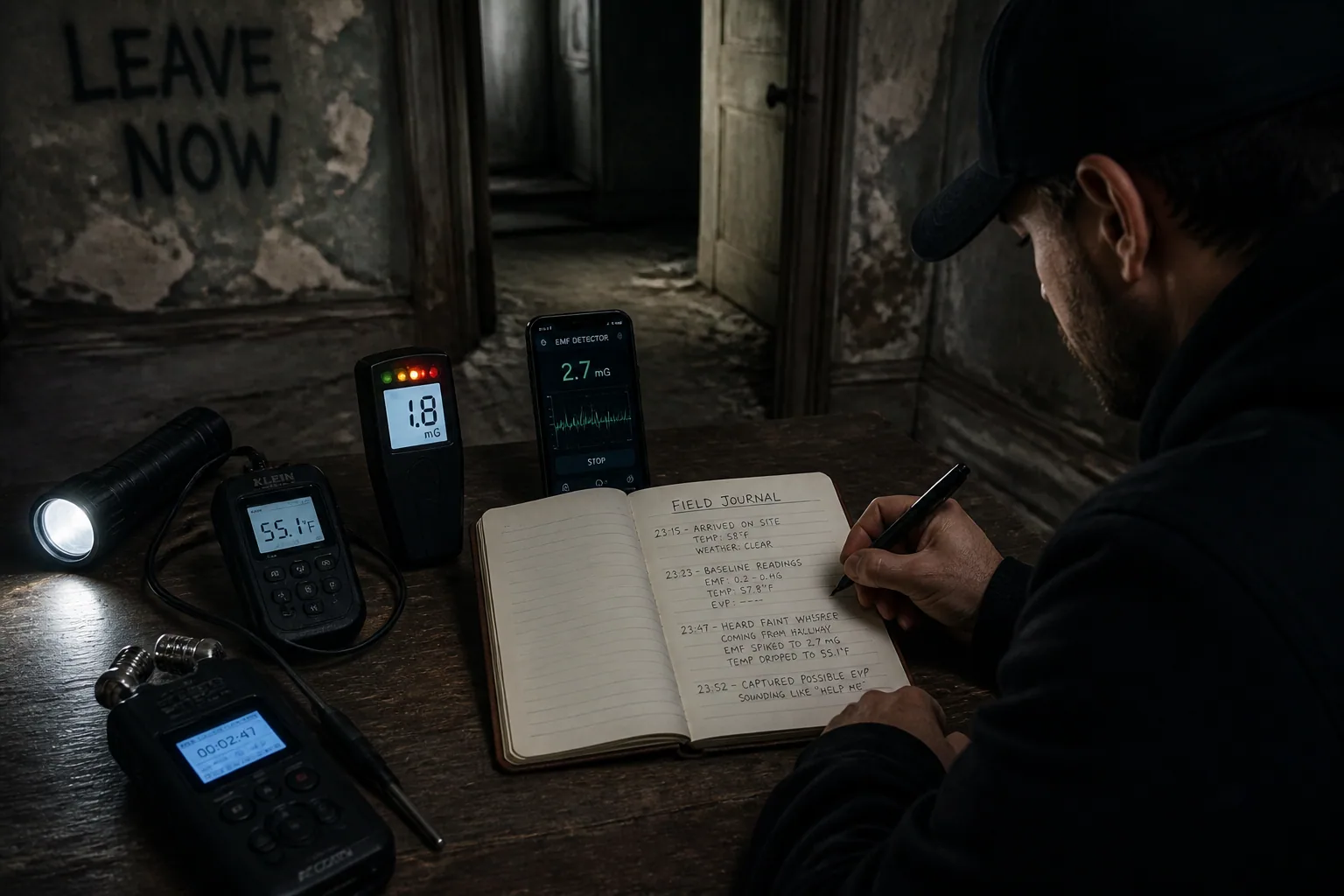
Ghost Hunting Journaling: Why Tracking Everything From EMF Spikes to Mental State Unlocks Real Discoveries
If you want better paranormal investigations, you do not always need better gear. Sometimes you need better notes. A disciplined ghost hunting journal can do more for your credibility, your observation skills, and your evidence quality than another flashlight, camera, or EMF meter ever will. When you record what happened, when it happened, what the environment was like, and how you were feeling, you create something much more valuable than a set of memories. You create a baseline.
That baseline matters because ghost hunts are full of variables. EMF readings fluctuate, temperature shifts happen, weather changes, people influence one another, and our own minds can amplify a sound, a shadow, or a mood into something that feels paranormal in the moment. Detailed logging does not kill the mystery. It helps you separate the meaningful from the noisy, which is exactly what serious investigators should want.
Why a Journal Can Be More Valuable Than New Ghost Hunting Gear
New equipment feels exciting because it promises a cleaner answer. A more sensitive meter, a better recorder, or a smarter app can absolutely help. But without context, more data is just more confusion. A journal gives that data meaning. It lets you compare one location to another, one hour of the night to the next, and one session to the next over time.
Think about it this way: if you only know that an EMF meter spiked, you know almost nothing. If you also know that the spike happened near a breaker box, during a radio transmission, after three people walked into a small room, and while a heating unit kicked on, the reading becomes far less mysterious. This is why logging is not busywork. It is part of the investigation itself.
A 2023 study on EMF readings at a non-haunted control site found that electromagnetic field levels are complex and time-varying even in places with no paranormal reputation, which is a strong reminder that baselines are essential for separating background noise from genuine anomalies. The researchers, Schumacher, Biddle, and Vickers, emphasized that fluctuations can look similar to those reported at haunted sites, which means careful records are not optional if you want to avoid fooling yourself. Source: https://philpapers.org/rec/SCHEFE-9
The Reliability Problem: False Positives, Bias, and Missed Context
The biggest problem in ghost hunting is not always that nothing happens. It is that too many things can look like something. A creak in a hallway can become a response. A cold draft can become a manifestation. A random EMF spike can become proof. Without context, investigators often overvalue the most dramatic moment and undervalue the conditions around it.
That is where false positives thrive. Household wiring, appliances, phones, radios, and metallic structures can all create readings that appear unusual if you are not documenting the surroundings. A University of California practice document on EMF investigation difficulty notes that phantom readings occur regularly when nearby electrical sources or devices are not carefully tracked. In other words, a meter can be technically accurate and still lead you badly astray if your notes are incomplete. Source: https://escholarship.org/content/qt3q71q8f7/qt3q71q8f7_noSplash_c05edc77a1ca4ed7e8be82bbc8d48172.pdf
Psychology adds another layer. Anomalistic psychology research shows that suggestion, pareidolia, agency detection, low light, sound reflections, and temperature gradients can all shape what people think they experienced. The more emotionally charged the setting, the easier it is to remember the scare and forget the context. Good journaling helps slow that process down and makes it easier to identify when the mind may be filling in gaps.
There is also the stress factor. A 2021 study on supposedly haunted natural environments found that believers experienced higher stress, suggestibility, and fatigue or irritability, and that paranormal belief and environmental attribution predicted a substantial portion of stress increase. That does not mean people are making everything up. It means mood and mindset can influence what gets noticed, how it gets interpreted, and how strongly it is believed in the moment. Source: https://www.sciencedirect.com/science/article/pii/S0169204621001468
What to Record on Every Investigation
A strong ghost hunting log should include both objective data and subjective observations. You want enough structure to compare hunts, but enough flexibility to note anything unusual. At minimum, every session should record the location, date, start and end time, who was present, weather, moon phase if relevant, equipment used, and every notable event with a timestamp.
The goal is not to write a novel during the hunt. The goal is to capture enough information that the session can be reconstructed later. If you review your notes weeks or months later, you should be able to answer basic questions: where were we, what changed, who was there, what did the environment do, and what did we feel?
Objective Data: EMF, Temperature, Time, Weather, and Location
Objective records are the backbone of any investigation log because they are easier to compare across sessions. Start with EMF readings. Note the baseline in each area before the hunt gets active, then log spikes with the exact location, meter type, and whether anything electrical could have explained the change. If possible, record whether the spike was brief or sustained, localized or spread out, and whether another meter or observer confirmed it.
Temperature is just as important. A sudden drop can feel compelling, but it means more when you know the starting temperature, the rate of change, the room’s size, whether windows or vents were open, and whether a person moved into the space. Even a seemingly dramatic cold spot may turn out to be a draft, a cooling system cycle, or simply a measurement taken near a wall that was colder than the rest of the room.
Time of day matters too. Some locations feel different at 9 p.m. than they do at 1 a.m., but not necessarily for paranormal reasons. Fatigue, reduced light, lower ambient noise, and changing human attention can all alter perception. Weather should also be logged because thunderstorms, heat, and cold nights may correlate with increased activity in some field reports, but they are not consistent predictors. A 2026 field article from Silent Slayer Ghost Tours noted that dramatic weather sometimes aligns with greater perceived spirit interaction, yet ordinary weather can produce activity as well. Source: https://silentslayertours.com/blog/f/how-weather-really-affects-ghost-hunting
Location notes should be specific. Do not just write the building name. Record the room, floor, doorway, hallway, and any nearby electrical sources or structural features. If an event happens near a panel, vent, old pipe, metal railing, or radio, that context may explain the reading or help identify a pattern later.
This level of detail becomes especially important if you suspect localized physical anomalies. In a 2019 study on reported object movements at a purported haunt, nearby EMF meters within two feet recorded suppression of EMFs while control meters farther away did not. Whether you interpret that as paranormal or environmental, it shows why proximity and placement matter. Source: https://www.researchgate.net/publication/340508724_CONCOMITANT_OBJECT_MOVEMENTS_AND_EMF-SPIKES_AT_A_PURPORTED_HAUNT
Subjective Data: Mood, Intuition, Fatigue, and Group Dynamics
A lot of investigators are careful about meters but careless about themselves. That is a mistake. Your emotional state can shape how you interpret the hunt. Were you anxious before entering the location? Were you exhausted? Were you already primed to expect activity? Did you feel more alert after a break or more suggestible after a long quiet stretch?
Log your mood in simple terms. You do not need a psychological essay. Use short entries like calm, tense, distracted, skeptical, excited, tired, or uneasy. If you had a strong intuition, write it down exactly as it happened, but separate the intuition from the evidence. That way, later you can see whether your gut feeling was useful or just a product of stress and atmosphere.
Group dynamics matter too. People influence one another constantly on paranormal investigations. A single comment can reshape what the whole team thinks happened. If one person says, “Did you hear that?” everyone else may start scanning the environment differently. That is why it is valuable to note when a response was spontaneous versus when it followed group suggestion.
Journaling also helps reveal the difference between shared excitement and shared evidence. A team can absolutely witness something strange together, but the more precisely you record each person’s location, reaction, and timing, the easier it becomes to tell whether the event was truly simultaneous or merely contagious.
Why Solo vs Group Sessions Can Change What You Experience
Solo hunts and group hunts are not the same experience, and your journal should treat them differently. Alone, you are more likely to notice subtle sounds and sensations, but you are also more vulnerable to misinterpretation, especially in low light or unfamiliar spaces. In a group, you gain cross-checks and support, but you also gain social pressure, suggestion, and noise.
Record how many people were present, who they were, and what roles they had. Was someone speaking constantly? Were there skeptics in the room? Was the group moving together or split up? Even simple differences in team energy can affect whether an event feels dramatic, forgettable, or transformative.
There is also a practical reason to document this: when you revisit logs later, you may discover that certain kinds of experiences happen more often when you are alone, while others only appear in groups. That pattern may not prove anything supernatural, but it can reveal the conditions under which your observations are most reliable.
How Lunar Phase, Time of Day, and Environment May Affect Patterns
Some investigators ignore lunar phase because it sounds too folkloric. Others overvalue it because it feels mysterious. The right approach is to log it and see what the data says. Research on reports from Tasmania’s Port Arthur Historic Penal Colony found higher frequencies of reported paranormal or sensory hallucinations around new and full moons, and that geomagnetic activity also influenced when reports were more likely to occur. Source: https://www.parapsychologypress.org/jparticle/jp-83-2-193-207
That does not automatically mean the moon causes hauntings. It does mean that repeating conditions may be associated with repeating experiences. If you never log lunar phase, you will never know whether your best nights cluster around certain cycles or whether that pattern is just coincidence.
Environmental context matters just as much. Darkness, humidity, wind, building age, acoustics, and nearby human activity all shape what people hear and feel. One reason careful journaling is so useful is that it helps you avoid making the same assumption twice. You may think you found a spirit on a windy night, only to realize later that the location produces similar effects whenever a certain room is under negative pressure or a nearby road gets busy.
Best Ways to Log a Hunt: Apps, Voice Notes, Audio Time Stamps, or Paper
There is no single best logging method. The best one is the one you will actually use consistently. Some investigators prefer mobile apps because they are fast and searchable. Others like voice notes because speaking is easier in the field than writing. Some depend on audio time stamps, while others still trust a paper journal because it never runs out of battery and encourages more deliberate observation.
If you use a phone, keep it simple. Date, location, baseline readings, and a quick event list are enough to make the session useful later. Voice notes are especially good when something happens suddenly and you do not want to miss the moment by typing. Later, you can transcribe the notes or align them with recorded audio.
Paper journals work well when you want to slow down and think. They are also useful in locations where you do not want to rely on signal, battery, or screen light. The downside is that paper is harder to search. A good compromise is to write the core facts in a notebook and then transfer highlights into a digital file after the hunt.
One practical option is to pair your notes with an app that already tracks session history. If you want a simple way to capture EMF fluctuations, record audio, and review previous hunts in one place, Ghost Detector: Ectify can help you keep everything in a single investigation flow: https://findthe.app/ectify-fc72z0
How to Review Old Logs and Spot Patterns You Missed in the Moment
The real value of journaling shows up after the hunt. A single session can mislead you, but ten sessions can reveal tendencies. Review your logs looking for repeated conditions, not just repeated outcomes. Maybe every major spike happens after 11 p.m. Maybe the same hallway always feels cold when the weather changes. Maybe the same team configuration produces the most unexplained events.
When reviewing old logs, ask three questions. First, what happened right before the event? Second, what else could explain it? Third, did anything similar happen under the same conditions before? Those questions move you from storytelling to analysis.
It also helps to mark events by type. For example, separate EMF spikes, temperature drops, voices, shadows, physical movement, and intuition-based impressions. Once categorized, patterns become easier to spot. You may notice that some rooms generate many sensations but few measurable anomalies, while others show the opposite.
Examples of Breakthroughs Found Only After Reviewing Detailed Notes
This is where journaling stops being theoretical. A detailed log can explain away a supposed haunting or uncover a real pattern that would otherwise have been missed. Imagine hearing a whisper in the same hallway on three different nights. Without notes, you might call it a repeating presence. With notes, you may discover that each event happened when a nearby event space was active and the building’s HVAC system was cycling in a specific way.
Or consider an EMF spike that seemed impossible in the moment. Later, your journal shows that the spike occurred every time a radio in the next room was keyed up, or whenever a particular investigator stood near a hidden conduit. That is not a disappointment. It is progress. You have learned something true about the location.
The reverse is also possible. A pattern that looked random may turn out to be meaningful only after enough sessions are compared. If the same subtle temperature shift happens at the same time of night, in the same room, under similar lunar or weather conditions, you may have found a repeatable anomaly worth deeper investigation.
Using Journaling to Separate Genuine Anomalies From Imagination
This is the main reason to write everything down: it protects you from your own brain. That sounds harsh, but it is true. Human perception is fast, emotional, and pattern-seeking. In a haunted location, that can be a strength and a weakness at the same time.
When you record your mental state, you create a useful filter. If a perceived event happened while you were exhausted, cold, stressed, and already expecting activity, you can treat the memory more carefully. If it happened while you were calm, well-rested, and later confirmed by another observer or another instrument, the event deserves more attention.
The point is not to dismiss intuition. The point is to train it. Over time, your instincts become sharper because they are repeatedly checked against reality. Good journaling creates that feedback loop. Bad journaling breaks it.
A Simple Ghost Hunting Log Template You Can Start Using Tonight
You do not need a complicated system to begin. Start with a simple template like this:
Location and room. Date and time. Names of investigators present. Weather and moon phase. Baseline EMF and temperature. Equipment used. Mood and energy level. Notable events with timestamps. Possible explanations. Follow-up needed.
If you want to keep it even easier, use a three-part format: before the event, during the event, after the event. That structure works well for both paper and digital notes, and it keeps you focused on sequence, which is one of the most important details in any investigation.
How Consistent Logging Sharpens Intuition Without Replacing Evidence
Good investigators do not have to choose between intuition and evidence. They can use both, but in the right order. Intuition tells you where to look. Evidence tells you whether what you found matters. Journaling trains that relationship by showing you how often a feeling actually leads to something measurable.
Over time, you may become better at noticing when a room feels active, when a team is too suggestible, or when an EMF reading is probably environmental. That is a real skill. It is not psychic certainty. It is disciplined perception.
And that discipline makes you more credible. If you can show a well-kept log, complete with timestamps, conditions, interpretations, and alternative explanations, you are no longer just saying something strange happened. You are showing how you investigated it.
Turning Better Notes Into More Credible Paranormal Investigations
The best ghost hunters are not the ones who claim the most. They are the ones who observe the most carefully. Journaling gives you a way to build that habit session by session. It improves your odds of catching real patterns, exposes equipment quirks, and reduces the chance that stress, suggestion, or bad context will hijack your conclusions.
It also makes your work easier to share and defend. When someone asks why you believe a reading mattered, you can point to the conditions around it. When a location produces repeat results, you can show the history. When a supposed anomaly turns out to be a wiring issue, you have the notes to prove it.
That is what separates memorable ghost stories from serious investigations. Careful logging does not remove the mystery. It makes the mystery clearer. And in paranormal research, clarity is often the most valuable evidence you can have.
