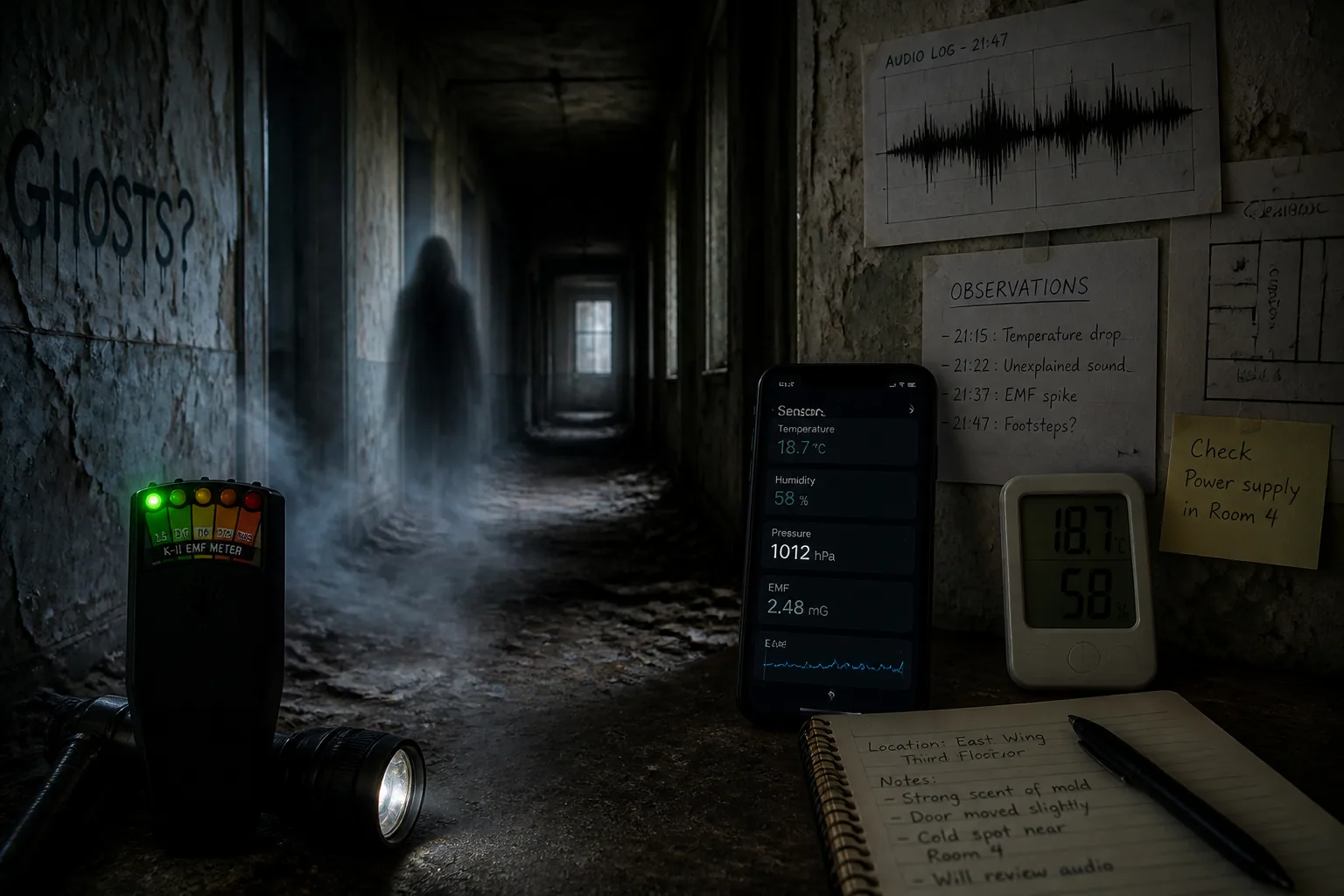
Ghost Hunting Myths vs. Documented Phenomena: What Holds Up Under Scientific Scrutiny?
Ghost hunting sits in a strange place between folklore, entertainment, and amateur fieldwork. It promises mystery, but it also produces a lot of claims that sound stronger than the evidence behind them. That is why a myth-vs-evidence reality check matters. If you want to understand what people experience in haunted places, you need to separate atmosphere, expectation, and environmental effects from anything that might truly be unexplained.
This does not mean every ghost story is false. It means the most dramatic parts of the story often have ordinary explanations that get overlooked. Cold spots can be caused by airflow. EMF spikes can come from wiring or nearby devices. Shadow figures can be misperceptions in low light. EVP recordings can be shaped by audio noise and listener bias. And sometimes the human brain is simply doing what it is built to do: finding patterns, filling gaps, and making sense of uncertainty.
Why Ghost Hunting Needs a Myth-vs-Evidence Reality Check
A serious investigation starts with a simple question: what exactly is being measured, and what else could produce the same result? Ghost hunting culture often skips that step. It jumps straight from an eerie feeling to a paranormal conclusion. That is understandable, because spooky experiences are memorable and emotionally intense. But memory is not measurement, and intensity is not proof.
The problem is that ghost-hunting lore has been shaped by many forces at once. Folklore gave us haunted rooms, restless spirits, and mysterious chills. Horror media amplified the idea that a drop in temperature means a presence. Investigation shows and social media then turned these ideas into a kind of toolkit, where gadgets and dramatic reactions can matter more than controls. The result is a field where people often report what they expect to find.
Scientific scrutiny does not erase the experience. It asks whether the experience is linked to known mechanisms. That is the standard that makes a claim stronger. If a haunting is real, it should survive attempts to rule out drafts, contamination, suggestion, and equipment error. If it does not, the mystery may be less supernatural and more methodological.
Where Popular Ghost Hunting Beliefs Came From
Many of the most famous ghost hunting beliefs were not born in laboratories. They grew out of older traditions, campfire stories, and the visual language of horror. A haunted house was once a place of moral warning or local legend. Later, films and television gave audiences a shared set of visual cues: flickering lights, cold air, whispers, shadowy movement, and unexplained static on a recorder.
That matters because repeated storytelling changes what people notice. Once a person has heard that spirits cause cold spots or that a shadow figure means a haunting, ambiguous sensations become easier to label. The category comes first, the interpretation second. In practice, this can make a normal event feel like confirmation of something paranormal.
Research on expectation effects supports this pattern. People primed to expect a haunted environment are more likely to report strange sensations in ordinary conditions. In other words, belief can change perception without changing the environment. That does not make the experience fake. It means the brain is part of the investigative system, and it has to be accounted for.
Do Cold Spots Really Signal a Spirit?
Cold spots are one of the oldest ghost hunting claims, and also one of the easiest to misunderstand. Reports of sudden chills are common in haunted-house lore, but scientific support for dramatic localized temperature drops is thin and often ambiguous. The Psi Encyclopedia notes that documented evidence for cold spots is scarce, and many reports correlate more closely with environmental factors or perceptual bias than with anything anomalous. Source: https://psi-encyclopedia.spr.ac.uk/articles/cold-spots/
There is also a practical reason cold spots feel convincing. Human temperature perception is highly sensitive to moving air, dampness, and body position. A draft from a vent, a gap under a door, or a shift in humidity can all feel like a chilling presence. In one study summarized by Ars Technica, areas in reputedly haunted locations associated with cold spots also had lower humidity, and temperature, lighting, and humidity varied in ways that could explain the sensations people reported. Source: https://arstechnica.com/science/2026/04/that-spooky-sensation-likely-due-to-rumbling-pipes-not-spirits/
So what should investigators do? Measure the room, not the mood. Use a thermometer, note where the airflow is, and compare the spot against nearby areas over time. If the cold feeling follows a vent, a corridor, or a damp wall, you have a clue. If it only appears when someone announces a spirit is near, that is also a clue.
What EMF Spikes Actually Mean in Investigations
EMF has become a staple of modern ghost hunting, largely because consumer meters make invisible signals feel concrete. But an EMF spike does not automatically mean a haunting. It means the electromagnetic field changed. The real question is why it changed.
Indoor EMF variations can come from wiring, appliances, fluorescent lighting, phone signals, power lines, elevators, and even the movement of nearby electronics. A spike is only useful if you know the baseline and have ruled out mundane sources. Without that context, the reading is just a reading.
Research is mixed, but it is more interesting than simple ghost stories suggest. A 2013 field study at a site without electrical sources found that EMF and geomagnetic field spikes were significantly associated with reported anomalous phenomena. At the same time, the timing and duration of the spikes were not reliably predictive, and increases versus decreases were not differentially meaningful. That means there may be a relationship worth studying, but the data do not support a simple formula like “spike equals spirit.” Source: https://www.parapsychologypress.org/jparticle/jp-77-2-212-236
Laboratory work adds another layer. Reviews of EMF exposure suggest that weak, complex electromagnetic fields, including geomagnetic activity, can sometimes contribute to sense-of-presence experiences in some people, especially when expectation is already high. The point is not that EMF proves ghosts. The point is that unusual electromagnetic conditions can affect perception in subtle ways. Source: https://www.emf-portal.org/en/article/12324
If you are using EMF as a ghost-hunting clue, treat it as a starting point for control testing, not as evidence on its own.
EVP Recordings: Paranormal Voices or Audio Pattern Recognition?
EVP, or Electronic Voice Phenomena, is one of the most compelling ghost hunting claims because it seems to offer a direct voice from the other side. In reality, EVP is also one of the most vulnerable claims to misinterpretation. Audio is messy. Noise, compression artifacts, radio bleed, and recorder behavior can all create patterns that sound meaningful when played back with expectation.
Controlled studies have had trouble supporting EVP as a paranormal phenomenon. In one experiment involving more than 60 hours of recording with multiple audio sources, no distinctly anomalous EVP was established under controlled conditions. That does not mean nobody ever hears something strange. It means the strongest claims fail when tested carefully. Source: https://www.researchgate.net/publication/290075852_Failure_to_replicate_electronic_voice_phenomenon
A recent historical and sociological analysis also argues that many EVP cases rely heavily on ambiguous audio and listener interpretation. In other words, the voice is often clearer after someone tells you what to hear. Technical issues such as radio interference and tape recorder artifacts are more parsimonious explanations than supernatural ones. Source: https://www.mdpi.com/2077-1444/15/12/1546
This is where a good investigative habit matters. Record clean audio. Keep the recorder away from phones and radios. Make note of background hum, footsteps, and traffic. Then listen back without priming the answer. If the words only appear once a claim has been suggested, you are probably hearing pattern recognition, not evidence of a voice.
Shadow Figures, Sleep Paralysis, and Low-Light Misperception
Shadow figures are among the most unsettling ghost reports because they exploit a basic human vulnerability: vision is unreliable in poor lighting. When the brain has limited information, it fills in missing detail. A coat on a chair, a doorway, a moving reflection, or a flicker in peripheral vision can easily become a person-shaped presence.
Research on shadow people points strongly toward sleep-related explanations, especially hypnagogic and hypnopompic hallucinations and sleep paralysis. These experiences occur at the edges of sleep and wakefulness, when perception, muscle control, and dream imagery can overlap. That is a perfect recipe for a vivid but mistaken impression of a figure in the room. Source: https://hauntedhosts.com/library/explainers/shadow-people-explained
Even outside sleep paralysis, the mind is prone to pareidolia, which is the tendency to see meaningful shapes in ambiguous input. In haunted spaces, where tension is already high, a dark corner can suddenly look like a person. A hanging curtain can look like movement. A shadow can look like an observer. Once that impression forms, it is easy for it to harden into certainty.
That is why timing matters. If someone sees a shadow figure late at night, after stress, exhaustion, or a long investigation session, the experience should be treated as a perceptual event first. It may still be important, but it is not automatically paranormal.
Infrasound, Mold, Carbon Monoxide, and Other Hidden Causes
Some haunted experiences are not psychological in the abstract sense. They are environmental. Infrasound, for example, can create discomfort, unease, and odd bodily sensations without being consciously noticed as a sound. Mold exposure can contribute to fatigue and cognitive fog. Carbon monoxide is especially important because it can cause headache, confusion, and bizarre perceptions, which is why any serious haunted-location safety check should include basic environmental awareness.
The Haunt Project experiment is often cited here because it exposed participants to infrasound and fluctuating EMFs in a purpose-built chamber. Some people reported feelings of presence, dizziness, and odd smells, but the findings suggested that suggestion and belief were stronger drivers than the environmental manipulations alone. Source: https://www.sciencedirect.com/science/article/pii/S0010945208001299
That does not mean infrasound or other hidden causes are irrelevant. It means the environment can shape experience in complicated ways. A draft may cause a cold spot. A faint vibration may make a room feel uncanny. Poor air quality can make people feel unwell. Once the body is off balance, the mind is more likely to interpret uncertainty as danger, presence, or intrusion.
Case Studies: Famous Hauntings Revisited Through Science
Famous hauntings often look strongest when told as a story and weakest when examined as a system. A room that supposedly produces cold spots may actually be near a ventilation problem. A corridor with repeated EMF readings may sit beside a hidden electrical source. A recurring voice on a recorder may be a radio artifact or a misheard fragment. The legend survives because each piece is emotionally persuasive, not necessarily because each piece is independently verified.
The strongest scientific approach to a haunting is to ask whether the same effect can be reproduced under controlled conditions. If a room causes chills, does it still do so when humidity, airflow, occupancy, and time of day are tracked? If a shadow figure is seen repeatedly, do sightings cluster around fatigue, darkness, or sleep loss? If a voice appears on tape, does it remain after audio filters, device swaps, and blind review? Most famous cases become less mysterious when those questions are asked carefully.
That said, some cases do remain incomplete. Human perception is not a lab instrument, and old buildings change over time. A haunting may be a bundle of separate events rather than one single cause. Science is most useful when it trims away weak explanations without pretending to answer what has not yet been tested.
What Researchers and Investigators Agree On
There is more agreement in this field than people assume. Researchers and experienced investigators usually agree that context matters. They agree that controls matter. They agree that anecdote alone is not enough. They also agree that people can have genuine experiences that feel paranormal even when the cause is ordinary.
Where they diverge is in interpretation. A skeptic may see a perceptual error. A believer may see an incomplete explanation. A careful investigator sees a data problem that needs better testing. That is the healthiest position, because it keeps curiosity alive without turning every anomaly into a conclusion.
Across the research, a few themes keep showing up. Expectation shapes reporting. Environmental conditions can produce physical sensations. Audio and visual ambiguity create false positives. And consumer ghost-hunting gadgets often provide more theatrical certainty than scientific reliability. The best investigations are the ones that reduce guesswork, not amplify it.
How to Test Paranormal Claims Using a Smartphone and Basic Tools
You do not need a van full of expensive equipment to investigate better. In fact, a smartphone can be a surprisingly useful tool if you use it carefully. Many phones include sensors that can help you document temperature trends, sound, motion, light changes, and magnetic fluctuations. The point is not to prove a haunting with a phone. The point is to create a record that can be checked later.
Start with audio. Record before, during, and after the event. Keep your phone still and note exactly when something unusual happens. If possible, use a second device for backup. Then add written notes. Time, location, weather, who was present, what lights were on, whether doors or windows were open, and what you were feeling all matter. Details that seem boring in the moment can become crucial later.
Next, establish a baseline. Walk the space when nothing unusual is happening and compare readings. If the magnetometer fluctuates near a wall, try a different spot. If the temperature dips near a vent, check airflow. If a voice appears on recording, see whether anyone outside the room could have generated it. A claim becomes stronger when it survives comparison, repetition, and blind review.
If you want a more organized way to capture sessions, Ghost Detector: Ectify can help by turning your smartphone into a ghost-hunting setup with real-time EMF detection, session recording, and history tracking. It is not a substitute for controls, but it can make documentation more consistent: https://findthe.app/ectify-fc72z0
A Practical Checklist for More Credible Ghost Investigations
Before you call something paranormal, work through a basic checklist. First, rule out airflow, HVAC, open windows, and temperature gradients. Second, check for electrical sources, hidden wiring, and nearby devices that could affect EMF readings. Third, consider lighting conditions and camera limitations. Fourth, note fatigue, stress, alcohol, illness, and sleep loss, since each can distort perception. Fifth, compare experiences across multiple nights rather than relying on a single dramatic moment.
It also helps to create controls. Record in a room next door. Turn off unnecessary electronics. Repeat the same route with different people. Use blind listening when reviewing audio, so you are not telling yourself where the EVP should be. If possible, have one person handle the procedure while another records observations without discussing what they expect to find.
Most importantly, do not confuse a strong feeling with a strong result. Good investigation is patient. It tolerates uncertainty. It prefers measured oddities over dramatic assumptions. And it accepts that the most valuable discovery might be that the haunting was environmental, psychological, or both.
Which Ghost Stories Still Resist Easy Explanation?
After all the debunking, some stories still feel unresolved. That is partly because not every case has enough data, and partly because human experience is more layered than any one explanation can capture. A location might have drafts, old wiring, and suggestive folklore, yet still produce events that witnesses sincerely cannot explain. That does not make the supernatural conclusion the best one, but it does mean the file is not always closed.
The most intellectually honest position is this: many ghost claims collapse under better testing, but a smaller set remains ambiguous because the evidence is incomplete. Ambiguity is not proof of ghosts. It is a reminder that investigation is a process. The more carefully you measure, document, and control for bias, the closer you get to whatever is actually happening.
So, what holds up under scientific scrutiny? Environmental effects, perceptual quirks, expectation, and some genuinely measurable but non-paranormal phenomena. What does not usually hold up? Automatic assumptions that cold spots, EMF spikes, EVP, and shadow figures are direct evidence of spirits. The mystery may remain, but the explanation usually starts closer to home.
