Ghost Hunting on a Budget: How to Make Powerful Paranormal Tools from Things You Already Own
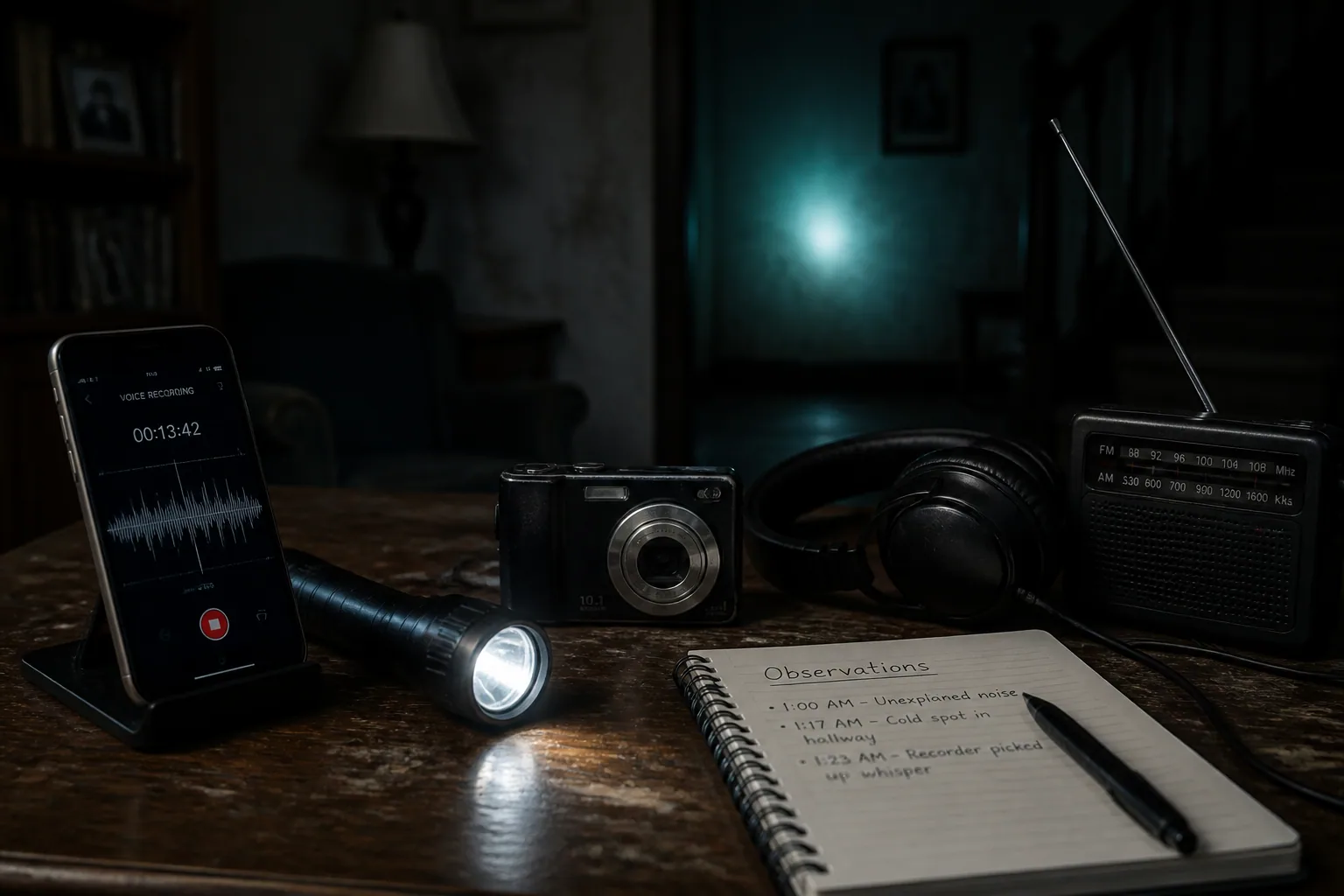
You do not need a suitcase full of expensive gadgets to start ghost hunting. In fact, some of the most useful paranormal investigation tools are probably already in your home: a smartphone, a flashlight, a voice recorder, a camera, a radio, and a few simple household items for quiet monitoring and note-taking. The key is not buying more gear, but learning how to use what you already have with care, consistency, and a skeptical eye.
That approach matters because budget ghost hunting is not about pretending every strange sound is evidence. It is about building a repeatable process. If you can record clean audio, track environmental changes, reduce contamination, and document your observations honestly, you can do meaningful paranormal work without spending much at all.
Why Ghost Hunting Doesn’t Have to Be Expensive
A lot of beginners assume paranormal investigation requires specialized devices, but the basics are surprisingly accessible. Most investigations rely on three things more than anything else: observation, documentation, and comparison. You need to notice something unusual, record it accurately, and then compare it against normal explanations.
That is why simple tools often outperform flashy ones. A phone can record audio and video. A flashlight can help you detect movement or inconsistencies in shadows. A cheap radio can create a controlled audio environment for experiments. Even basic household items like timers, notebooks, and extension cords can help you monitor a space without introducing unnecessary noise or confusion.
The real advantage of low-cost ghost hunting is that it forces you to be methodical. If your evidence holds up when all the expensive gadgets are removed, it is usually stronger evidence. And if it falls apart under basic scrutiny, you save yourself from chasing a false lead.
The Everyday Items That Can Double as Paranormal Tools
You may already own enough equipment for a solid beginner setup. A smartphone is the most versatile tool because it can handle audio recording, video, photos, timestamps, notes, and even sensor-based experiments. A portable voice recorder is excellent for longer sessions because it is usually more reliable than a phone for continuous capture.
Flashlights can be used to check for environmental changes, visualize movement in a dark room, or watch for flicker patterns that may indicate loose wiring or interference. Cameras, including older digital cameras, are helpful for still shots and wide-angle room documentation. Radios can be used for controlled sound-based experiments, especially when you want to compare random noise against claimed voices or responses.
Even ordinary household appliances can help create a better investigation environment. A fan can reveal how sound travels through a room. A clock can provide a steady reference for timing. Sticky notes can mark doors, drawers, and object positions before a session, helping you see whether something was moved later. The goal is not to make the house look haunted. The goal is to make the environment measurable.
How to Use Your Phone for EVP Sessions and Environmental Notes
For many beginners, the phone is the best starting point. It is always available, easy to operate, and good enough for initial EVP sessions and field notes. That said, phones are not ideal for the cleanest possible EVP work. Smartphone recordings can suffer from compression, limited frequency range, and internal signal-processing noise, which means they are useful, but not the gold standard for final analysis. According to UK Paranormal eXperience guidance, smartphones are usable in budget setups, but they are still inferior to dedicated digital recorders for EVPs. Source: https://ukpx.org/2025/10/12/electronic-voice-phenomena-evp-best-practices-and-technical-guidance/
The best way to use a phone is to treat it like a field notebook that happens to record sound. Before you begin, test your recording app in normal conditions so you know what it sounds like when the phone is handling background noise, app glitches, or automatic processing. Beginners Guide to Ghost Hunting with Just a Smartphone recommends testing apps first so you can tell normal ambient fluctuations from bugs or unusual events. Source: https://www.paraghosts.com/beginners-guide-to-ghost-hunting-with-just-a-smartphone/
During the session, announce the date, time, location, and investigator names at the start. If people enter or leave, say it out loud. If someone moves an object or opens a door, announce that too. The Paranormal’s guide to digital voice recorders emphasizes that this makes later review much easier because any sound can be tied back to a known source. Source: https://www.theparanormal.net/digital-voice-recorders-guide-for-ghost-hunters/
If you are doing EVP work, keep your questions short and leave pauses between them. Speak normally and do not whisper. TVI.Show also recommends no whispering and one speaker at a time so that playback stays clean and easy to evaluate. Source: https://www.tvi.show/ghost-gear/capturing-evp-best-practices-for-recording-spirit-voices-in-paranormal-investigations
Turning Flashlights, Cameras, and Radios Into Investigation Gear
Flashlights are more useful than many people think. A cheap flashlight can help you track movement, compare room-to-room lighting differences, and notice when a shadow is caused by an object rather than a sudden environmental change. If you set a flashlight on a stable surface and observe it over time, you may spot vibration, flicker, or dimming caused by batteries, not anything paranormal. That makes it a useful control tool as well as a practical light source.
Cameras are ideal for documenting the scene before any investigation begins. Take wide shots of the room, then close-ups of windows, vents, mirrors, electronics, and reflective surfaces. If you later hear a noise or notice something odd, these reference images help you check whether the area already contained a likely explanation. A phone camera is perfectly acceptable here, especially if you keep notes about the angle and time of each photo.
Radios can be used in a few different ways. Some investigators use them for simple audio background experiments, while others use them to see whether a claimed response actually rises from the noise floor or if it is just the brain trying to impose patterns on random sound. If you use a radio, keep the volume steady and document exactly what station, static level, or sweep setting you used so your results can be compared later.
If you want a more immersive but still budget-friendly option, a product like Ghost Detector: Ectify can turn your smartphone into a broader ghost-hunting companion by combining EMF-style readings, session recording, and shareable history in one place. It is a convenient way to keep all your sessions organized without buying separate hardware: https://findthe.app/ectify-fc72z0
DIY Tricks to Improve Recording Quality at Home or On Site
Good evidence starts with cleaner audio. If you are setting up at home, choose the quietest room you can find. Close windows and doors, silence notifications, and turn off noisy appliances before you begin. Friendly Specter specifically advises shutting off noisy appliances, closing windows and doors, and silencing electronics to reduce background noise during EVP recording. Source: https://www.friendlyspecter.com/how-to-record-an-evp-step-by-step-guide/
A simple voice-activated recorder, or VAR, can also save time. EyeSpySupply reports that when a VAR is properly set, it can reduce review time by about 40 to 70 percent by skipping silent stretches. That is especially useful for longer investigations where you do not want to listen to hours of empty audio. Source: https://blog.eyespysupply.com/2026/01/24/using-voice-activated-recorders-for-ghost-hunting-and-evp-investigation/
Recording quality matters too. The same source recommends at least 44.1 kHz sample rate and 16-bit depth for EVP work, with some higher-end investigations using 96 kHz and 24-bit recordings. If your device allows those settings, use them. If it does not, just make the best recording possible and document the limitations.
You can improve your setup without buying anything. Place the recorder on a folded towel or cloth to reduce table vibrations. Keep it away from vents, speakers, and buzzing electronics. If you are using more than one device, place them in different parts of the room so you can cross-check whether a sound is local or present across multiple recorders. TVI.Show recommends multiple recorders in different locations for exactly that reason. Source: https://www.tvi.show/ghost-gear/capturing-evp-best-practices-for-recording-spirit-voices-in-paranormal-investigations
One of the smartest habits you can build is verbal tagging. If an air conditioner starts, say so. If a door creaks, say it. The Paranormal’s guide recommends announcing ambient noises during recording so they are easy to identify later. This small habit can save hours of confusion during playback. Source: https://www.theparanormal.net/digital-voice-recorders-guide-for-ghost-hunters/
How to Reduce False Positives and Rule Out Normal Explanations
This is where budget ghost hunting becomes serious. The less gear you have, the more important your process becomes. A strange sound is not paranormal just because you cannot explain it immediately. It might be wind, a cooling pipe, a loose hinge, a distant car, a phone interference issue, or even your own movements echoing in a hallway.
Start by eliminating the obvious. Record a room while no one is speaking. Then repeat the same test with the same setup on a different day. If the same noise appears again in a predictable place, you have a pattern to investigate rather than a mystery to believe in. If you can recreate the sound by closing a door, shifting your weight, or moving a chair, you have already learned something valuable.
For EVP specifically, it helps to classify what you hear. UK Paranormal eXperience notes common EVP categories: Class A is clear and easily understood, Class B is audible but indistinct, and Class C remains unclear or ambiguous even after editing. Source: https://ukpx.org/2025/10/12/electronic-voice-phenomena-evp-best-practices-and-technical-guidance/
That classification approach keeps you honest. A Class C sound may be interesting, but it should not be treated like strong evidence. The more ambiguous the audio, the more carefully you should compare it with the room conditions, your notes, and the timestamps from other devices.
It also helps to compare multiple sources. If your phone captures a noise but a second recorder in the same area does not, the sound may be device-specific. If both recorders catch it, you still need to check whether it came from the environment. Cross-comparison is one of the best ways to prevent wishful thinking from taking over.
Safety Rules for Investigating Unfamiliar or Abandoned Locations
Never treat an unfamiliar or abandoned property like a playground. Safety comes first. Check for structural hazards such as weak floors, broken glass, exposed nails, mold, water damage, unstable stairs, and low visibility. If a place looks unsafe, leave. No piece of evidence is worth an injury or an emergency call.
Investigate with at least one other person whenever possible, and make sure someone outside the location knows where you are. Keep your phone charged and bring a basic flashlight even if you plan to rely on night vision or screen light. Avoid rushing into dark rooms. Let your eyes adjust, move slowly, and document the layout before you start any audio or visual session.
Do not enter private property without permission. That is both unsafe and unethical. If a location is open to visitors, still respect posted rules, restricted areas, and closing times. Abandoned does not mean unowned, and curiosity is not an excuse to trespass.
If you are investigating outdoors, pay attention to weather, traffic, wildlife, and nearby power sources. Many supposed anomalies turn out to be simple environmental effects. Wind through broken windows, insects near a microphone, and distant machinery can all create convincing false leads.
The Ethics of Ghost Hunting: Consent, Respect, and Privacy
Good ghost hunting is not just about evidence. It is also about how you treat people, places, and stories. Paranormal Phenomena Research & Investigation says investigators should obtain consent when working on private property, clearly explain what participants should expect, and avoid misrepresenting abilities or findings. Source: https://www.ppri.net/about/about-us/learn-more/
That means you should never exaggerate a sound just to make it look dramatic. If you are unsure what something is, say so. If your results are inconclusive, say that too. Honest uncertainty is far more credible than fake confidence.
Respect also means protecting privacy. Do not publish personal details, home layouts, or identifying conversations without permission. If you record guests, residents, or staff, make sure they understand that audio and video may be captured. If a location has a sensitive history, handle it carefully and avoid turning someone else’s trauma into entertainment.
A respectful investigator is also a better investigator. People are more likely to grant access, share background information, and cooperate during a session when they trust that you are there to document, not to exploit.
Real Examples of Paranormal Evidence Captured With Minimal Gear
Some of the most compelling ghost-hunting stories come from simple setups, not high-end equipment. EyeSpySupply describes a real-world scenario in an old UK house where a voice-activated recorder with a 1 to 2 second pre-buffer captured a whispered phrase during a silent monitoring segment. Without that pre-buffer, the device would have started too late and the sound may have been missed entirely. Source: https://blog.eyespysupply.com/2026/01/24/using-voice-activated-recorders-for-ghost-hunting-and-evp-investigation/
That example is important because it shows how tiny details matter. You do not need a supernatural-looking machine to get a meaningful result. Sometimes the difference between evidence and nothing is a recorder setting, a careful pause, or a better position in the room.
There are also many investigation stories where a simple phone recording or a second handheld recorder helped confirm that a sound was present across multiple devices. That does not prove a paranormal cause by itself, but it does strengthen the case that something unusual happened. And in ghost hunting, a careful record of a strange event is often more useful than a dramatic story with no evidence behind it.
The best examples are usually the least flashy. A clear timestamp. A clean audio clip. A photographed room with no obvious source for the noise. A consistent report from multiple listeners. Those are the building blocks of a credible investigation, and none of them require a big budget.
A Simple Budget Ghost-Hunting Kit You Can Build Today
If you want to start tonight, keep it simple. You only need a few items to build a practical beginner kit: a smartphone, a charger or power bank, a flashlight, a notebook, and either your phone’s recorder or a basic voice recorder. If you already have a second phone or another recorder, even better.
Here is a strong no-frills setup: use your phone for notes and photos, another device for continuous audio, and a flashlight for visual checks. Add a small towel to stabilize devices, and bring sticky notes or tape to mark objects or doors before the session. If you can, set one recorder near the center of the room and another farther away to compare sound sources.
Before you begin, write down the location, time, weather, and any noises you expect to hear. Then start recording, speak clearly, and leave deliberate pauses. During review, categorize every interesting sound, note the possibility of normal causes, and compare the results across devices. That process alone will make your investigations far more credible.
Ghost hunting on a budget is not about cutting corners. It is about learning to be observant, disciplined, and honest with what the evidence actually shows. With a few household items and a careful method, you can run thoughtful paranormal experiments without spending a fortune.
