Ghost Hunting on the Go: How Mobile Devices & Wearables Are Transforming Paranormal Investigation
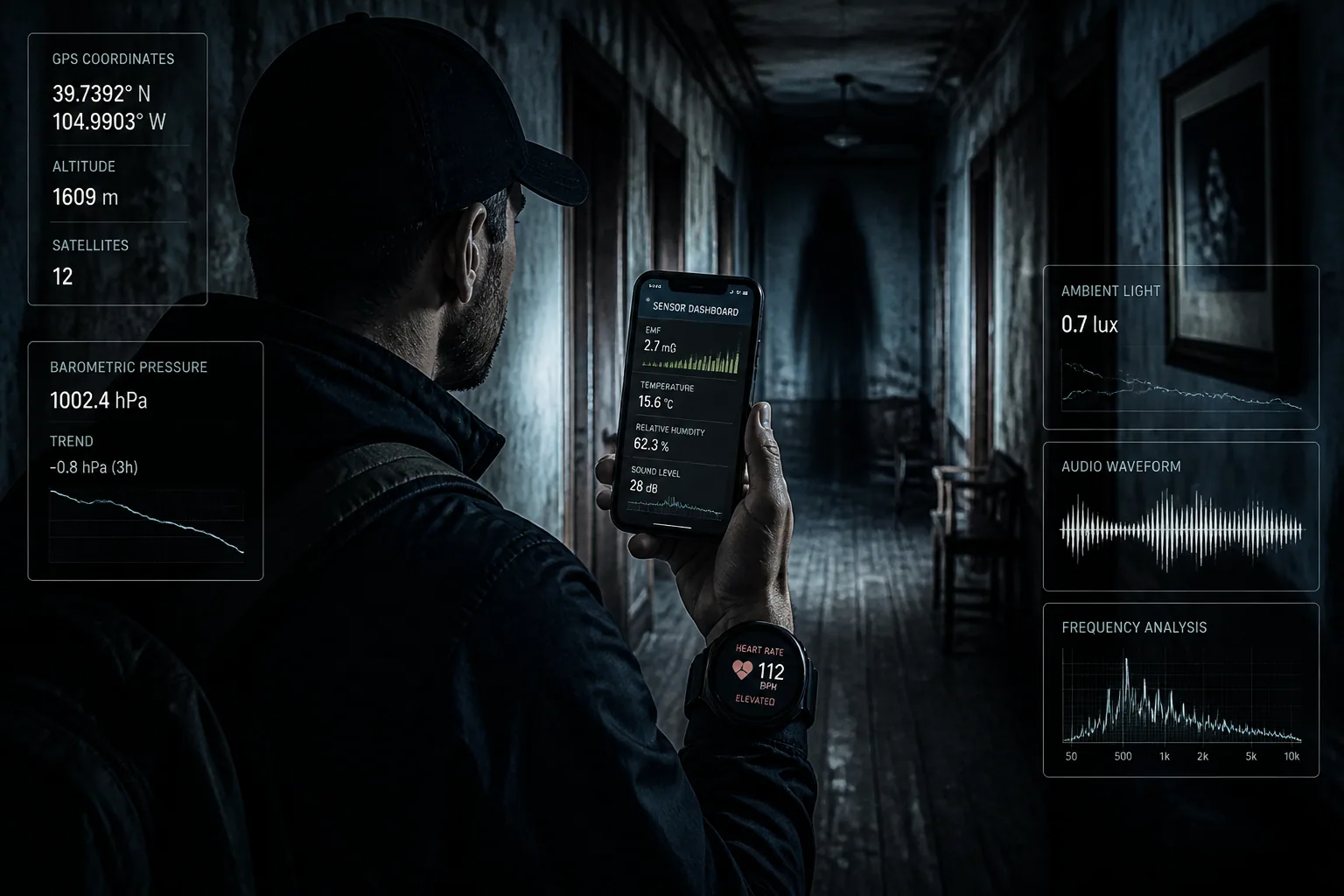
Paranormal investigation used to mean packing a bag full of dedicated gear, from EMF meters to audio recorders to infrared cameras. Today, a surprisingly capable toolkit already lives in your pocket and on your wrist. Smartphones, tablets, and wearables now offer sensors and logging features that can help you document environmental change, track movement, preserve timestamps, and even compare physiological reactions during a session. That does not make them perfect ghost hunting tools, but it does make them practical ones.
The big shift is convenience with context. Mobile tech is lightweight, always available, and often more data-rich than older novelty devices. At the same time, these devices are not magic. They can be affected by background apps, sensor drift, environmental interference, and user bias. If you want credible results, the goal is not to believe every spike. It is to build a cleaner investigation process, establish baselines, and rule out ordinary causes first.
Why Mobile Tech Is Becoming a Serious Paranormal Tool
A modern smartphone is far more than a camera. As noted in patent-related sensor documentation, smartphones commonly include accelerometers, gyroscopes, magnetometers, ambient light sensors, GPS, proximity sensors, multiple cameras, and microphones, all of which can be useful in fieldwork when used thoughtfully. https://ptacts.uspto.gov/ptacts/public-informations/petitions/1549344/download-documents?artifactId=r9LuIoXZBd4q3OiyDS6EqpPCdBmuhhMNOLX-k4gtDJt_jh96BlVaVM4
That matters because paranormal investigation is often about pattern recognition. When a location feels active, investigators want to know what changed, when it changed, where it changed, and whether the change can be reproduced. Mobile devices are good at capturing exactly that kind of context. They can timestamp events, tag locations, record environmental shifts, and keep a session log without requiring a box full of specialized hardware.
They are also appealing because most investigators already know how to use them. Instead of learning a dozen separate devices, you can use one familiar platform for video, audio, sensor readings, note taking, and mapping. For beginners, that lowers the barrier to entry. For experienced investigators, it creates a more streamlined and portable workflow.
What Your Smartphone Sensors Can Actually Measure
The most useful thing about a smartphone is not that it can detect ghosts. It is that it can measure change. Sensors in a phone can help you observe motion, orientation, light, location, and nearby magnetic disturbance. When those readings are recorded with enough context, they can support a more disciplined investigation.
For example, ambient light sensors can detect changes in illumination over a wide range, from very dim conditions to bright daylight. That makes them useful for spotting unexplained light fluctuations, but also for identifying simple causes such as a door opening, a passing vehicle, or a flashlight beam entering the room. https://en.wikipedia.org/wiki/Ambient_light_sensor
Academic work has also shown that accelerometers and orientation sensors in smartphones are widely used in physics experiments to detect motion patterns such as oscillations and shifts in angle. In paranormal work, that same basic capability can help identify movement in a device, object, or surface, especially when you are trying to separate genuine disturbance from a table that is simply unstable. https://arxiv.org/abs/1406.3867
Magnetometers are probably the most commonly repurposed sensor in ghost-hunting apps. They are often marketed as EMF-style detectors, but there is an important limitation here. A phone magnetometer is not a laboratory-grade electromagnetic survey instrument. It is sensitive, but also easily influenced by nearby electronics, power sources, and even how you hold the device. Used carefully, it can flag magnetic changes worth investigating. Used carelessly, it can turn every Wi-Fi router into a paranormal event.
Using Accelerometers, Gyroscopes, and Motion Data in the Field
Accelerometers and gyroscopes are best understood as movement sensors. They tell you whether the device has shifted, tilted, vibrated, or been jostled. In an investigation, that can be useful in several ways. You can monitor whether a table, floorboard, or doorway is vibrating when no one is supposed to be near it. You can also use a device to track whether a supposed event happened while the phone was completely still or while someone had accidentally bumped it.
This kind of data is especially helpful when investigating claims of object movement. If a small object slides, tips, or falls, a simultaneous motion spike on the phone may tell you that the change was caused by a physical disturbance rather than an unseen force. On the other hand, if the phone remains stable while a camera records an anomaly, that at least gives you a cleaner line of inquiry.
The key is to treat these sensors like evidence support, not proof. Motion data becomes stronger when it is paired with video, audio, and notes. Without that context, a spike is just a spike.
Barometers, Ambient Light Sensors, and Environmental Change Tracking
Barometers are one of the most underrated tools for field documentation. In practical terms, they measure air pressure, which can shift when doors open, windows are disturbed, heating systems cycle, or weather changes. In a paranormal setting, that means a pressure change might help explain a draft, a sound, or a sudden temperature sensation. It is not inherently spooky, but it is useful for narrowing possibilities.
Ambient light sensors serve a similar purpose for visual conditions. A light change can reveal everything from a failing bulb to a camera exposure issue. They can also help you check whether a reported anomaly coincides with a genuine environmental shift. If the room suddenly darkens, you want to know whether that was a shadow, a passing cloud, or a camera problem.
Together, barometers and light sensors help turn a vague impression into trackable data. That is a major step forward from relying on memory alone. When paired with timestamps, these measurements create a more reliable timeline for the session.
How GPS, Time Stamps, and Mapping Improve Investigation Logs
Good paranormal investigation is as much about recordkeeping as it is about equipment. GPS and time stamps may not sound exciting, but they help establish where and when something happened. That matters if you are revisiting a site, comparing rooms, or trying to correlate activity with specific weather, traffic, or building patterns.
Mapping also makes your notes more useful later. If you mark the same hallway, staircase, or room across multiple visits, you can compare reports over time instead of starting from scratch. This is especially important in larger locations where activity may be uneven. A simple location log can reveal that what felt random was actually recurring in one area and absent in another.
For serious fieldwork, the best habit is to log raw observations immediately. Record the room, device, time, weather if relevant, and what everyone present was doing. Then your sensor data has a real-world frame instead of floating as an isolated mystery.
Can Cameras, Microphones, and ToF Sensors Capture Useful Evidence?
Yes, but with caution. Cameras and microphones remain among the most valuable tools in any investigation because they create a direct record. A phone camera can capture light anomalies, movement, reflections, dust, and human behavior in one shot. A microphone can capture unexplained sounds, footsteps, knocks, and environmental noise for later review.
The problem is that cameras and microphones also capture a huge amount of ordinary interference. Dust in front of the lens can look dramatic. A noisy HVAC system can sound like a whisper. Automatic exposure and compression can create artifacts that seem strange but are entirely technical. This is why video and audio evidence should always be reviewed carefully and ideally alongside control footage.
Some newer phones also include depth or time-of-flight, often called ToF, sensors. These can help estimate distance and spatial changes in the scene. In theory, that makes them useful for monitoring movement or detecting changes in a room layout. In practice, their usefulness depends heavily on the device and the app. They are promising, but not yet a replacement for dedicated imaging tools.
What Smartwatches and Wearables Add to Paranormal Investigations
Wearables add a different kind of evidence. Instead of measuring the environment directly, they measure how the investigator responds to it. That is valuable because many paranormal reports include fear, stress, chills, elevated pulse, or a sudden feeling of dread. A wearable can show whether those reactions were accompanied by measurable physiological changes.
Some devices are surprisingly advanced. For example, the Withings ScanWatch 2 offers continuous tracking of heart rate, heart rate variability, SpO₂, body temperature, breathing disturbances, sleep stages, and ECG snapshots. https://www.crutchfield.com/p_2386711312/Withings-ScanWatch-2-Blue-42-mm.html
Other wearables, such as the Frontier X2, provide 24-hour continuous ECG recording, respiratory rate tracking, strain monitoring, and exportable metrics. https://fourthfrontier.com/pages/heart-rate
That kind of data can be useful when you want to compare a reported event with a measurable physiological reaction. If someone claims to feel a presence, you can look at pulse, breathing, or stress markers before, during, and after the moment. It does not prove paranormal activity, but it can show whether the event had a consistent physical effect on the witness.
Using Heart Rate and Skin Response as Correlated Evidence
Heart rate and related signals are best used as correlation tools. If an investigator’s pulse rises every time they enter a certain room, that may suggest anxiety, anticipation, temperature change, or a genuine environmental trigger. It is only meaningful if you compare it with baseline readings and with the same person in other parts of the location.
Some wearables also track skin response, temperature changes, or stress-adjacent metrics. These can be interesting when tied to a report of sudden dread or a physical sensation. Still, you must be careful not to treat emotion as evidence by itself. People react strongly to dark spaces, silence, and expectation. A physiological spike may be real without being paranormal.
The real value comes from pairing data streams. If a voice anomaly, a temperature drop, and a heart rate rise all occur within a narrow window, you have something worth studying. If only one metric changes, the simpler explanation is often the better one.
Dedicated Ghost Hunting Gear vs. The Devices You Already Own
Dedicated tools still have a place. EMF meters, digital thermometers, audio recorders, and infrared cameras are designed for specific tasks and can be easier to interpret when used correctly. However, many dedicated ghost-hunting devices are also limited. Some have vague LED bars, no frequency information, no logging, and questionable calibration. According to technical criticism of EMF gear, issues like orientation effects, RF interference, and lack of meaningful frequency separation can make readings harder to trust. https://ukpx.org/2025/10/12/emf-and-ghost-detection-a-technical-guide-for-serious-investigators/
That is where phones and wearables become attractive. They are not necessarily more accurate in every category, but they often give you more context, better timestamping, and easier export options. They also reduce the amount of gear you need to carry. For many investigators, that tradeoff is worth it.
The ideal approach is not either-or. Use the device you already own for logging, correlation, and convenience, and use dedicated gear where it truly adds value. The strongest cases usually come from multiple tools agreeing, not one gadget shouting the loudest.
The Biggest Limits of Phones, Tablets, and Wearables
The biggest limitation is that these devices were not built for ghost hunting. They were built for consumer convenience. That means sensor outputs may be filtered, app-controlled, or influenced by power management and background processes. A reading can look dramatic while actually reflecting software behavior, not the physical world.
There is also the problem of interference. Nearby electronics, Wi-Fi, Bluetooth, power cables, and even the phone itself can affect readings. Magnetometers are especially vulnerable to this, and EMF-style apps can easily mislead users if they are treated as direct proof of activity.
Wearables have their own weaknesses. Stress metrics can be affected by caffeine, movement, anxiety, breathing, temperature, and sleep debt. In other words, a spike on a watch does not automatically mean something supernatural happened. It may simply mean the investigator was cold, startled, or out of breath.
False positives are common in paranormal work for a reason. Drafts, wiring, switching power supplies, lighting changes, creaking structures, wildlife noises, insects, and dust or debris in front of lenses can all create misleading evidence. https://www.tvi.show/ghost-gear/skepticism-and-equipment
How to Calibrate Devices and Build a Reliable Baseline
If you want credibility, calibration and baselines are not optional. Start by measuring the normal state of the location before any active investigation begins. Note room temperature, light levels, pressure if available, signal conditions, noise patterns, and the investigator’s resting physiological state. Then repeat those measurements under similar conditions at different times.
Where possible, calibrate the device or at least verify consistency. Use the same phone, the same wearable, the same app, and the same setup position during your tests. Small changes can produce large differences in output, especially on consumer devices. Consistency matters more than sophistication.
A useful method is to create a control point away from the main investigation zone. If a sensor changes in the active room but stays stable in the control area, the anomaly becomes more interesting. If both areas shift together, the cause is probably environmental rather than paranormal.
Best practice also includes documenting raw data with timestamps and, when possible, running blind or double-blind protocols. That means limiting what participants know about expected activity so suggestion does not drive the results. The goal is not to remove curiosity. It is to reduce self-confirming bias.
Control Tests, False Positives, and Common Sensor Pitfalls
Control tests are the difference between a cool story and a usable investigation. If you think a magnetometer spike means something unusual, recreate the conditions without anyone in the room and see whether the spike still happens. If a wearable shows stress at a specific moment, repeat the setup on another night under similar conditions and compare the results.
This approach helps expose common pitfalls. For example, a bright flashlight may alter light sensor readings. A phone kept too close to another device may trigger magnetometer changes. A smartwatch may react to movement or temperature shifts rather than emotional responses. Even the app itself can create noise if it uses smoothing, thresholds, or background refresh in a misleading way.
The more you practice control testing, the easier it becomes to spot patterns that are repeatable versus patterns that only happen once. Repeatability is where credibility starts.
Best Practices for Creating a Lightweight but Credible Investigation Kit
A strong mobile-based kit does not need to be expensive. It needs to be organized. At minimum, consider a smartphone with reliable battery life, a charging solution, a tripod or stand, a note-taking method, and, if you use one, a wearable that records physiological data over time. Keep your workflow simple enough that you can actually follow it in the field.
It also helps to define the role of each device before the session begins. One phone can record video, another can log sensor readings, and a wearable can track the investigator’s own responses. If you assign roles in advance, you reduce confusion and make your evidence easier to compare later.
For a more immersive session experience, some investigators also like to test apps built for ghost hunting. One example is Ghost Detector: Ectify, which turns a smartphone into a session-based tool with real-time EMF-style scanning, spirit box features, recording, and session history. https://findthe.app/ectify-fc72z0
Used responsibly, tools like that can add atmosphere and structure to a session. Just remember that novelty should never outrank documentation. The best kit is the one that helps you record clearly, compare consistently, and review objectively.
The Future of Paranormal Investigation in a Pocket-Sized Setup
The future of paranormal investigation will probably not be one single breakthrough device. It will be a smarter combination of everyday sensors, better logging, and more disciplined methods. Phones and wearables already make it easier to collect layered evidence from the environment and from the investigator themselves. As sensors improve, the gap between consumer tech and field instrumentation will keep narrowing.
What will matter most is not whether the device claims to detect ghosts. What will matter is whether it helps you build better records, cleaner controls, and more repeatable observations. That is where mobile tech really shines. It makes investigation lighter, faster, and more accessible, while still leaving room for skepticism and review.
In the end, the most credible paranormal work is not about having the fanciest gadget. It is about using the tools you have in a way that respects data, challenges assumptions, and keeps ordinary explanations on the table. Mobile devices and wearables can support that goal beautifully, as long as they are treated as instruments for observation, not proof of the unexplained.
