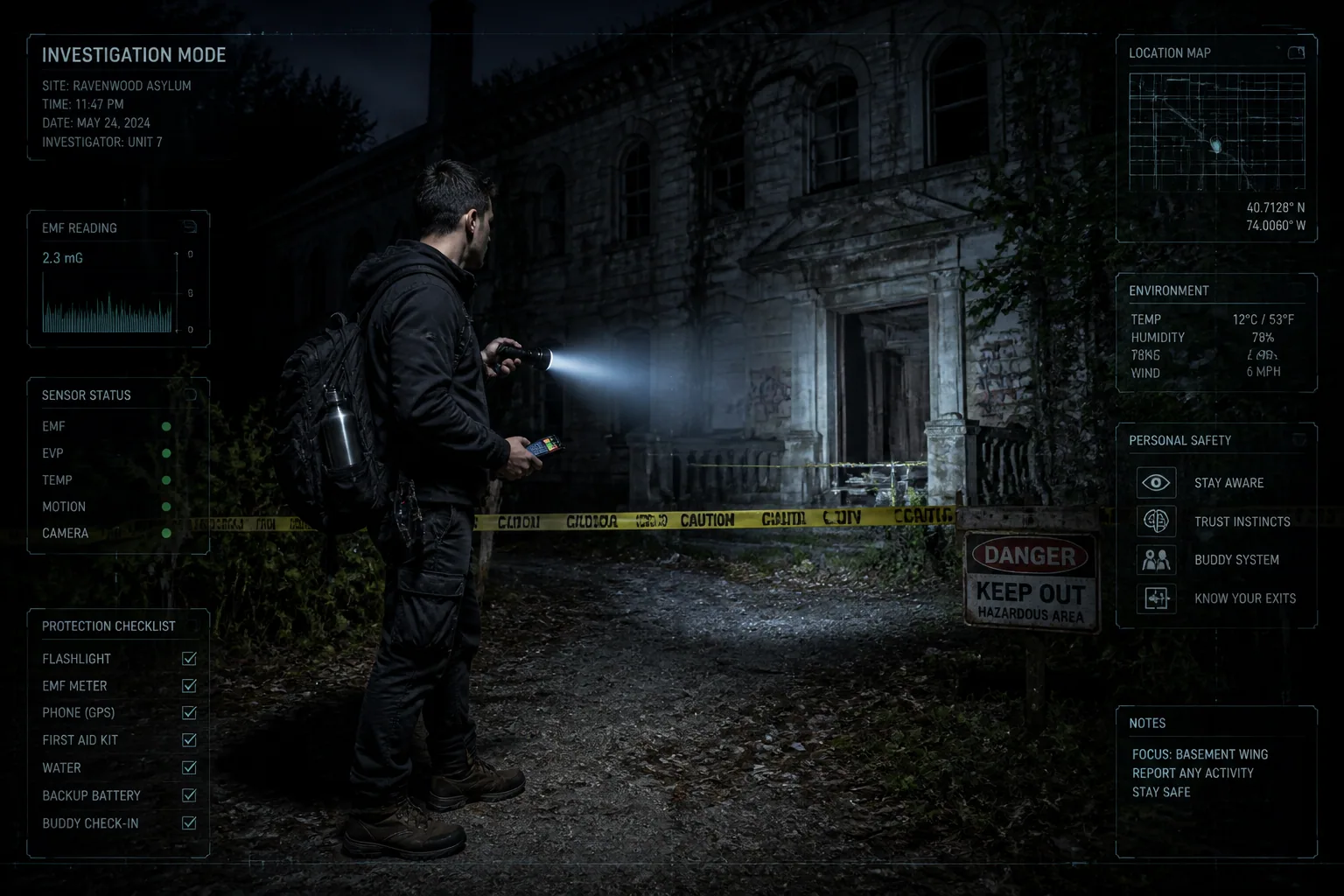
Ghost Hunting Safety 101: Physical, Psychological, and Digital Protection Tips
Ghost hunting is exciting precisely because it sits at the edge of the unknown. But the mystery should never come at the cost of your health, your privacy, or your gear. Whether you are exploring abandoned buildings, using paranormal apps, or filming content for social media, safety has to come first. The best investigators stay curious and cautious at the same time.
This beginner-friendly guide covers the three areas that matter most in the field: physical safety, psychological protection, and digital safety. Think of it as a practical checklist for staying prepared without losing the atmosphere that makes paranormal investigation fun in the first place.
Why Safety Is the Most Overlooked Part of Ghost Hunting
A lot of new investigators focus on equipment, spirit communication, and finding the right location. That is understandable, but it can create a blind spot. Old houses, derelict hospitals, historic basements, attics, stairwells, and underground spaces can all hide real hazards. According to Paralearning’s health and safety course, these sites may contain weak floors and roofs, asbestos, steep drops, low oxygen, and other unmarked dangers that are easy to miss in the dark https://www.paralearning.org/courses/practical-ghost-hunting/health-and-safety/
Safety also matters because ghost hunting is emotionally charged. Fear is normal, and research suggests paranormal beliefs can intensify stress in “haunted” settings. One study found that people who strongly believe in the paranormal experienced higher anxiety in these environments, which means the psychological side of a session is just as important as the physical one https://www.sciencedirect.com/science/article/pii/S0169204621001468
And then there is the digital side. If you are recording evidence, posting clips, or using a ghost-hunting app, you are also handling data. That means protecting raw footage, respecting privacy, and presenting your findings responsibly. Good safety habits protect not only your body, but also your reputation.
Pre-Investigation Planning: Research the Site Before You Go
Preparation starts long before you step inside a location. Research the history of the site, but also the practical details. Is it privately owned? Is it open to the public? Are there permits required? Are there known structural issues? Are there nearby emergency services? These are not boring questions. They are the difference between a controlled investigation and a dangerous improvisation.
A daylight walkthrough is one of the smartest things you can do. Monstrous.com recommends checking a site in daylight first so you can spot broken glass, loose boards, low ceilings, wildlife, and unsecured wiring before nightfall https://www.monstrous.com/ghost-hunting-rules/ That kind of scan gives you a mental map of the building and helps you identify safe entry and exit routes.
You should also tell someone outside your group where you are going and when you expect to be back. Moleopedia’s safety protocols stress that you should never investigate alone and should always let someone know your location and timeline https://moleopedia.com/investigation-techniques/ghost-hunting-safety/ If something goes wrong, that outside contact becomes invaluable.
A simple pre-investigation checklist can include: site name, access permissions, planned arrival and departure times, team member contact details, weather conditions, nearby hospitals, exit points, and a backup plan if the location becomes unsafe or inaccessible.
Physical Safety Basics: Clothing, Gear, and Emergency Essentials
The right gear does not make a place safe, but it does reduce risk. Start with sturdy footwear that protects your feet from glass, nails, wet surfaces, and uneven ground. Wear clothing that covers your skin enough to help with scrapes, insects, dust, and debris without restricting movement.
Lighting is essential. Haunted Silence recommends carrying multiple light sources, such as flashlights and headlamps, plus spare batteries, and making sure exit routes are clearly known before entering a site https://hauntedsilence.com/paranormal-101/how-to-ghost-hunt-beginners-complete-guide/ In a dark building, a single failing flashlight can turn a routine session into a rescue situation.
A practical emergency kit should include a first aid kit, a charged phone or radio, extra batteries, water, and emergency lighting. Moleopedia specifically lists first aid, reliable communication devices, sturdy footwear, protective clothing, and emergency lighting as core essentials https://moleopedia.com/investigation-techniques/ghost-hunting-safety/ If you are going into a remote or structurally compromised location, consider adding gloves, a whistle, and a portable charger.
Avoid alcohol, drugs, or anything else that could impair judgment. Monstrous.com explicitly warns that impaired judgment increases risk during ghost hunts https://www.monstrous.com/ghost-hunting-rules/ This is one of the easiest safety rules to follow, and one of the most important.
How to Spot Dangerous Locations and Avoid Structural Hazards
Not every spooky place is equally risky, but old and abandoned buildings deserve a healthy dose of caution. Common problems include rotted floorboards, unstable ceilings, weak roofs, dark basements, steep stairwells, and attics with low headroom. Paralearning also points out that poor air quality and low oxygen can be serious issues, especially in sealed spaces https://www.paralearning.org/courses/practical-ghost-hunting/health-and-safety/
When you enter a site, slow down and observe before you wander. Look for sagging floors, water damage, exposed nails, hanging wires, broken railings, and areas where the floor changes texture or sound. If a section feels questionable, do not test it by walking farther in. Mark it mentally or with your team and move around it.
Be extra careful in basements, attics, crawl spaces, and underground areas. These are places where people often get trapped, disoriented, or injured because visibility is poor and exits are limited. If you notice stale air, mold, strong odors, or difficulty breathing, leave immediately and do not treat it as part of the experience.
A good rule is simple: if you would not comfortably bring a child, an older relative, or a person with mobility issues into a space, it probably is not a good place to push your limits.
Respecting Property Laws, Permissions, and Local Rules
The supernatural may be mysterious, but trespassing laws are not. Before any investigation, get written permission from the owner or the responsible authority. HauntedHosts notes that without permission, you risk trespassing charges, and some historic or private sites require formal permits https://hauntedhosts.com/library/explainers/ghost-hunting-ethics-dos-and-donts
That permission should ideally spell out when you can enter, where you can go, whether you can film, and what areas are off-limits. If a location is public, check local rules about opening hours, photography, night access, and recording. Good investigators do not rely on assumptions.
Respect also means leaving the site as you found it. Do not move objects, tamper with locks, force access, or mark walls and surfaces. Paranormal investigation should never become vandalism disguised as research.
Psychological Protection: Managing Fear During Intense Sessions
Fear is part of the experience for many people, and that is not automatically a bad thing. In fact, fear can heighten awareness. But once it starts to overwhelm your thinking, it becomes a problem. Survey data suggests that supernatural beliefs are widespread, and many people have a strong emotional response to ghost-related ideas. A Neuroscience & Biobehavioral Reviews article reported that around 32% of people in the U.S. believe in ghosts and 37% believe in haunted houses https://www.sciencedirect.com/science/article/pii/S0149763421002785 That means you are far from alone if a location gets under your skin.
Psychological safety begins before the session. Set expectations with your group. Decide what behaviors are off-limits, what scares you most, where the boundaries are, and what will count as a reason to take a break. Safety Tips for Using Spirit Boxes in Active Hauntings recommends clear rules, built-in breaks, debriefing after intense sessions, and stopping when fear becomes overwhelming https://www.tvi.show/ghost-gear/safety-tips-for-using-spirit-boxes-in-active-hauntings
A useful mindset is to treat nerves as data, not destiny. If your heart is racing, that does not mean the location is dangerous in a paranormal sense. It may simply mean you are in a dark, unfamiliar setting with heightened expectations. That awareness can keep you from spiraling into panic.
Horror media and previous experiences can also affect how stressful a session feels. A 2025 study in Psychology Research and Behavior Management found that prior exposure and horror-related experiences influence fear tolerance and emotional stress during investigations https://www.tandfonline.com/doi/pdf/10.2147/PRBM.S529004 In other words, your emotional history matters, and it is worth respecting.
Grounding Techniques and Safety Rituals for Calm Investigations
Grounding does not have to conflict with paranormal beliefs. In fact, a calm ritual can make an investigation feel more intentional and less chaotic. Some people prefer a short breathing routine before entry. Others do a team check-in, hold a flashlight together, or say a simple statement of purpose like, “We are here respectfully, and we will leave if needed.”
The point is not to eliminate mystery. It is to keep your nervous system steady enough to observe clearly. Grounding can be as simple as naming five things you can see, feeling your feet on the floor, or taking a slow breath before entering a room. These techniques help interrupt the fear cascade without making the session feel clinical or cold.
If you work with a group, create a safety phrase that means pause immediately. It can be something ordinary and unmistakable. That way, when someone feels overwhelmed, the team does not need to debate whether it is “real fear” or “just nerves.” The session stops, everyone resets, and the group stays aligned.
A respectful ritual can also help with closure. For some teams, that means thanking the location, packing up in silence for a minute, or reviewing the next steps before leaving. The ritual matters less than the consistency. Predictability reduces stress.
Knowing When to Stop: Trauma, Panic, and Emotional Red Flags
One of the most important skills in ghost hunting is knowing when not to continue. If you feel dizzy, panicked, detached, disoriented, or unable to focus, stop. If someone in your group starts crying, hyperventilating, becoming agitated, or freezing up, stop. These are not signs of weakness. They are signs that the session has crossed a personal line.
This matters even more for anyone with a history of trauma, anxiety, or panic attacks. A haunted setting can intensify emotions very quickly. If a location triggers old memories or causes a loss of control, it is better to leave and regroup than to force yourself through it for the sake of a recording.
Seasoned investigators often treat emotional safety as seriously as physical safety. They watch for changes in speech, breathing, posture, and focus. They also normalize leaving early. That attitude keeps the group healthier over time and prevents one bad session from becoming a larger problem.
Digital Safety for Paranormal Investigators and Content Creators
If you film investigations or use phone-based tools, you also need digital protection. Your footage may include faces, locations, voices, timestamps, and other personal details. It may also be edited, reposted, or misinterpreted once it is online. Digital safety starts with good file habits and honest presentation.
Ectify, the Ghost Detector app, is a good example of how many creators now use smartphones as part of the ghost-hunting toolkit. It lets you scan for EMF fluctuations, record session audio, and keep session history with timestamps, which makes organization easier if you are tracking multiple investigations. You can find it here: https://findthe.app/ectify-fc72z0
To preserve evidence integrity, HauntedHosts recommends timestamped recordings, raw data backups, and consistent device naming and syncing https://hauntedhosts.com/library/explainers/ghost-hunting-ethics-dos-and-donts These habits make it easier to compare sessions and defend your findings if questions come up later.
How to Record Responsibly Without Inviting Hoaxes or Data Misuse
Responsible recording means separating observations from interpretations. If you capture a strange noise, say what it is: a sound, a movement, a reading, a clip. Do not jump immediately to dramatic conclusions. HauntedHosts stresses transparency about claims versus observations, especially when content is edited or shared publicly https://hauntedhosts.com/library/explainers/ghost-hunting-ethics-dos-and-donts
You should also know the most common false-evidence sources before you panic over a clip. Ghostly World and Haunted Silence both point to reflections, dust, lens flares, drafts, electrical interference, and camera or audio artifacts as frequent culprits https://www.ghostlyworld.org/articles/ghosts/ghost-hunting/ A careful investigator checks those possibilities first.
If you publish online, be mindful of privacy and consent. Avoid showing private property, addresses, and identifiable faces without permission. When necessary, anonymize details and use disclaimers. That is not hiding the truth. It is protecting people from being dragged into your content without their consent.
This becomes especially important if your audience is large or highly engaged. Sensational claims can spread fast, but so can backlash if viewers feel misled. Clear language, honest editing notes, and a refusal to exaggerate will protect your credibility much better than any fake scare ever could.
Protecting Your Devices, Footage, and Personal Privacy
Your devices are part of the investigation, so protect them like tools you depend on. Charge everything fully, bring backups, and store files as soon as you can after a session. If you are carrying more than one device, keep them organized and labeled so you do not lose track of what came from where.
Back up raw footage in more than one place if possible. That reduces the risk of loss from battery failure, accidental deletion, water damage, or a corrupted card. Keep sensitive clips private until you have reviewed them carefully and decided what is appropriate to share.
Also think about your personal digital footprint. If you post from a location in real time, you may reveal where you are, who you are with, and when a site is empty. That can raise safety concerns and make unwanted attention more likely. A slight delay in posting is often a better choice than live broadcasting from an isolated location.
Finally, lock your devices and accounts with strong passwords and basic privacy settings. A ghost hunt is not the place to discover that your footage, contacts, or location history was left exposed.
A Beginner’s Ghost Hunting Safety Checklist
Before the investigation: confirm permissions, research the site, check weather and access conditions, tell someone your plan, charge devices, pack spare batteries, and review exit routes.
What to bring: sturdy shoes, weather-appropriate clothing, first aid kit, water, flashlight, headlamp, spare batteries, charged phone or radio, and any necessary permits or written approval.
During the session: stay with your group, avoid risky areas, watch for structural damage, monitor your breathing and stress level, and pause if anyone feels unwell or overwhelmed.
After the session: debrief, document what you observed, back up footage, review whether any clips could be explained by reflections, dust, drafts, or artifacts, and remove any identifying private details before sharing.
Expert Advice: What Seasoned Investigators Never Skip
Experienced investigators tend to be consistent about a few things. They do not skip site checks. They do not go in unprepared. They do not ignore uncomfortable physical or emotional signals. And they do not treat safety as a separate task from the investigation itself.
They also understand that a good session is one everyone can leave safely. The goal is not to prove bravery by staying longer in a dangerous place. The goal is to gather experiences, footage, and impressions without creating avoidable harm.
Perhaps the best expert habit is simple respect. Respect for the site, the laws, your team, your own limits, and your audience. That respect keeps the mystery intact while making the process sustainable.
Final Thoughts: Staying Open-Minded Without Being Reckless
Ghost hunting works best when curiosity and caution move together. If you prepare well, you give yourself the best chance to have a memorable session without putting anyone at risk. Physical safety keeps you from getting hurt, psychological safety keeps fear from taking over, and digital safety keeps your evidence and reputation protected.
In the end, the safest investigators are usually the best ones too. They can stay present, notice details, and enjoy the atmosphere because they are not constantly worried about what they failed to prepare for. That is the real secret: being open-minded is easier when you are not being reckless.
