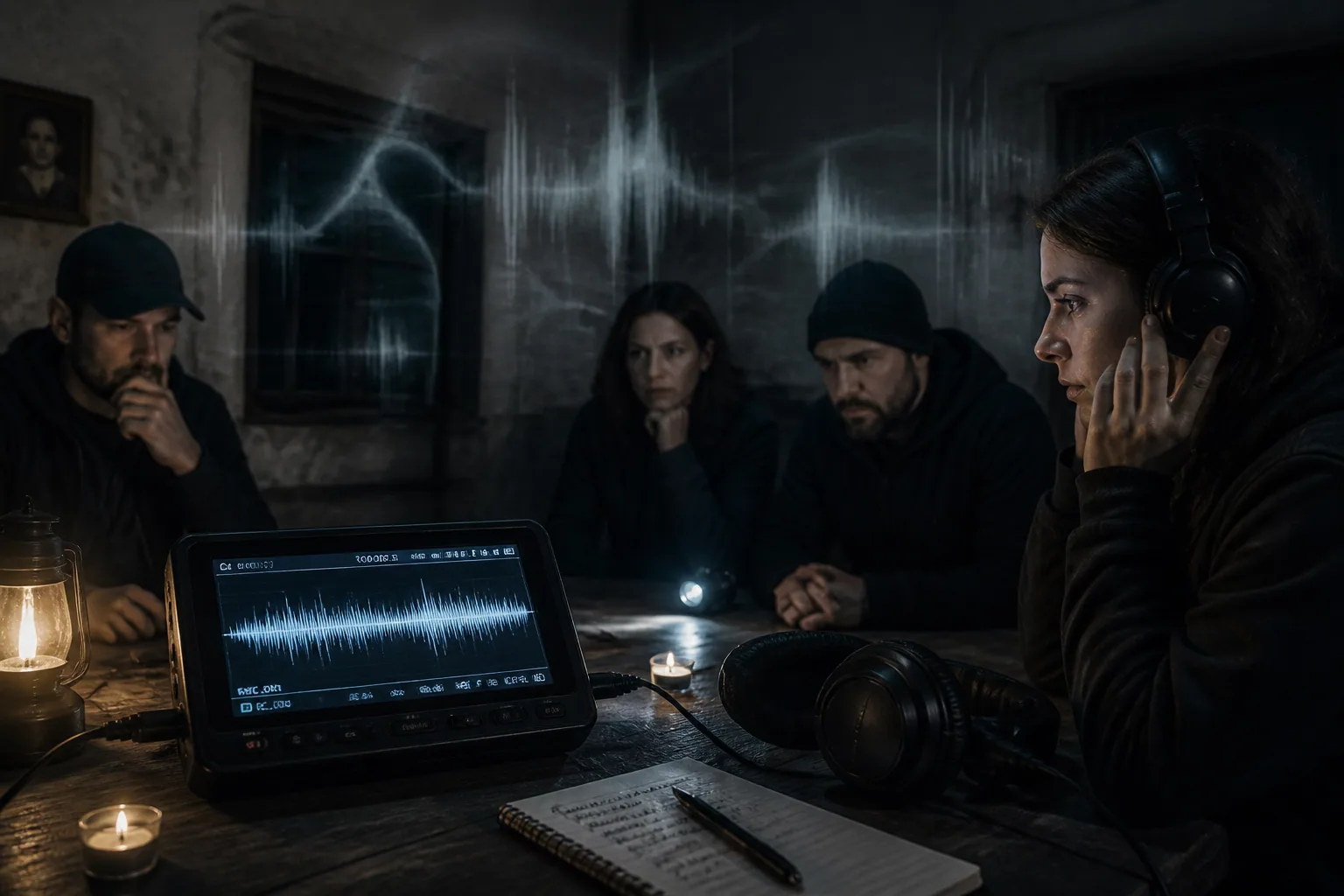
Ghost Voices That Seem Too Right: How Expectation and Bias Shape What We Hear in EVPs
A lot of EVP clips feel convincing the first time you hear them. The voice sounds close, the phrase seems oddly specific, and the timing feels almost too perfect to ignore. For ghost hunters and curious listeners alike, that instant certainty is part of the appeal. But the problem is that EVP audio often works on the brain the same way a blurry image works on the eyes. When sound is unclear, we do not just hear it. We interpret it. And once a suggestion enters the room, it can quickly become part of what everyone thinks they heard.
That is why some EVPs seem to gain power in the moment and lose it later. Under closer review, the same clip can turn into something much less definite. One listener hears a warning. Another hears a name. A third hears only noise. This article breaks down why that happens, how expectation and group influence shape interpretation, and what you can do to review recordings more objectively before calling them evidence.
Why Some EVP Voices Feel Uncannily Specific
An EVP can feel unusually convincing when the phrase appears to answer the moment. Someone asks a question in a dark hallway, the recording is played back, and a voice seems to say something relevant enough to raise goosebumps. That sense of directness is powerful because the brain loves pattern and meaning. If the audio is rough, short, or buried in background noise, the mind will often fill in the gaps with the most plausible words it can find.
This is not a sign that people are careless or dishonest. It is a normal feature of perception. In uncertain conditions, the brain prefers a meaningful match over a blank. That can make an EVP sound deeply personal even when the actual waveform is ambiguous. The less clear the recording, the more room there is for expectation to steer interpretation.
What Auditory Pareidolia Is and Why the Brain Hears Words in Noise
Auditory pareidolia is the tendency to hear meaningful sounds, especially words or voices, in random or distorted noise. It is the audio version of seeing faces in clouds. Instead of treating sound as raw data only, the brain tries to organize it into speech because speech is one of the most important signals humans ever learned to detect.
Research shows that priming people to believe they are hearing EVP increases the chance that they report hearing voices, even in degraded speech and ambiguous clips. In other words, the label changes the experience. Michael A. Nees and Charlotte Phillips found that contextual priming affected what listeners reported hearing, and that people told the task involved EVP heard more voices than those told they were simply listening to noisy or ambiguous recordings. Source: https://cir.nii.ac.jp/crid/1363951793267326976
A related PLOS ONE study found that when individuals were primed to expect ghost voices, they tended to hear more voices in EVP recordings specifically, compared with degraded speech, while unprimed participants did not show the same effect. Source: https://pmc.ncbi.nlm.nih.gov/articles/PMC9473424/
The practical lesson is simple. If a listener expects a voice, the brain becomes more willing to turn weak sound into speech. That means a convincing EVP is not just a question of whether a voice is present. It is also a question of what the listener was ready to hear.
How Expectation Shapes What You Think You Heard
Expectation bias works like a filter. Once you suspect a recording should contain a phrase, the brain begins testing incoming sound against that guess. A few consonant-like bursts, a rhythm that resembles speech, or a familiar cadence can be enough to lock in a result. After that, the interpretation can feel surprisingly stable even if the clip is unclear.
Recent research on voice detection found that expectations strongly affect response bias, especially when the audio is unreliable. People expecting voices were more likely to say yes, they heard one, even when the signal was weak or ambiguous. Source: https://www.sciencedirect.com/science/article/pii/S1053810024000850
That matters in EVP work because many recordings are already in the danger zone for over-interpretation. They may contain wind, movement, equipment noise, room reflections, distant voices, or digital artifacts. In that kind of material, the brain is not detecting a clean message. It is guessing under pressure. The more a listener wants the clip to mean something, the easier it becomes to hear that meaning.
The Power of Place: Haunted Histories, Leading Questions, and Familiar Themes
A haunted location brings more than atmosphere. It brings a story. If a place is known for a tragedy, a death, or a famous haunting, that backstory shapes what investigators expect to hear. People walk in already primed by reputation, by photos, by rumors, and by the emotional weight of the site itself.
That context can quietly suggest likely phrases. At a place linked to a child ghost, people may be more alert to names, crying, or pleas for help. In a former hospital, they may expect medical words. In a historic jail, they may hear commands, threats, or calls for release. Once those themes are in mind, ambiguous sound can easily drift toward them.
Leading questions add another layer. If someone asks, “Did you just say help?” or “Was that your name?” the suggestion can shape not only what others think they heard, but what they say they heard on playback. In group settings, a single confident interpretation can spread quickly, especially when it matches the story of the location.
This is where haunted history becomes a filter instead of a clue. The backstory may be real, but it can also function like a template. People stop listening for what is actually there and start listening for what would make sense there.
Group Dynamics and the Problem of Shared Interpretation
Groups are useful in investigations because they provide witnesses, comparison, and shared memory. But group settings also increase the chance that people converge on the same interpretation for social reasons rather than acoustic ones. When one person confidently names a phrase, others often become less certain of their own ears and more likely to align with the group.
This is especially true in emotionally charged settings. If the team already believes the location is active, agreement can become a kind of social reward. Nobody wants to be the person who says, “I just hear noise,” when the rest of the group hears a response. Over time, the group can reinforce a single interpretation until it feels like fact.
Research on EVP perception points to low agreement among listeners about what words are actually being said, even when a voice is detected. Nees and Phillips found high variability in guessed speech across EVP and degraded-speech conditions, which suggests that people often hear something different from one another in the same clip. Source: https://cir.nii.ac.jp/crid/1363951793267326976
That low agreement is important. If ten listeners hear ten different phrases, the clip is not becoming clearer. It is showing its ambiguity. Shared belief can create confidence, but it does not automatically create accuracy.
When One EVP Becomes Three Different Phrases
A good way to test your own bias is to revisit a clip after some time has passed and ask different people to transcribe it without context. Often, the results are striking. One listener hears “get out.” Another hears “I’m here now.” A third hears “can you help?” The more ambiguous the audio, the more likely each listener is to construct a phrase that fits their expectations, vocabulary, and the surrounding story.
This does not mean nobody heard anything real. It means the recording may be too unclear to support a single confident transcription. In paranormal audio, a phrase that seems obvious in the moment can later split into several different interpretations. That should be treated as a warning sign, not a triumph.
A useful habit is to listen to the same recording under different conditions. Try with headphones, then without. Listen at normal speed, then slowed down slightly. Remove the haunted-story context entirely. If the phrase remains stable across all conditions, that is more interesting. If it shifts wildly, the clip is likely doing more work in your imagination than in the signal itself.
Common Review Mistakes That Turn Ambiguous Audio Into Evidence
One of the most common mistakes is deciding what the clip says before all the listening is done. Once a phrase is proposed, every later replay becomes a search for confirmation. People begin to notice fragments that match the first guess and ignore fragments that do not.
Another mistake is reviewing audio with full knowledge of the session. If you know the question that was asked, the location’s history, the team’s theory, and what the main investigator wants to find, your interpretation is already loaded. The mind starts matching sound to narrative instead of assessing the signal on its own.
A third mistake is treating control-free audio as special by default. Many sessions contain background noise that can sound voice-like even when it is completely ordinary. Without a baseline recording of the location’s ambient sound, it is harder to tell whether the EVP stands out or simply resembles the environment around it.
Finally, people often stop at the first convincing interpretation. But if a clip can only support one phrase when you already know what someone expects to hear, then the evidence is weaker than it feels. A solid review process should survive disagreement, not rely on it disappearing.
How to Review EVP Recordings More Objectively
A more careful approach starts with removing as much expectation as possible. That means separating the listening task from the story of the investigation. It also means treating each recording as uncertain until multiple listeners have evaluated it independently.
EVP analysis protocols commonly recommend blind listening, independent transcription, baseline ambient recordings, and documentation of what investigators expected beforehand. Paranormal Learning Center outlines a step-by-step approach that includes stripped metadata, no clues about what to expect, multiple listener comparisons, and control clips from the same environment. Source: https://paranormallearning.com/blog/evp-analysis-techniques-step-by-step
Blind listening is especially useful because it reduces the power of suggestion. If a person was not present when the audio was recorded and is not told what others think it says, their transcription is less likely to mirror group belief. If their interpretation still matches the team’s reading, that is more meaningful than a match produced after discussion.
Independent notes matter for the same reason. Ask each listener to write down exactly what they hear before hearing anyone else’s opinion. Then compare the results. The goal is not unanimous agreement. The goal is to see whether the clip supports a stable interpretation or only appears clear after debate.
Controls matter too. If ambient noise, pure noise, or a background clip from the same session produces similar voice-like perceptions in blind tests, confidence should drop sharply. When the control sounds as speech-like as the claimed EVP, the audio is probably too ambiguous to support a strong claim.
Blind Listening, Independent Notes, and Multi-Listener Testing
Blind listening works best when the reviewer knows as little as possible. Ideally, the file should be cleaned of labels, session notes, and clues about the alleged message. If possible, use listeners who were not at the investigation at all. That way, they cannot rely on memory, group energy, or the emotional charge of the event.
After each person listens, collect their transcription without discussion. Do not ask leading follow-ups like, “Did you hear the name?” Ask neutral questions instead, such as, “What words do you think are there?” or “How confident are you?” Confidence level is as important as the phrase itself. A low-confidence guess should not be treated like a clear hit.
Multiple-listener testing also helps identify whether the phrase is robust. If several blind listeners independently report something close to the same wording, the clip deserves a closer look. If they diverge widely, the evidence becomes much weaker. The variability itself is information.
This kind of review is slower than simply playing a clip and reacting emotionally. But it is more honest. In EVP work, speed often favors belief. Slower methods favor clarity.
What to Write Down: Expected Phrase vs. Heard Phrase
One of the simplest ways to improve your process is to record expectations separately from perceptions. Before playback, write down what you think might be there, if anything. Include the question asked, the context, and any words you are hoping or fearing to hear. Then, after listening, write the exact phrase you think is present, along with your confidence level.
This separation matters because expectation and perception can blend together so quickly that you stop noticing where one ends and the other begins. If you later compare your expected phrase with your heard phrase, you may find that they were closer than you realized. That does not automatically invalidate the clip, but it helps reveal the bias around it.
A good note sheet might include: timestamp, who was present, what was asked, environmental conditions, device used, expected phrase before playback, heard phrase after playback, confidence rating, and alternative interpretations. The point is to make the analysis traceable. A clip should not be judged by memory alone.
Examples of EVPs That Changed Meaning on Re-Listen
Imagine a team recording in a stairwell after asking, “Is anyone here?” During playback, one investigator hears a sharp “leave now” and the group reacts immediately. Later, a blind listener hears “we know.” Another hears “be gone.” A third hears only a scrape and a breath. The original interpretation felt precise because it matched the mood of the place. On re-listen, it becomes less like a single message and more like a shape the brain could fill in several ways.
Or consider a clip from a former home associated with a child spirit. The team expects a name or a plea. In the room, someone swears they hear “mama.” After the session, outside listeners suggest “come on,” “not now,” or even “I know.” The haunted-history context made one phrase feel inevitable, but the audio itself did not lock it down. What sounded like contact may have been the mind selecting from a menu of plausible options.
These examples are not meant to dismiss every EVP. They show why confidence and certainty are not the same thing. A clip can feel meaningful and still remain ambiguous enough that honest reviewers should hesitate before calling it evidence.
Better Habits for More Credible Paranormal Audio
If you want stronger EVP work, the answer is not to stop listening carefully. It is to listen more carefully, but with better guardrails. Treat ambiguous sound as ambiguous until proven otherwise. Separate recording, review, and interpretation. Use blind listeners. Save control audio. Write down expectations before you know the result. Compare multiple transcriptions before settling on one.
It also helps to remember that not every interesting sound needs to become a ghost story. Some of the most valuable moments in investigation are the ones that survive skepticism. If a clip still looks unusual after independent review, that is worth noting. If it falls apart under re-listen, that is useful too. Good critical thinking does not weaken paranormal research. It makes it stronger.
For investigators who want a more immersive session while still keeping a record of what happened, a tool like Ghost Detector: Ectify can be a practical companion. It combines session recording with real-time EMF detection and EVP-style features, and it can help you document what was heard and when during a hunt: https://findthe.app/ectify-fc72z0
In the end, the biggest lesson from EVP audio is not that people are imagining everything. It is that the human brain is actively trying to make sense of uncertainty. Once you understand that, you can hear ghost stories more clearly, and judge them more fairly.
