Ghosts, Gadgets & the Mind: How Environmental Psychology Shapes Paranormal Perception
Haunted places can feel strange long before anything “paranormal” happens. That is one reason ghost hunts are so compelling: the setting itself starts working on your attention, your expectations, and your body. A draft in a hallway, a dim corner, a creaking beam, or a story you heard before arriving can all push your mind toward meaning-making. Environmental psychology helps explain why a location can feel charged even when the evidence is thin, inconsistent, or simply hard to interpret.
This does not mean every experience is fake or that people who report hauntings are imagining everything. It means perception is active, not passive. We do not just record a place. We interpret it through fear, suggestion, memory, stress, and context. Once you understand that, you can investigate in a way that is both more grounded and more interesting.
Why Haunted Places Feel Different Before Anything Happens
A reputedly haunted house, asylum, hotel, or theater rarely feels neutral to someone who walks in already expecting something unusual. Before a single EVP session begins, the mind is already on alert. The building may be old, quiet, poorly lit, or architecturally unfamiliar. Those features alone can create a sense of unease. Add local lore, photos of past incidents, and stories from previous visitors, and the location starts to feel loaded with meaning.
That sense of difference is important because it means the experience begins before the “event.” The environment frames what you notice, what you ignore, and what you later remember. This is why two people can stand in the same room and walk away with very different accounts. One person hears an ordinary pipe knock. Another hears a warning. The room did not change, but the interpretation did.
The Power of Expectation, Folklore, and Suggestion
Expectation is one of the strongest forces in paranormal perception. If you enter a room already told that a child’s voice has been heard there, or that a figure appears in the mirror, your mind becomes primed to detect exactly those kinds of signals. In a 2022 study on priming and ambiguous perception, participants told that recordings contained ghost voices reported significantly more voices in white noise and ambiguous EVP stimuli than unprimed participants. Higher sensory-processing sensitivity was also linked with more anomalous reports. The takeaway is simple: suggestion can shape what people think they hear or see, especially when the stimulus is unclear. Source: https://pmc.ncbi.nlm.nih.gov/articles/PMC9473424/
Folklore works the same way, but more slowly. Over time, stories create a template for what a haunted place is supposed to produce. People begin to match their own sensations against that template. A cold spot becomes a spirit’s touch. A flicker in peripheral vision becomes a shadow person. A vague sound becomes a whispered name. Context then reinforces the interpretation, especially when everyone in the group is already talking about ghosts.
Research on haunt reports has repeatedly shown how strongly context matters. In Harte’s work on haunting and poltergeist-like experiences, contextual variables such as time of day, emotional state, and climatic conditions appeared in 99.2% of reports, and in almost 59% of cases the report content matched the environmental or emotional context. That does not prove a non-paranormal cause in every case, but it does show that surroundings and internal state are not background noise. They are part of the experience itself. Source: https://journals.sagepub.com/doi/10.2466/pms.2000.91.2.451
How Your Brain Turns Ambiguous Cues Into Paranormal Meaning
The brain hates uncertainty. When information is incomplete, it fills in the gaps with the most available explanation. In a haunted location, that explanation is often already in place. If you are searching for paranormal signs, your mind becomes tuned to threat, agency, and pattern. Random sounds become footsteps. Shadows become figures. Static noise becomes a voice. This is not stupidity or gullibility. It is how predictive perception works.
This is why ambiguous stimuli are such a big deal in ghost hunting. An EVP recording with faint noise, a blur in a phone photo, or an odd reflection in a window can feel meaningful because the mind is designed to complete patterns. If you are tired, anxious, or primed by the atmosphere, that completion process gets even stronger. The result is often a confident experience built on very weak sensory input.
A related issue is pareidolia, the tendency to perceive meaningful shapes or voices in random input. Paranormal settings make pareidolia more likely because they combine uncertainty with expectation. The experience then feels personal and immediate, which is exactly why it is so persuasive.
Environmental Triggers: Infrasound, Air Quality, Lighting, and Drafts
Some haunted places are genuinely uncomfortable for physical reasons. Recent research has added more nuance to this point. An April 2026 study found that exposure to an infrasound tone around 18 Hz significantly raised salivary cortisol and increased feelings of irritability, sadness, and discomfort, even when subjects could not consciously detect the sound. The effects appeared regardless of whether calming or unsettling music was playing, suggesting infrasound can amplify negative emotion in ambiguous settings. Sources: https://arstechnica.com/science/2026/04/that-spooky-sensation-likely-due-to-rumbling-pipes-not-spirits/ and https://pmc.ncbi.nlm.nih.gov/articles/PMC13158192/
This is not an isolated idea. A field experiment in the Purcell Room in London found that a 17 Hz infrasound tone embedded in a concert program was associated with about 22% more reports of sinking feelings, vague unease, and other unusual sensations than non-infrasound segments. In other words, people noticed that something felt off even if they did not consciously identify the sound itself. Source: https://open-data.spr.ac.uk/articles/infrasound
Lighting matters too. In research summarized in Dagnall and colleagues’ review of 66 studies on allegedly haunted houses, six ambient variables came up most often: static cues, lighting levels, temperature, air quality, infrasound, and electromagnetic fields. Across studies, correlations were weak or inconsistent, which suggests no single environmental factor explains most haunt reports. Still, the same review notes that dim, stable lighting patterns can contribute to creepiness and reinforce expectation. Source: https://pmc.ncbi.nlm.nih.gov/articles/PMC7304295/
That makes sense in practice. Low light reduces detail, exaggerates contrast, and increases the chance of misreading shapes. Poor air quality can add fatigue, headache, or a sense of discomfort. Drafts can feel like a touch. Temperature shifts can amplify the impression that a room is “occupied.” None of these automatically mean something supernatural is happening, but they can all create a setting in which a normal sensation feels deeply strange.
When Architecture Creates Footsteps, Whispers, and Shadow Figures
Old buildings are full of acoustic tricks. Long hallways carry sound farther than people expect. Staircases can transfer vibration. Ducts, loose floorboards, aging windows, and hollow walls all create noises that seem to come from somewhere else. In some spaces, a sound can appear to move or change direction just because the geometry of the building bends it in unexpected ways.
Architecture also shapes vision. Narrow corridors, uneven lighting, reflective glass, archways, and unfamiliar layouts force the brain to work harder to map the environment. That extra effort makes misperception more likely. A coat hanging on a door can look like a person. A reflection can appear to move. A shadow at the edge of vision can become a figure before you have time to check it carefully.
This is why many experienced investigators pay close attention to the layout of a site, not just the stories attached to it. A location that produces repeated “footsteps” may have a mechanical source. A room where people keep hearing whispers may have airflow, echo, or outside noise passing through cracks. Sometimes the building itself is the special effect.
Why Fear, Stress, and Hypervigilance Change What You Notice
Fear changes perception by narrowing attention. When you are tense, your body prepares for threat. You scan more, blink less, and interpret ambiguous input more quickly. That can help in some situations, but during a ghost hunt it can also make everything feel charged. A suspenseful environment can push you into hypervigilance, and hypervigilance can turn weak signals into meaningful ones.
Research on physiological arousal supports this. In a 2020 study, increased stress from suspenseful film clips led to significantly more catastrophic misinterpretation of ambiguous stimuli, even after controlling for trait anxiety and other variables. In simple terms, when people were aroused or stressed, they were more likely to read harmless or unclear cues as threatening. Source: https://pubmed.ncbi.nlm.nih.gov/32054518/
That matters in haunted settings because the emotional state of the investigator becomes part of the data. If you are cold, tired, startled, or socially primed by the group, you may be more likely to interpret a creak or flash as evidence. Some people are also naturally more sensitive to environmental cues than others. In one study of 251 visitors at a reputedly haunted location, self-described sensitives reported more unusual phenomena and more prior paranormal experiences than non-sensitives. Subtle variations in electromagnetic fields during the tour also correlated with increased reports among sensitives. Source: https://era.ed.ac.uk/handle/1842/2851
How to Calibrate Your Senses During an Investigation
Calibration is the habit of checking your own perception against the environment before you decide something is paranormal. It means asking basic questions: What exactly did I hear? Where was I standing? Was anyone else moving? Was there a draft? Was the sound inside the building or outside it? Did I see the object directly, or only in peripheral vision? The more precise your observation, the less likely you are to overinterpret it.
A good calibration practice is to spend a few minutes in a space before starting any investigation. Notice the normal acoustic texture of the room. Notice the temperature, air movement, light levels, and background mechanical noise. If you can, map the environment with your own senses first, then begin recording. That creates a baseline, which is much more useful than jumping straight into questions and assumptions.
It also helps to separate personal experience from conclusion. You can say, “I felt a sudden drop in temperature near the doorway,” without immediately saying, “A spirit walked through.” The first statement is observation. The second is interpretation. Keeping those separate is one of the simplest ways to stay grounded.
Grounding Techniques and Observation Checklists for Ghost Hunts
When the atmosphere gets intense, grounding techniques help bring your attention back to the present. Slow your breathing. Relax your jaw and shoulders. Look at fixed details in the room. Name five concrete things you can verify right now, such as a running fan, a window, a floorboard, a light source, or a visible exit. The goal is not to kill the mood. It is to keep your nervous system from doing all the interpreting for you.
An observation checklist can be even more valuable than a dramatic story later. Before and during a session, note time, weather, lighting, number of people present, emotional state, device settings, and any known sources of noise or vibration. If something unusual happens, write down your exact position, the duration, and whether anyone else independently noticed it. That kind of record makes it much easier to compare subjective experience with objective data afterward.
If you are visiting a site often, consistency matters. Use the same checklist each time if possible. Over multiple sessions, patterns become easier to see. You may discover that the “haunting” spikes when the HVAC is active, when the group is larger, or when the room is darker than usual. Even if the location remains mysterious, you will be investigating it more carefully.
Using EMF Meters, EVP Recorders, and Spirit Boxes Responsibly
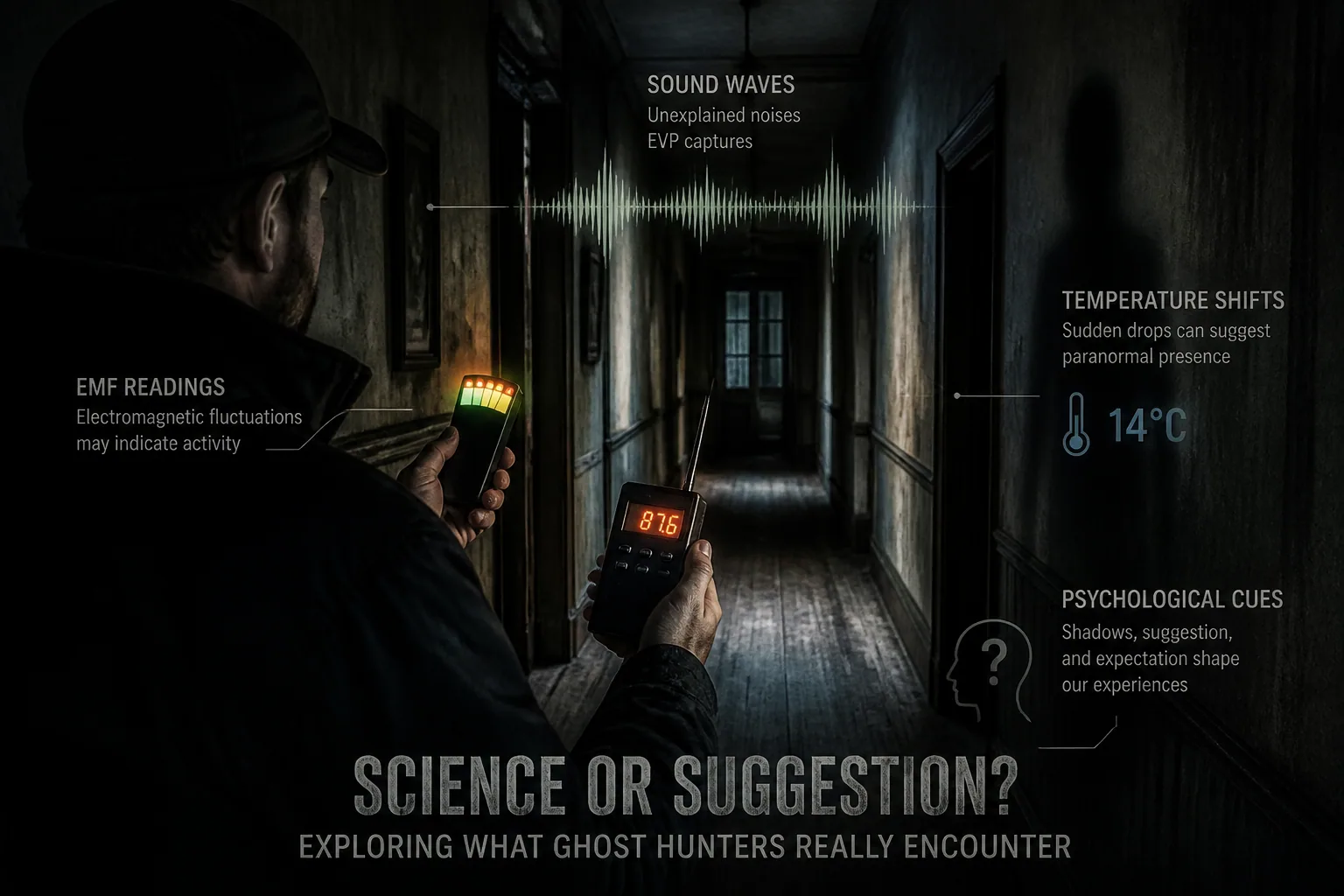
Ghost-hunting devices can be useful, but only when they are treated as tools rather than proof. EMF meters can help you document electrical conditions in a building. EVP recorders can capture audio for later review. Spirit boxes and similar devices can create an immersive experience and may help generate leads for discussion. But none of these devices automatically identify a paranormal source.
That distinction matters because many people assume EMF spikes mean a spirit is present. The evidence does not support that causal claim. Reviews of electromagnetic hypersensitivity and EMF-related paranormal beliefs generally find that positive findings suffer from methodological problems, while many experiments produce null results or fail to replicate. The WHO position, as summarized in broader safety reviews, does not confirm harmful effects from low-level EMF exposure. Source: https://pmc.ncbi.nlm.nih.gov/articles/PMC7201940/
So how should you use these tools? First, treat baseline readings seriously. If an EMF meter changes near a known electrical source, that is data, not a mystery. Second, avoid overclaiming from a single spike or a fleeting audio fragment. Third, document environmental conditions alongside each reading. A tool is only as useful as the context you record with it.
If you want an accessible way to explore this side of the hobby, the Ghost Detector: Ectify app can be a fun entry point because it combines session recording, real-time EMF detection, and EVP-style interaction in one place: https://findthe.app/ectify-fc72z0. Just remember that convenience and immersion are not the same thing as validation.
Where Paranormal Apps and Real-Time Tools Help, or Mislead
Paranormal apps and real-time devices can help with organization, replay, and documentation. A good app can timestamp events, store audio, and make it easier to compare sessions. For solo investigators and content creators, that can be genuinely useful. It lowers the barrier to collecting material and helps keep a record of what happened and when.
The downside is that real-time feedback can amplify suggestion. If a device is constantly producing sounds, words, or alerts, it can create a feedback loop in which the investigator expects something meaningful on every cue. That expectation can make random outputs feel intentional. In a group, it can also encourage people to search for patterns after the fact, especially when the session is already emotionally charged.
The best use of paranormal apps is as a logging and replay layer, not as an authority. If a tool helps you organize observations, great. If it makes you more certain than the evidence justifies, slow down. Good investigation should reduce ambiguity, not multiply it.
How to Corroborate an Experience Instead of Jumping to Conclusions
Corroboration is the heart of disciplined ghost hunting. An experience becomes more interesting when it survives comparison with other sources of information. Did another person notice the same thing independently? Did the recorder capture a corresponding sound? Does a meter show an environmental change at the same moment? Is there a plausible physical explanation that fits the timing better than a paranormal one?
This is where careful comparison matters. If you felt a touch on your arm, check for air movement, nearby surfaces, and body posture. If you heard a voice, compare it with other audio channels and the room’s acoustic environment. If you saw a figure, ask whether lighting, motion, or reflective surfaces could explain it. Sometimes the data will remain unresolved. That is okay. Unresolved is not the same as supernatural.
A strong investigation makes room for uncertainty without filling it too quickly. It also avoids turning every unknown into a belief claim. The goal is not to “debunk” every moment, but to preserve the difference between an experience, a hypothesis, and a conclusion.
Balancing Skepticism and Open-Mindedness in Modern Ghost Hunting
The best paranormal investigators are neither dismissive nor credulous. They are curious, but careful. They understand that haunted places can feel convincing because the human mind is highly responsive to context, suggestion, stress, and environmental cues. They also understand that not every unusual report can be reduced to one simple cause. Sometimes the strongest position is to say, “I do not know yet.”
That balance is what makes modern ghost hunting more interesting than a simple yes-or-no debate. Skepticism keeps you from mistaking atmosphere for evidence. Open-mindedness keeps you from shutting down a genuine anomaly too quickly. Together, they create a more honest investigation process. You observe more clearly, record more carefully, and interpret more responsibly.
If haunted places seem powerful, it is partly because they are. Not necessarily in a supernatural sense, but in a psychological and environmental one. They are designed, by age, story, light, sound, and expectation, to make ordinary perception feel extraordinary. Once you know that, you can still enjoy the thrill of the hunt without losing your footing in the dark.
