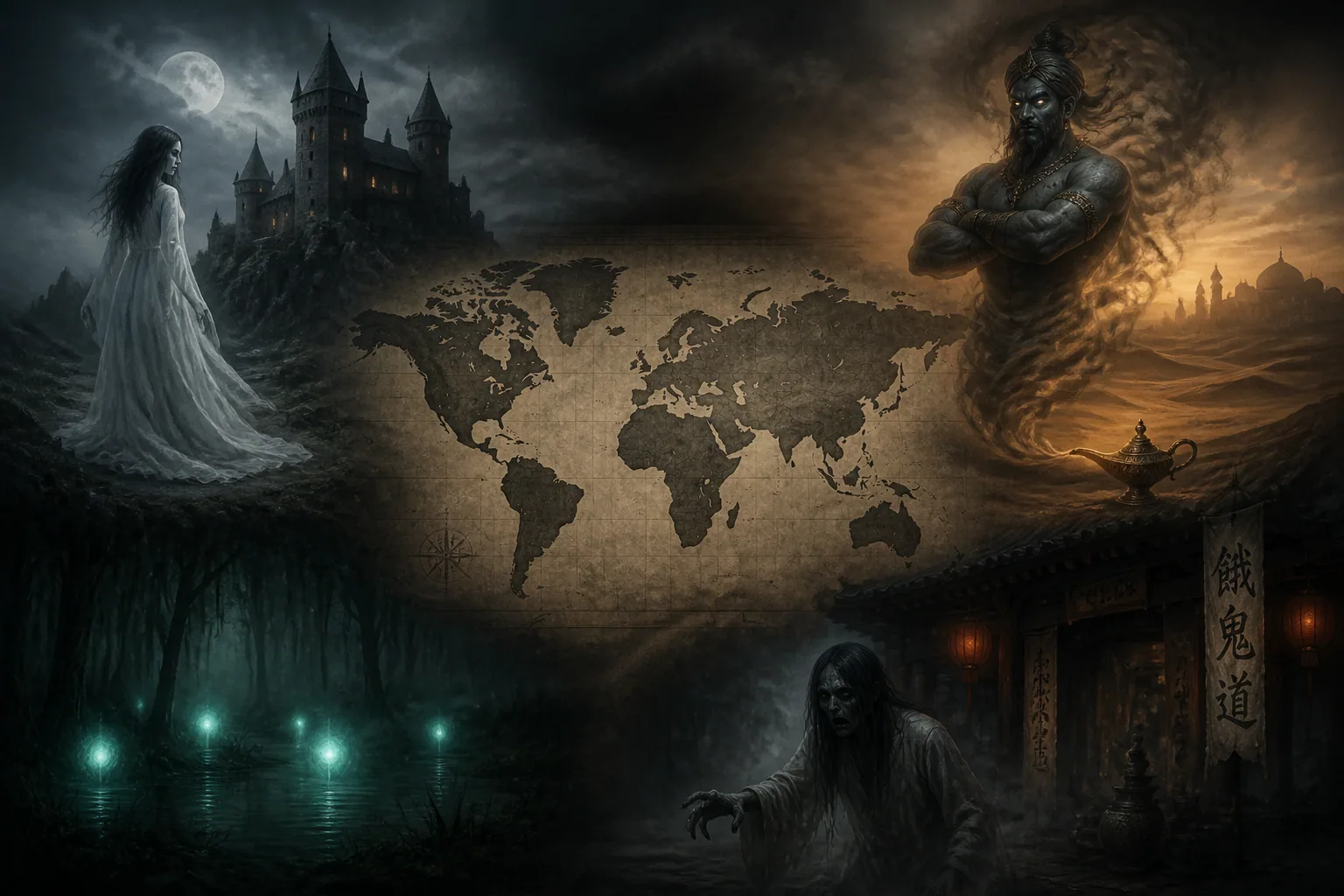
Ghosts of the World: What Global Beliefs Teach Us About Paranormal Phenomena
Ghost stories do not travel the world in a single uniform shape. They change with language, religion, local history, landscape, and social memory. In one place, a haunting may be a revenant rising from the grave. In another, it may be a mourning mother in white, a djinn pressing on the chest during sleep paralysis, or a hungry spirit that needs ritual feeding. The details differ, but the pattern is familiar: people everywhere use ghost lore to explain fear, grief, danger, and the strange things that happen when the world feels thin.
That is what makes global paranormal traditions so useful. They do not just provide spooky stories. They also teach us how expectation shapes experience, why certain locations become haunted in the public imagination, and how natural events can be folded into supernatural explanations. If you enjoy ghost hunting, folklore, or simply trying to understand why people report the same kinds of encounters in very different cultures, a cross-cultural approach gives you a much richer lens.
Why Ghost Stories Look Different Around the World
At first glance, ghost beliefs can seem wildly different from culture to culture. But if you look closely, many share the same underlying themes. The dead are often imagined as lingering because of violence, unfinished business, improper burial, bad karma, broken rituals, or emotional attachment. The living, meanwhile, use stories about spirits to make sense of unexplained sounds, visions, illness, and misfortune.
What changes is the symbolic language. In some traditions, the dead return physically to trouble the living. In others, they appear as shadowy presences, omens, or spirits tied to a specific moral lesson. The shape of a ghost often reflects what the culture fears most, what it honors most, and how it understands the boundary between life and death.
That is why paranormal reports are never just about the event itself. They are also about the framework around the event. A person raised with stories of djinn may interpret a sleepless night very differently than someone who grew up hearing about White Ladies, while someone immersed in East Asian ancestor rituals may view a restless spirit through the lens of obligation and care rather than simple terror.
Common Spirit Types in Global Folklore
Some spirit types appear again and again in world folklore, even when the names and settings differ. One major category is the revenant, a spirit or animated corpse believed to return from the dead and physically haunt the living. Revenants are found across Celtic, Norse, Slavic, and many other traditions. Archaeologists have even found ancient graves designed to prevent revenants, including stones placed on limbs or mouths, with examples dating back to the Bronze Age. Source: https://en.wikipedia.org/wiki/Revenant
Another widely shared figure is the White Lady. These legends are especially common in Europe and the Americas, and they often feature a pale or white garment, a tragic death, and a connection to liminal places such as roadsides, rivers, abandoned buildings, or graveyards. The white clothing can symbolize mourning, purity, burial dress, bridal imagery, or simply a striking visual marker in low light. Source: https://occult-world.com/white-lady-1/
A different but equally important category is the spirit that is not exactly a ghost in the Western sense, but a being whose suffering spills into the human world. Hungry ghosts, known as pretas in Buddhism and egui in Chinese folk religion, are tormented by insatiable desire or attachment. They are often linked to greed, neglect, or violent death, and rituals such as Yulanpen or Japanese Se-gaki are designed to feed or appease them. Source: https://en.wikipedia.org/wiki/Hungry_ghost
In Islamic belief, djinn occupy yet another category. They are spirits that exist alongside humans and can interact with the material world. In some regions, especially in Egypt and nearby areas, experiences that many outsiders might call sleep paralysis are often interpreted as djinn attacks. Belief in djinn remains strong across many educated communities, which shows how durable these frameworks can be. Source: https://en.wikipedia.org/wiki/Jinn
Revenants, Ladies in White, Djinn, and Hungry Ghosts Explained
Revenants are among the most physically threatening ghost figures in folklore because they return not merely to be seen, but to act. They can choke, haunt, disturb graves, or bring illness and fear. Their stories often center on bodies that were not properly contained, morally troubled deaths, or social anxiety about the dead returning to disturb the order of the living.
Ladies in White, by contrast, are often tied to grief and tragedy. A familiar example in Latin America is La Llorona, or the Weeping Woman, a ghostly mother dressed in white who is said to have drowned her children and now wanders near water mourning them. Her cries are often treated as an omen of misfortune or death. Source: https://en.wikipedia.org/wiki/La_Llorona
The recurring white garment matters more than it may first seem. White clothing stands out in darkness, which helps make the figure memorable in oral tradition. It also carries strong associations with funerals, mourning, birth, marriage, and purity, depending on the culture. That makes the White Lady an especially flexible symbol, one that can hold innocence, loss, guilt, and unresolved emotion all at once.
Djinn stories are different because they do not always present the spirit as the soul of the dead. Instead, djinn are often understood as a parallel kind of being, hidden from ordinary sight but capable of affecting the physical world. This helps explain why many experiences involving pressure on the chest, fear during waking transition, or a sensed presence during paralysis are interpreted through that lens.
Hungry ghosts highlight yet another dimension: spirit lore as moral psychology. They represent the pain of endless craving, whether for food, attention, or release. In many traditions, the response is not just fear, but ritual care. That is a major difference from ghost stories that focus on exorcism or banishment. In hungry ghost traditions, the living may have a responsibility to help the dead find relief.
Why Certain Places Are Seen as Haunted Across Cultures
Across cultures, haunted places are often places of transition. Ruins, battlefields, crossroads, marshes, abandoned houses, and graveyards all sit at the edge of ordinary life. They are either physically in-between or symbolically charged with death, change, and uncertainty. That makes them perfect settings for ghost stories.
Crossroads are especially important because they are literal intersections. In folklore, an intersection can represent choice, passage, danger, or contact between worlds. Battlefields carry the trauma of mass death, while ruins suggest the collapse of a former order. Marshes and swamps feel unstable underfoot, difficult to cross, and visually deceptive, which makes them ideal environments for eerie sightings.
This is where folklore and environment work together. A remote road with low lighting, humidity, strange reflections, or naturally occurring marsh gases can create a setting that feels active and uncanny. The result may be interpreted as a ghost light, a spirit, or a will-o’-the-wisp. In other words, some haunted places are culturally haunted because the landscape itself is unusual enough to produce strange sensations and ambiguous sightings.
Sacred Nights, Festivals, and Times When Spirits Are Said to Roam
Not all hauntings are tied to places. Many are tied to times. Across the world, certain nights or festival periods are believed to thin the boundary between the living and the dead. Halloween in the modern Western imagination is one example, but it is far from the only one. The Ghost Festival in East Asia, ancestral remembrance rituals, and local calendrical observances all create moments when spirits are believed to be especially active.
This timing serves several functions. It gives communities a shared ritual schedule for remembering the dead, it marks seasonal transitions, and it provides a culturally recognized explanation for unusual events. If someone hears a strange sound during a festival associated with the dead, they are more likely to interpret that sound symbolically.
These sacred or liminal nights also matter because people are primed to notice patterns. Darkness, ceremony, expectation, and group storytelling all increase the odds that an ordinary event will be experienced as meaningful. A creaking floorboard during a memorial rite feels different from the same sound on a random weekday morning.
How Folklore Shapes Modern Paranormal Investigations
Modern ghost hunting is often presented as an objective search for evidence, but folklore always enters the room first. Investigators bring expectations about what a haunting should look like, sound like, and feel like. Those expectations shape where they go, what tools they use, and how they interpret the results.
If a location has local legends about a White Lady or a revenant, investigators may pay more attention to human-shaped shadows, temperature changes, or emotional reactions in specific rooms. If a site is known for djinn activity, people may focus on sleep disruption, chest pressure, or unexplained movement. The cultural script influences the evidence people think they are collecting.
That is why it can help to treat every investigation as both a paranormal and historical inquiry. Ask what stories were already attached to the place, who told them, when they emerged, and what social fears they reflect. A haunted reputation is often built layer by layer through repeated retellings, local trauma, and a few memorable experiences that become folklore.
For people who want to keep track of these sessions in a more structured way, a tool like Ghost Detector: Ectify can make the process easier by letting you record investigations, review session history, and capture your notes in one place: https://findthe.app/ectify-fc72z0
Expectation, Fear, and the Psychology of Seeing a Haunting
One of the most important lessons from cross-cultural ghost beliefs is that expectation is powerful. If a person enters a building believing it is haunted, they become more alert to ambiguous stimuli. A draft becomes a sign. A distant footstep becomes a presence. A reflection becomes a face. This does not mean the experience is fake. It means the mind is actively organizing uncertainty.
Sleep paralysis is a clear example. During the transition between sleep and wakefulness, a person can feel unable to move, sense a presence, or even see a figure in the room. In cultures where this is understood as an attack by a spirit or djinn, the experience is framed in supernatural terms. In other contexts, it may be explained as a medical or neurological event. Either way, the experience can feel intensely real.
Suggestion also plays a major role. If someone hears ghost stories before entering a location, the stories begin to prime interpretation. A place with a strong legend can practically guide the mind toward haunting. This is one reason paranormal reports often cluster around well-known sites and specific narratives.
Environmental psychology adds another layer. Studies and reviews of reported hauntings suggest that environmental factors like lighting, acoustics, humidity, and prior belief can shape what people report seeing or feeling. Source: https://www.researchgate.net/publication/407254157_Environmental_Factors_Misidentified_as_Paranormal_Activity_A_Scientific_Review_of_Physical_Chemical_Biological_Environmental_and_Psychological_Influences_on_Reported_Hauntings
Natural Explanations Behind Classic Ghost Phenomena
A grounded approach does not erase folklore. It helps explain why certain folklore patterns are so durable. Infrasound is a good example. Acoustic frequencies below about 20 Hz are inaudible to humans, but they can still affect the body. Research summaries have reported that hidden bass frequencies may increase irritability and cortisol levels, even when people do not consciously detect the sound. That can contribute to unease, a sense of presence, or visual misinterpretation. Source: https://arstechnica.com/science/2026/04/that-spooky-sensation-likely-due-to-rumbling-pipes-not-spirits/
Likewise, ghost lights and will-o’-the-wisps have long been connected to marshes, cemeteries, and lonely roads. Folklore often treats them as spirits or guides, but natural factors such as marsh gases, reflections, and low-visibility conditions can produce strange lights that seem to move or hover. Source: https://beyondhaunted.com/blog/lady-in-white
When we combine these explanations with human psychology, the picture becomes clearer. The brain is constantly trying to complete patterns, especially under stress. A dim hallway, a humming pipe, a flicker of light, and a scary local legend can create a powerful haunting experience without requiring anything supernatural to be physically present.
What Paranormal Enthusiasts Can Learn From Cross-Cultural Beliefs
Cross-cultural ghost lore can make paranormal enthusiasts better observers. Instead of asking only, “Was that a ghost?” it helps to ask, “What kind of story would this experience fit in its local context?” That question encourages better documentation and more respectful interpretation.
It also reminds investigators that not every haunting is the same. A revenant, a White Lady, a hungry ghost, and a djinn each imply different assumptions about death, morality, place, and spiritual agency. If you understand those assumptions, you can avoid flattening every unexplained event into one generic ghost category.
There is also value in humility. A report that sounds supernatural may still have a natural explanation, and a location that feels haunted may also be genuinely meaningful because of its history. Cross-cultural folklore helps us hold both ideas at once: that people are telling the truth about what they experienced, and that the experience itself may be shaped by culture and environment.
How to Log Encounters With Better Historical and Cultural Context
If you keep a paranormal log, include more than the date, time, and basic evidence. Record the local legend associated with the site, the type of spirit that is supposed to appear there, and whether the location is tied to burial grounds, conflict, water, crossroads, ruins, or ritual observance. Those details matter because they influence interpretation.
Also note the conditions of the encounter. Was it near a festival or sacred night? Was it raining, humid, or windy? Was the area poorly lit? Did anyone mention a story before the session began? Did anyone in the group already expect a particular kind of manifestation? These are not minor details. They are often the difference between a vague feeling and a useful record.
Finally, write down your own emotional state. Fear, fatigue, excitement, and suggestion can all color perception. A good log is not about dismissing experiences. It is about preserving them with enough context to study patterns later. When you approach ghost hunting this way, you become less likely to confuse atmosphere for evidence and more likely to understand what the experience meant, both culturally and personally.
That is the real value of global ghost beliefs. They do not simply tell us what people fear. They show us how humans organize mystery, grief, and uncertainty into stories that can be shared, remembered, and investigated. Whether the figure is a revenant, a White Lady, a djinn, or a hungry ghost, the haunting is always doing more than frightening us. It is revealing the world as the culture knows how to see it.
