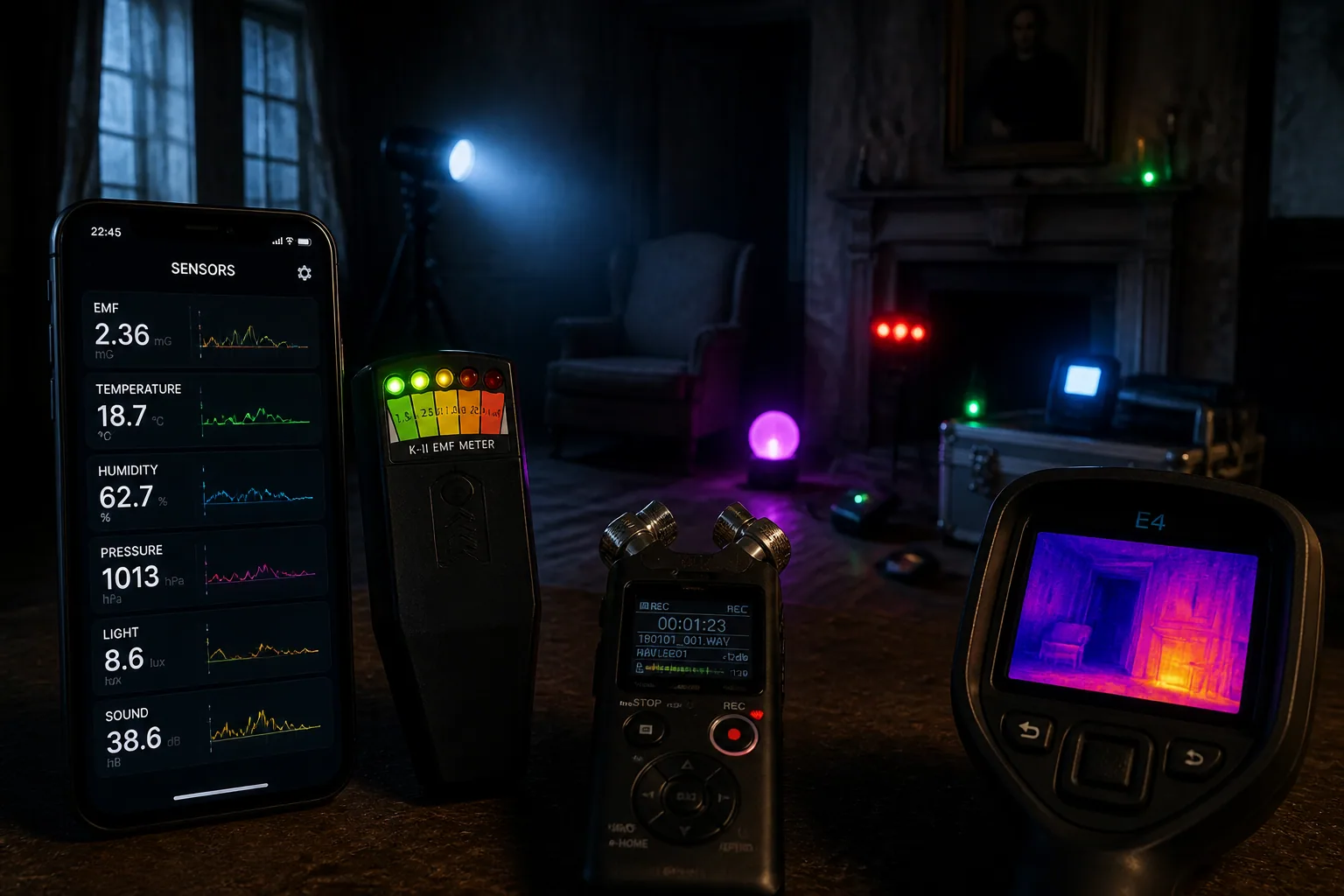
Haunted Technologies: Useful Ghost-Hunting Gear vs Paranormal Hype
Ghost-hunting gear is easy to oversell because most people do not know what the devices are actually measuring. A flashing light, a dramatic sound effect, or a screen full of numbers can feel scientific even when the underlying tool is only loosely connected to the claim being made. That is why paranormal shopping lists often mix legitimate instruments with gadgets that are better at creating atmosphere than evidence. If you are a beginner, or a skeptical enthusiast who still enjoys the hunt, the real goal is not to buy the spookiest device. It is to understand which tools measure something useful, which ones are just rebranded entertainment, and how to avoid fooling yourself with noise, interference, and expectation.
Why Ghost-Hunting Tech Is So Easy to Oversell
Paranormal technology sells well because it promises a shortcut to mystery. A device that reacts to a draft, a radio signal, or a change in temperature can be framed as detecting a presence if the marketing is vague enough. The problem is that many ghost-hunting products borrow the language of science without offering the controls science requires. They may use real sensors, but that does not automatically mean they are detecting anything paranormal.
This is where skepticism helps. Real measurement tools have defined ranges, known limitations, and predictable responses. Hype tools tend to have dramatic interfaces, loosely explained algorithms, and ambiguous outputs that invite interpretation. If a gadget can be made to “say” almost anything, then it is usually telling you more about your expectations than about the room you are standing in.
The Core Tools That Actually Measure Something Useful
The most practical ghost-hunting gear is boring in the best possible way. It does not need a spooky name to be useful. A good investigation kit usually starts with tools that measure electromagnetic fields, sound, and temperature changes. These readings may not prove a haunting, but they can reveal whether something in the environment has changed and whether that change has an ordinary explanation.
The important distinction is this: a useful tool gives you data you can compare, repeat, and question. A flashy tool gives you an impression. In paranormal work, that difference matters a lot because the environment is full of false triggers such as electrical wiring, HVAC systems, pipes, metal framing, outside radio traffic, and human pattern recognition.
What a Real EMF Meter Can and Cannot Tell You
A real EMF meter is a genuine scientific instrument. EMF meters measure electromagnetic fields, and many are calibrated around AC mains frequencies in the 50 to 60 Hz range. More advanced versions use tri-axis probes so they can detect fields in multiple directions, which makes them more informative than simple single-axis devices. EMF measurement is used in industry, environmental testing, and hazard assessment, not just ghost hunting. Source: https://en.wikipedia.org/wiki/EMF_measurement
What it can tell you is whether electromagnetic fields are present and how they change as you move through a space. That can help you find wiring in walls, hidden appliances, faulty fixtures, or strong magnetic sources. What it cannot tell you is why the reading changed. A spike is not evidence of a spirit by itself. It is only evidence that something altered the field.
This is why calibration matters. EMF meters vary by sensitivity, frequency range, and sensor design. A basic meter can be overwhelmed by electrical infrastructure, motors, cell signal interference, or magnetic materials in the building. NIST calibration research on electromagnetic hazard meters shows how carefully these instruments need to be characterized in real conditions. Without that understanding, your reading may be technically real but practically meaningless. Source: https://www.nist.gov/publications/calibration-techniques-electromagnetic-hazard-meters-500-mhz-20-ghz
Audio Recorders, EVP Claims, and the Problem of Noise
Audio recorders are among the most common tools in paranormal investigations because they are simple and genuinely useful. A field recorder can capture quiet sounds, distant footsteps, air movement, building creaks, and voices that were not obvious in the moment. That makes it valuable for documentation, but it does not make it a ghost detector.
The big issue is EVP, or Electronic Voice Phenomena. People often listen back to recordings hoping to catch a hidden message, but the human brain is exceptionally good at filling in missing information. If you expect to hear a word, you are more likely to hear one in an ambiguous sound. That is classic confirmation bias, and it is one of the biggest sources of false paranormal conclusions. Skeptical reviews of ghost-hunting gadgets point out that listeners often “discover” speech in noise because they are primed to expect it. Source: https://www.howtogeek.com/ghost-hunting-gadgets-and-why-they-dont-work/
The practical approach is to treat audio as evidence only after you have ruled out ordinary sources. Record in a quiet room, note HVAC cycles, use more than one recorder, and compare files side by side. If a supposed voice only appears on one device, or only when you already know where the “haunting” is supposed to be, that is a warning sign. Good audio work is more about controls than about drama.
Thermal Imaging: Helpful Tool or Misread Mystery Machine?
Thermal imaging and digital thermometers are actually useful during investigations. They can reveal cold spots, heat sources, airflow patterns, and temperature changes that might otherwise go unnoticed. In a real building, this can help you identify drafts, poor insulation, HVAC output, or equipment that is producing heat. The tool itself is legitimate. The interpretation is where mistakes begin.
A sudden temperature drop sounds eerie, but it is usually easier to explain than people think. Drafts under doors, leaky windows, ventilation systems, and uneven room insulation are all common causes. Even the skeptically minded ghost-hunting literature notes that apparent temperature anomalies are more often environmental than paranormal. Source: https://www.en.wikipedia.org/wiki/Ghost_hunting
Thermal cameras are best used as a way to narrow down questions, not answer them. If a camera shows a cold patch, the next step is to check the room physically, repeat the reading, and compare it with the building’s known airflow and heating patterns. The device is a starting point for investigation, not a supernatural verdict machine.
Popular Ghost Gadgets That Lean on Hype
A lot of ghost gadgets work because they are exciting, not because they are reliable. Spirit boxes, word-bank apps, LED meters, radar-style phone interfaces, and SLS-style overlays all create the feeling of direct contact with the unknown. That feeling can be powerful, especially in a dark location with other people reacting in real time. But the more a device is designed to produce a dramatic experience, the more carefully you should ask what it is actually measuring.
Many apps marketed as paranormal tools also include “for entertainment purposes only” disclaimers. That is not just legal fine print. It is a clue that the app is using phone sensors like the magnetometer, microphone, or gyroscope in ways those sensors were never meant to support for paranormal detection. Several reviews of ghost apps make the same point: the outputs may be fun, but the scientific validity is weak. Sources: https://www.tvi.show/ghost-gear/paranormal-phone-apps and https://www.spiritshack.co.uk/blog/ghost-hunting-apps/do-ghost-hunting-apps-work/
Spirit Boxes, Word Banks, and LED Meters Under a Skeptical Lens
Spirit boxes are popular because they seem to generate real-time answers. In practice, many of them scan radio frequencies rapidly and pull in fragments of AM and FM broadcasts mixed with static. When tested inside a Faraday cage, recognizable speech fragments stop appearing, which strongly suggests the audio comes from ordinary radio sources rather than supernatural communication. Source: https://truthradar.ai/fact-check/are-spirit-boxes-real
Word-bank devices and apps are a similar story. If a device is choosing from a limited set of words, then the impression of meaningful messages often comes from confirmation bias and pareidolia, the tendency to perceive patterns and meaning in randomness. Once people already believe they are in contact with something, even loosely related words can feel strangely specific. Source: https://www.higgypop.com/news/word-bank-communication/
LED meters can also be misleading. A row of lights makes a reading look objective, but if the device has weak calibration or poor shielding, those lights may react to nearly anything nearby. In ghost hunting, an interface that looks scientific is not the same thing as a measurement that is scientifically useful. The key question is always: what caused the change, and can I reproduce it?
Calibration, Sensitivity, and Environmental Interference Explained
If you only learn one technical lesson from ghost-hunting gear, make it this: calibration matters. A meter is not reliable because it has numbers on the screen. It is reliable when you know what those numbers mean, what range the device covers, and how it responds to known conditions. Single-axis and tri-axis sensors can produce very different results, and simple consumer devices may respond strongly to nearby wiring, motors, metal structures, or even phone and radio interference. Source: https://en.wikipedia.org/wiki/EMF_measurement
Sensitivity can be a double-edged sword. A very sensitive meter may catch subtle changes, but it may also become unusable in a cluttered environment. A less sensitive meter may miss small fluctuations but give you cleaner readings. Neither is automatically better. What matters is whether the tool fits the space and whether you understand the sources of interference around you.
This also applies to sound and thermal tools. A microphone will capture real audio, but it will also capture road noise, distant voices, and structural creaks. A thermal camera will show temperature differences, but those differences may be caused by airflow or heat leakage. The environment is always trying to fool you, which is why careful setup beats excited interpretation every time.
How to Test Your Gear and Rule Out False Positives
The best way to learn whether equipment is useful is to test it like you do not trust it yet. Begin with control experiments. Record in a room with the HVAC off if possible. Compare a quiet room with one that has known background noise. Check EMF meters near outlets, fuse boxes, appliances, wiring runs, and metal beams so you know what normal interference looks like in that building. If a supposed anomaly appears in the same place every time you pass a known electrical source, you have probably found the source.
For audio, use at least two recorders in the same area. If a voice appears only on one device, or only after someone announces they heard something, that is weak evidence. For thermal checks, repeat your scan after the room has settled and compare it to the building’s normal temperature behavior. The goal is not to eliminate mystery. The goal is to eliminate avoidable error.
This approach is especially important if you are trying to separate compelling stories from data you can trust. Many community guides and skeptical resources recommend exactly this kind of comparison testing because it helps you see how often a device reacts to ordinary conditions. Source: https://www.accessparanormal.com/blog/2018/5/31/ghost-hunting-apps-do-they-work
Using Your Phone as a Smart Paranormal Investigation Kit
A smartphone can cover more of the basics than many beginners realize. It has a microphone, accelerometer, gyroscope, magnetometer, camera, and a decent amount of processing power. That does not make it a supernatural detector, but it does mean you can build a low-cost setup that captures audio, tracks environmental changes, and documents sessions without buying a full hardware kit right away.
The downside is obvious: phone-based tools are easy to overinterpret. Because the sensors were not built for paranormal detection, the results are usually rougher, noisier, and more vulnerable to misreading than dedicated instruments. Still, for a beginner who wants to explore without overspending, a phone can be a practical first step if it is used carefully and with skepticism.
How Ectify Replicates Key Tools Without Extra Hardware
If you want a simple mobile setup, Ghost Detector: Ectify turns your phone into a compact investigation kit by using the device’s built-in hardware. It offers real-time EMF-style readouts through the magnetometer, a spirit box and EVP-style generator, session recording, and history tracking in one place. You can explore it here: https://findthe.app/ectify-fc72z0
The value of a tool like this is convenience and immersion. It lets you capture sessions, review them later, and share the results without needing a bag full of gear. That said, the same skeptical rules still apply. A phone magnetometer is still sensitive to nearby electronics and magnetic materials, and a word-bank or spirit-box feature is still more atmospheric than scientific. Used honestly, though, it can be a helpful way to practice documentation, compare readings, and learn how investigations are structured before investing in more specialized equipment.
A Beginner’s Checklist for Buying Less and Investigating Smarter
If you are starting out, the smartest purchase is usually not the most haunted-looking one. It is the gear that helps you document, compare, and rule things out. Start with a decent audio recorder, a reliable flashlight, a thermometer or thermal tool if your budget allows, and an EMF meter only if you are willing to learn what it actually measures. Add a notebook, timestamps, and a method for keeping track of room conditions.
Before buying any gadget, ask three questions. First, what exactly does it measure? Second, what common environmental factors can trigger it? Third, can I test it against a known source or a control setup? If the answer to those questions is unclear, the device is probably more entertainment than evidence. That does not mean it cannot be fun. It just means you should treat it as part of the experience, not proof of the paranormal.
In the end, haunted technologies are most useful when they help you investigate thoughtfully rather than react dramatically. The best kit is the one that lets you notice what is real, explain what is ordinary, and stay honest about what remains unknown.
