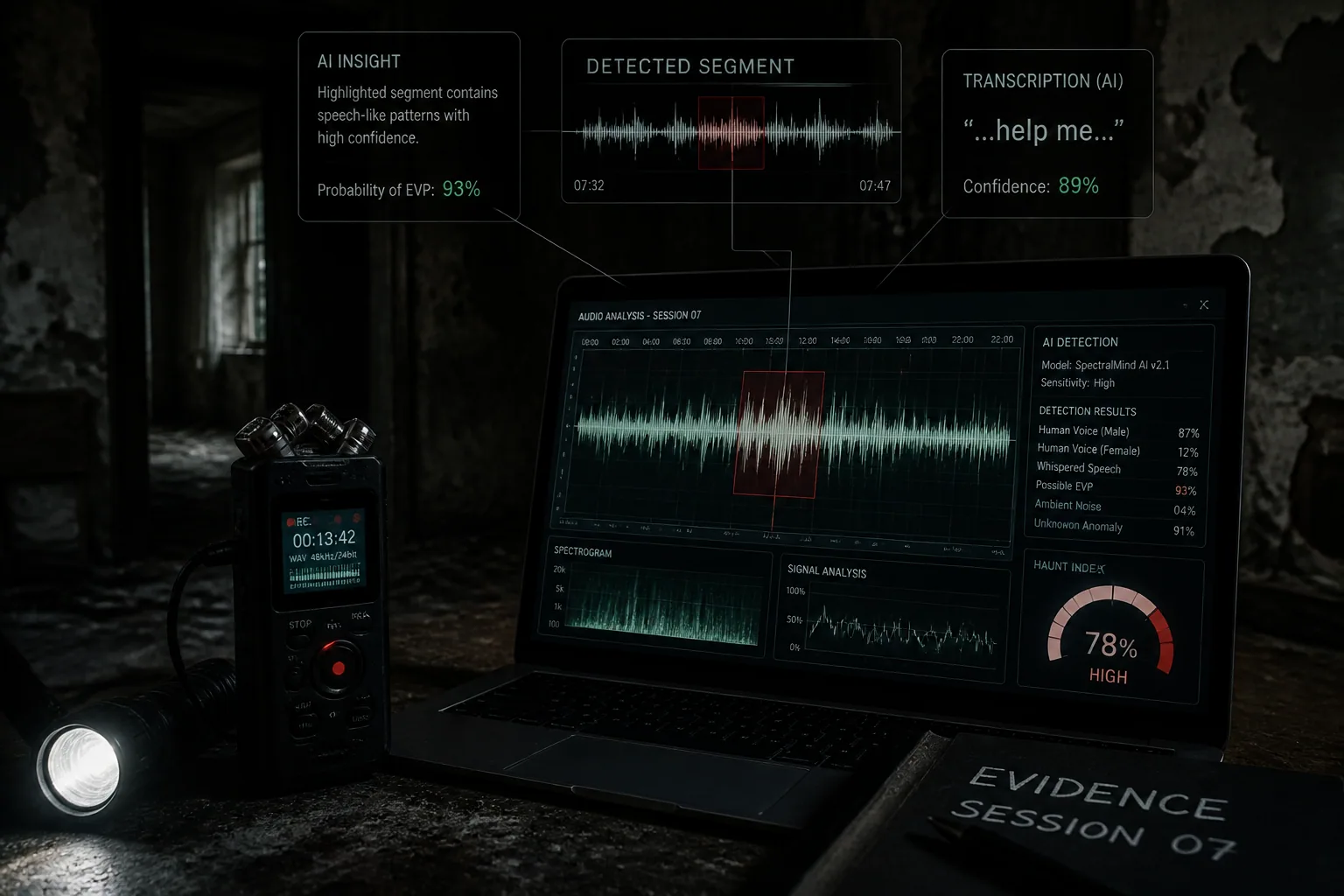
How AI & Machine Learning Are Reshaping EVP Analysis: What Every Investigator Should Know
Artificial intelligence is starting to change the way paranormal investigators work with EVP recordings. What used to be a slow process of replaying audio, listening for faint phrases, and arguing over what was actually heard is now being assisted by tools that can clean up noise, separate voices from clutter, and highlight patterns a human ear might miss. That sounds exciting, and in many ways it is. But it also creates new problems. AI can make an unclear recording sound more convincing than it really is, and that can lead investigators toward false certainty if they are not careful.
For beginner to intermediate investigators, the key thing to understand is that AI is not magic. It does not prove a spirit voice, and it does not automatically invalidate one either. It is simply a tool for audio analysis. Used well, it can help improve documentation, reduce obvious interference, and support more repeatable review. Used badly, it can overprocess evidence, create misleading clarity, and reinforce the very biases EVP researchers are trying to avoid.
Why AI Is Becoming a Big Deal in EVP Work
EVP analysis has always lived in a difficult space between signal and interpretation. Recordings are often noisy, affected by echoes, RF contamination, digital compression, or background sounds that are hard to isolate. Human listeners naturally try to make sense of ambiguous audio, which is one reason pareidolia remains such a persistent issue in EVP work. The brain is excellent at turning uncertainty into familiar speech patterns, even when no clear words are present.
AI is becoming important because it can process large amounts of audio faster than a person can. It can reduce unwanted noise, separate overlapping sources, and identify repeated acoustic patterns. That means investigators can spend less time manually scrubbing every clip and more time evaluating whether a sound is really unusual. In theory, this makes EVP work more efficient and more transparent. In practice, it only helps if the investigator understands what the software is doing and what it may be distorting.
This matters because a cleaned-up recording can feel more authoritative than the raw file. If an AI tool makes a faint vocal-sounding sound easier to hear, people may assume it is genuine. But clarity is not the same as truth. A clearer artifact is still an artifact. That is why AI should be treated as an aid to analysis, not a replacement for it.
What AI and Machine Learning Actually Do in Audio Analysis
At a basic level, machine learning systems learn statistical patterns from large data sets. In audio work, that means a model can be trained to recognize speech, noise, room reverberation, breathing, overlapping speakers, or environmental distortion. Once trained, it can make predictions about what parts of a recording are likely speech and what parts are likely background interference.
Some tools perform speech enhancement, which means they try to make speech more intelligible by reducing noise, echo, or distortion. A good example is Adobe Research’s HiFi-GAN-2, which is designed to convert noisy, reverberant, or EQ-distorted speech into studio-quality audio. That kind of enhancement could be very useful for EVP recordings with heavy background noise or long room echo, because it may reveal faint structures that were previously buried. Source: https://research.adobe.com/publication/hifi-gan-2-studio-quality-speech-enhancement-via-generative-adversarial-networks-conditioned-on-acoustic-features/
Other systems focus on speech separation. These models try to distinguish a voice from surrounding sound sources, which is directly relevant in a location where footsteps, wind, machinery, and conversation can all overlap. But the research also shows an important limitation: systems trained on synthetic audio mixtures often perform worse in real-world noisy and reverberant conditions. That is a major warning for EVP investigators, because field recordings are usually messier than lab data. Sources: https://arxiv.org/abs/1708.07524 and https://arxiv.org/abs/2105.12315
In other words, AI is strongest when the problem looks like the data it was trained on. EVP recordings often do not. That gap between training conditions and real conditions is where many mistakes happen.
Current AI-Based Tools Investigators Are Using for EVP
Today, most investigators are not using highly specialized paranormal AI platforms. They are more often using general-purpose speech enhancement, denoising, transcription, and separation tools. These can still be valuable when applied carefully. For example, a tool designed to reduce breathing noise and other distortions, such as ClearAI, is relevant because it helps clean up speech extracted from noisy environments. The NSF summary of the tool reports noticeably improved clarity in speech enhancement tasks, which makes it a good fit for the cleanup stage of EVP review. Source: https://par.nsf.gov/servlets/purl/10608098
Investigators also use transcription systems to convert speech into text, spectrogram tools to visualize frequencies, and audio editors with AI-assisted noise reduction. These tools can help flag candidate sounds for further review. But they should never be treated as final judges. A transcription engine may confidently produce a phrase where the original audio is actually just background noise plus a harmonic pattern that resembles speech.
This is why the best use of current AI tools is often as a first-pass filter. They can help reduce obvious clutter, point out repeatable features, and organize large sets of recordings. They are less useful when asked to decide whether a sound is paranormal. That decision still requires careful listening, context, and comparison with the original file.
If you want to capture sessions in a way that makes later review easier, a practical companion tool like Ghost Detector: Ectify can help you record, organize, and review paranormal sessions in one place. It is not an EVP validator, but it does make it easier to keep session history and export recordings for analysis: https://findthe.app/ectify-fc72z0
How Reliable Are AI EVP Tools in Real Investigations?
The honest answer is that reliability depends on the recording, the model, and the task. AI tools can be very effective at reducing certain kinds of noise and at spotting patterns in audio, but they are much less reliable when the environment is highly variable. Real investigation sites are full of unpredictable sounds, and that unpredictability is exactly where machine learning can struggle.
Research on speech separation shows that models often perform well in controlled testing but lose accuracy when exposed to real-world conditions. That means a tool may look impressive in a demo but behave very differently inside an abandoned building, a basement with plumbing noise, or a location with unpredictable airflow and reflective surfaces. Research also notes that training on noisy speech data can outperform relying only on synthetic mixtures, which suggests that real-world diversity matters a great deal. Source: https://www.sciencedirect.com/science/article/abs/pii/S0885230822000432
For EVP investigators, this means one simple rule: if the software has not been tested against the kind of audio you actually record, its confidence is not the same as accuracy. Reliability should always be judged against the original evidence, not the enhanced version alone.
Another issue is bias. Speech-recognition systems have been shown to misinterpret accented and dialectal speech more often, and they often perform worse for speakers from underrepresented groups. That matters in EVP work because if a tool is used to auto-detect or transcribe faint voices, it may systematically miss some voices and over-identify others. Source: https://www.axios.com/2025/11/22/ai-accents-chatgpt-jobs-health
Where Algorithms Help Most: Cleanup, Detection, and Pattern Recognition
The most practical use of AI in EVP analysis is cleanup. Removing hiss, reducing reverb, and lowering background clutter can make a recording easier to inspect. Tools like HiFi-GAN-2 and ClearAI show how modern enhancement models can improve intelligibility in noisy speech. That does not mean the cleaned result should be treated as evidence by itself, but it can help investigators hear what is present before making a judgment. Sources: https://research.adobe.com/publication/hifi-gan-2-studio-quality-speech-enhancement-via-generative-adversarial-networks-conditioned-on-acoustic-features/ and https://par.nsf.gov/servlets/purl/10608098
Detection is another major use. AI can help flag moments where a sound stands out from the rest of the recording. This is especially useful when reviewing long sessions. Rather than listening to hours of mostly empty audio, an investigator can focus on sections with unusual spectral features, sudden amplitude changes, or repeated vocal-like structures. But the model may also flag harmless sounds such as cloth movement, room reflections, or distant conversation.
Pattern recognition can also support investigation logs. If a recording repeatedly shows the same noise source, a recurring echo, or a consistent frequency profile, AI can help identify that pattern faster than manual review. This is valuable because repeatability is a major part of credible EVP work. If a sound cannot be reproduced or tied to a stable source, the investigator needs to know that before drawing conclusions.
The Biggest Risks: False Positives, Audio Pareidolia, and Overprocessing
The biggest danger in AI-assisted EVP analysis is not that the software will miss something. It is that it will create something that seems more meaningful than it really is. False positives can come from RF contamination, environmental voices, recorder artefacts, digital compression problems, echoes, and the listener’s own imagination. ATransC specifically identifies these as common sources of false EVP and recommends characteristic tests to reject suspect utterances. Source: https://atransc.org/locating-false-positives/
Overprocessing is another serious risk. The more aggressively a file is cleaned, the easier it becomes to strip away the context needed to judge whether the sound was real speech, environmental interference, or an enhancement artifact. A voice-like result can become more convincing simply because the software suppressed everything around it.
That is why investigators need to remember audio pareidolia. People naturally hear meaningful words in randomness, especially when they expect to hear a message. This problem has been discussed for years in EVP literature, and it becomes even more dangerous when an AI tool gives a recording a polished, speech-like quality. Source: https://science.howstuffworks.com/science-vs-myth/afterlife/evp.htm
Digital compression can also create misleading artifacts. MP3 warbling, echo trails, and frequency smearing may all sound oddly vocal. EVP guidance warns investigators to minimize these problems during capture and processing so they do not mistake technical distortion for evidence. Source: https://ukpx.org/2025/10/12/electronic-voice-phenomena-evp-best-practices-and-technical-guidance/
Case Examples Where AI Changed the Interpretation of Evidence
Imagine a team records a faint whisper in a hallway. In the raw file, it is nearly impossible to identify. After AI enhancement, the audio sounds like a clear short phrase. The team becomes excited. But when they compare the enhanced file with the original spectrogram and environmental notes, they notice the same moment matches a distant door movement and air turbulence from a nearby vent. The AI did not invent the sound, but it did make an ambiguous event sound far more deliberate than it was.
In another case, a basement recording contains low hum, dripping water, and several overlapping reflections. A speech separation tool isolates a voice-like segment and returns a transcription. Without caution, the investigator might mark it as an EVP. But after peer review, multiple listeners hear different things, and the original audio shows strong interference exactly where the phrase appears. Here, AI helped locate a candidate but also increased the risk of overinterpretation.
There are also positive examples. Suppose a long field session contains dozens of clips, and most are pure room noise. AI cleanup reduces the hiss and reveals that several suspicious sounds all occur during moments when a heater kicks on. That lets the investigator reject those clips quickly and focus on the few that remain unexplained. In this case, AI strengthened the investigation by narrowing the field and improving transparency.
The lesson is simple. AI changes interpretation, sometimes for the better and sometimes for the worse. The difference is not the technology itself, but whether the investigator preserves context and resists the urge to accept the first clear-sounding result.
How to Use AI Without Compromising Investigative Integrity
The safest way to use AI in EVP work is to keep it in a supporting role. Start with the raw recording, and do not overwrite or replace it. Make every enhancement repeatable so another investigator can apply the same settings and see the same result. If the method cannot be explained, it should not be used as proof.
Transparency matters here. If an AI tool was used to denoise, separate, or transcribe a clip, that should be clearly noted in the investigation log. The raw version, the processed version, and the settings used should all be preserved. That way, anyone reviewing the evidence later can see exactly what changed.
Investigator discipline also matters. Never let the enhanced audio become the only audio anyone hears. Compare it against the original file, review it with other listeners, and ask whether the sound could be explained by normal sources. If a claim only exists after aggressive processing, it is too weak to stand on its own.
Ethically, it is also important not to present AI-assisted output as if it were untouched evidence. Enhanced clarity can be useful, but it is still interpretation. Clear labeling is what protects credibility.
Best Practices for Documenting AI-Assisted EVP Analysis
Strong EVP documentation starts with preserving the original recording. Do not edit over the source file. Save the untouched file, then create separate copies for processing. This ensures the raw evidence remains available for later review and helps protect against accusations that the clip was altered to fit a story.
Peer verification is equally important. Multiple independent listeners should review the same clip without being told what phrase to expect. If several people identify the same sound differently, that is a sign the evidence may be ambiguous. If they independently hear the same unusual structure, the case for further review becomes stronger.
Environmental logging should also be standard practice. Record EMF readings, temperature, humidity, device placement, and any known sources of noise. UKPX guidance also recommends spectral analysis to visualize frequencies that are not typical of human speech. That kind of documentation gives you a better chance of separating real anomalies from technical artifacts. Source: https://ukpx.org/2025/10/12/electronic-voice-phenomena-evp-best-practices-and-technical-guidance/
It also helps to note exactly which AI tools were used, what they were designed to do, and whether the output was manually reviewed. If a model was trained for generic speech enhancement, that is worth stating. If the file was transcribed by an automated system, that should be noted too, especially because bias in training data can affect the result. Good documentation is not extra work. It is what makes the analysis trustworthy.
What the Future of AI in Paranormal Research May Look Like
The future of AI in paranormal research will probably be less about proving paranormal claims and more about improving workflow, documentation, and consistency. Better models may become more capable of separating speech from noise in unusual environments, recognizing common artifacts, and flagging recordings that deserve closer human review. That could make investigations faster and more organized.
At the same time, future tools will likely create stronger illusions of certainty. As enhancement systems get better, their output may sound more convincing even when the underlying evidence remains weak. That means the role of the investigator will become even more important, not less. Human judgment, skepticism, and careful recordkeeping will still be necessary.
The best future is probably a hybrid one. AI handles cleanup, sorting, and initial pattern detection. Investigators handle context, comparison, peer review, and final interpretation. If paranormal research can keep that balance, AI can improve credibility instead of undermining it.
For now, the main takeaway is this: AI can make EVP analysis more efficient, but it cannot make a claim true. If you use it transparently, preserve the raw evidence, and stay alert to bias and false positives, it can become a useful part of your toolkit. If you trust it too much, it can lead you away from the evidence you were trying to study in the first place.
