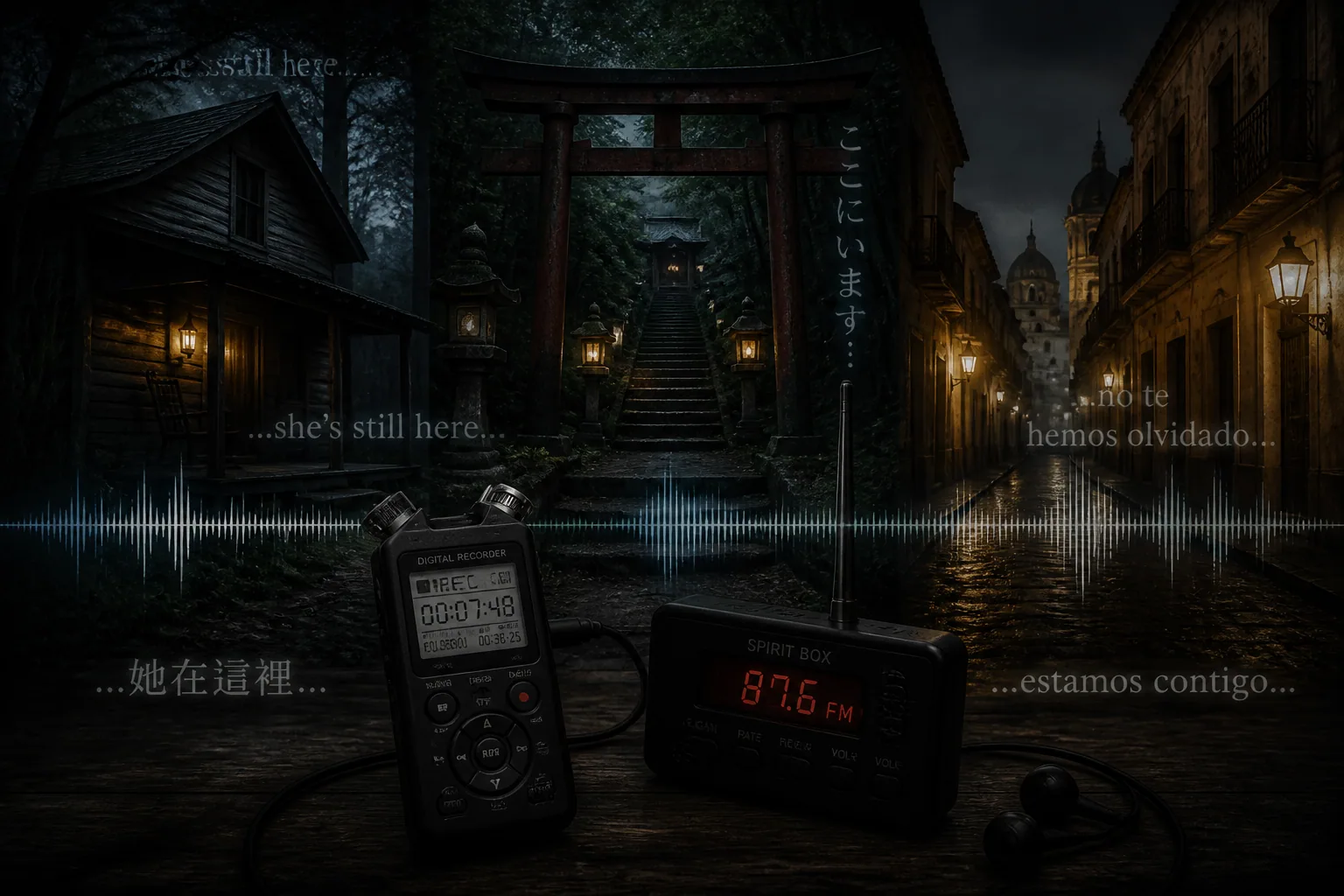
How Cultural Folklore Influences What Ghosts “Say” During EVP Sessions
Electronic voice phenomena, or EVP, are often treated as if they were pure audio facts. In practice, they are also cultural events. The words people think they hear during a session can be shaped by folklore, religion, dialect, local legends, and even the expectations investigators bring into the room. That is why EVP interpretation is never culturally neutral. The same static burst, faint syllable, or radio-like fragment can sound completely different depending on where you are, what story the location carries, and what language patterns your brain is already ready to recognize.
For intermediate ghost hunters, paranormal creators, and folklore-minded investigators, this is not a weakness in the field. It is a clue. Cultural context can act like an interpretive filter, giving meaning to ambiguous audio while also increasing the risk of false certainty. If you learn how folklore shapes voice, symbol, and phrasing, you can listen more carefully, document more honestly, and present your evidence with much more credibility.
Why EVP Interpretation Is Never Culturally Neutral
EVP are typically short, usually the length of a word or short phrase, which makes them especially vulnerable to interpretation. A brief sound can be reassembled by the brain in many different ways, and the version that feels most convincing is often the one that fits the listener’s background. That is why one investigator might hear a religious warning, while another hears a local name, and a third hears nothing at all.
This is where expectation matters. Paranormal sources note that EVP content often reflects what a person is primed to hear, and skeptical explanations frequently point to auditory pareidolia, our tendency to perceive familiar patterns like language in ambiguous audio. In other words, the mind does not just receive sound. It completes sound. If a location is associated with a certain myth, accent, or religious tradition, the mind is more likely to fill in those familiar shapes.
That does not automatically mean the recording is meaningless. It means the meaning is layered. A session can contain environmental noise, device distortion, investigator bias, and a genuinely unusual anomaly all at the same time. The challenge is not to ignore culture, but to account for it.
How Folklore Creates a Linguistic Framework for Spirit Communication
Folklore gives haunted places a vocabulary. Every region has its own stories about who the dead are, how they speak, what warnings they give, and which words mark supernatural contact. Over time, those stories form a linguistic framework that shapes how people interpret strange audio. If a community has long described a location as cursed, sacred, occupied by ancestral spirits, or haunted by preacher figures, those motifs become the expected language of the haunting.
This framework matters because people rarely hear raw sound. They hear sound inside a narrative. A creak becomes a footstep, a hiss becomes a whisper, and a whisper becomes a phrase that fits the legend of the site. The more culturally familiar the phrase, the more likely it is to feel like proof. That is why local folklore is not just background context. It is part of the evidence environment.
Research on EVP and related haunting reports has also noted that religion may influence what is said, including linguistically coherent foreign language responses when no fluent speaker is present, or invocations of religious phrases and names tied to the history of the location. That makes folklore and religious memory important interpretive tools, especially in sites where local identity is deeply tied to faith and tradition.
Regional Legends, Symbolism, and the Words Investigators Expect to Hear
Regional legends do more than add flavor to a case. They establish expectations. If a property has a story about a mother protecting her children, a miner warning visitors away, or a priest blessing a troubled room, investigators may unconsciously listen for protective language, labor-related terms, or religious phrases. Once a phrase is expected, it becomes easier to hear.
This is especially true in places where supernatural stories are passed down with strong symbolic cues. A biblical reference in a rural Appalachian setting, a memorial phrase in a Japanese temple context, or a Catholic invocation in Latin American folklore can feel remarkably fitting because it belongs to the local cultural memory. The result is an interpretive loop: folklore shapes expectation, expectation shapes perception, and perception then seems to confirm folklore.
That loop can be useful if it is documented carefully. If several investigators independently hear the same culturally grounded phrase under the same conditions, that deserves attention. But if the phrase only appears after someone mentions the local legend, it may be more about suggestion than spirit communication.
How Environment and Local Dialect Influence EVP Vocabulary
The words people hear during EVP are not formed in a vacuum. Environment matters. Background noise, electromagnetic interference, gain settings, and post-processing can all distort recordings and create warbling, masked syllables, or speech-like fragments. Even small changes in a location can affect how a sound pattern is perceived, especially when the room already contains echoes, machinery, wind, or distant voices.
Language environment matters too. If investigators, guides, or nearby residents speak with a local dialect or accent, those rhythms can influence what the ear expects to hear. A sound may be interpreted through the phonetic habits of the region. In that sense, local speech patterns can act like a hidden template for EVP vocabulary.
Best-practice recording guidance recommends documenting ambient noise, the linguistic background of everyone present, and any environmental factors that could shape a hearing or recording. That is not just technical housekeeping. It is how you separate a possible anomaly from a phrase created by the room, the device, or the investigator’s own speech habits.
Spirit Boxes, Word Banks, Radio Sweep, and Cultural Audio Contamination
Spirit boxes and radio-sweep devices introduce another layer of cultural influence. Their outputs are already shaped by a moving word bank of broadcast fragments, static, and short audio snippets. If a device uses a curated word bank, then the available words are not random in a pure sense. They reflect the vocabulary chosen by the system’s design, which may itself lean toward common conversational patterns, emotional triggers, or regionally recognizable language.
This matters because the device can seem to answer in a way that matches the setting. When the available words are filtered through local language expectations, the result can feel like meaningful dialogue. Some investigators describe this as a kind of transform EVP theory, where spirits use environmental noise like white noise, radio static, or ambient sound to form words. Whether one accepts that theory or not, the practical implication is clear: the source material already contains linguistic bias.
This is why careful documentation matters so much. If you are using a spirit box or EVP generator, note the session settings, the environment, the word bank behavior, and any phrases that repeat across multiple passes. A recording can still be fascinating even if the audio source is contaminated by culture and technology, but honesty about that contamination makes the evidence stronger.
If you want a modern tool for capturing and reviewing these sessions, Ghost Detector: Ectify can help you record, track, and share your investigations while keeping session history organized: https://findthe.app/ectify-fc72z0
The Psychology of Suggestion: When Bias Shapes What You Hear
Suggestion is one of the biggest forces in EVP interpretation. If someone says, “Did you hear that say mother?” the room changes instantly. The mind begins searching for mother-like syllables, and ambiguous noise can lock into that shape. This is why many researchers prefer blind review, where listeners interpret recordings without being told the location history, the expected message, or another person’s reading of the clip.
Auditory pareidolia helps explain why this happens. The brain is built to recognize speech quickly, even in noise. That is usually useful for survival. In an EVP session, though, it can make us overconfident. A partially heard consonant or vowel gets promoted to a full sentence, and then culture supplies the rest.
So the question is not only, “What did it say?” The better question is, “What did the session environment, the legend, and the listeners make it most likely to say?”
Case Study: Appalachian USA and the Echo of Local Belief
Appalachian folklore is rich with religious imagery, warnings, omens, and traditions that blend Protestant Christianity with local storytelling. In many communities, supernatural language tends to carry biblical references, preacher imagery, and moral framing. That means an EVP session in Appalachia may produce interpretations involving terms like preacher, summoning, blessing, judgment, or names linked to scripture and revival culture.
This does not happen because the mountains are somehow more likely to speak in those words. It happens because the cultural atmosphere already contains them. If a cellar, church ruin, homestead, or old road has a reputation for spiritual activity, the investigator’s ear will be primed by generations of local belief. The same faint sound that might be treated as random elsewhere can become a sermon-like warning in this context.
A careful investigator in Appalachia should therefore separate the sound itself from the symbolic layer. If the phrase matches local theology, oral tradition, or inherited superstition, that is an important finding. It may reveal more about the relationship between place, memory, and perception than about a disembodied voice alone.
Case Study: Rural Japan, Ancestral Spirits, and Linguistic Context
In rural Japan, folklore offers a different but equally powerful interpretive lens. Voice-yokai such as Uwan, a disembodied shout heard in abandoned temples or homes, or Oiteke-bori, where a voice repeats leave it behind in legends tied to water or moats, show how strongly location and phraseology are linked in supernatural storytelling. Even the phrasing of these stories reflects specific linguistic texture, including regional speech and older vernacular forms.
That matters for EVP because investigators may hear a voice and immediately map it onto known folkloric speech. If a lonely temple or forest path already carries the idea of a speaking presence, then ambiguous audio can easily be interpreted as a regional spirit voice. The same is true for echo-based folklore such as Yamabiko, which names the mountain echo itself as a voice-like phenomenon. In such places, the border between natural echo and supernatural reply is already culturally thin.
For investigators, the lesson is not to dismiss the experience. It is to research the local folklore carefully enough to know when a phrase sounds like a modern anomaly and when it echoes a historical story pattern. In Japan, where language nuance and place-based narratives are tightly connected, that distinction can be especially important.
Case Study: Latin America, Catholic Symbolism, and Folk Supernatural Traditions
Latin American haunting traditions often carry strong Catholic imagery. Phrases invoking Padre nuestro, virgen, or Jesús appear frequently in oral accounts because Catholic language is deeply woven into folk religion, domestic ritual, and popular supernatural belief. In that environment, an EVP clip that seems to say a prayer or a sacred name may feel immediately meaningful to local investigators.
This can be especially powerful in homes, cemeteries, chapels, or rural sites where devotional culture remains active. The vocabulary of the dead, as reported by witnesses, often mirrors the vocabulary of the living. That means an EVP session may reflect a community’s spiritual grammar more than a literal ghostly transcript.
Used carefully, this insight strengthens the investigation. Instead of flattening all strange audio into generic ghost talk, you can ask whether the phrase aligns with local devotional patterns, folk saint traditions, or family ritual language. That gives the evidence historical depth and protects you from overinterpreting a sound that merely resembles a familiar prayer.
How to Research Folklore Before an EVP Session
Good EVP work begins before you press record. Start by learning the history of the site, the local legends attached to it, and the dialect or language patterns common in the area. Read regional histories, oral tradition collections, cemetery records, church histories, and local archives if available. If the location is associated with a specific ethnic group, religious tradition, or migration history, learn those details too.
You should also prepare a vocabulary list. Write down the names, phrases, symbols, and recurring motifs that matter to the site. If the area has stories about preachers, ancestral guardians, protective saints, or mountain voices, note those themes in advance. Then, during the session, you can distinguish between a phrase that is surprisingly site-specific and one that is simply a common word your mind was expecting anyway.
This research does not make the session less mysterious. It makes it more precise. A well-researched investigator can spot when an EVP seems to borrow from the location’s own cultural memory, which is often more compelling than a generic spooky phrase.
Field Tips for Recognizing Regional Phrases and Avoiding Misinterpretation
A few practical habits can help keep your interpretation grounded. First, record the room tone, ambient sounds, and any nearby human speech separately if possible. Second, label who was present, what languages or dialects were spoken, and whether anyone mentioned the legend before or after the clip. Third, avoid announcing a guess too quickly. Let each listener write down what they hear before group discussion begins.
You should also compare repeated takes. If a phrase only appears once and only after a leading question, treat it cautiously. If a sound appears in multiple passes, in different review settings, and without prompting, it becomes more worth discussing. Even then, distinguish between clarity and meaning. A clear phrase can still be culturally prompted, and an unclear phrase can still be technically interesting.
When in doubt, include a confidence note in your evidence log. Class A EVP are clear and understandable without enhancement, Class B need enhancement or interpretation, and Class C are faint or highly ambiguous. That classification helps you avoid presenting a culturally suggestive Class C fragment as if it were a confirmed message.
How Cultural Context Can Make Your EVP Evidence Stronger and More Credible
Paradoxically, cultural context can strengthen your evidence when you handle it honestly. If a voice seems to invoke a local saint, a regional warning phrase, or a legend-specific symbol, that is worth more than a vague generic whisper because it shows a relationship between the audio and the site’s history. The key is not to oversell the result. It is to document why the phrase matters.
When you demonstrate that you researched the folklore, accounted for dialect, and ruled out obvious suggestion effects, your audience is more likely to trust your findings. You are not claiming certainty where none exists. You are showing discipline. That is what makes paranormal evidence credible to both believers and skeptics.
In this sense, folklore is not a problem to be removed from EVP research. It is a context to be understood. The more carefully you understand it, the less likely you are to mistake an expected phrase for an unexplained one.
A Smarter Way to Listen: Blending Paranormal Investigation With Folklore Analysis
The most effective investigators do not choose between paranormal curiosity and cultural analysis. They use both. They listen for anomalies, but they also listen for history. They recognize that a recording can be shaped by white noise, radio sweep, device settings, local dialect, religious memory, and suggestion all at once. That is not a failure of the investigation. It is the real texture of the investigation.
If you want stronger sessions, treat every EVP as both an audio event and a cultural artifact. Ask what the sound is, where it came from, who was present, what legends were already in the room, and why that particular phrase would have felt meaningful there. In doing so, you will separate compelling anomalies from culturally influenced bias without losing the mystery that makes the work exciting.
That approach leads to better recordings, better reports, and better storytelling. Most of all, it helps you hear more carefully. And in paranormal investigation, careful listening is often the difference between a fascinating clue and a misleading echo.
