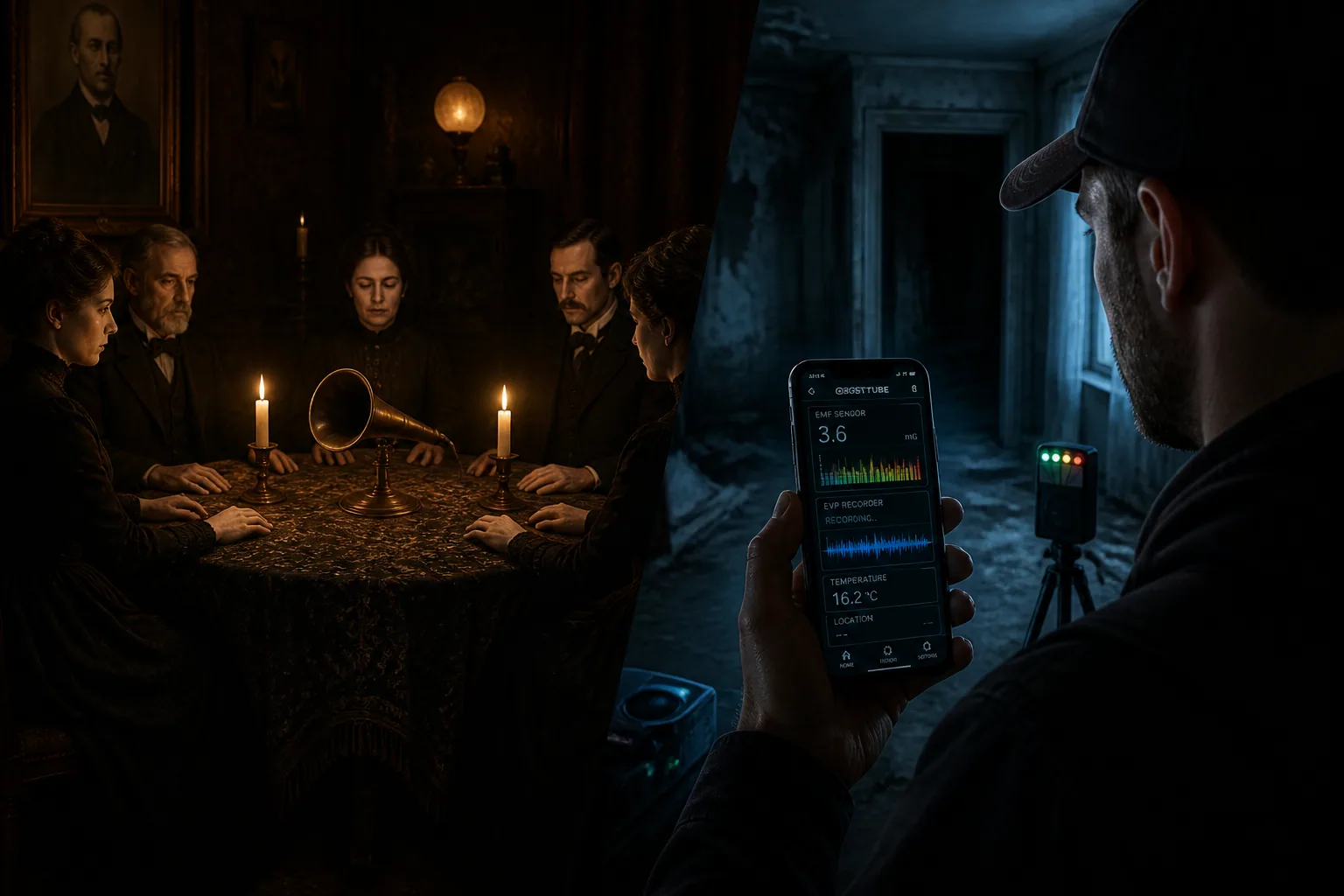
How Ghost Hunting Evolved: From Séances to Sensor Apps
Ghost hunting has never been a fixed practice. It has always shifted with the tools available, the beliefs of the time, and the way people wanted to prove what they were experiencing. In the Victorian era, the search for spirits depended on séances, spirit trumpets, table tipping, and manifestation cabinets. Later, investigators started borrowing the language of science with thermometers, audio recorders, and structured field notes. Then came the electronic age, when EMF meters, spirit boxes, thermal cameras, and motion sensors turned paranormal investigation into something that looked more like field research. Today, that evolution has reached smartphones, where built-in sensors and ghost-hunting apps try to make the entire experience portable, social, and easy to record.
That long history matters because it shows that modern ghost detector apps are not a sudden break from the past. They are the latest version of an old impulse: to use the best available technology to ask whether something unseen is really there. The tools have changed dramatically, but the basic question has remained the same.
Why Ghost Hunting Has Always Changed With Technology
Ghost hunting has always been tied to the technology of its era because every generation wants a more convincing way to measure the unknown. In the 1800s, people trusted ritual, physical props, and the authority of mediums. In the early 1900s, investigators wanted repeatable observation and a more disciplined method. In the late 20th century, electronics offered graphs, readings, and mysterious sounds that seemed objective at first glance. And in the smartphone era, people expect a device in their pocket to do almost everything, from recording a session to flagging a possible anomaly in real time.
This pattern makes sense. Paranormal claims are difficult to verify, so investigators often lean on whatever tool feels most capable of capturing the hidden. At the same time, every new tool comes with the same challenge: it can reveal something interesting without necessarily proving a ghost. That tension between evidence and interpretation has been part of ghost hunting from the very beginning.
Victorian Spiritualism and the First Ghost Hunting Tools
Modern ghost hunting has roots in Victorian spiritualism, a movement that treated contact with the dead as both possible and socially meaningful. The word séance comes from the French for “session,” and séances became central to the culture of spiritualist investigation. Participants would sit around a table, often holding hands, waiting for signs such as knocks, movements, or a table tipping on its own. According to History.com, spirit trumpets, spirit boards, planchettes, slates, and manifestation cabinets were frequently used in these gatherings. https://www.history.com/articles/ghost-hunting-victorian
These early tools were part performance, part ritual, and part attempt at proof. Spirit trumpets were supposed to amplify whispers or allow voices from beyond to be heard more clearly. Spirit boards and planchettes let participants spell out messages letter by letter. Slates could supposedly receive written communications from spirits. None of these devices functioned like scientific instruments in the modern sense, but they created a framework in which believers could interpret movement, sound, and timing as evidence of contact.
Manifestation cabinets added another layer of drama. These wardrobe-like enclosures, draped in heavy curtains, were used by mediums such as the Davenport Brothers in the 1850s. As History.com notes, mediums might even be bound inside to prove authenticity, while faces, apparitions, or spirit drapery emerged from the cabinet to heighten the effect. https://www.history.com/articles/ghost-hunting-victorian
Séances, Spirit Trumpets, and Manifestation Cabinets Explained
To understand early ghost hunting, it helps to see how these tools worked together. A séance was not just a conversation with the dead. It was an environment carefully arranged for expectation. The room, the table, the lighting, the props, and the medium all contributed to the experience. A slight knock could become a response. A shift in the table could become movement from an unseen intelligence. A voice from a trumpet could feel like direct communication from beyond the room.
In other words, the tools did not simply “detect” spirits. They shaped the interpretation of events. That is one of the most important ideas in the history of ghost hunting. The evidence often depended on what participants were prepared to see, hear, or believe. The tools amplified uncertainty, and uncertainty made room for meaning.
That does not mean every séance was a deliberate fraud or a total misunderstanding. It means the early history of paranormal investigation was deeply tied to theatricality and interpretation. The equipment was designed to create an atmosphere where the impossible could feel momentarily plausible. That legacy still influences ghost hunting today, even when the tools look much more technical.
How Early Investigators Interpreted Signs and Spirit Contact
As spiritualism spread, some investigators tried to move beyond pure belief and into observation. The Society for Psychical Research, founded in London in 1882, became one of the first groups to apply what were then considered more disciplined methods. It collected testimonies, used questionnaires, and investigated mediums under controlled conditions. One of its best-known projects was the 1894 Census of Hallucinations, which surveyed about 17,000 people. https://esovitae.com/ghost-hunting-techniques-and-technology/
This shift mattered because it introduced a new standard. Instead of asking only whether a spirit had appeared, researchers began asking how the event was reported, how often it happened, and whether the circumstances could be repeated or verified. Even though these early methods were far from today’s scientific standards, they marked an important transition from ritual to observation.
That change in mindset also altered what counted as evidence. A medium’s testimony was no longer enough on its own. Investigators wanted notes, witness accounts, and controlled settings. This is where ghost hunting began moving toward the field study model that would later shape modern paranormal teams.
The Shift Toward Scientific Observation in the Early 20th Century
By the early 20th century, paranormal research increasingly borrowed the appearance of science. Investigators began carrying thermometers, recording devices, and notebooks into allegedly haunted places. The goal was not just to participate in a haunting, but to document it. This created a much more systematic approach, even if the underlying claims remained controversial.
Thermometers became especially important because cold spots were often interpreted as signs of spirit activity. Research summaries mention cases where paired thermometers were used to track unusual temperature changes in haunted locations, including reports associated with Borley and the Cambridge Commission. https://esovitae.com/ghost-hunting-techniques-and-technology/
Audio recording also changed the field. If a haunting could leave behind unexplained voices or sounds, then recording equipment might preserve them for later analysis. That idea laid the groundwork for what would later be called Electronic Voice Phenomena, or EVP. This is where ghost hunting began to feel less like a séance and more like a data collection exercise, even if the interpretation of the data was still highly subjective.
Structured note-taking became just as important as the equipment itself. Investigators tried to log times, locations, witness reactions, weather changes, and environmental conditions. In theory, that made it easier to compare one case with another. In practice, it also showed how difficult paranormal work is, because most supposed evidence depends on context that is hard to standardize.
Audio Recorders, Thermometers, and Structured Paranormal Field Notes
This early scientific turn helped establish a basic ghost-hunting workflow that still exists today. Investigators would identify a location, document the environment, note baseline conditions, and then watch for anomalies. A temperature drop, a strange sound, or an unexplained recording became something to review later rather than something to treat as instant proof.
That approach made ghost hunting more credible to some audiences because it borrowed the language of measurement. At the same time, it introduced a new problem: the more a paranormal claim resembles a scientific observation, the more careful you have to be about error, calibration, and interpretation. A thermometer can show a temperature shift, but it cannot explain why it happened. A recorder can capture a sound, but it cannot determine whether that sound came from a ghost, a person, a device, or the building itself.
This is why early field notes were so important. They provided the context needed to decide whether an event was unusual or simply unexplained. That same tension still defines ghost hunting today, especially when phone apps claim to detect paranormal activity using sensors that were never built for that purpose.
The Rise of Electronic Ghost Hunting Equipment
The electronic era transformed ghost hunting by making measurements feel more immediate and more objective. Once digital devices entered the field, investigators could point to numbers, lights, graphs, and audio clips instead of relying only on personal impressions. EMF meters, spirit boxes, digital recorders, thermal cameras, structured-light sensors, and motion detectors became standard parts of many paranormal toolkits. https://esovitae.com/ghost-hunting-techniques-and-technology/
Believers often argue that ghosts influence electromagnetic fields, which is why EMF meters became so popular. The logic is simple: if a disturbance shows up as a reading, then the reading may be evidence of a presence. The same idea helped make thermal cameras appealing, since unusual heat patterns could seem to reveal invisible activity. Motion sensors and REM-pods added another layer by signaling changes in nearby energy or movement.
The appeal of these tools is easy to understand. They create a sense of immediacy. Instead of waiting for a later interpretation, investigators get a visual or audible response in real time. That makes the experience feel active and investigative, not merely narrative. It also helps explain why electronic ghost hunting became so dominant in popular culture.
Still, mainstream science does not accept these devices as definitive evidence of ghosts. They can detect environmental changes, but they cannot prove paranormal causation. That distinction is crucial and is often lost in the excitement of a live reading.
EMF Meters, Spirit Boxes, and Environmental Sensor Claims
Among the most recognizable tools in modern ghost hunting are EMF meters and spirit boxes. EMF meters are used because believers think spirits may disrupt electromagnetic fields. Spirit boxes sweep through radio frequencies to create fragmented audio that some users interpret as spirit communication. Digital recorders capture alleged EVP, while thermal and structured-light devices aim to highlight anything unusual in the environment.
These tools fit the paranormal investigator’s need for something responsive. A ghost hunt becomes more compelling when a device reacts at the same moment someone asks a question. The timing can feel meaningful, even if the underlying mechanism is not supernatural. That is one reason these devices remain central to the field: they are good at generating memorable experiences.
The development of EVP is especially important here. Research notes that Friedrich Jürgenson gained attention in the late 1950s after he said he recorded his deceased mother’s voice while taping bird sounds outdoors. Konstantin Raudive later expanded on this in books such as Breakthrough in 1971. https://esovitae.com/ghost-hunting-techniques-and-technology/
This history matters because it shows how ghost hunting moved from voice-on-a-table to voice-on-a-tape. Each stage kept the same goal, which was communication, but changed the method to match the technology available. The spirit box is really just the latest version of that same desire to hear something intelligible from the noise.
How TV, Pop Culture, and Paranormal Media Shaped Modern Methods
Popular media played a huge role in making electronic ghost hunting feel normal. Television shows and online videos taught viewers what a ghost hunt is supposed to look like: dark hallways, handheld meters, sudden spikes, whispered questions, and dramatic reactions. As that style spread, the tools themselves became iconic. People did not just want evidence. They wanted the look and feel of an investigation.
That cultural influence changed expectations. A strange sound is no longer just a sound. It is potential EVP. A random movement on a meter becomes a signal. A shadow in a thermal image becomes a possible figure. The media environment trained audiences to interpret ambiguity as evidence of activity, which made electronic tools even more appealing.
At the same time, pop culture helped normalize the idea that ghost hunting should be portable, shareable, and visually dramatic. That shift set the stage for the smartphone era, where investigations are increasingly recorded, edited, and posted as content.
The Smartphone Era: Ghost Hunting Apps and Built-In Sensors
Today’s ghost hunting apps take the old desire for portable evidence and place it inside a device nearly everyone already carries. Smartphones now combine a microphone, camera, magnetometer, accelerometer, and gyroscope in one package, which makes them feel like miniature investigation kits. Apps often repurpose these features to mimic EMF readings, record EVP-style audio, detect movement, or produce SLS-style overlays. Research on ghost detector apps notes that they commonly use the magnetometer for EMF-like readings, the microphone for audio capture, and the camera for visual anomaly detection. https://migrate.littlecocalico.com/do-ghost-detector-apps-actually-work-science-vs-smartphone-paranormal-tech
This makes ghost hunting more accessible than ever. You do not need to buy separate gear to start exploring. You can open an app, enter a location, and begin a session in seconds. That convenience has made smartphone-based ghost hunting especially popular with casual users, social media creators, and people who want a low-cost introduction to the field.
The app ecosystem has also become surprisingly sophisticated. Some apps, including products like Ectify, combine real-time EMF detection, spirit box-style interactions, EVP generators, session recording, and shareable audio exports into a single experience. If you want to try a phone-based approach, Ghost Detector: Ectify is a good example of how modern ghost hunting has become mobile and media-friendly: https://findthe.app/ectify-fc72z0
But the convenience comes with limits. The phone is not a dedicated paranormal instrument. It is a general-purpose device whose sensors were built for navigation, communication, motion tracking, and imaging. That means ghost apps can create compelling sessions without necessarily offering reliable evidence.
What Phone Sensors Can Actually Detect and What They Can’t
Phone sensors can detect real environmental changes, but they cannot determine whether those changes are paranormal. A magnetometer can register magnetic variation, but that variation may come from wiring, electronics, metal structures, or even the phone itself. An accelerometer can detect motion and vibration, but it cannot tell you whether a floorboard creaked because of a presence or because someone shifted nearby. A microphone can capture sound, but it cannot label a voice as supernatural. A camera can show visual artifacts, but algorithms can easily misread shadows, reflections, dust, or ordinary movement.
That is why many ghost apps include disclaimers that they detect anomalies, not ghosts. App store descriptions often emphasize that the experience is immersive and entertaining rather than scientifically valid. Even when apps use features like SLS-camera overlays, AI pose estimation, or geophone-like vibration monitoring, they are still interpreting ordinary sensor data through a paranormal lens. https://play.google.com/store/apps/details?id=com.peerware.spectral.tracker
Comparisons between dedicated hardware and smartphone apps consistently favor the former when it comes to sensitivity, calibration, and reliability. Dedicated EMF meters and thermal cameras are built for one purpose and tend to respond more predictably. Phones, by contrast, are noisy environments in their own right. Their components generate signals, their software smooths or filters data, and their sensors are not calibrated for field-grade investigation. https://toxigon.com/13-ghost-hunting-apps-that-claim-to-find-paranormal-activity
So what can a phone do well? It can document, organize, and enhance the experience. It can make ghost hunting more portable and more shareable. It can help users collect audio, log sessions, review moments later, and compare notes over time. What it cannot do is replace the interpretive caution that serious investigation requires.
What We Gained and Lost as Ghost Hunting Went Digital
The digital turn brought obvious benefits. Ghost hunting became cheaper, more accessible, and easier to document. A single device can now perform tasks that once required several separate tools. That lowers the barrier to entry and encourages more people to explore haunted sites, compare experiences, and keep records of what they find.
But something was lost too. Older methods were often slower and more grounded in the social experience of the investigation. Séances depended on group attention, ritual, and shared interpretation. Early field research relied on notes, observation, and patience. Today, apps can make the process feel instantaneous, which is exciting, but sometimes encourages people to jump too quickly from anomaly to conclusion.
Digital tools also make it easier to chase a result rather than a process. When a meter spikes or a word appears on a screen, it is tempting to treat that moment as confirmation. In reality, it may simply be a device behaving within its limits. The more technology enters the field, the more important disciplined interpretation becomes.
How Historical Methods Still Influence Today’s Paranormal Investigators
Even with all the new hardware and app-based tools, the oldest ghost-hunting habits are still alive. Investigators still gather in groups like séance participants did. They still ask questions into the dark. They still watch for movement, listen for knocks, and treat sudden environmental changes as potentially meaningful. The language may have changed, but the core behavior has not.
You can also see the influence of early psychical research in the modern emphasis on recording sessions, comparing witness accounts, and trying to create repeatable methods. Likewise, the theatrical side of Victorian spiritualism survives in the way many investigations are presented today. Ghost hunting remains as much about experience as it is about data.
That continuity is one reason the subject stays popular. It sits at the intersection of belief, entertainment, and experimentation. Whether someone is using a spirit board, an EMF meter, or a smartphone app, they are participating in a very old pattern: using the best available tools to make the invisible feel closer.
Where Ghost Hunting Tech May Go Next
Looking ahead, ghost hunting will probably continue following consumer technology. That could mean better AI-based audio analysis, improved sensor fusion, more accurate thermal imaging, and wearable devices that make investigations even more hands-free. Future apps may combine environmental readings, video overlays, and automatic session logs in ways that feel increasingly polished and immersive.
But the fundamental issue will remain the same. Better technology can improve documentation, not automatically solve interpretation. A more advanced sensor may detect more subtle changes, but it still cannot tell us whether an event has a paranormal cause. The best ghost-hunting tools of the future will likely be the ones that help people record conditions clearly, compare data responsibly, and resist the urge to overclaim.
That is what makes the history of ghost hunting so interesting. From séances to sensor apps, the tools have changed, but the mystery has not. Every era builds its own version of the same question, and every new device offers a new way to ask it.
