How to Build a Paranormal Investigation Playlist: Music, Field Recordings & Soundscapes That Set the Mood
A good paranormal investigation playlist does more than make a location feel spooky. It helps shape attention, create tension at the right moment, and support a focused, disciplined session without muddying your evidence. If you are an amateur investigator or a spooky-content creator, the goal is not to flood the room with dramatic noise. The goal is to use sound with intention so your audience feels the atmosphere while you still preserve the integrity of your EVP, EMF, and environmental recordings.
That means thinking carefully about what you play, when you play it, and how you separate mood-building audio from actual captured evidence. The best ghost hunt soundtrack is often subtle, layered, and deliberately restrained. It uses low drones, sparse textures, natural field recordings, and moments of silence to sharpen perception instead of distracting from it.
Why Sound Shapes Fear During Paranormal Investigations
Sound has a direct line to emotion because it primes the brain to expect change. In a quiet building, even a small creak, a distant tap, or a low hum can feel amplified. That is part of why paranormal investigators rely so heavily on audio atmosphere. The brain starts scanning for patterns, and the body responds before the mind fully explains what is happening.
Recent research supports this effect. A study in Frontiers in Cognition found that low-frequency sounds in the 40 to 110 Hz range, especially in resonant spaces, can initially create positive emotion and then, after 15 to 40 minutes, increase arousal, heart-rate variability changes, galvanic skin response, and localized EEG power, all of which contribute to tension and unease. Source: https://www.frontiersin.org/journals/cognition/articles/10.3389/fcogn.2026.1806052/full
That matters in paranormal work because the emotional arc of a session often depends on pacing. A room that feels ordinary at first can become deeply unsettling if the soundscape is slowly nudged into a more charged state. But more sound is not always better. In many cases, the strongest effect comes from controlled restraint and careful contrast.
The Psychology of Ambient Noise, Drones, and Silence
A great investigation playlist usually rests on three pillars: ambient noise, sustained drone, and silence. Ambient noise creates a sense of place. Drone creates pressure. Silence creates expectation. Together, they can turn an empty hallway into a psychologically active space without overwhelming the investigator’s ability to notice real events.
Low-frequency noise deserves special care. Reviews of low-frequency exposure up to 100 Hz have linked it with discomfort, sleep disturbance, annoyance, hearing loss, and increased tension or blood pressure, even when the sound sits below conscious hearing thresholds. Source: https://www.mdpi.com/2076-3417/10/15/5205
Very low or infrasound, such as around 10 Hz, has also been associated with the subjective sense of pressure in the ears, annoyance, and physiological discomfort, even when people do not consciously hear the sound. Source: https://journals.sagepub.com/doi/10.1177/026309238400300101
Silence may be the most underrated tool in the whole playlist. It is not simply the absence of sound. It creates contrast, increases anticipation, and makes the next interruption feel more meaningful. Horror sound design discussions often point out that silence can trigger a startled nervous response when it is broken by even a small noise. Source: https://www.fearing.org/horror-art-and-music/how-sound-design-shapes-fear-in-horror-art-and-music/600
For paranormal investigators, that means silence should not be treated as dead air. It is an active part of the session. If you use music constantly, your brain adapts and the tension collapses. If you leave space, the smallest sound can carry the scene.
What Makes a Great Paranormal Investigation Playlist
A strong playlist for a ghost hunt is not a random collection of spooky tracks. It should be functional. Every sound should serve a purpose, whether that purpose is setting tone, marking transitions, supporting a video narrative, or helping a live team stay focused.
The best playlists usually include a mix of sustained tones, very light texture, environmental beds, and occasional punctuations. Think less cinematic jump scare and more unease under the surface. Avoid tracks with obvious melodies, strong lyrics, or sudden dramatic rises unless you are using them deliberately in post-production for a social clip rather than during a live evidence session.
A good structure often looks like this: start with soft ambient texture while everyone settles in, move into a more minimal drone during the core investigation, then use near-silence for key question-and-answer moments or EVP attempts. If you are filming content, you can add more dramatic sound in editing later, but keep live sessions clean.
The important question is always: does this sound help the investigation, or does it just make it feel louder? If the answer is only the second, it may be better left out.
Using Field Recordings Without Contaminating Evidence
Field recordings can make a paranormal playlist feel authentic, but they also create one of the biggest risks in the entire process: confusing atmosphere with evidence. A loop of wind, a distant footstep, or a subtle murmur can deepen the mood, but it can also mask real sounds or create false positives during review.
If you plan to use field recordings, keep them separated from the evidence workflow. In practice, that means labeling them clearly, timestamping them, and never assuming that something eerie in the background is paranormal just because it sounds haunting. A creak added for atmosphere is not evidence, and it should never be treated like one.
One useful precaution is dual recording. Use a control recorder in a quiet area alongside the recorder collecting your evidence. If a sound appears on both devices, it is likely environmental and should be excluded from paranormal interpretation. This method is recommended as a way to avoid contaminating live sensor data. Source: https://atransc.org/using-a-control-recorder-for-evp/
Another important habit is tagging known noises as they happen. If someone coughs, shifts a chair, or opens a door, note it immediately. Best-practice EVP guidance recommends high sampling rate digital recorders, WAV format, 24-bit capture, fixed sensitivity rather than auto gain, still environments, and turning off other electronics. Source: https://ukpx.org/2025/10/12/electronic-voice-phenomena-evp-best-practices-and-technical-guidance/
That does not mean field recordings are off limits. It means they should be used as mood design, not as evidence inputs. The clearer the line between atmosphere and capture, the more credible your session remains.
Best Sound Types for Mood: Wind, Creaks, Hum, Static, and Distant Voices
Some sounds are especially effective for paranormal atmosphere because they occupy the edge of perception. Wind creates movement without a visible source. Creaks suggest old structures and hidden stress. Hum adds body to empty spaces. Static suggests interference. Distant voices, when used carefully, create unease because the listener cannot immediately locate the source.
Wind works well as a base layer, especially if it sounds like it belongs to the location. A drafty corridor, a rooftop, or a hollow stairwell can all benefit from soft wind beds. Just be careful not to use wind so prominently that it becomes the main event. If the room sounds like a storm is raging outside when the weather is calm, your credibility drops fast.
Creaks and floor groans are powerful because they feel physical. They suggest unseen movement, but they should be used sparingly. Repeating the same creak too often makes it obvious that it is part of the soundtrack. Variation is key.
Hum and static are useful because they sit underneath conscious attention. Low-level electrical hum can help the room feel active. Static can work as a transition texture, especially in short-form video. But if static gets too sharp or too loud, it can interfere with actual EVP listening.
Distant voices are the most dangerous category. They can be incredibly effective in a horror edit, but they are also the easiest way to confuse analysis. If you include them at all, make sure they are unmistakably part of the mood layer and never used during live EVP collection. A sound that is meant to feel like a whisper should never be mistaken for a possible response.
There is also an emotional dimension to consider. Horror research shows that scream-like music with high roughness and abrupt transitions can trigger the amygdala and increase threat perception. Source: https://pubmed.ncbi.nlm.nih.gov/32611175/
You do not need actual screams to use that principle. Slight roughness, unstable textures, and subtle instability in the soundbed can raise tension without becoming melodramatic.
How to Approach EVP Audio Carefully and Ethically
EVP sessions should be approached with discipline, not excitement. If your sound design is too busy, you increase the chance of mishearing ordinary noises as voices. That hurts your own analysis and weakens your content when others review it.
The safest method is simple. Keep EVP sessions as clean as possible. If you want mood audio, either pause it during questioning or record it on a separate track so you can review the raw evidence independently. This is where clear track naming, timestamps, and written logs become essential.
Good practice also means thinking about the ethics of presentation. If you later publish a video, viewers should be able to tell what was captured live and what was added in editing. Never present a manipulated soundscape as if it were raw evidence. Paranormal content can be entertaining and atmospheric without pretending to be something it is not.
If you are building a session specifically around EVP, prioritize quiet, stable conditions. According to technical guidance, use a high sampling rate recorder, disable automatic gain, keep the environment still, and document all known noises as they occur. Source: https://ukpx.org/2025/10/12/electronic-voice-phenomena-evp-best-practices-and-technical-guidance/
This is also where a tool like Ghost Detector: Ectify can fit naturally into your workflow. It is designed to turn a smartphone into an immersive ghost hunting companion, with real-time EMF detection, a spirit box and EVP generator, session recording, and shareable exports for social platforms. For creators who want a more polished session format, it can help structure the experience while keeping your workflow organized: https://findthe.app/ectify-fc72z0
Live Soundscapes vs Post-Production Overlays
There is a major difference between sound used during an active investigation and sound used after the fact. Live soundscapes influence the room, the investigators, and the recording environment in real time. Post-production overlays influence only the audience experience.
For live sessions, keep the mix simple. You want enough atmosphere to shape the mood, but not so much that your ears stop detecting subtle changes. For post-production, you can be more expressive. That is where you can create tension ramps, cut to near silence before a reveal, or layer subtle textures beneath your footage to help TikTok, YouTube, or Instagram viewers feel the session’s emotional arc.
If the purpose is evidence collection, raw audio must stay untouched. If the purpose is storytelling, you have more freedom, but it should still be disclosed. The audience may forgive a dramatic edit, but they will not forgive confusion about what was genuinely recorded.
A strong workflow is to maintain separate versions: one raw capture archive, one clean review version, and one edited presentation version. That way, your investigation remains credible while your content still feels cinematic.
Tools and Apps for Mixing Audio in Real Time
You do not need a studio to build a convincing paranormal atmosphere. Several tools can help you mix soundscapes live or shape them on the fly. AURA Sounds is a browser-based ambient mixer that lets users layer atmosphere, leads, and transitions without needing MP3 files or a dedicated app. That makes it useful if you want a simple live setup with minimal friction. Source: https://auraneural.net/
MyNoise is another good option because it offers natural and synthetic soundscapes and allows users to customize sound generators based on environment and hearing profile. That flexibility makes it useful for tuning a session to a basement, attic, cemetery perimeter, or abandoned hallway. Source: https://en.wikipedia.org/wiki/MyNoise
If you want something more experimental, Reverie by Parallel Minds can import audio files and transform them into evolving, non-repeating atmospheres using tools like spectral freeze, blur, and formant shift. It is especially useful when you want a familiar field recording to become something more unsettling without sounding repetitive. Source: https://www.kvraudio.com/news/66474
On the hardware side, the Sound Devices MixPre-6 II remains a strong choice for serious field ambience work because of its 32-bit float recording, rugged build, multiple channels, and post-production flexibility. For investigators who also create content, that combination can make one device handle capture, cleanup, and layered mix preparation more smoothly. Source: https://www.musicradar.com/news/best-field-recorders
Editing Tips for YouTube, TikTok, and Instagram Paranormal Content
When you edit paranormal content for social platforms, think in terms of pacing and clarity. The audio should guide attention, not bury the moment. If a clip is too noisy, viewers will miss the reaction, the response, or the supposed anomaly. If it is too clean and flat, the atmosphere disappears.
For YouTube, longer-form storytelling can support layered sound design. You can start with a quiet opening, add a drone during the investigation, then use selective emphasis in post-production to highlight the most important moments. For TikTok and Instagram, short clips benefit from a fast setup, a clear payoff, and a simple soundbed that does not compete with the visual action.
A practical editing rule is to keep the raw evidence track intact and build the final soundtrack on top of a duplicate. That gives you freedom to experiment without risking the original file. It also makes it easier to answer audience questions about whether a sound was captured live or added later.
If you are using ambient loops, avoid obvious repetition. The human ear catches repetition very quickly, especially in short-form video. Use variation, crossfades, and subtle changes in tone to keep the atmosphere from feeling like a stock audio bed.
Common Mistakes That Can Ruin Credibility
The biggest mistake is overproducing the investigation. If every minute is packed with thunder, whispers, and cinematic rises, your audience stops trusting the footage. Paranormal content works best when the soundscape feels plausible and restrained.
Another mistake is forgetting that audio can distort interpretation. A low hum can mask a real voice. A wind loop can hide a chair scrape. A whisper effect can trick the ear into hearing a phrase that was never there. If you cannot tell the difference between the soundtrack and the evidence, neither can your viewers.
A third mistake is failing to log sounds in real time. Later review becomes much harder when there is no note saying who coughed, who moved, or when the building creaked naturally because of temperature shifts.
Finally, avoid treating any unsettling sound as paranormal by default. Responsible investigators stay curious, but they also stay skeptical. That balance is what gives your work value.
Sample Playlist Structure for a More Immersive Ghost Hunt
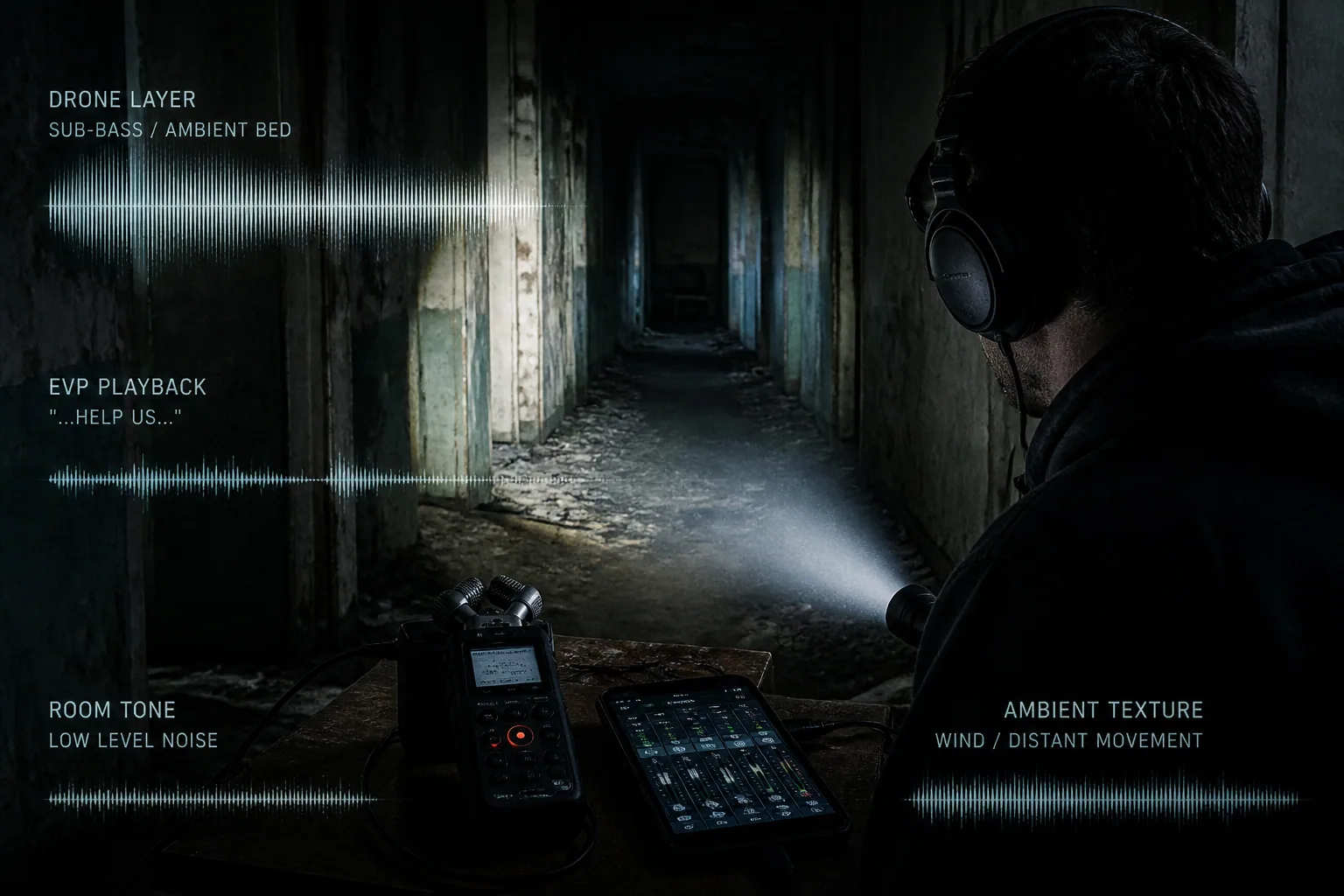
A simple structure can make your playlist much more effective. Start with a quiet ambient bed that matches the location. Use soft wind, room tone, or a faint electrical hum while the team sets up. Then introduce a low drone for the first observation phase, keeping the volume just high enough to shape attention without overpowering speech.
For the middle of the session, alternate between drone and silence. Leave space for questions, responses, and microphone sensitivity. If you want a more intense segment, add a slightly rougher texture or a barely audible instability under the base sound, but stop before the mix becomes distracting.
For transitions, use brief field recordings such as a door settling, distant footsteps, or a gust of wind. Save more dramatic textures for post-production, where they can support the story without affecting the live evidence environment.
A good sample flow might look like this: room tone, soft wind, sparse drone, silence for EVP, minimal static, near silence, then a controlled ambient swell for the closing segment. That pattern keeps the session feeling alive while preserving room for genuine anomalies.
Final Checklist for Creating Atmosphere Without Faking Evidence
Before you hit record, ask yourself a few simple questions. Is the soundscape helping the investigation, or only decorating it? Are your ambient layers separate from your evidence track? Have you logged known noises and turned off unnecessary electronics? Is the room still quiet enough for meaningful EVP review?
If you can answer yes to the right questions, your playlist is doing its job. You are creating tension, guiding attention, and supporting the mood without compromising the integrity of the session. That is the sweet spot for paranormal storytelling.
Build your atmosphere with intention, keep your evidence clean, and use sound like a tool rather than a prop. That approach will make your ghost hunts more immersive, your analysis more credible, and your finished content far more compelling.
