How to Incorporate Ambient Sensor Training into Ghost Hunting Practice
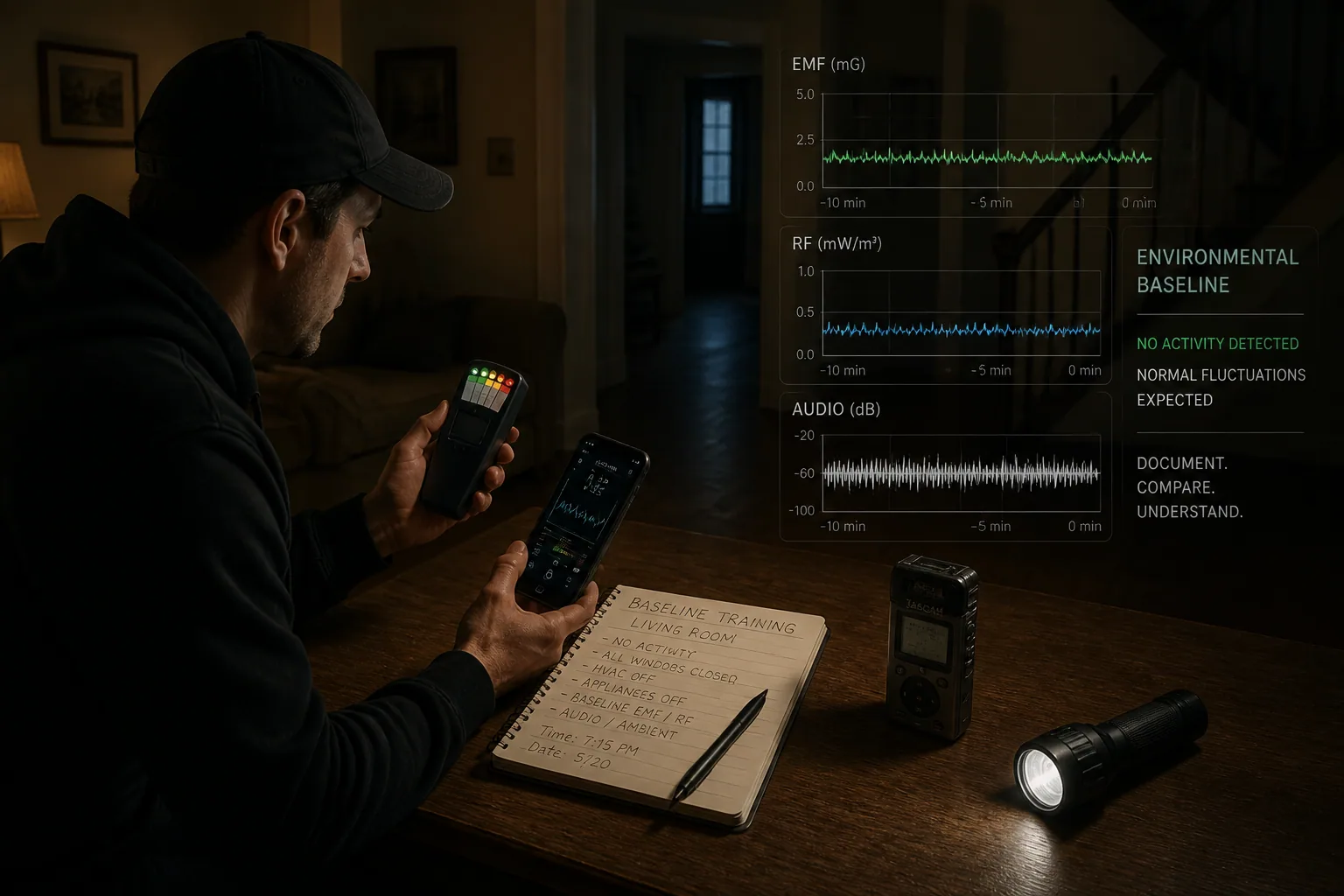
If you want to get better at ghost hunting, one of the smartest things you can do is practice before the investigation begins. Ambient sensor training helps you build a sense of what normal looks like in a room, a hallway, a basement, or even your own home, so that when something unusual happens in the field, you have a real point of comparison.
That matters because paranormal gear is only useful when you understand its behavior. A meter reading, a sudden sound, or a temperature shift is not automatically evidence of anything supernatural. It may be wiring, airflow, a phone nearby, a device moving slightly, or just the natural variation of the environment. The more you calibrate your senses and your tools, the less likely you are to chase false positives.
This is also why baseline practice is such a core part of disciplined investigations. PSI notes that baseline tests are foundational, but often mishandled because people take only momentary readings or do not place the device well enough to understand the room properly: https://www.p-s-i.org.uk/smallarticles/baselines.html
Why Ambient Sensor Training Matters in Ghost Hunting
Ambient sensor training is really about building observational discipline. Instead of walking into a location and reacting emotionally to every spike or noise, you learn to ask a better question: is this actually unusual, or is it just part of the environment?
That shift in mindset changes how you investigate. It makes you slower, more careful, and much more credible. When you know what a location normally does, you can compare that against the event you are trying to evaluate. In practice, this means your evidence becomes easier to defend, and your conclusions become less dependent on guesswork.
It also improves teamwork. If everyone on the crew has trained on baseline readings, then the group can discuss an anomaly in the same language. You are no longer saying, “That felt weird.” You are saying, “This is different from the control area, it happened after the HVAC cycled, and the EMF spike was consistent over time.”
What Baseline Readings Are and Why They Prevent False Positives
A baseline reading is a measurement of normal conditions in a location before, during, or after a suspected event. It tells you what the room usually looks like in terms of EMF, sound, magnetic activity, airflow, temperature, or other environmental factors.
Without a baseline, every reading feels dramatic. With a baseline, a reading becomes data.
That difference is especially important because environmental fields are not static. ASSAP notes that even in fixed locations, magnetic or temperature conditions can vary over time due to appliances switching on and off, geomagnetic shifts, or HVAC cycles: https://www.assap.ac.uk/articles/detail/paranormal-vigil-baselines
In other words, a spike is not automatically a paranormal event. It may be an ordinary fluctuation that you would have understood immediately if you had spent enough time logging the room first.
This is why some investigators recommend continuous data logging when possible, and why all possible interference sources should be noted. The Paranormal Response Network specifically emphasizes controlling for phones, wiring, and electronics when checking strange meter readings: https://www.paranormalresponsenetwork.org/evidence-guides/meters
Learning What Normal EMF, Audio, and Magnetic Activity Looks Like
If you are training your instincts, it helps to think of each sensor type as a different way of listening to the environment.
EMF readings are a good place to start. Public Parapsychology notes that many buildings generally sit around 0.2 to 2 milliGauss, which gives you a rough sense of the range you might expect before any unusual source is considered: https://www.publicparapsychology.org/hauntingsandmagnetismprimer.pdf
But the key lesson is not the number alone. It is the pattern. A room may have one corner that always reads higher because of nearby wiring, while another area stays stable unless a device turns on. Once you have spent enough time watching those changes, you start to recognize the difference between a persistent environmental source and a more isolated anomaly.
Audio works the same way. Every location has a noise floor. That includes HVAC hum, traffic outside, footsteps in adjacent rooms, pipes, distant voices, and the little mechanical sounds you usually stop noticing after a few minutes. Paranormal Learning Center recommends making audio baseline recordings in each room, with HVAC both on and off, so you can evaluate EVP claims against the room’s normal sound profile: https://paranormallearning.com/blog/field-investigation-protocols
Magnetic activity can be even trickier because it changes in relation to your position and the orientation of your device. Meridian Loom stresses the importance of fixed positioning, timestamps, and consistent device orientation, since moving the device can create the very change you think you are detecting: https://meridianloom.com/field-use/
How to Practice in Everyday Spaces Before an Investigation
You do not need a haunted building to start training. In fact, ordinary places are better for practice because they are full of real-world interference that teaches you how sensors behave.
Try a kitchen, a bedroom, a garage, a basement, a stairwell, or even a parking lot near electrical infrastructure. The goal is not to prove anything paranormal. The goal is to learn the environment.
Start by standing still in one place and taking readings for several minutes. Then move to a nearby control area that shares similar conditions, such as the same floor level or the same type of wall construction. ASSAP has pointed out that comparing hot spots with nearby control zones helps reveal whether a sensor deviation is meaningful: https://www.assap.ac.uk/articles/detail/paranormal-vigil-baselines
You can also repeat the same practice at different times of day. A room may feel quiet in the afternoon and active at night simply because the refrigerator, heating system, or neighboring electronics behave differently. Once you log those changes, the room stops being mysterious and starts becoming legible.
Simple Tools for Sensor Training: Phones, Cheap Meters, and Recorders
The best training tools are usually the ones you already have, plus a few inexpensive add-ons.
A smartphone is surprisingly useful because it can act as a basic sensor platform, a recorder, a camera, and a note-taking device all at once. If you want a more paranormal-style experience during practice, Ghost Detector: Ectify turns your phone into a ghost hunting tool with real-time EMF detection, a spirit box and EVP generator, recording, and session history: https://findthe.app/ectify-fc72z0
Cheap EMF meters are helpful because they give you immediate feedback when you move through a space. But the important part is not just seeing numbers. It is learning how the numbers react to distance, orientation, walls, outlets, appliances, and your own body position.
Voice recorders are equally valuable. A recorder lets you build a noise library for a space, which is often more useful than a dramatic one-off audio clip. When you hear something odd later, you can compare it to the baseline sound of the room and identify whether it matches a recurring environmental noise.
If you use a spirit box or EVP-style device during training, treat it as a tool for familiarization rather than proof. Controlled use helps you understand what normal radio bleed, digital artifacts, and ambient interference sound like before you try to interpret the results as possible communication.
Exercises to Sharpen Perception Alongside Your Equipment
One of the best ways to improve is to pair your equipment with simple perception drills.
For EMF training, choose one room and walk it slowly from corner to corner while holding the meter at the same height. Notice where the reading changes and whether it changes in repeatable places. Then repeat the route with the meter rotated slightly, because the device orientation can affect what it detects.
For audio training, record two or three minutes of silence in a room with all expected sources identified. Then record again with one predictable change, such as HVAC off, a window open, or a fan running. That gives you a practical sense of how the noise floor shifts under different conditions.
For magnetic awareness, compare a hallway, a room near an electrical panel, and a room farther away from household electronics. You will usually notice that the environment is not uniform. That is the point. Learning those differences makes it easier to interpret field conditions later.
You can also practice noticing non-device clues. Drafts, reflections, hums, subtle vibrations, and pressure changes all affect how a space feels. Llewellyn’s discussion of overlooked environmental parameters includes light, airflow, humidity, carbon monoxide, pressure gradients, and even refraction and reflection sources, all of which can matter during a serious baseline sweep: https://llewellyn.com/journal/print.php?id=3286
Using Spirit Boxes Responsibly During Baseline Practice
Spirit boxes can be entertaining, but they can also become a shortcut to confirmation bias if they are used carelessly. That is why baseline practice matters here too.
A good way to practice is to divide the session into phases. First, record silence or ambient room noise. Then introduce controlled stimuli, such as a knock, a spoken word, or a simple environmental change. Finally, return to silent monitoring. This approach helps you distinguish ordinary response patterns from unusual output.
EyeSpySupply describes a similar three-phase approach for voice-activated recorders: baseline silence, controlled stimuli, then silent monitoring. That structure is useful because it creates a cleaner comparison point for later analysis: https://blog.eyespysupply.com/2026/01/24/using-voice-activated-recorders-for-ghost-hunting-and-evp-investigation/
If you use a spirit box during practice, do not treat every burst of audio as meaningful. Instead, ask whether the result could be explained by scanning speed, radio stations, local interference, or your own expectations. Responsible use means you are trying to learn how the device behaves, not forcing it to confirm a theory.
How to Log Notes, Photos, and Audio for Better Pattern Recognition
Your memory is not a reliable evidence archive. If you want to get better at spotting patterns, you need logs.
At minimum, note the time, location, device used, device orientation, and what else was happening in the environment. Did someone enter the room? Was the phone nearby? Did the HVAC cycle on? Was there traffic outside? Even a short note can explain a reading later.
Photos are helpful because they preserve context. A picture can show the meter’s placement, the room layout, nearby outlets, reflective surfaces, and the exact spot where an audio recorder was set down. That context matters when you revisit the session days later.
Audio logs should be labeled carefully as well. If you record multiple rooms in the same night, separate each file by location and time. If possible, keep a simple naming system that makes the session easy to review. The more organized your archive is, the more likely you are to notice recurring patterns instead of random noise.
Session history is especially useful if your app or device supports it. That is one reason a tool like Ectify can fit naturally into training, since it stores session history with timestamps and lets you review active recordings over time: https://findthe.app/ectify-fc72z0
Turning Daily Calibration into Better Field Investigation Habits
The real value of ambient sensor training is that it changes how you investigate in the field. You stop treating every moment as a mystery and start approaching each location with a method.
Before a live investigation, try to build a habit of doing a short baseline sweep in every new space. Check for obvious interference sources, note how the room sounds, identify likely electrical hotspots, and compare them with quieter control zones. Pacific Paranormal recommends mapping sources such as fuse boxes, appliances, and power lines as part of a thorough sweep: https://www.pacificparanormal.com/index.php/menu-btn-team-resources/133-baseline-readings
If you practice this daily, even in ordinary places, the process becomes automatic. You will be less tempted to overreact, and more likely to preserve the integrity of your evidence. That is the difference between casual ghost hunting and disciplined investigation.
Daily calibration also improves confidence. When you have seen how normal environments fluctuate, you are less easily surprised by the field. At the same time, you become more responsive when something truly stands out because it is standing out against a real baseline, not against ignorance.
Common Mistakes Beginners Make When Reading Anomalies
Beginners often make the same handful of mistakes, and most of them are avoidable.
The first is taking baseline readings too quickly. A few seconds in one spot is not enough to understand a room. Environmental variation takes time, and short readings often miss the context that explains the anomaly.
The second is changing device position without realizing it. Even a small shift in angle or height can change the reading, especially with magnetic or EMF tools. If you are not consistent, you may think the environment changed when the real variable was your hand.
The third is ignoring interference sources. Phones, routers, wiring, appliances, and nearby electronics are not minor details. They are often the explanation. If you do not note them, you cannot control for them.
The fourth is treating one reading as evidence. A single spike means very little unless it is repeatable, documented, and understood in context. A stronger approach is to compare the reading to a control area, repeat it, and see whether it tracks with environmental conditions.
The fifth is forgetting that some anomalies are only interesting because of the story we attach to them. If you train your senses on everyday spaces first, you are far less likely to mistake a normal fluctuation for something extraordinary.
That is the real benefit of ambient sensor training. It gives you better instincts, cleaner logs, and a more evidence-based ghost hunting routine. Instead of hoping your equipment will tell you the truth, you learn how to read the environment well enough to recognize it for yourself.
