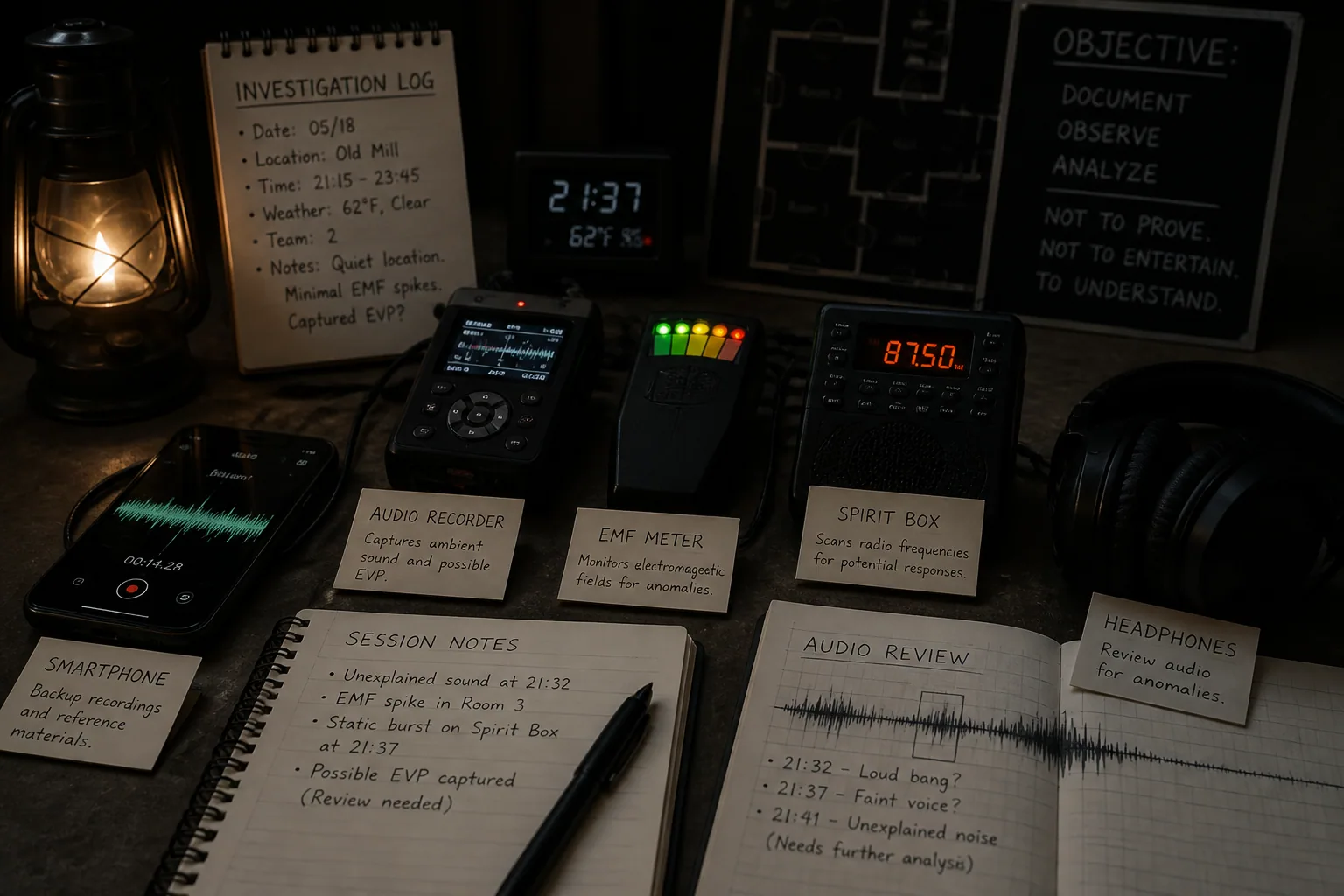
How to Vet Your Ghost Hunting Evidence Without Convincing Yourself Too Fast
If you have ever come home from an investigation thinking, “That has to be something,” this article is for you. Good paranormal evidence does not start with certainty. It starts with doubt, patience, and a willingness to let the evidence survive scrutiny before you call it meaningful.
That can feel less exciting at first, especially when you are hoping for a strong EMF spike, a clear EVP, or a spirit box response that seems too perfect to ignore. But the investigators who build real trust in their methods are the ones who learn how to ask better questions before they decide what they saw or heard.
Why Good Evidence Starts With Doubt
The biggest mistake in paranormal investigating is deciding too early. Once you label something paranormal in your head, every later step becomes easier to bend toward that conclusion. A brief meter jump becomes a “hit.” A noisy audio clip becomes a voice. A random coincidence becomes a pattern.
Doubt is not the enemy of ghost hunting. It is the filter that keeps weak evidence from being mistaken for strong evidence. If you want results that hold up later, you need a process that treats the first exciting interpretation as a hypothesis, not a conclusion.
The Biggest Mistake in Paranormal Investigating: Deciding Too Early
Once you expect a haunting, your brain starts narrowing the field. You begin noticing details that support the idea and overlooking the ones that do not. This is where confirmation bias becomes dangerous, because it can make a session feel more successful than it really was.
That problem is not unique to paranormal research. It is part of normal human cognition. We are built to search for meaning, even in ambiguous data. In ghost hunting, that means you have to slow down long enough to ask whether the evidence is actually telling you something, or whether you are supplying the meaning yourself.
Confirmation Bias, Pattern Matching, and the Human Need for Meaning
Confirmation bias pushes us to prefer evidence that supports what we already believe. Pattern matching helps us make sense of incomplete information. Together, they are useful in daily life, but they are risky in paranormal work, where static, shadows, and environmental noise can easily be reinterpreted as messages.
Research on auditory pareidolia shows how strongly expectation can shape what people hear. In one controlled study, participants primed to expect paranormal EVPs reported hearing more voices in ambiguous audio clips than those given a neutral explanation, and agreement on what was heard was low. In other words, expectation did a lot of the work. Source: Nees & Phillips, 2015, https://onlinelibrary.wiley.com/doi/full/10.1002/acp.3068
A 2022 study found a similar pattern, showing that people with higher sensory-processing sensitivity and more reported paranormal experiences were more likely to detect voices in ambiguous sounds even when no actual speech was present. Source: PMC, 2022, https://pmc.ncbi.nlm.nih.gov/articles/PMC9473424/
EMF Readings 101: What Your Meter Is Really Detecting
EMF meters can be useful, but only if you understand what they measure. They do not automatically detect ghosts. They detect electromagnetic fields, which come from many ordinary sources: wiring, power lines, appliances, phones, routers, and other electrical equipment.
A useful place to start is baseline reality. In a survey of 992 U.S. homes, average whole-house magnetic field levels, excluding proximity to appliances, were about 0.9 milligauss, with half the houses at 0.6 mG or less. That suggests many environments already have a steady background level before you ever enter the room with a meter. Source: NIEHS, https://www.niehs.nih.gov/sites/default/files/2024-04/emf_electric_and_magnetic_fields_associated_with_the_use_of_electric_power_508.pdf
That matters because an EMF spike is only meaningful if you know what “normal” looks like in that location. Without a baseline, you are reacting to numbers without context.
Natural and Technical Causes of EMF Spikes
The most common mistake with EMF evidence is assuming that a spike is automatically unusual just because it changed quickly. In real homes and buildings, magnetic fields can shift for boring reasons all the time.
Certain appliances can produce fields that are far stronger than background levels. Research has found that very close to appliances, magnetic fields can be 10 to 100 times higher than typical background. Electric blankets, hair dryers, drills, and electric shavers are all examples of devices that can create strong fields that fall off sharply with distance. Sources: Tanaka et al., https://www.jstage.jst.go.jp/article/ieejfms/129/9/129_9_627/_article/-char/en and Tofani et al., https://pubmed.ncbi.nlm.nih.gov/8789066/
That means a “hot spot” near a wall might simply be wiring behind the plaster, a fuse box, a power panel, or nearby portable electronics. Even your own gear can create artifacts if you are too close to it.
How to Baseline a Location Before You Start Investigating
A baseline is your starting map. Before you ask whether the room is active, record what the room does when nothing unusual is happening. Measure in multiple spots, note the time, and pay attention to whether the readings are stable or inconsistent.
When a strange reading appears, log the exact value, location, duration, and any nearby devices. Then look for fixed infrastructure such as fuse boxes, wiring runs, power panels, or nearby appliances. Try to reproduce the reading in the same spot under the same conditions. That is the basic approach recommended by the Paranormal Response Network. Source: https://www.paranormalresponsenetwork.org/evidence-guides/meters
This is also where good note-taking matters. If you cannot explain when the spike happened, where it happened, and what was around it, then you do not really have evidence. You have an anecdote.
EVPs Under the Microscope: Noise, Pareidolia, and Recording Limits
EVPs can feel powerful because they often arrive wrapped in silence, static, or faint background noise. But that is exactly why they deserve careful review. Human hearing is excellent at turning uncertainty into language.
The verbal transformation effect shows that when listeners hear repeated or ambiguous sounds like white noise or static, the brain often creates wordlike perceptions, especially when people expect speech. Source: https://www.paranormalresponsenetwork.org/research/blog/verbal-transformation-effect-voices-in-noise
That does not mean every EVP is fake. It means an EVP should be treated as a claim that needs testing, not as proof by itself. Background hiss, radio bleed, nearby conversation, and even your own expectation can all shape what seems to be there.
This is why a clip that sounds clear to you may sound completely different to someone else. If there is no independent agreement on the words, and no way to rule out noise or contamination, the clip remains weak evidence.
How to Audit an EVP Session Step by Step
Start with the full recording, not the 10-second clip you are most excited about. Listen to the entire session in context. Check what was said before and after the moment you think you heard something, and note whether any sounds might have carried into the clip.
Then compare the suspect audio with a clean baseline recording from the same location and device settings. Look for similar static patterns, nearby hums, and background interruptions. If possible, use headphones, then speakers, then another listener who has not been told what to expect.
Metadata matters too. Good audio and video evidence should include administrative details like who recorded it, when, and from what source, plus technical details such as format, quality, and device settings. The NISO RP-41-2023 guidelines recommend metadata that supports authenticity, reproducibility, and edit checking. Source: https://www.niso.org/publications/rp-41-2023-vamd
If your recording lacks that context, it becomes much harder to verify later. A clip with no timestamp, no device info, and no session notes is far less useful than a slightly less dramatic clip that comes with a complete paper trail.
Spirit Box Responses: Signal, Suggestion, or Coincidence?
Spirit boxes can produce compelling moments, but they also create ideal conditions for overinterpretation. Rapid scanning, radio bleed, partial words, and expectation all make it easy to hear a response where none may exist.
The Paranormal Response Network advises that spirit box responses should be considered unverified unless supported by multiple sources, because radio bleed and audio pareidolia can strongly shape what people think they heard. Source: https://www.paranormalresponsenetwork.org/evidence-guides/meters
A practical rule is simple: do not treat a single matching word as meaningful on its own. Ask whether the response was clearly audible, whether it matches the question only loosely, whether other people hear the same thing, and whether the device could have pulled in ordinary broadcast audio.
If you are using a phone-based tool like Ghost Detector: Ectify, which combines EMF detection, spirit box-style features, recording, and session history, it can be helpful as an experience and documentation aid. But it should still be checked the same way you would check any other tool: with baselines, context, and skepticism. https://findthe.app/ectify-fc72z0
Reviewing Metadata, Time Stamps, and Environmental Context
A lot of weak evidence falls apart once you match it to the environment. Was the window open? Were people talking in another room? Was a phone nearby? Was the HVAC cycling on? Did a car pass outside? The answer to any of these can explain what seemed paranormal at first glance.
Time stamps are especially important because they let you correlate a recording with external events. If a spike or sound happened exactly when a refrigerator kicked on, a walkie-talkie transmitted, or someone moved a chair nearby, the mystery may dissolve quickly.
Context also protects you from selective memory. When you review sessions later, it is easy to remember the exciting moment and forget the ordinary noise around it. Good notes make the full picture harder to ignore.
Control Sessions: The Most Underrated Tool in Ghost Hunting
Control sessions are one of the simplest ways to improve your evidence. A control is just a session where you replicate the setup without the claim you are testing. Same room, same device, same distance, same time if possible, but without the dramatic assumptions.
If your meter still spikes in the same place under the same conditions, that tells you the reading may be environmental rather than paranormal. If your audio still produces apparent voices in a quiet control recording, that is a sign the setup itself may encourage pareidolia.
Controls are not glamorous, but they help you separate what the location is doing from what your interpretation is doing.
Cross-Checking Evidence With Multiple Sensors and Methods
Single-source evidence is fragile. Stronger cases usually involve more than one line of support. If an EMF spike appears, check whether there is also a temperature change, a consistent audio event, a visual anomaly, or a reproducible environmental explanation.
The key is not to stack gadgets and call it stronger evidence automatically. More devices can still produce more confusion if you do not know what each one measures and how each one can fail. The point is cross-checking, not collecting shiny readings.
If a claim survives across different methods, different reviewers, and different sessions, it becomes more interesting. If it only exists in one place, on one device, at one moment, and only makes sense when you want it to, it is still very weak.
How to Use Apps and Mobile Tools Without Overtrusting Them
Mobile tools can be useful for recording, logging, and making sessions easier to review later. They can also be tempting, because a polished interface can make a rough idea feel more scientific than it is.
Use apps as part of a broader workflow, not as proof on their own. Check whether the app documents session time, history, and exportable recordings. Make sure you can still inspect what happened after the session, instead of relying on a live display that is hard to verify later.
The more you can save, compare, and revisit, the better. But no app can substitute for a skeptical process.
Bring in Both Believers and Skeptics for Peer Review
Peer review is not just for academics. In ghost hunting, it is one of the fastest ways to reduce self-deception. Ask someone who leans skeptical to review the raw evidence. Ask someone who is open to the paranormal to review it too. If both groups hesitate, that is informative.
You are not trying to win an argument. You are trying to see whether the evidence stands up when different minds with different expectations look at it. If everyone reaches the same conclusion for different reasons, you may be onto something. If everyone sees a different story, you probably need more testing.
Case Study: Evidence That Falls Apart Under Scrutiny
A beginner investigator records a strong EMF spike in a hallway near a bedroom. At first, it looks impressive because the meter jumps every time they stand in one corner. The team assumes the corner is “active.”
Then they do the boring work. They check the wall, the adjacent room, and the power layout. They repeat the test with phones removed from the area and find that the spike is strongest near a concealed wiring run. When they move a few feet away, the signal drops. The room is still interesting, but the original conclusion is gone.
That is not a failed investigation. That is a successful one. It prevented a technical artifact from becoming paranormal evidence.
Case Study: Evidence That Becomes More Interesting After Testing
In another session, investigators capture a faint phrase on audio after asking a question. At first, the clip sounds like a perfect reply. Instead of posting it immediately, they do a full review.
They compare the clip with the entire recording, note the environmental conditions, and ask independent listeners to evaluate it without context. They also record a control session in the same room on another night. The same phrase does not appear in the control, there is no nearby radio source, and the clip has a clear timestamp and complete notes.
Even then, the result is not proof of anything supernatural. But it is more interesting because it has survived more tests. That is the difference between a compelling moment and a stronger piece of evidence.
A Repeatable Evidence Verification Workflow You Can Use Every Time
Here is a simple workflow you can reuse on every investigation. First, establish baseline conditions before the session starts. Second, record exact times, device settings, and environmental details. Third, collect the evidence without reacting too quickly. Fourth, review the full session in context.
Next, compare suspect moments against baseline or control recordings. Then cross-check with other sensors or independent observations. After that, ask at least one believer and one skeptic to review it separately. Finally, write down your conclusion in plain language, including what you do not know.
If you repeat that process consistently, your evidence will become more trustworthy even when the conclusion is disappointing. Especially when the conclusion is disappointing.
When the Most Honest Conclusion Is ‘We Don’t Know’
A good investigator does not force certainty where there is none. Sometimes the right answer is that the spike came from wiring. Sometimes the EVP was shaped by noise and expectation. Sometimes the session is simply inconclusive.
That does not make the work pointless. It makes it honest. And honesty is what allows you to improve your methods, earn trust, and keep separating unusual experiences from wishful thinking.
In paranormal investigation, the strongest habit is not believing faster. It is checking better. If your evidence can survive careful review, it becomes more valuable. If it cannot, you have still learned something important about the location, the tools, and your own assumptions.
