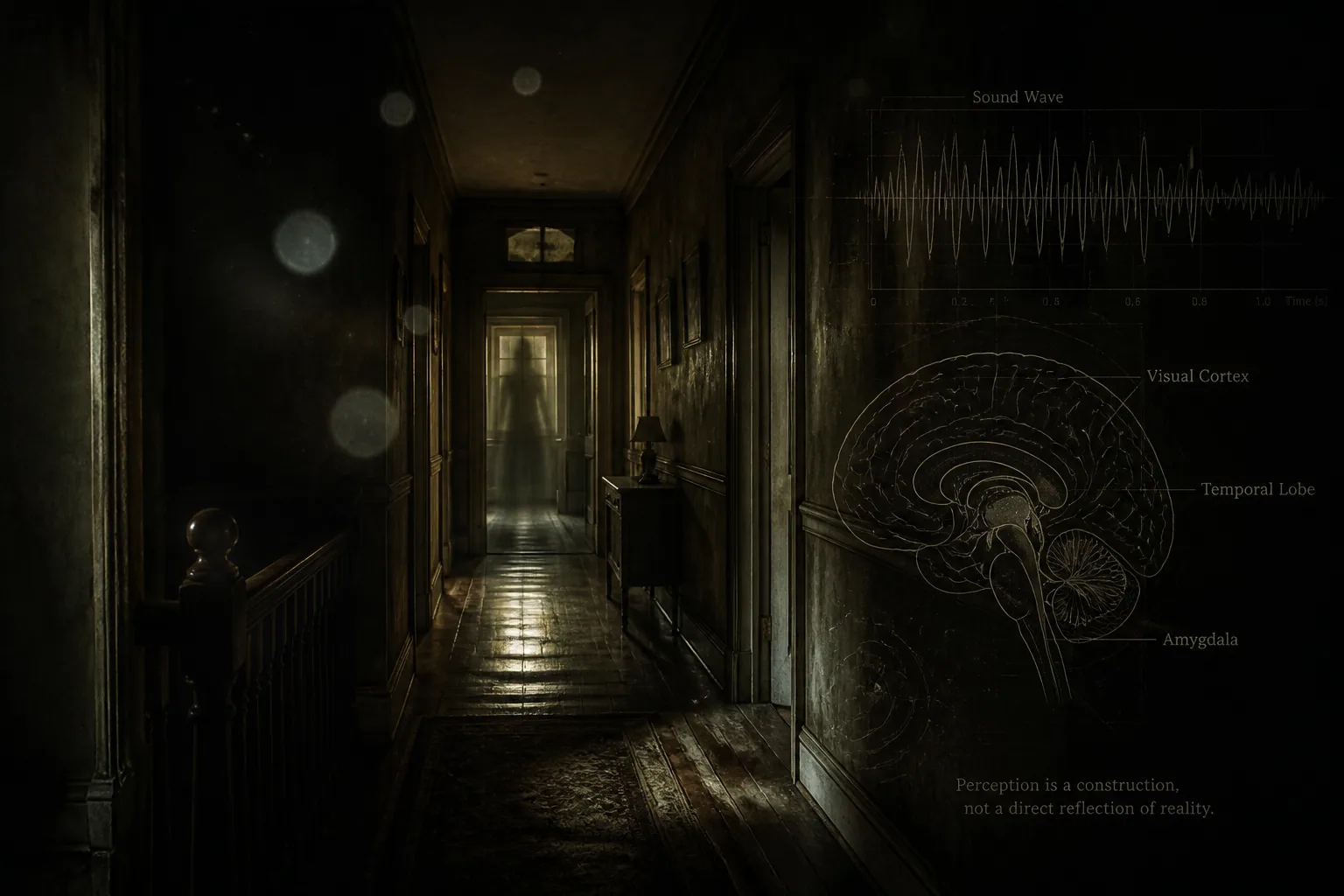
Mind Tricks & Mirages: Why We See Ghosts When There’s Really Nothing There
Ghost encounters often feel intensely real because the brain is not a passive camera. It is a prediction machine, constantly filling in gaps, sorting patterns, and trying to make sense of incomplete information. In dim hallways, echoing rooms, or emotionally charged places, that prediction system can produce something that feels like a face in the dark, a whisper in the static, a presence behind you, or a sudden cold spot. None of that requires a paranormal cause to feel convincing.
That does not mean people are imagining everything or lying. It means perception is fragile, especially under uncertainty. Fear sharpens attention, expectation guides interpretation, and memory later rebuilds the event in a way that can make the experience seem even stranger than it was in the moment. Once those pieces combine, a normal environmental cue can become a ghost story.
Why Ghost Encounters Feel So Convincing
A haunting usually begins with ambiguity. You saw movement, but only out of the corner of your eye. You heard something, but it was buried in air conditioner noise. You felt a chill, but you were standing near a doorway. In everyday life, the brain usually resolves those uncertainties quickly. In a creepy setting, though, it often resolves them in the most emotionally charged direction available.
That is why ghost encounters are so persuasive. They do not need to be clear. They only need to be just clear enough to trigger interpretation. Once a person starts thinking a place is haunted, each additional detail becomes easier to fit into that framework. A faint sound becomes a footstep. A shadow becomes a figure. A memory becomes evidence.
Pareidolia: Seeing Faces and Figures in Random Patterns
Pareidolia is the tendency to see meaningful shapes, especially faces and bodies, in random or ambiguous patterns. It is one of the most important reasons people report shadow people, figures in windows, and faces in wallpaper, curtains, smoke, or darkness. The brain is especially tuned to detect faces quickly because missing a real face has historically been more costly than accidentally seeing one where none exists.
Recent research supports how fast and powerful this process is. A study on face pareidolia found that illusory face images were rated as significantly more face-like than matched control objects, and brain imaging showed face-detection systems activating rapidly even for purely illusory faces. In other words, the brain can treat a fake face almost like a real one before conscious reasoning has time to weigh in. Source: https://www.nature.com/articles/s41467-020-18325-8
This helps explain why dark doorways, stairwells, and distant corners are such common settings for ghost sightings. When visual information is poor, the mind does not wait politely. It guesses. And its guesses often have a human shape.
Apophenia and the Brain’s Need to Find Meaning
Apophenia is the broader tendency to see connections, patterns, or meaning in unrelated data. If pareidolia is about seeing a face in a stain, apophenia is about turning a series of small events into a meaningful narrative. A creak, a draft, a strange feeling, and a flicker of light can easily become proof that something unseen is present.
This pattern-seeking tendency is useful in ordinary life, but it can also create false certainty. Humans prefer a story over randomness. If the room felt cold and then a picture fell off the wall, the mind may connect those events even if they are unrelated. Once the pattern feels meaningful, it can become difficult to separate coincidence from cause.
In paranormal settings, apophenia is often fed by coincidence itself. People are already alert for signs, so every anomaly feels loaded with significance. The result is a feedback loop: the more you look for meaning, the more meaning you find.
How Fear, Expectation, and Suggestion Shape Paranormal Experiences
Fear changes perception. It narrows attention, raises arousal, and makes neutral stimuli seem threatening. Expectation does something similar by biasing interpretation before an event even happens. If someone tells you a building is haunted, your brain starts scanning for the kind of evidence that would confirm the claim.
Suggestion alone can be surprisingly powerful. In one anomalistic psychology study, participants who were told a theater was haunted reported more intense anomalous experiences on most measures than participants told the building was simply under renovation. That means the label attached to a place can change what people think they sense, even when the physical environment is the same.
This is also why shared ghost experiences can spread so quickly. One person reacts, another becomes alert, and the whole group begins to interpret ordinary sounds and shadows through the same lens. Once a story starts in a room, the room itself seems to support it.
Why Dim Corridors and Shadowy Rooms Trigger False Sightings
Hallways and corridors are perfect illusion machines. They tend to have long sightlines, limited lighting, hard surfaces, and a lot of visual compression. In low light, the visual system loses detail and depends more heavily on contrast, motion detection, and prediction. That is where misperceptions thrive.
A jacket on a chair can become a person. A coat rack can seem to shift shape. The end of a corridor can appear deeper or darker than it really is. Even a brief glance can create the impression of a figure standing in place. The brain often finishes the image after the eyes have already moved on.
Environmental reviews of haunted-house reports repeatedly point to low lighting as a major factor because it reduces visual cues and increases ambiguity. The same review also highlights air quality, temperature changes, infrasound, and EMF fluctuations as common contributors to uncanny feelings. Source: https://www.frontiersin.org/journals/psychology/articles/10.3389/fpsyg.2020.01328/pdf
Whispers in Static: How Ambiguous Audio Becomes a Voice
Audio ambiguity is one of the easiest ways to create a ghost experience. A fan, radiator, road noise, or distant conversation can all be misheard when the brain is primed to expect a message. This is why so many people think they hear whispers, names, or footsteps in places where the sound source is diffuse or hidden.
The mind is constantly trying to impose language on noise. If the sound is vague enough, it can be heard as speech one moment and lost the next. That uncertainty makes the impression feel eerie, because speech implies agency. A voice suggests a speaker.
This is also where audio recording can mislead. When people replay a noisy clip and focus on it repeatedly, they may notice patterns that were never obvious in real time. The interpretation grows stronger with each listening, even if the original sound was just static or environmental interference.
Cold Spots, Drafts, and the Physics of Creepy Spaces
Cold spots are one of the most common haunted-house complaints, but they are also one of the easiest to explain without ghosts. Drafts from windows, doors, vents, stairwells, and temperature differences between rooms can create sudden chills. Your body is very sensitive to localized changes in airflow, especially when you are already tense.
The important detail is that the sensation feels meaningful because it arrives at the same moment as fear. If you walk into a room expecting nothing and feel a temperature drop, you may barely register it. If you are investigating a supposed haunting, that same drop can feel like physical evidence of a presence.
Sudden cold is often interpreted as an event when it is really a condition. In a creepy environment, the brain treats it like a signal instead of a background fluctuation.
Can EMF, Infrasound, and Bad Acoustics Make a Place Feel Haunted?
Sometimes the environment really does contribute to ghost-like experiences, just not in the supernatural way people assume. Infrasound, for example, can produce stress responses even when it is below conscious hearing threshold. A recent study found that exposure to around 18 Hz was associated with elevated salivary cortisol, greater irritability, sadness, and disinterest, even when participants could not detect any sound. Source: https://link.springer.com/article/10.1007/s11069-013-0827-3
That matters because stress changes how people interpret sensations. If a place makes you uneasy without you knowing why, your body may already be in a heightened state before you notice any apparent anomaly. Low-frequency sound can also be physically felt as vibration, pressure, or discomfort, which people may later interpret as a presence.
There is also evidence that low-frequency acoustic environments can be tied to paranormal-type reporting. At The Real Mary King’s Close in Edinburgh, about one-third of people exposed to infrasound reported sensations such as feeling watched, touched, or hearing footsteps. The research review associated with that work suggests low-frequency sound can contribute to ghost-like perceptions. Source: https://open-data.spr.ac.uk/articles/infrasound
EMF is more complicated. People often assume electromagnetic fields directly create haunting experiences, but the evidence is mixed. In the Haunt Project, participants exposed to infrasound and fluctuating EMFs reported anomalous sensations such as presence, smells, and dizziness, yet the number of reports correlated more with personality and belief in the paranormal than with whether EMF or infrasound was actually present. Source: https://www.sciencedirect.com/science/article/pii/S0010945208001299
That is an important caution. An odd environment may contribute to unease, but the meaning people assign to that unease often depends more on expectation than on the field itself. Bad acoustics can also deepen the effect by smearing sound reflections, making rooms feel alive, empty, or impossible to localize.
Case Studies: Orbs, Shadow People, and Misread Evidence
Many famous ghost images and videos are easy to reinterpret once you know what to look for. Orbs are often dust, moisture, insects, or lens artifacts illuminated by flash. Shadow people may be normal objects seen in poor light, briefly moving figures, or the brain’s own face and body detection systems overreaching in the dark.
This is not just skepticism for its own sake. It is the same visual logic the brain uses all day long. If you catch a glimpse of something at the edge of your vision, your brain has to decide fast whether it is a threat. That quick judgment can be wrong, but it feels immediate and authoritative.
People who repeatedly report ghostly encounters may also be more prone to certain cognitive and sensory styles. A case study on Haunted People Syndrome found that frequent experiencers often shared traits such as high sensory-processing sensitivity, transliminality, paranormal belief, and somatic-sensory sensitivity. Source: https://pmc.ncbi.nlm.nih.gov/articles/PMC9216229/
That does not mean their experiences are fake. It means the same environment can be processed very differently by different people. Some notice subtle cues more strongly, and others are more likely to interpret ambiguous cues as significant.
What Recent Research Says About Perception and Hauntings
Modern perception research keeps pointing toward the same conclusion: the brain is not just receiving the world, it is building it. That construction process is especially vulnerable when sensory information is weak, strange, or incomplete. Ghost sightings flourish in exactly those conditions.
One study on pareidolia found that right-hemispheric brain function was especially important for generating illusory perceptions. Stroke patients with right-hemispheric lesions produced significantly fewer pareidolic perceptions than healthy controls, especially for global visual forms. Source: https://pmc.ncbi.nlm.nih.gov/articles/PMC10926141/
This is a reminder that seeing a figure in a doorway is not a mystical event by default. It is a normal brain function working too hard, or with too little information, to make sense of something uncertain. When you combine that with fear, expectation, and a suggestive setting, the result can feel supernatural even when it is fully human.
How to Investigate a Strange Experience Without Fooling Yourself
If you have a strange experience, the best first step is not to decide what it means. It is to document what happened as precisely as possible. Note the time, location, lighting, weather, nearby devices, ventilation, sounds, and who else was present. Try to separate the raw sensation from the interpretation you attached to it.
If you heard a voice, ask what else was happening in the room. Was there music, static, HVAC noise, or distant traffic? If you saw a figure, what was the light source? What objects could have cast the shape? If you felt a cold spot, was there a window, fan, vent, or doorway nearby?
It also helps to test the place under different conditions. Walk through the same corridor with lights on and off, compare sound levels at different times, and look for physical drafts. If possible, have another person independently describe what they notice before you share your own impressions. That reduces suggestion and helps reveal whether multiple people truly sensed the same thing or just influenced each other.
For people who enjoy paranormal investigation and want a fun way to capture sessions, a tool like Ghost Detector: Ectify can add an interactive layer to the experience. You can learn more here: https://findthe.app/ectify-fc72z0. Used thoughtfully, tools like this are best treated as part of the entertainment and documentation process, not as proof of a haunting.
When an Anomaly Is Worth Taking Seriously
Most ghost-like experiences have ordinary explanations, but not every anomaly should be brushed aside. If a location consistently produces physical symptoms, repeated acoustic effects, or identifiable environmental hazards, it is worth taking seriously as a safety issue even if the paranormal explanation is unnecessary.
A persistent mold smell, electrical instability, poor ventilation, structural drafts, or unusually high noise exposure can all affect how people feel and behave. Likewise, if multiple independent observers notice the same specific event under controlled conditions, that deserves careful documentation. Skepticism should not become dismissal.
The most useful position is a balanced one. Respect the experience, but test the explanation. A person who thought they saw a ghost may have genuinely experienced fear, perception distortion, or an environmental trigger. That experience is real, even if the ghost is not. And sometimes, understanding the illusion is even more fascinating than the illusion itself.
