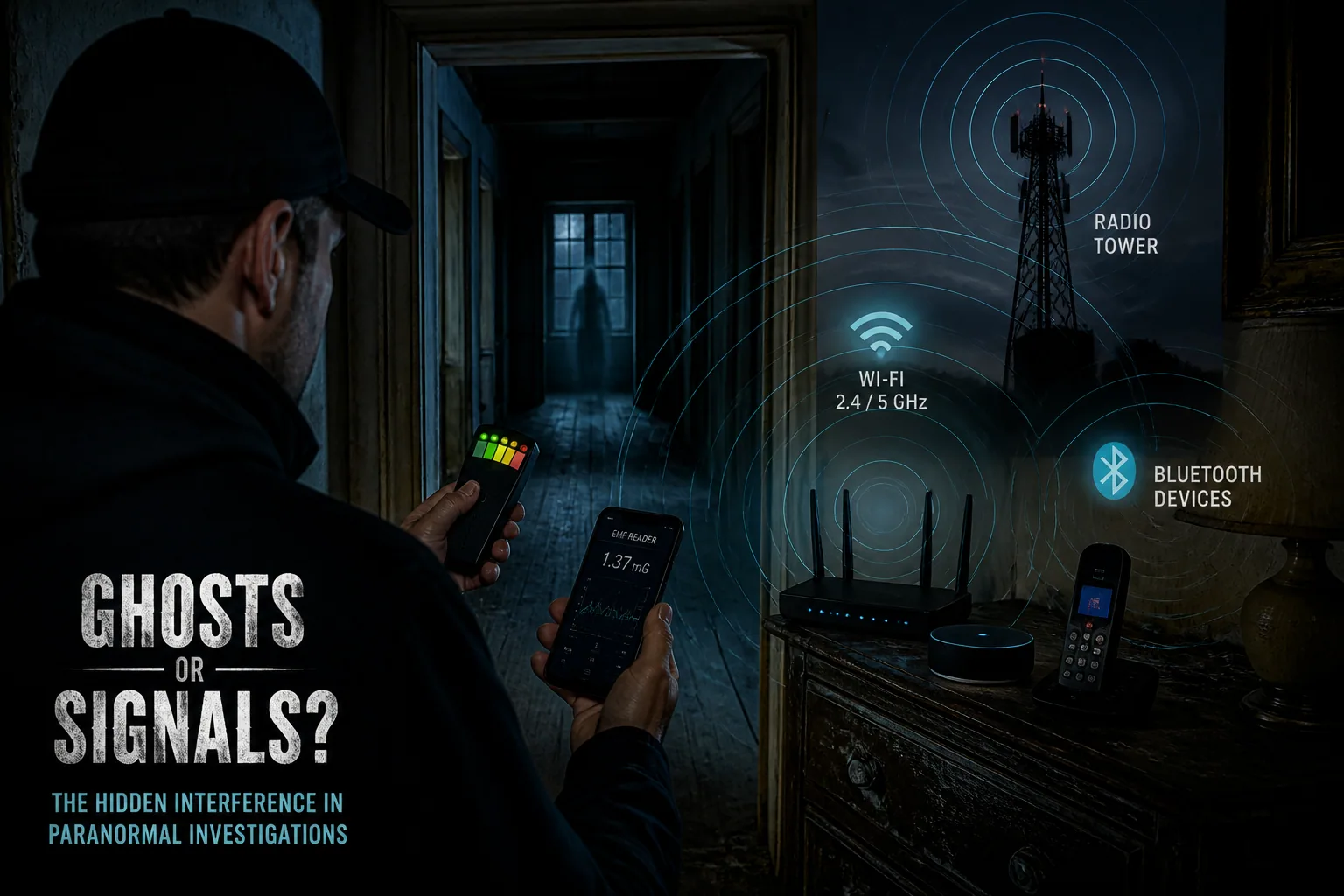
Phantom Frequencies: How RF Interference Can Fake Paranormal Evidence
Radio frequency interference can make a normal location feel intensely haunted. A meter jumps, a phone app lights up, a spirit box spits out a phrase, and suddenly everyone in the room is looking at the same corner. The problem is that many of those moments are not paranormal at all. They are often the result of nearby transmitters, smart devices, wiring faults, or even team members’ own gear creating a field the equipment cannot properly interpret.
That is why RF awareness matters so much in modern investigations. If you want evidence that holds up under scrutiny, you need to know what your tools are actually measuring, where false positives come from, and how to separate environmental contamination from genuinely unusual behavior. In practice, that means treating every strange signal as a clue, not a conclusion.
Why RF Interference Matters in Paranormal Investigations
A lot of paranormal equipment is sensitive, but sensitivity is not the same as intelligence. Consumer-grade EMF and RF detectors respond to changes in electromagnetic conditions, yet they usually cannot tell you whether the source is a cell tower, a Wi-Fi router, a dimmer switch, a defective cable, or something unexplained. As the Paranormal Response Network notes, a spike is just a field, not definitive evidence of a presence, and many phantom readings are caused by nearby transmitting devices, including radios, phones, and appliances.
This is where investigations can go wrong. If a team walks into a house with phones active, radios on, smart devices nearby, and no baseline sweep, then any reading becomes easy to over-interpret. The data may feel dramatic, but if the environment is contaminated, the signal does not belong to the case. It belongs to the infrastructure around the case.
There is also a psychological layer to this. People can feel watched, uneasy, or energized when equipment starts reacting, but those reactions can be driven by expectation and suggestibility as much as by the environment itself. That is one reason disciplined measurement matters. It keeps the story anchored to what the location is doing, not just what the room feels like.
RF Interference vs. ‘Paranormal’ Signal Spikes
A paranormal spike is usually described as a sudden change in a meter, recorder, or app that seems to happen at the right moment. But RF interference can produce the same pattern. A door opens and a team member adjusts a two-way radio. A phone pings in a pocket. A smart meter sends a routine burst. A nearby transmitter fades in and out as someone moves between walls or floors. All of these can look like meaningful activity if you are not tracking the source.
The important distinction is simple: paranormal interpretation begins only after ordinary causes have been tested and reduced. If a spike disappears when a phone is set to airplane mode, when a radio is moved away from the meter, or when the team exits a room with noisy electronics, that spike was never evidence of an entity. It was environmental contamination.
That does not mean every unusual reading is automatically mundane. In research by Laythe and Owen, a controlled field study at a haunted site without electrical infrastructure found that anomalous phenomena correlated with increased EMF and geomagnetic variability compared to baseline. Interestingly, both increases and decreases were associated with activity, and the duration of a spike did not predict the presence of phenomena. The takeaway is not that EMF proves ghosts. It is that unusual environmental changes deserve careful measurement before any story is attached to them.
How EMF Meters and Phone-Based Tools Get Fooled
EMF meters are often used as if they are ghost detectors, but they are really environment detectors. They react to electrical and magnetic changes, and sometimes to RF contamination depending on the model. That is useful, but only if you understand the limits. A meter can show something changed. It cannot tell you why.
Phone-based detection apps can be even more misleading. They rely on the hardware already inside the device, which was designed for general consumer use, not for forensic analysis. If the phone is receiving notifications, connecting to networks, or sitting near Bluetooth peripherals, the app may be reading internal device activity instead of the room itself. That creates a false sense of precision, especially in social-media style investigations where dramatic visuals matter more than careful controls.
This is why investigators should be skeptical of any tool that appears to instantly validate a claim. If the device cannot identify source type, cannot separate internal from external signals, and cannot provide meaningful context, then its output should be treated as a prompt for further testing, not proof.
