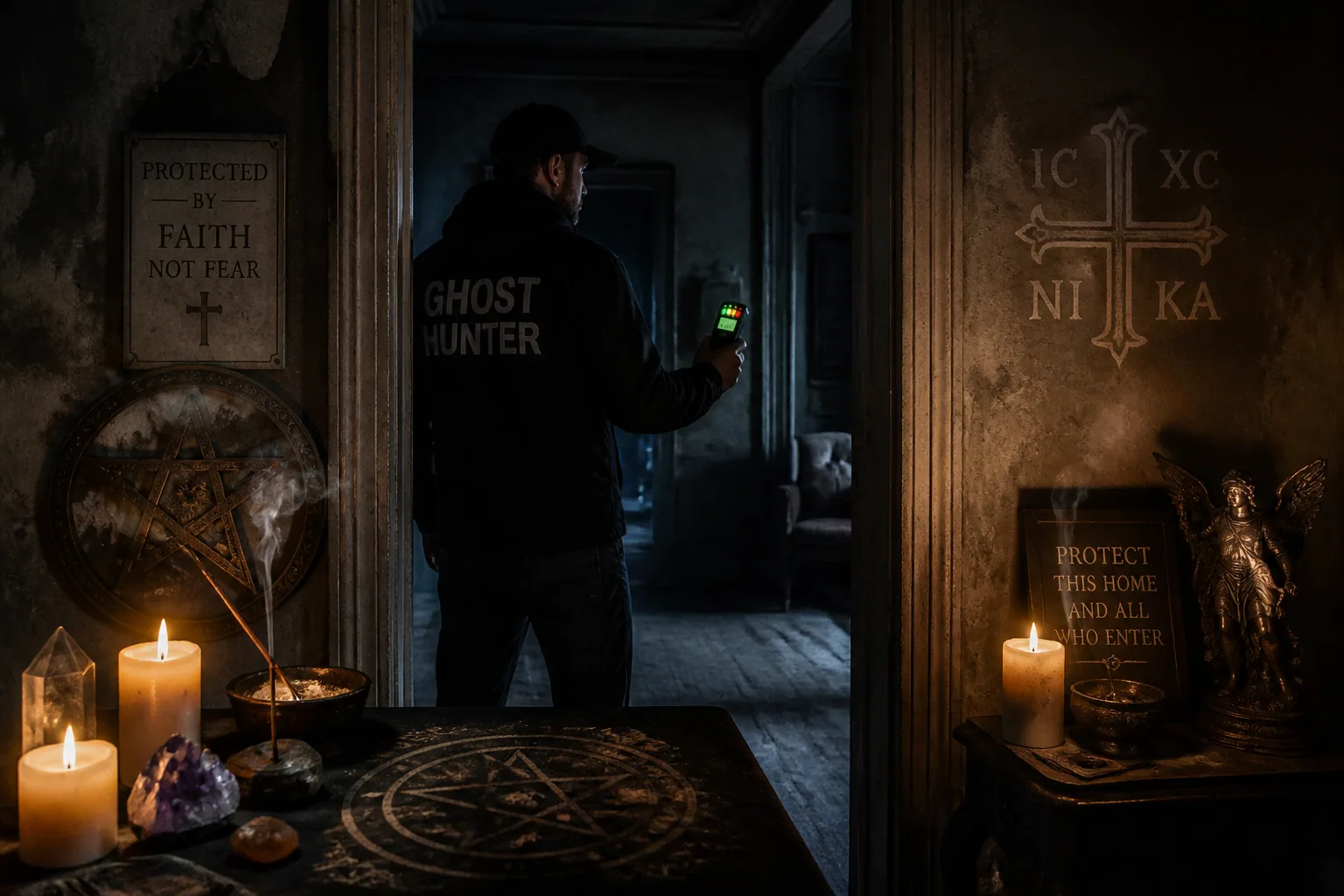
Sacred Spaces & Psychic Shielding: How to Spiritually Protect Haunted Locations Before and After Investigations
Paranormal investigations can be exciting, intense, and deeply meaningful, but they can also be draining. When you enter a haunted location, you are not only dealing with unexplained sounds, shadowy impressions, and sudden temperature shifts. You are also stepping into an environment that may carry fear, grief, memory, tension, or simply the psychological weight of expectation. That is why spiritual protection matters so much. Whether you approach it from a religious, cultural, or intuitive perspective, protection practices help investigators stay grounded, respectful, and mentally clear before, during, and after a session.
This guide explores how to spiritually protect haunted locations and the people investigating them through grounding, prayer, cleansing, intention-setting, symbols, crystals, and careful boundary work. It also covers what to do with clothing, tools, and haunted objects, along with the importance of post-investigation recovery. Responsible ghost hunting is not just about what happens inside the location. It is also about how you enter, how you move through the space, and how you leave it behind.
Why Spiritual Protection Matters in Paranormal Investigations
For many investigators, spiritual protection is part practical safety measure and part mental discipline. Haunted locations can create an atmosphere that heightens anxiety, amplifies suggestibility, and leaves you feeling unsettled long after the investigation ends. Even when no one believes the location is actively hostile, the emotional environment alone can be intense. A good protection routine helps create a sense of structure, calm, and personal sovereignty before you begin.
There is also a cultural and ethical dimension. Many haunted sites are not empty backdrops for a thrill. They may be homes, sacred spaces, memorial places, or sites with living communities nearby. Approaching them with protective intention encourages humility and respect rather than conquest or provocation. In that sense, protection is not about dominating the unknown. It is about entering carefully and leaving cleanly.
The Hidden Risks of Energy Overload, Fear, and Attachment
One of the most commonly reported challenges in paranormal work is emotional fatigue. Investigators often describe feeling unusually tired, irritable, heavy, or emotionally scattered after a long night in a charged location. Community accounts also frequently mention the fear of carrying energy home, especially after interacting with a place that felt oppressive or after handling objects with a strong emotional history. While there is limited quantitative research, first-hand reports consistently emphasize the importance of energetic hygiene and post-investigation care. Source: https://paranormalsocieties.com/articles/shielding-for-mediums.cfm
Fear can also distort judgment. When your nervous system is activated, ordinary sounds feel louder, shadows look stranger, and it becomes harder to think clearly. That is why a protection plan should include both spiritual and psychological support. If you are grounded, hydrated, rested, and clear about your boundaries, you are less likely to spiral into overwhelm or mistake stress for evidence. Attachment is another subtle risk. Some investigators become so emotionally invested in an entity, a location, or a theory that they lose balance. Protection practices create enough inner space to observe without absorbing.
Pre-Investigation Preparation: Grounding, Intention, and Mental Readiness
Before entering a haunted site, begin by grounding yourself. This can be as simple as standing quietly, feeling your feet on the floor, and taking a few slow breaths. Some investigators prefer prayer, meditation, or a short centering ritual. The point is to move out of scattered, everyday stress and into a calm, alert state. If you go in already tense, you may become more vulnerable to emotional overload once the atmosphere intensifies.
Intention matters as much as technique. State clearly why you are there. You may want to observe, document, learn, or support a property owner, but your intention should also include a boundary. For example, you might mentally affirm that you are there to witness respectfully, that you only welcome communication that is safe and relevant, and that you leave behind anything that is not yours to carry. This kind of intentional clarity can be especially useful when a location feels emotionally dense or spiritually ambiguous.
Mental readiness also means checking in with yourself honestly. If you are sleep-deprived, emotionally destabilized, or already anxious, an investigation may not be the right time to push yourself. Responsible paranormal work requires self-awareness. Sometimes the most protective choice is to step back, reschedule, or take on a support role instead of leading the session.
Protection Rituals and Tools from Different Spiritual Traditions
Across cultures, people have developed methods for cleansing, shielding, and inviting beneficial presence. In many traditions, the goal is not to fight the unseen but to create a space that is orderly, reverent, and protected. This might involve smoke, water, sound, prayer, offerings, or symbolic objects. The exact form varies, but the underlying principle is similar: establish a boundary between what is welcomed and what is not.
Sage smoke rituals are often used to cleanse people and spaces of negative energy and to promote healing and stress reduction. Research cited by Beyond Haunted also notes sage smoke’s antimicrobial properties, though these rituals should never replace physical cleaning or medical care. Source: https://beyondhaunted.com/blog/cleanse-how-with-sage-tips-steps
Burning herbs and sacred plants is also cross-cultural. Paranormal Arabia notes that sage, frankincense, and wormwood are used in both Western and Arab traditions, where they are moved through spaces with prayer or intention to purify and cleanse. Source: https://www.paranormalarabia.com/en/articles/2025/11/how-to-deal-with-a-haunted-house
In African diaspora traditions, cleansing may involve offerings, smoke, plants, water, rhythm, and the support of spiritual community. Ubuntu Village USA describes these practices as holistic, addressing emotional, spiritual, and physical wellbeing together. Source: https://ubuntuvillageusa.org/the-ritual-at-home-african-diaspora-cleansing-practices/
In Korean shamanistic ritual, the space itself is purified by fire and water before the rite begins, and white paper may be burned as a symbol of cleansing and purity. The broader point is reverence. Whatever tradition you are drawing from, the ritual should be done carefully and respectfully, not as a prop for aesthetics.
Using Prayer, Recitations, Symbols, and Crystals with Respect
Prayer and recitation can be powerful forms of protection when used sincerely and in the context of your own faith tradition. In Islamic practice, recitations such as Surah Al-Baqarah and Ayat al-Kursi are said regularly in homes to drive away jinn and unwanted spiritual activity, and prayers are also offered upon entering and leaving places. Source: https://www.paranormalarabia.com/en/articles/2025/11/how-to-deal-with-a-haunted-house
Christian house blessings may include holy water, incense, scripture such as Psalm 91 or Ephesians 6, anointing oil, and prayers of authority. Source: https://longhornhaunts.com/exorcisms/
Many magical and pagan traditions also rely on visualization. A common method is to imagine a sphere of white light around your body, creating a psychic shield that filters out unwanted energy while allowing helpful influence to pass through. Source: https://www.spookyisles.com/shield/
Crystals are another tool commonly used by paranormal investigators. Black tourmaline, obsidian, amethyst, clear quartz, onyx, and tiger’s eye are often carried as protective stones, with clear quartz sometimes used to amplify psychic sensitivity. Source: https://ghosthuntersequipment.com/blogs/the-ghost-gazette/crystals-in-paranormal-investigation
A practical caution is important here. Respect does not mean borrowing from every tradition at once. If you use prayer, symbols, or ritual forms rooted in a living culture, learn their context and use them appropriately. The goal is not to mix and match spiritual systems as decoration, but to engage with them thoughtfully and with genuine care.
Protecting Your Clothing, Equipment, and Personal Objects
Investigators often focus on protecting the person, but clothing and gear can also carry emotional residue in a psychological sense. Many people therefore create a small pre- and post-investigation routine for their jacket, shoes, bag, recorder, or camera. Even if you do not believe in literal contamination, the ritual of cleaning and resetting your tools helps you mentally separate one investigation from the next.
Before entering a site, keep your gear organized and intentional. Use only the equipment you need, and avoid mixing everyday personal items with items reserved for investigations whenever possible. Afterward, wipe down physical surfaces, empty storage containers, and return everything to a neutral place. If you use spiritual cleansing practices, do them in addition to physical maintenance, not instead of it.
This also applies to personal objects like rings, watches, notebooks, or clothing worn in a particularly heavy location. Some investigators prefer to have one dedicated set of clothing or accessories for fieldwork so the association with the investigation stays contained. That boundary can be surprisingly helpful when you are trying to unwind at home later.
Setting Physical, Spiritual, and Psychological Boundaries on Site
Once you arrive, think in terms of layers of protection. Physical boundaries include staying with your team, respecting locked or restricted areas, and not separating unnecessarily. Spiritual boundaries might include a prayer before entry, a brief cleansing, or a statement that only safe and constructive communication is welcome. Psychological boundaries involve not feeding your fear, not provoking for entertainment, and not letting the location control your attention.
Sound can help reinforce these boundaries. Bells, chanting, clean vocal tone, or the simple act of opening doors and windows when appropriate can shift the atmosphere and signal transition. The All About House Blessing Traditions resource notes that audible and visual boundary-setting is often used to invite positive energy and counter a heavy psychic atmosphere. Source: https://theamm.org/articles/1353-all-about-house-blessing-traditions
The most important boundary is internal. If a room feels overwhelming, step back. If a team member becomes anxious or fixated, pause and reset. Protection is not only for dramatic moments. It is the steady discipline of knowing when to continue and when to stop.
How to Stay Clear and Centered During a Haunted Investigation
During the investigation, keep returning to your anchor. That may be your breath, a repeated prayer, a visualization of light, a phrase of protection, or the simple awareness of your feet on the floor. These small check-ins help interrupt spirals of fear and keep your attention on observation rather than reaction.
Stay hydrated and avoid overstimulation whenever possible. Too much noise, too many voices, and too much scanning for signs can make your senses less reliable, not more. A centered investigator is a more effective investigator. If your intuition is part of your practice, use it alongside documentation rather than instead of it. Record what happened, note your emotional state, and compare impressions later when you are calmer.
This is also where tools can support your workflow. If you want an accessible way to document sessions while keeping your attention on the experience, Ghost Detector: Ectify can help turn your smartphone into a ghost hunting companion with real-time EMF detection, a spirit box and EVP generator, session recording, and history tracking. It is a natural fit for investigators who want to capture and review sessions without losing their sense of structure. https://findthe.app/ectify-fc72z0
Safe Handling and Storage of Haunted Objects
Haunted objects deserve special care, even if you are approaching the topic from a skeptical standpoint. At minimum, treat them as emotionally charged or historically significant items. Do not handle them casually, leave them exposed, or pass them around without a clear reason. Use gloves or a dedicated cloth if appropriate, and store the item separately from your regular tools.
If you use spiritual cleansing, do so with intention and restraint. Some traditions recommend prayer, incense, water, or placement in a reserved area. Others may call for consultation with a religious leader or cultural practitioner. The key principle is not to improvise recklessly. If an object seems to intensify distress, return it to the property owner or keep it isolated until a proper plan is made.
You should also think about documentation. Write down where the object came from, who handled it, and what was experienced around it. Responsible handling reduces confusion later and helps ensure that fear does not become the only record of the encounter.
Post-Investigation Cleansing for You, Your Team, and Your Gear
After the investigation ends, do not rush straight back into ordinary life. Build a deliberate transition. Many investigators use smoke cleansing, prayer, showering, a change of clothes, or a quiet closing ritual. The purpose is to mark the boundary between the haunted environment and home. This matters whether your framework is spiritual, psychological, or both.
A team cleanse can be especially helpful. If everyone participated in the same session, everyone should also participate in the reset. This may be as simple as a spoken closing, a moment of gratitude, and a reminder that the experience is complete. For those whose traditions support it, a fuller cleansing practice can be used for people and gear alike. In the research gathered here, sage smoke, herb-burning, water, prayer, and communal rituals all serve the same broad aim of clearing residual heaviness and restoring wellbeing. Sources: https://beyondhaunted.com/blog/cleanse-how-with-sage-tips-steps and https://ubuntuvillageusa.org/the-ritual-at-home-african-diaspora-cleansing-practices/
Do not skip the practical side. Wash clothing, charge and clean equipment, back up recordings, and store gear in a designated place. The combination of physical reset and symbolic cleansing is what helps the mind truly file the investigation away.
Rebalancing Your Energy Through Rest, Journaling, and Debriefing
One of the most underrated parts of spiritual protection is recovery. After a difficult investigation, your body may still be in a state of alert. Journaling can help you process what happened without immediately assigning meaning to every sensation. Write down observations, emotional reactions, moments of tension, and anything that felt unusually strong. Later, you can review those notes with more perspective.
Debriefing with your team is equally valuable. Talk about what each person experienced, where the group felt aligned, and where the group may have gotten overstimulated. This kind of conversation can reveal whether the atmosphere was genuinely unusual, whether one person’s fear influenced the rest, or whether there are practical issues that need to be improved for next time.
Finally, rest. Sleep, hydration, food, quiet, and time away from stimulation are not luxuries after a haunted investigation. They are part of the work. Without recovery, even the best protection ritual will eventually wear down your resilience.
Responsible Ghost Hunting: Protecting Both People and Places
Responsible ghost hunting is not only about shielding yourself from harm. It is also about protecting the location. That means leaving the site physically intact, not disturbing objects unnecessarily, not escalating tension for entertainment, and not treating a home, memorial, or sacred place as a stage set. Good investigators leave a place as they found it, or better.
That responsibility also includes spiritual humility. If you pray, cleanse, visualize, or use sacred objects, do so with sincerity. If a site belongs to a tradition that is not yours, learn enough to avoid disrespect and consider consulting someone from that tradition when appropriate. The more carefully you work, the less likely you are to harm the people or places you are trying to understand.
At its best, psychic shielding is not about fear. It is about stewardship. It helps investigators remain clear enough to observe, compassionate enough to respect, and steady enough to leave without bringing the night home with them.
