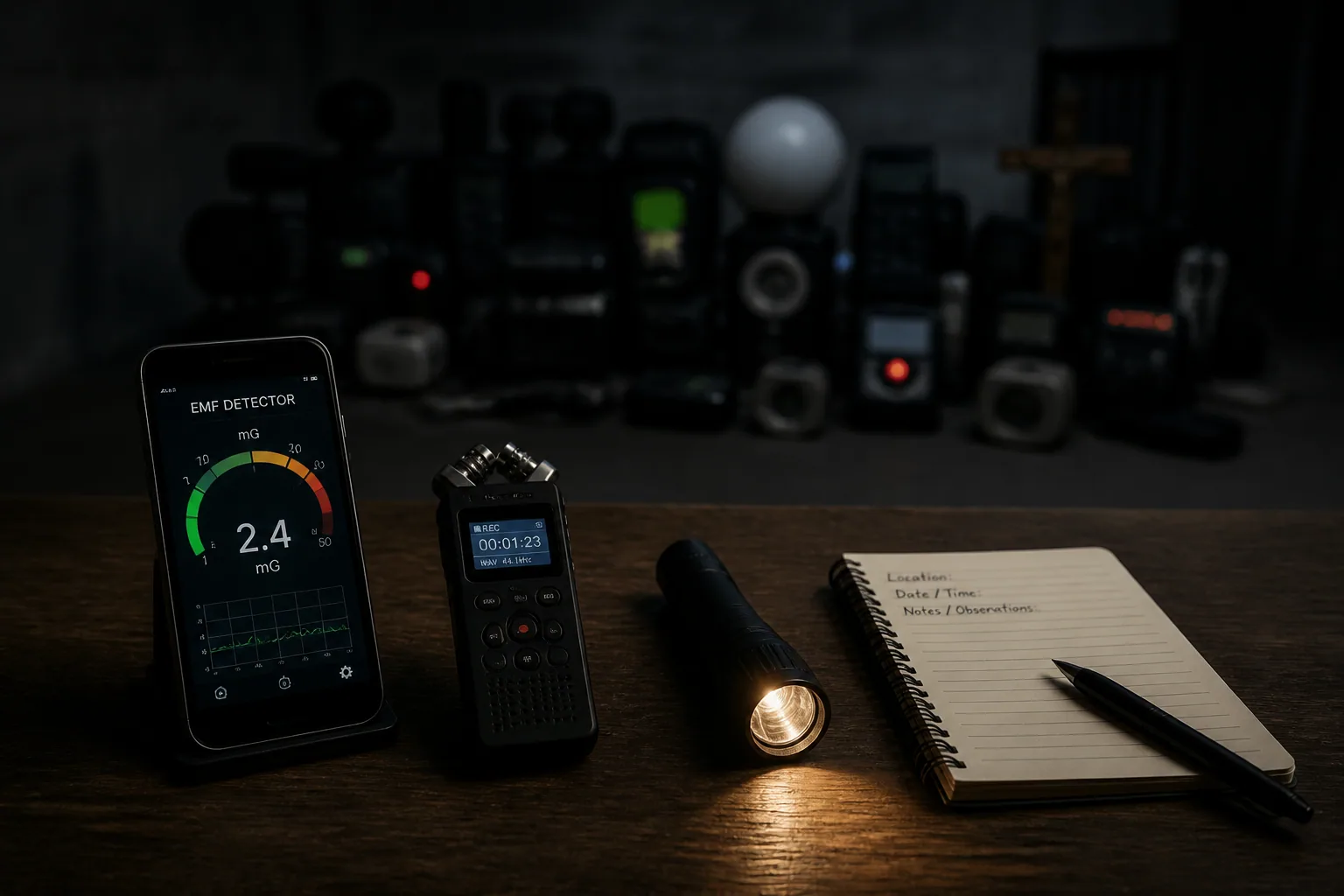
Sensor Saturation Point: When More Paranormal Tech Stops Helping
In ghost hunting, it is easy to assume that more gear means better evidence. More meters, more cameras, more boxes, more apps, more lights. In practice, there is a point where adding devices stops improving an investigation and starts overwhelming it. That point is sensor saturation.
Sensor saturation happens when the amount of data, alerts, and visual clutter becomes so high that it is no longer useful. Instead of helping you notice patterns, the equipment starts competing for attention. You miss environmental context, you misread ordinary interference, and you spend more time reacting to gadgets than observing the location itself.
For serious beginners and intermediate paranormal hobbyists, this is one of the most important skills to learn early. The best investigators are not always the ones with the biggest kit. They are often the ones who know when to stop adding tools and start using the ones they already have with purpose.
What Is Sensor Saturation in Paranormal Investigations?
Sensor saturation is the tipping point where the investigation environment is being sampled by so many devices that the output becomes difficult to interpret. Each tool may be useful on its own, but together they can create a wall of inconsistent readings, overlapping alerts, and competing hypotheses. In that state, the team is not getting more clarity. It is getting more ambiguity.
This is especially common in paranormal work because many devices are sensitive to ordinary conditions. EMF meters can react to wiring, appliances, phones, transmitters, and lighting. Audio recorders can capture environmental noise, distant voices, HVAC rumble, and handling artifacts. Spirit box sessions can generate language-like fragments that feel meaningful even when they are not. Once all of these are running at once, the chance of misinterpreting coincidence rises quickly.
Research on common ghost-hunting tools shows that some of the most popular EMF meters are widely used, but many measure only a narrow variable or are adapted from non-paranormal purposes, which means several similar devices often duplicate noise instead of adding clarity. That concern is discussed in a study archived by eScholarship: https://escholarship.org/content/qt3q71q8f7/qt3q71q8f7_noSplash_c05edc77a1ca4ed7e8be82bbc8d48172.pdf
Why More Devices Can Mean Worse Evidence
It sounds counterintuitive, but more equipment can make evidence worse. Once you introduce too many inputs, you increase the number of things that can trigger a reaction, distort a reading, or distract the team. Instead of collecting a cleaner dataset, you create a crowded one that is harder to analyze and easier to cherry-pick.
A simple example is the EMF category. If you place multiple meters in the same room, they may all react to slightly different sources or positions. One could be near a wall with wiring, another beside a phone, another near a power strip. The result may look like a coordinated paranormal event, when it is actually a cluster of mundane influences.
Controlled research on allegedly haunted sites has found that magnetic variability can correlate with what people report as paranormal, but those variations need careful comparison with baselines because normal environmental factors can produce similar fluctuations. That is why baseline readings matter so much. Without them, you are not comparing mystery to normal conditions. You are comparing one unknown to another. The research is summarized here: https://www.parapsychologypress.org/jparticle/jp-68-2-255-288
The more devices you add, the harder it becomes to know which tool is telling you something meaningful. When every sensor is active, the investigation can drift into pattern hunting rather than evidence gathering. That is not better science. It is just louder folklore.
The Warning Signs You’re Over-Equipped
There are a few reliable signs that your setup has crossed from useful to excessive. The first is that you are spending more time looking at screens than looking at the room. If you are constantly checking readings, notifications, and device status, you are no longer fully observing the environment.
Another warning sign is repeated disagreement between tools without a clear reason. If one meter spikes while another stays flat, and a third device reacts to your movement or phone presence, you may simply be seeing ordinary interference. At that point, the question is not what paranormal force is causing the readings. The question is what in the room is causing the confusion.
A third sign is that your notes get thinner as your gear gets bigger. Good investigations produce detailed context. Who was present, where each device was placed, what the room temperature was, whether a window was open, whether lights were on, what appliances were active, and when the activity occurred. If the team is too busy managing gadgets to document the environment, the final evidence package becomes weaker even if the raw data looks impressive.
A fourth sign is that the location itself fades into the background. You stop listening to the building, the airflow, the sounds from outside, and the behavior of the people on site. That is a major loss, because the room is often the best sensor you have.
When Data Becomes Noise Instead of Insight
Data becomes noise when it no longer helps answer a question. In paranormal work, the real question is rarely, “Did something happen?” It is usually, “What happened, when, where, and what else could explain it?” If your gear cannot help you answer that clearly, it is not improving the investigation.
This is why over-instrumented sessions often produce dramatic but weak conclusions. A team might capture an EMF spike, an audio burst, a moving shadow, and a spirit box fragment all within a few minutes. On paper, that seems strong. But if the room had exposed wiring, someone was standing too close to the device, and the audio came from a passing car outside, the pile of signals is not meaningful evidence. It is just a busy room.
The same idea applies to visual anomalies. Photo research has shown that many so-called orb images are explained by ordinary optical issues such as reflections, dust, and flash artifacts, especially in cluttered environments or places with shiny surfaces. A crowded investigation setup increases the chance of those errors because it adds more surfaces, more movement, and more opportunities for misread visuals. See the conventional explanation here: https://experts.arizona.edu/en/publications/anomalous-orbic-spirit-photographs-a-conventional-optical-explana/
In short, more data is only better when it is organized, controlled, and interpretable. Otherwise, it is just more material for your own bias to sort through.
How Too Much Gear Creates False Positives
False positives are one of the biggest risks in paranormal investigation, and sensor saturation makes them more likely. EMF meters are a perfect example. As one practical guide on avoiding false EMF readings points out, everyday sources such as breaker panels, wiring in walls, fluorescent lighting, powered appliances, radio transmitters, and even a nearby phone can cause spikes. Source: https://hauntgears.com/how-to-avoid-false-emf-readings/
That matters because a busy setup tends to keep devices close together. Phones sit near meters. Cameras sit near recorders. Spirit boxes sit near people who are talking. Multiple gadgets are powered on in the same small space. Each one can interfere with the others, and each can be mistaken for the cause of activity.
There is also a psychological problem. Studies show that belief and suggestion influence what people perceive as paranormal. When participants are told a place is haunted, they report more unusual experiences even without unusual sensor readings. A cluttered, high-tech session can intensify that effect because ambiguous device outputs feel like confirmation. The study on suggestion and paranormal interpretation is here: https://uhra.herts.ac.uk/id/eprint/2334/
So yes, more gear can create more “events.” But those events are often produced by the interaction between the equipment, the environment, and expectation. That is why experienced investigators try to reduce variables before they interpret them.
Building a Lean Investigation Kit That Still Works
A lean kit is not a weak kit. It is a controlled kit. The goal is to use enough tools to collect meaningful evidence without turning the session into a juggling act. For many investigators, a solid minimal setup includes one EMF meter, one audio recorder, one camera or phone, and a structured note-taking system.
That combination works because each tool has a distinct job. The EMF meter checks for fluctuations that might merit further observation. The audio recorder captures potential EVP and environmental sound. The camera documents the space and visual conditions. Notes preserve context, timing, and sequence. Together, those four pieces create a coherent story that can be reviewed later.
This is also why experienced voices in the field often recommend restraint. A concise review of better ghost hunting argues that a lean set of tools produces more credible and reviewable results than a crowded loadout. The article emphasizes observation, documentation, and intention over gadget accumulation. You can read it here: https://www.mcgill.ca/oss/article/critical-thinking-pseudoscience-technology/how-be-better-ghost-hunter
If you want a practical rule, use this: every tool must have a specific question it is meant to answer. If you cannot say what a device is for, why it is in the room, and how you will interpret its output, leave it out.
How to Use Phone Sensors Wisely Without Overcomplicating Things
Phones are useful because they consolidate several functions into one device. They can record audio, capture stills and video, log time, and in some cases access magnetometer-based EMF-style readings. That makes them an efficient addition to a lean investigation kit, especially for beginners who want fewer separate pieces of hardware.
The key is to use the phone intentionally. Do not treat every feature as a separate investigation channel running all at once. If you are using the phone as an audio recorder, keep it stable and away from interference. If you are using its sensor-based EMF feature, isolate it from other electronics as much as possible. If you are filming, avoid constantly switching apps and settings mid-session.
A good principle is to assign one primary role per session. For example, one session can be centered on audio and notes, while another focuses on EMF conditions in a controlled area. That makes later review much cleaner. You are less likely to confuse a reading from a tool with a reading from your own handling or from another nearby device.
If you want a phone-based option that combines several of these functions in one place, Ghost Detector: Ectify is a natural fit. It turns your smartphone into a ghost hunting tool with real-time EMF detection, spirit box and EVP generation, session recording, and session history, which can be helpful as long as you still use it with discipline and not as a substitute for observation. Product link: https://findthe.app/ectify-fc72z0
Choosing Between EMF, Audio, Video, and Spirit Box Tools
Choosing tools should be about investigation goals, not just excitement. EMF is best when you want to test a specific area for fluctuations and compare them against baseline conditions. Audio is best when you want clean playback and possible EVP review. Video is best when you want visual context and documentation of the environment. Spirit box sessions are best approached as exploratory and highly subjective, not as standalone proof.
If you try to run all four at full intensity in every location, you will almost always dilute the quality of the session. A spirit box may create too much auditory clutter for your recorder. A camera flash may affect reflective surfaces. An EMF meter may react to your own phone. The more overlap you create, the harder it is to isolate cause and effect.
A smarter approach is to prioritize one or two tools at a time. In a suspected hot spot, begin with observation and notes. Then add an EMF sweep. If something stands out, switch to audio recording and record a controlled response period. Save video for documenting the setup or any visible anomaly. Spirit box use should be time-limited and clearly labeled so it does not contaminate the rest of the session.
The point is not to reduce your investigation to one device forever. It is to avoid turning every moment into a device demo. Paranormal work needs structure more than spectacle.
Why Simpler Setups Improve Credibility and Reviewability
Simple setups are easier to defend because they are easier to explain. If you present a clean audio file, a clear EMF trace, a timestamped note log, and a photo of the room layout, another investigator can understand exactly how the evidence was gathered. That makes your findings more reviewable, and reviewability is one of the best markers of credibility.
By contrast, a session filled with overlapping sensors often produces evidence that is hard to audit. If an investigator cannot tell which device was active, where it was placed, what else was running in the room, or who was nearby, the evidence becomes difficult to evaluate. Even if something unusual happened, the case is harder to make convincingly.
Credibility also benefits from restraint because it shows discipline. It communicates that you were not trying to force an event. You were trying to observe one. That matters when sharing results with other hobbyists, on social media, or in a team report. Clean methods make it easier for others to take the work seriously.
Minimal-Tech Case Examples With Strong EVP or EMF Results
Minimal-tech investigations often outperform gear-heavy sessions because they reduce interference and make the evidence easier to hear, see, and compare. For example, a quiet room, one audio recorder, and one investigator can produce a much clearer EVP review than a crowded space with multiple gadgets humming, chatting, beeping, and reacting to one another.
In another common scenario, a single EMF meter used after a baseline sweep can reveal a repeatable hotspot near a wall or doorway. That hotspot may turn out to be wiring, but the discovery is still valuable because it narrows the search area. If the same reading repeats under controlled conditions and disappears when the room changes, you have learned something real about the environment. Even a non-paranormal explanation is still useful evidence.
The strength of a minimal approach is not that it guarantees paranormal results. It does not. Its strength is that when something unusual does appear, you can describe the conditions clearly enough for someone else to evaluate it. That is far more persuasive than an exciting clip surrounded by unexplained gear noise.
A Practical Checklist for Deciding When to Stop Adding Gear
Before bringing another device into the room, ask yourself a few simple questions. What exact question does this tool answer? Will it add a new type of information, or just duplicate what something else is already doing? Could it create interference for another device? Do I know how I will interpret its results if it reacts? If the answer is unclear, stop there.
Also ask whether you already have enough context. If you have notes, baseline readings, a stable audio setup, and a visual record of the room, you may already have more than enough for a useful session. More gear is not automatically better if the missing ingredient is discipline.
A good field rule is this: when the room starts feeling like a control panel, you have probably added too much. When you can still hear the space, track the timeline, and explain every device in the kit in one sentence, you are probably in the right range.
Depth Over Quantity: A Smarter Way to Investigate
The deeper lesson of sensor saturation is that paranormal investigation is not about collecting the largest pile of signals. It is about collecting the clearest possible account of an event. That requires patience, baseline knowledge, and the willingness to leave some devices in the bag.
Depth over quantity means using fewer tools more intelligently. It means understanding what your EMF meter can and cannot tell you. It means treating audio as evidence only after careful review. It means respecting how easily suggestion can shape perception. It means documenting the environment so that you can defend your conclusions later.
In the end, the best investigators do not chase the most lights and sounds. They chase clarity. And clarity usually appears when the noise drops, the kit gets simpler, and the observer finally has room to think.
