Sensory Overload: How to Tell If Your Senses Are Playing Tricks During Paranormal Hunts
Paranormal investigations are exciting precisely because they sit in a tense middle ground between curiosity, fear, and uncertainty. That is also why they can go wrong so easily. When you are in a dark location, tired from a long night, listening for tiny sounds, and hoping for something unusual to happen, your brain does not simply passively receive reality. It interprets it. And under the right conditions, it can interpret ordinary sensations as something supernatural.
This is where sensory overload becomes a real problem for ghost hunters. What feels like a cold spot, a whisper, a movement at the edge of your vision, or a sudden presence may be a genuine experience to you, but not necessarily a reliable paranormal event. If you want cleaner evidence, you need to understand how perception bends under pressure and how to separate subjective impressions from documentation you can actually trust.
Why Sensory Overload Matters in Paranormal Investigations
A good paranormal investigation depends on observation, patience, and repeatability. The challenge is that the human senses are not built like calibrated instruments. They are influenced by expectation, fatigue, lighting, noise, emotional state, and even what you think you are about to find. In other words, the investigator is part of the experiment, and that can create a lot of false positives.
Research on sleep deprivation shows how quickly perception can become unreliable. After about 24 hours awake, people begin to experience visual anomalies, illusions, and auditory disturbances, and by 48 to 72 hours awake, hallucinations across multiple senses become more likely (pmc.ncbi.nlm.nih.gov). That matters in ghost hunting, where all-night sessions are common and poor rest is often treated like a badge of honor rather than a problem.
For intermediate hunters and skeptical observers alike, the key point is simple: if your senses are under strain, your conclusions need extra caution. A disciplined investigation is not about ignoring personal experiences. It is about verifying them before treating them as evidence.
How Fatigue Can Turn Normal Stimuli into Paranormal Experiences
Fatigue affects more than just your energy level. It changes how the brain filters information. Sleep loss reduces inhibitory control and pushes you to rely more on expectations than on actual sensory input, which makes ambiguous stimuli easier to misread as meaningful or paranormal (pmc.ncbi.nlm.nih.gov). In practice, that means a vague sound, a shadow, or a slight temperature shift can feel like proof of a presence when you are simply exhausted.
Fragmented sleep is also strongly associated with hallucinations across visual, auditory, tactile, and olfactory senses, and poor sleep quality can make these experiences more frequent, intense, and distressing (nature.com). This is especially relevant for investigators who travel, set up late, and spend hours in a high-alert state. Even if you are not hallucinating in a clinical sense, you may still be more prone to false interpretation.
A tired brain is also a pattern-seeking brain. It fills in gaps quickly. So if you hear a knock after a long drive and little sleep, your mind may immediately connect it to an intelligent source. The better habit is to pause and ask whether the sensation could be explained by your body state first. Sometimes the most important evidence is not what you captured, but how alert you were when you captured it.
What Darkness and Poor Lighting Do to Your Perception
Darkness is one of the biggest amplifiers of misperception in paranormal fieldwork. Low lighting reduces visual detail, making the brain work harder to fill in missing information. Shapes become ambiguous. Movement becomes harder to track. A coat hanging on a chair can look like a figure, and a reflection can look like someone standing in a doorway.
This is not just common sense. Environmental research into haunted locations has found that irregular electromagnetic fields, lower lighting, and building architecture often correlate with reports of apparitions or sensed presences (pubmed.ncbi.nlm.nih.gov). Another study, known as The Haunt Project, found that dim illumination combined with infrasound and complex EMFs led participants to report more unusual sensations such as presence, dizziness, and smell anomalies, which are classic ghost-story features (sciencedirect.com).
That does not prove every sensation is fake, but it does show how the environment can shape what people feel. When visibility drops, uncertainty rises. And when uncertainty rises, the brain often turns vague input into a story. The lesson is not to avoid dark locations, since that would defeat the purpose of many investigations. The lesson is to document lighting conditions carefully and avoid making strong claims from weak visual information.
If something is only visible in one angle, under one flashlight beam, or at the edge of your peripheral vision, treat it as a lead, not a conclusion.
How Ambient Noise and Silence Can Create False Alarms
Sound is one of the easiest places for ghost hunters to fool themselves. Abandoned buildings creak, pipes expand, wind shifts through broken windows, and distant traffic can travel in strange ways. In a noisy environment, your mind may isolate a sound that is not actually significant. In a silent environment, the opposite problem happens: you begin to overvalue the smallest noise because the silence has made it stand out.
Auditory pareidolia experiments show how strongly expectation changes what people think they hear. Participants primed to expect paranormal content reported hearing voices in EVP recordings and degraded speech or noise, but there was very low agreement among listeners about what those voices actually said (onlinelibrary.wiley.com). That low agreement is important. It suggests that many alleged EVP messages are highly interpretive, especially when the audio is unclear.
If you are working in silence and hear a single word in a noisy recording, ask whether another listener would hear the same thing without being told what to expect. If the answer is no, the result may be more about perception than communication. That does not mean you should ignore the moment. It means you should not treat one person’s impression as if it were objective proof.
The best investigators keep sound claims grounded in context. Note the source, the time, the distance, whether the sound was captured live or through playback, and whether other team members independently heard the same thing.
Expectation Bias: Seeing What You Came to Find
Expectation bias is one of the most powerful forces in paranormal hunting. If you go into a place convinced it is haunted, your brain starts hunting for confirmation. That can make a random noise sound meaningful, a shadow seem intentional, or a minor temperature change feel like a sign. Once you expect the presence of something, your threshold for detecting it drops dramatically.
Research suggests that paranormal believers show a stronger yes-response bias, such as detecting biological motion in noisy displays even when no agent is present, especially under conditions of low visibility or ambiguity (sciencedirect.com). This does not mean believers are foolish. It means the mind is quicker to say yes to pattern and agency when the situation is unclear.
That bias becomes even stronger when you are primed by stories, reputation, or prior group energy. If everyone on the team is talking about a murder, a spirit, or a supposed entity before the session begins, the investigation can drift toward suggestion very quickly. You may begin noticing what the group has already decided matters.
The fix is not to become emotionally detached. The fix is to slow the interpretation process down. Write down what happened before you hear anyone else’s take. Separate raw observation from the story you want to attach to it.
When to Trust What You Feel and When to Question It
Not every unusual feeling should be dismissed. Sometimes a location genuinely feels oppressive, strange, or emotionally charged, and that can be a useful clue. But feelings are not the same thing as proof. A sense of dread may reflect environmental strain, group tension, fatigue, or something you have not yet identified. A careful investigator respects the feeling without overcommitting to its explanation.
A good rule is to trust the experience, but question the interpretation. If you feel a presence, record the exact circumstances. Were you tired? Had you been standing in the same room for a long time? Was the lighting low? Was there noise, vibration, or airflow? Did another person feel the same thing independently? The more context you collect, the easier it becomes to separate sensation from assumption.
This approach is especially useful when the experience is fleeting. One strong emotional hit is not enough to establish a pattern. Repeated, corroborated observations under controlled conditions are far more meaningful.
Grounding Techniques to Stay Mentally and Physically Centered
If you want cleaner evidence, you need a cleaner state of mind and body. Grounding does not make you immune to bias, but it lowers the chances that your nervous system will amplify every stimulus into a paranormal event. Start with the basics: rest well before a hunt, hydrate, eat enough, and avoid pushing yourself into a state of exhaustion for the sake of the session.
During the investigation, take short resets when possible. Step out of a room, breathe normally, and reorient yourself to the environment. Use deliberate note-taking to slow your reactions. If you feel anxious or overstimulated, reduce sensory input briefly rather than forcing yourself to stay hyper-focused. That may mean stepping away from headphones, turning up a light, or pausing playback until your mind settles.
It also helps to assign one role per person when working in a group. If one team member is taking notes while another operates equipment, the chance of shared misinterpretation drops. A calmer, more structured team tends to produce better evidence than a group feeding off each other’s reactions.
How to Use EMF, EVP, and Audio Recording to Cross-Validate Experiences
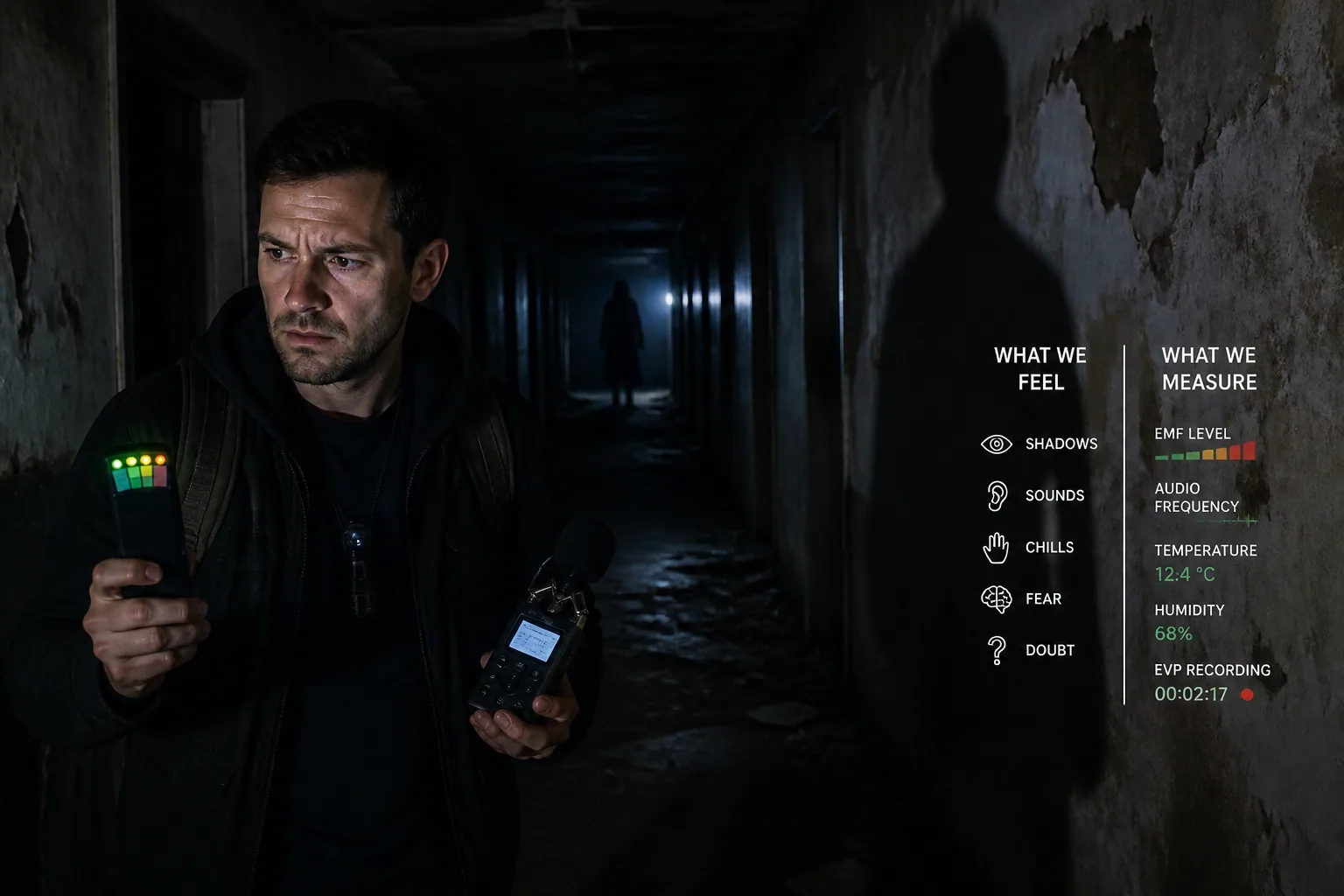
Personal impressions become more meaningful when they line up with independent data. That is where tools matter. EMF readings, EVP sessions, and audio recording can help you cross-check what you think you felt against what the environment actually produced. Used properly, they do not replace your senses. They help you verify them.
Environmental research has repeatedly noted that fluctuating electromagnetic fields are associated with reports of unusual phenomena in haunted settings (pubmed.ncbi.nlm.nih.gov). That makes EMF monitoring a useful part of your fieldwork, not because every spike is paranormal, but because it gives you a measurable reference point. If you feel a presence and the EMF stays stable, that does not disprove your feeling, but it does weaken any claim that the sensation was triggered by a detectable field change.
This is also where a tool like Ghost Detector: Ectify can fit naturally into a disciplined workflow. With its real-time EMF detection, spirit box and EVP generator, and built-in audio recording, it gives you a simple way to capture the full session and compare impressions afterward. You can review the timestamps, re-listen to moments that felt unusual, and check whether what you sensed aligned with what the device recorded at the time. Learn more here: https://findthe.app/ectify-fc72z0
The important part is not to confuse activity with explanation. A spike, a word, or a sound is only useful when viewed in context. Cross-validation is what turns a spooky moment into something worth analyzing.
Common Investigation Scenarios Where the Senses Mislead You
Some situations are especially prone to false positives. One is the first twenty minutes after entering a site. Your senses are adjusting, you are scanning hard for anomalies, and your imagination is active. Another is the long midpoint of a hunt, when fatigue and boredom can make you mentally reach for stimulation. A third is the final stretch, when everyone is eager for one last event and patience starts to fade.
Other common traps include hearing your name in ambient noise, mistaking a teammate’s movement for a figure, feeling a chill from airflow or structural drafts, and attributing smells to paranormal causes without checking for environmental sources. The Haunt Project’s findings are a good reminder that unusual sensations often cluster in environments with dim lighting and complex physical conditions (sciencedirect.com). In other words, eerie conditions can manufacture eerie feelings.
The stronger your emotional investment, the more important it is to slow down. If a moment seems incredible, your first job is not to announce it. Your first job is to test it.
Building a More Skeptical, Evidence-Driven Ghost Hunting Routine
A skeptical routine does not kill the fun of paranormal hunting. It makes the experience more credible. Start every session by checking your physical state. If you are running on no sleep, hungry, overstimulated, or stressed, acknowledge that your perception is less reliable than usual. Then set simple rules for the night: document first, interpret later; get second opinions; and never rely on a single sensation alone.
Use a consistent method for logging events. Record the time, location, lighting, team members present, equipment readings, and your own emotional state. If something strange happens, compare subjective impressions with objective outputs. Look for repeatability before you look for meaning. If the same type of event happens across multiple sessions under similar conditions, it becomes more interesting. If it only appears when you are tired, anxious, or primed, it may be a perception problem instead of a paranormal one.
The most disciplined ghost hunters are not the ones who feel the least. They are the ones who know how feelings can mislead them. By understanding fatigue, darkness, ambient noise, expectation bias, and sensory deprivation, you can investigate with a clearer head and stronger standards. That means less noise in your conclusions, better evidence, and a much better chance of telling the difference between a haunting and your own senses playing tricks.
