Sleep, Hallucinations & Ghosts: How Sleep Deprivation, Lucid Dreams, and Sleep Paralysis Fuel Paranormal Encounters
A lot of ghost stories begin the same way: late at night, when everything is quiet, the mind is tired, and ordinary sensations start to feel loaded with meaning. A shadow in the doorway, a whisper in the room, pressure on the chest, a feeling that someone is standing nearby, all of these can sound like classic paranormal evidence. But sleep science offers a powerful alternative explanation. When sleep is disrupted, dream states can spill into waking life, perception can become unreliable, and experiences can feel intensely real even when they are being generated by the brain itself.
That overlap is exactly why sleep deprivation, lucid dreams, and sleep paralysis are so often tangled up with hauntings. In many cases, people are not imagining things in a casual sense. They are having genuine perceptual experiences, just not necessarily caused by ghosts. Recent research shows that sleep-related hallucinations are common, vivid, and strongly associated with paranormal belief. That makes this topic especially important for believers, skeptics, ghost hunters, and anyone who has ever wondered why so many encounters happen after dark.
Why So Many Ghost Encounters Happen at Night
Night is the perfect setting for confusion between sleep and reality. Darkness removes visual detail, silence amplifies tiny sounds, and fatigue lowers the brain’s ability to interpret ambiguous input. If you wake suddenly from deep sleep, drift off while thinking, or stay awake for too long, your brain is more likely to misread internal signals as external events. That is why the classic haunted house story often starts in bed, in a hallway, or during a half-awake moment.
The body also naturally cycles through states where dreaming and waking overlap. Those transitions can produce hypnagogic hallucinations as you fall asleep and hypnopompic hallucinations as you wake up. In both states, a person may hear footsteps, see figures, feel movement, or sense a presence in the room. Because these episodes often happen at night, they are easily interpreted through a paranormal lens, especially if the person already expects a haunting.
The Science of Sleep Deprivation and Hallucinations
Sleep deprivation can do far more than make someone groggy. Research on severe sleep loss, from 24 to 264 hours without sleep, shows a reliable progression of perceptual disturbances. Visual distortions appear in about 90% of studies, somatosensory changes in about 52%, and auditory anomalies in about 33%, with symptoms becoming more intense as wakefulness continues. In some cases, these disturbances develop into full hallucinations and even delusion-like thinking. Source: https://pmc.ncbi.nlm.nih.gov/articles/PMC6048360/
This matters because sleep loss can create the exact ingredients people often associate with paranormal encounters. A tired brain may misinterpret a shadow as a person, turn a creak into a voice, or transform a vague sensation into a structured presence. The more exhausted someone becomes, the less stable their perception gets. At that point, the experience can feel unmistakably external, even though it began as a breakdown in normal sensory processing.
Sleep deprivation also weakens attention and memory. That means a person may be more suggestible, more likely to connect unrelated events, and more convinced by their own interpretation of a strange moment. In a haunted location, those effects can be especially strong because the setting already primes the mind for eerie meaning.
How Lucid Dreams Blur Reality and the Paranormal
Lucid dreaming is another reason ghost encounters can feel so convincing. In a lucid dream, the dreamer knows they are dreaming while the dream is happening. That awareness can create highly vivid experiences where the environment seems real, the body feels present, and interactions with figures or entities become emotionally intense. A meta-analysis of 50 years of research found that about 55% of people have had at least one lucid dream in their life, and around 23% experience lucid dreams one or more times per month. Source: https://www.sciencedirect.com/science/article/pii/S1053810016301283
Lucid dreams can feel paranormal because they often include impossible events that still feel immersive and immediate. Some people report flying, leaving the body, speaking with dead relatives, or encountering beings that seem intelligent and autonomous. Since the dreamer is partly aware, the memory of the event can later be described as if it happened in a different layer of reality rather than in sleep. That can make lucid dreaming especially confusing when someone wakes up with a strong emotional residue and interprets the dream as contact with something supernatural.
The boundary becomes even blurrier when lucid dreams occur alongside sleep paralysis or fragmented sleep. In those situations, a person may wake into a half-dream state, see a figure, and still retain the sense that the experience was meaningful and real. It is easy to understand how that could become a ghost story.
Sleep Paralysis, REM Atonia, and the Classic Night Visitor
Sleep paralysis is one of the strongest sleep-based explanations for ghost encounters. It happens when a person becomes aware while the body is still in REM atonia, the temporary paralysis that normally keeps us from acting out dreams. The mind is awake enough to notice the room, but the body has not fully “come back online.” That mismatch can be terrifying.
A systematic review and meta-analysis of 76 studies with 167,133 participants estimated that about 30% of people worldwide experience at least one episode of sleep paralysis in their lifetime. Source: https://pmc.ncbi.nlm.nih.gov/articles/PMC10902800/
Even more striking, sleep paralysis often comes with vivid hallucinations. About 24.25% of cases involve both visual and auditory hallucinations, while nearly 4% involve only visual hallucinations. Another summary found that roughly 75% of episodes include distinct hallucinations such as intruder presences, chest pressure or incubus experiences, and vestibular-motor sensations like flying or out-of-body movement. Source: https://www.sleepfoundation.org/parasomnias/sleep-paralysis
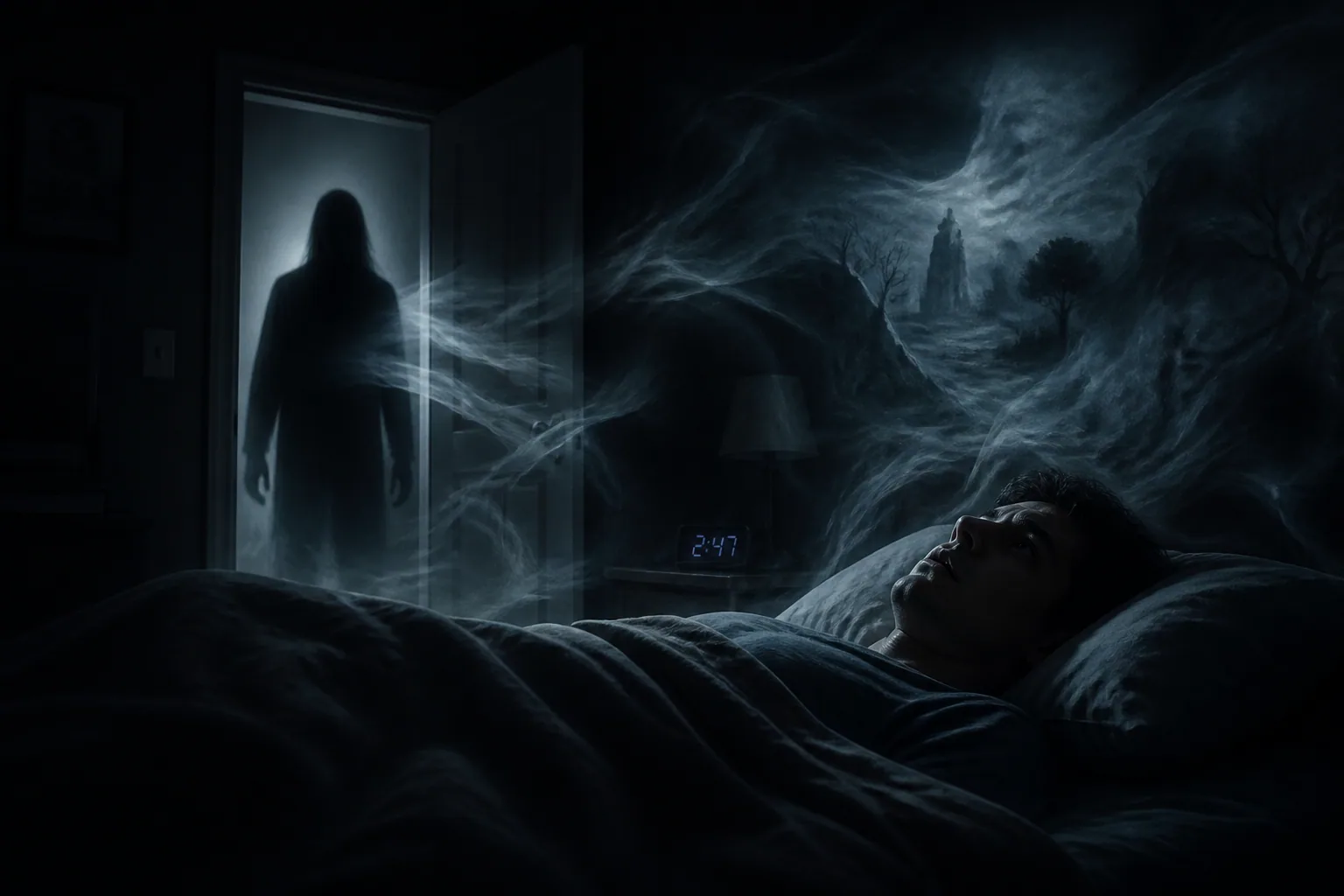
That combination is almost a direct blueprint for a haunting. A person may wake unable to move, feel a weight on their chest, hear a sound near the bed, and see a dark figure near the doorway. In paranormal language, that becomes a classic night visitor. In sleep science, it is a known REM-related event that can be frightening, especially if the person does not realize what is happening.
Hypnagogic and Hypnopompic States: When Dreams Leak Into Waking Life
Hypnagogic hallucinations happen as you fall asleep, while hypnopompic hallucinations happen as you wake up. These states are important because they sit right on the border between dreaming and waking consciousness. In them, a person can briefly hear voices, see faces, sense movement, or feel as if someone is in the room.
A longitudinal U.S. general-population study of about 12,000 people found that 11.7% reported hypnagogic hallucinations in the previous year, falling to 9.3% three years later, with a 3-year incidence rate of 5.7%. The same study found that persistent hypnagogic hallucinations were strongly predicted by persistent sleep paralysis, hypersomnolence, chronic pain, and cataplexy-like symptoms. Source: https://academic.oup.com/sleep/article/45/Supplement_1/A245/6592818
These experiences are not rare outliers. They are part of a broader sleep instability pattern that can make a person feel as if reality is leaking. In a haunted bedroom, a hypnopompic hallucination can easily be interpreted as a spirit at the bedside. In the dark, with only fragments of awareness and a racing heart, the brain fills in the rest.
Why Shadow Figures and Sensed Presences Feel So Real
One of the most unsettling parts of these experiences is that they rarely feel vague. People often describe a specific presence, a human-shaped shadow, a pressure on the body, or a sense that something is watching them. That sensation of presence is a normal feature of sleep-related hallucinations, not just a dramatic embellishment.
The brain is built to detect agents, meaning it is highly tuned to notice possible people, faces, and threats. Under conditions of sleep loss, partial waking, and sensory uncertainty, that system can become overactive. Instead of asking whether there is an actual person in the room, the mind starts with a simpler and safer assumption: something is there. If the environment is dark and the person is frightened, that “something” can quickly become a ghost, intruder, or entity.
This is one reason ghost experiences are so resistant to correction. They are not just mistaken observations. They are compelling, whole-body events involving perception, emotion, and bodily sensations all at once. A person may know rationally that sleep paralysis is possible, yet still feel convinced they saw a figure at the foot of the bed. The experience is real. The interpretation may be what needs questioning.
What Recent Research Says About Sleep and Paranormal Belief
Research increasingly suggests that sleep-related phenomena and paranormal belief often cluster together. A scoping review of 44 studies found positive associations between sleep-related variables such as sleep paralysis, lucid dreaming, nightmares, and hypnagogic hallucinations, and reported paranormal experiences or beliefs in ghosts, spirits, or near-death experiences. Source: https://pubmed.ncbi.nlm.nih.gov/37070349/
That does not mean every believer is sleep deprived or every ghost sighting is a hallucination. It does suggest that sleep experiences help shape how people interpret unusual events. If someone is prone to vivid dream states, recurrent paralysis, or fragmented sleep, they may be more likely to report encounters that feel supernatural. Over time, these events can reinforce belief, especially when they occur in emotionally charged settings.
This is where sleep science becomes especially useful. It does not need to dismiss a person’s experience to explain part of it. Instead, it offers a framework for understanding why a strange night can become a lifelong ghost story.
How Common Are Sleep-Related Hauntings Really?
If you compare the numbers, sleep-related “hauntings” are more common than many people realize. Around 30% of people may experience sleep paralysis at least once in their life. Roughly three-quarters of those episodes can include vivid hallucinations. Hypnagogic hallucinations affect a meaningful minority of the general population, and severe sleep deprivation can trigger perceptual distortions in a large share of affected individuals. Taken together, these figures show that a surprisingly large number of eerie experiences may be rooted in sleep rather than the supernatural.
This also explains why ghost reports often share similar patterns across cultures: nighttime timing, sensed presences, chest pressure, voices, shadows, and body immobility. Those are exactly the kinds of experiences sleep science predicts. The details vary, but the structure is remarkably consistent.
In other words, if a story sounds like a textbook haunting, that may be because it also sounds like a textbook sleep episode.
Real-World Cases That Sound Paranormal but Fit Sleep Science
Consider the person who wakes at 3 a.m., cannot move, feels pressure on the chest, and sees a dark shape standing in the room. That story is often told as an intruder encounter or demonic visitation. But it also matches sleep paralysis nearly point for point. The body is still in REM atonia, the visual system is half-dreaming, and the brain translates fear into a figure.
Or think about someone who is exhausted after several sleepless nights and starts hearing their name called from an empty hallway. Severe sleep deprivation can produce auditory anomalies and visual distortions, and the meaning of the sound is often supplied by expectation. If the person already believes the house is haunted, the brain is more likely to decide the voice belongs to a spirit.
Even out-of-body sensations can fit the pattern. Vestibular-motor hallucinations are common in sleep paralysis, and they can include floating, falling, spinning, or leaving the body. That makes reports of astral projection or ghostly separation feel less mysterious from a scientific standpoint, even if the person experiencing them is convinced they were somewhere else.
How to Tell a Sleep-Induced Experience From a Possible Haunting
There is no perfect test, but there are clues. Sleep-induced events are more likely if the experience happened while falling asleep, waking up, or after severe sleep loss. They are also more likely if the person was unable to move, felt heavy pressure, saw brief shadowy forms, or experienced voices and presence sensations in a bedroom setting. Repeated episodes that occur during irregular sleep, stress, or illness also point toward a sleep explanation.
A possible external event becomes more plausible if multiple fully awake people independently observe the same thing at the same time, if there is clear physical evidence that cannot be explained by expectation or environment, or if the event happens in broad daylight under normal alertness. Even then, caution matters. Human perception is highly reconstructive, and memory can be shaped by fear, suggestion, and social reinforcement.
The simplest question is often the best one: was the person fully awake, or were they crossing the border between sleep and waking? If the answer is uncertain, sleep science deserves serious consideration.
Practical Tips for Believers, Ghost Hunters, and Curious Skeptics
If you want to investigate paranormal claims responsibly, start with sleep. Ask about bedtime, recent sleep loss, stress, medications, alcohol use, naps, nightmares, and any history of paralysis or vivid dreams. Keep a log of when experiences happen and whether they cluster around waking moments. A pattern will often emerge.
For ghost hunters, this does not ruin the investigation. It improves it. A team that knows how to separate sleep phenomena from environmental events will make cleaner observations and fewer false conclusions. Recording the exact time of an episode, noting whether someone was asleep or awake, and checking whether others were present and alert can save a lot of confusion later.
For believers, sleep science can add depth rather than take away meaning. An experience can still feel profound, emotional, and transformative even if it originated in the brain’s sleep systems. For skeptics, the key lesson is to avoid laughing off the person who saw the shadow. The experience may be rooted in biology, but it is still real to the person who lived it.
If you like documenting those late-night sessions, a tool like Ghost Detector: Ectify can help you record and review what happened in the moment, all in one place: https://findthe.app/ectify-fc72z0
What Sleep Science Can Teach Us About Ghost Stories
Sleep science does not simply explain away ghost stories. It explains why they are so emotionally convincing, why they often happen at night, and why they share such similar features across different people and cultures. The brain under stress, in transition, or deprived of sleep is capable of generating remarkably detailed experiences that feel outside the self.
That is what makes the overlap between sleep and the paranormal so fascinating. Ghost stories persist not only because people want to believe, but because the human mind is capable of creating encounters that are vivid enough to rival reality. When sleep paralysis, hallucinations, lucid dreams, and severe fatigue enter the picture, a haunting may be less a sign of an external spirit and more a sign that the boundary between dreaming and waking has broken down.
In the end, the lesson is not that ghost stories are silly. It is that the sleeping brain is powerful, creative, and sometimes terrifying. And if a shadow appears in the hallway at 3 a.m., it is worth asking not only who is there, but also whether the mind is still partly dreaming.
