Sleep Paralysis, Alien Abductions & Ghosts: When Nightmares Masquerade as Paranormal Encounters
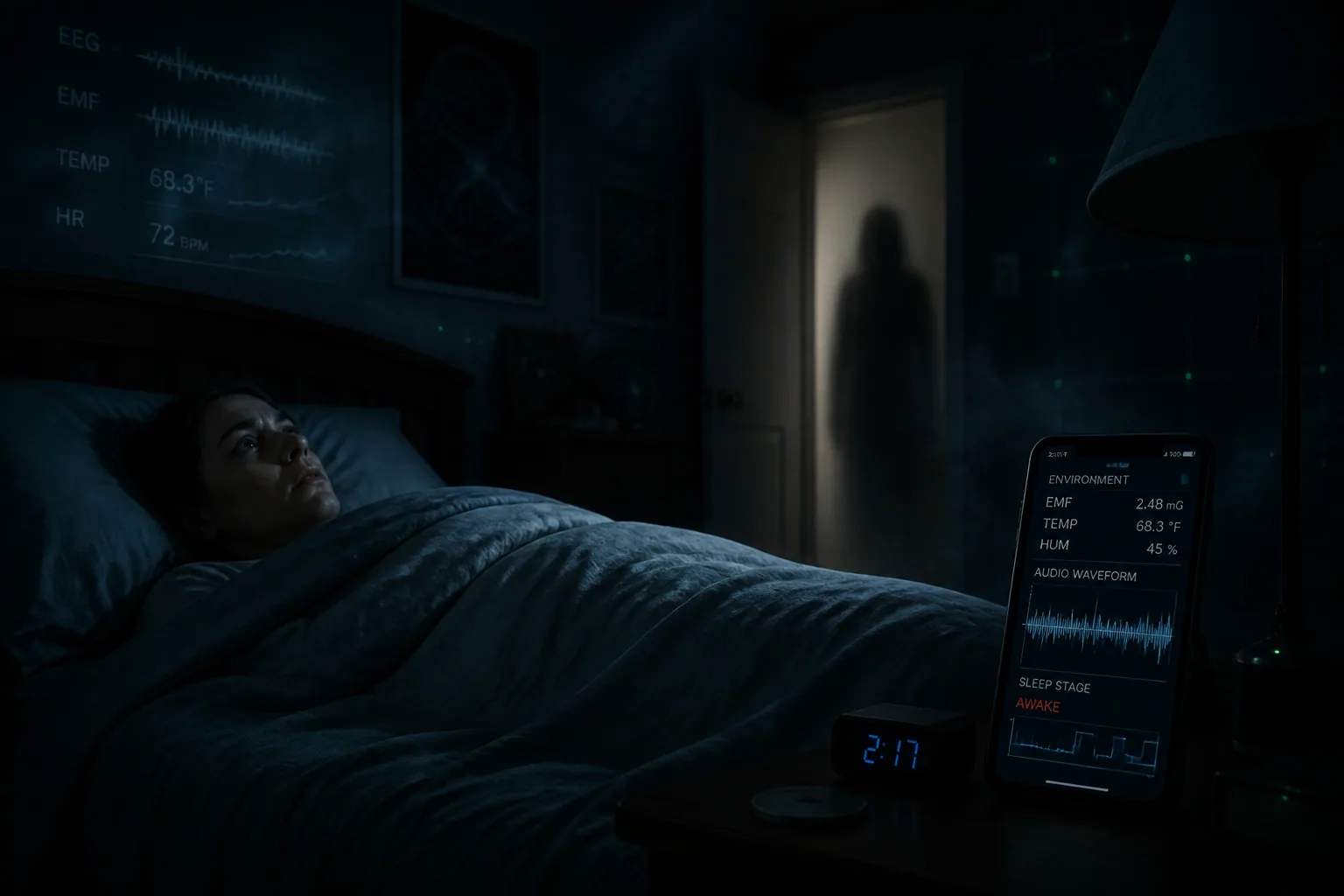
A lot of the most chilling ghost stories and alien abduction accounts begin in the same place: a bedroom, at night, with someone waking up unable to move. That overlap is one reason sleep paralysis can feel so convincingly supernatural. In the moment, it is not just a strange sleep event. It can feel like an intruder is in the room, a presence is standing over the bed, or something nonhuman is pressing down on the chest.
The eerie part is that the experience can be vivid, emotional, and memorable without needing a paranormal explanation. Sleep paralysis sits at the intersection of REM sleep, partial wakefulness, and hallucination. Once you understand how those pieces fit together, a lot of classic haunting and abduction narratives suddenly look less like separate mysteries and more like different interpretations of the same kind of night-time event.
Why Sleep Paralysis So Often Feels Paranormal
Sleep paralysis is not rare. Research suggests the global prevalence is about 30% across varied populations, with higher rates among students and psychiatric patients (PMC). That alone helps explain why so many cultures have some version of a night visitor, night hag, or spiritual attack story. If millions of people experience the same basic physiology, the details that get attached to it are often shaped by local beliefs and expectations.
It also tends to happen at the exact wrong time for clear thinking. The body wakes before the brain fully exits REM sleep, so the person can become aware while still stuck in a dreamlike state. That combination makes the experience feel hyper-real. You are awake enough to register the room, but still close enough to dream logic for shadow figures, voices, and impossible sensations to slip in convincingly.
Episodes are usually brief, but that does not make them feel brief. Symptoms typically last from a few seconds up to 20 minutes, with an average around six minutes (Sleep Foundation). Six minutes is a long time when you cannot move, cannot call out normally, and are convinced something is in the room with you.
What Sleep Paralysis Actually Is: REM Atonia, Hypnagogia, and Hypnopompia
The core mechanism is REM atonia. During REM sleep, the brain essentially switches off most voluntary muscle movement so you do not act out dreams. Sleep paralysis happens when that REM muscle shutdown lingers into waking consciousness. In plain terms, part of the dream-state body lock stays on while awareness starts to come back.
This can happen at sleep onset, which is called hypnagogic, or upon waking, which is hypnopompic. Either transition can produce vivid sensory distortions. Sounds may seem amplified, the room may feel unfamiliar, and the line between internal imagery and external reality can blur. That is why people often describe hearing buzzing, footsteps, whispers, or a voice saying their name.
Certain factors make episodes more likely. Research points to shortened sleep duration, major depressive disorder, PTSD, hypersomnolence, cataplexy, pain, hypnagogic and hypnopompic hallucinations, and some medications as predictors or triggers (PubMed). In other words, sleep paralysis often shows up when sleep is disrupted, stress is high, or the nervous system is already under strain.
The Classic Symptoms: Shadow Figures, Chest Pressure, Buzzing, and Intruders
If you compare sleep paralysis reports across different people, a pattern emerges. Common experiences include a sensed presence, pressure on the chest, auditory distortions, visual figures, and tactile sensations. One survey found chest or other body pressure was reported often or always by about 32.3% of experiencers, sensations of suffocation by about 20.8% to 21.9%, auditory hallucinations by about 34.5%, visual hallucinations by about 34.7% to 36.3%, a sensed presence by about 54.7%, and tactile sensations like being touched or tingling by about 39% to 43% (IGPP survey preprint).
A separate review found that among people who have sleep paralysis, about 24.25% report both visual and auditory hallucinations, while a majority, roughly 71.9%, report no hallucinations at all (PMC). That means not every episode is filled with ghosts or monsters, but when hallucinations do happen, they can be extremely convincing.
The most common supernatural-feeling element is often the sensed presence. That vague but intense feeling that someone is there can be enough to launch the mind into a full horror narrative. In some cases, people report seeing a distinct figure, sometimes dark, human-like, or creature-like, even as they feel pinned down or unable to move. About 14% of people in one study reported seeing a distinct creature or person sitting on their chest (PMC).
That is one reason the classic ghost image and the sleep paralysis image are so similar. Both often involve a figure at the bedside, a sense of threat, and the feeling that the room itself has become hostile.
From Bedroom Hauntings to Alien Abductions: Why the Stories Sound So Similar
When people describe ghost sightings, they often talk about waking at night, noticing a presence, seeing a figure near the bed, hearing a voice, or feeling unable to move. Alien abduction narratives frequently follow the same pattern, just with a different label and a different cast of characters. Instead of a ghost, it is a gray being. Instead of a demon, it is a visitor with a medical or experimental agenda.
The structure is strikingly similar: awakening from immobility, intense fear, sensed presence, unusual lights or sounds, and a belief that something external is happening. In recovered-memory accounts of alien abduction, memories often begin with sleep episodes involving awakening from paralysis, intense fear, feeling a presence, full-body paralysis, and sometimes visual or tactile hallucinations (Harvard-linked PDF).
That does not mean every abduction story is sleep paralysis, but it does show why sleep-based events can be remembered later as something else. The brain tries to make sense of an overpowering experience. If the only available framework is paranormal, then the memory may harden into a ghost, demon, or extraterrestrial encounter.
What Research Says About Sleep Paralysis and Abduction Reports
One of the more important findings in this area is that sleep paralysis can be part of the origin story of alien abduction beliefs. In one study, none of the sleep paralysis experiencers initially interpreted their episode as an alien abduction, even though later cultural narratives could shape how the event was understood (PMC). That is a useful reminder that interpretation is not fixed at the moment the event happens.
The same raw experience can be reframed later. A person may first remember a dark presence and a sense of paralysis, then later, after reading books, watching documentaries, or discussing the event with others, start to place it in an abduction storyline. Human memory is highly suggestible, especially when an episode is frightening and incomplete.
That is why researchers often pay close attention to timing, context, and the transition into wakefulness. An experience that begins in sleep and ends in confusion can easily become a narrative that feels fully external, even when the original event was rooted in sleep physiology.
How Culture Shapes the Experience: Ghosts, Demons, Witches, or ETs
Culture does not create the bodily event, but it strongly shapes the meaning attached to it. In some settings, the same episode is described as a witch sitting on the chest. In others, it is a demon, a spirit, a dead relative, or an alien examination. The mind reaches for the most available explanation in its environment.
This is one reason movies, local folklore, religious beliefs, and internet communities matter so much. If a person already has a mental library of haunted bedroom scenes, their sleep paralysis may be remembered as a ghost. If they have been immersed in UFO stories, abduction accounts can become the more likely interpretation. The sensory content may be similar, but the story format changes.
That cultural shaping does not make the experience less real to the person having it. It simply means the interpretation is being built from available symbols. The fear is real, the paralysis is real, and the hallucination is real in the sense that it is truly experienced. The source, however, may be internal rather than external.
When Paranormal Tools Mislead: EMF Apps, EVP Recorders, and Phone Sensors
It is understandable that people reach for tools when they think they have encountered something unexplained. Ghost hunting equipment feels like a way to move from fear to evidence. But many tools used in paranormal settings are easy to misread, especially in a bedroom or other sleep environment.
EMF detectors are a good example. Experts note that electromagnetic fluctuations can come from wiring, appliances, and nearby infrastructure, and there is no scientific proof that low-level EMFs cause paranormal experiences. Controlled work has also failed to show a significant correlation between EMF-active and sham conditions in producing strange reports, including in the French et al. Haunt Project (Paranormal Response Network).
That matters because a phone app or handheld detector can make a normal fluctuation feel like a confirmation. Likewise, EVP recordings can turn noise, room ambience, or ordinary speech fragments into pattern-rich evidence once someone already expects a haunting. The tool may capture something real, but the interpretation can still be wrong.
If you are trying to understand a nighttime episode, it helps to remember that a gadget can increase excitement without increasing certainty. In some cases, it may simply deepen the story rather than clarify it. For readers interested in exploring the immersive side of this world while keeping a record of sessions, a product like Ghost Detector: Ectify can be useful as an entertainment and documentation tool, especially if it is treated as part of the experience rather than proof of the paranormal: https://findthe.app/ectify-fc72z0
How to Document a Nighttime Encounter Without Jumping to Conclusions
The best way to approach an unusual night-time event is with a calm log, not a conclusion. Start by writing down the time, the position you were sleeping in, what woke you, how long it seemed to last, and whether you could move or speak. Note any chest pressure, buzzing, sensed presence, shadow figures, voices, or touch sensations as specifically as possible.
Then record the environment. Was the room hot or cold? Was there light from a hallway or window? Were fans, devices, alarms, pets, or other people present? If you had your phone nearby, note whether notifications, vibrations, or sounds could have contributed. These small details often matter more than they first seem to.
It also helps to track sleep patterns over time. Keep a simple session log with bedtime, wake time, naps, stress level, alcohol or caffeine use, illness, medication changes, and nights of shortened sleep. Since shortened sleep duration, PTSD, depression, hypersomnolence, pain, and some medications are linked to sleep paralysis, pattern-tracking can reveal whether episodes cluster around a trigger (PubMed).
If you want a fair test of an alleged haunting, compare the episode with sleep timing, not just with what the room sensor or recorder said. A dramatic experience at 3 a.m. after poor sleep is not the same as unexplained activity in broad daylight with multiple observers.
Sleep Hygiene Strategies That May Reduce Future Episodes
Because sleep paralysis is tied so closely to disrupted sleep and REM transitions, good sleep habits can make a real difference. Aim for consistent sleep and wake times, even on weekends. Regularity helps stabilize the sleep-wake cycle and reduces the chance of fragmented REM transitions.
Try to avoid severe sleep deprivation. Research suggests shortened sleep duration is a key trigger, and even modest loss can matter if it accumulates. If stress is high, build a wind-down routine that lowers arousal before bed. That may include reducing late-night scrolling, avoiding stimulant use too late in the day, and keeping the bedroom environment as calm and predictable as possible.
Sleeping on your back can be a trigger for some people, so changing sleep position may help if you notice a pattern. If episodes happen repeatedly, write down what was different on those nights and look for trends instead of assuming every event has a separate supernatural cause.
The goal is not to deny the experience. It is to reduce the conditions that make it more likely.
How to Share These Stories Ethically Without Reinforcing Panic or Misinformation
If someone tells you they were visited by a ghost or abducted by aliens, the most helpful response is not mockery. The fear was real, and dismissive reactions can make people less willing to talk about it. A better approach is to validate the experience while staying careful about the explanation.
You can say, for example, that the episode sounds terrifying, that sleep paralysis can create very vivid sensations, and that it might be worth checking whether sleep disruption played a role. That keeps the conversation respectful without turning the event into proof of a haunting or conspiracy.
This matters because fear spreads quickly in groups. If one person frames a sleep paralysis episode as a demon attack or alien contact, others may reinterpret ordinary sleep phenomena through the same lens. That can amplify anxiety, distort memory, and create a feedback loop of expectation and perceived evidence.
Ethical storytelling means being honest about uncertainty. It is fine to say, “I had an experience I cannot fully explain.” It is not responsible to claim certainty where none exists, especially if the person has not considered sleep-based causes, medical factors, or environmental explanations.
When to Seek Medical or Mental Health Support
Most sleep paralysis is not dangerous, but recurring episodes can still be a sign that something else needs attention. If events are frequent, especially if they come with excessive daytime sleepiness, sudden muscle weakness, panic, trauma symptoms, or disrupted daily functioning, it is worth talking to a doctor or sleep specialist.
Support may also be helpful if the experiences are causing intense fear, insomnia, or anxiety about going to sleep. People who have trauma histories, depression, or PTSD may be especially vulnerable to distress around sleep interruptions, and professional support can help address both the sleep problem and the emotional aftermath.
If you are unsure whether an event was sleep paralysis, a sleep disorder, a mental health issue, or something else, the safest path is assessment rather than self-diagnosis. The aim is not to strip away meaning. It is to make sure the explanation is grounded in reality and the person is getting appropriate care.
A Balanced View: Respect the Experience, Test the Explanation
Sleep paralysis sits in a fascinating place between biology and belief. It can produce the exact ingredients that make a haunting feel real: immobility, a sensed presence, pressure on the chest, buzzing sounds, shadow figures, and deep fear. It can also supply the raw material for alien abduction stories, especially when culture and media provide a ready-made narrative.
That does not make experiencers gullible or dishonest. It means the human brain is powerful, especially when half-awake and under stress. The right response is a balanced one: respect what was felt, document what happened, and test the explanation before jumping to the paranormal.
In many cases, the scariest thing about a ghost story or abduction story is not that it is supernatural. It is that a perfectly ordinary sleep state can feel, in the moment, like proof that the impossible has entered the room.
