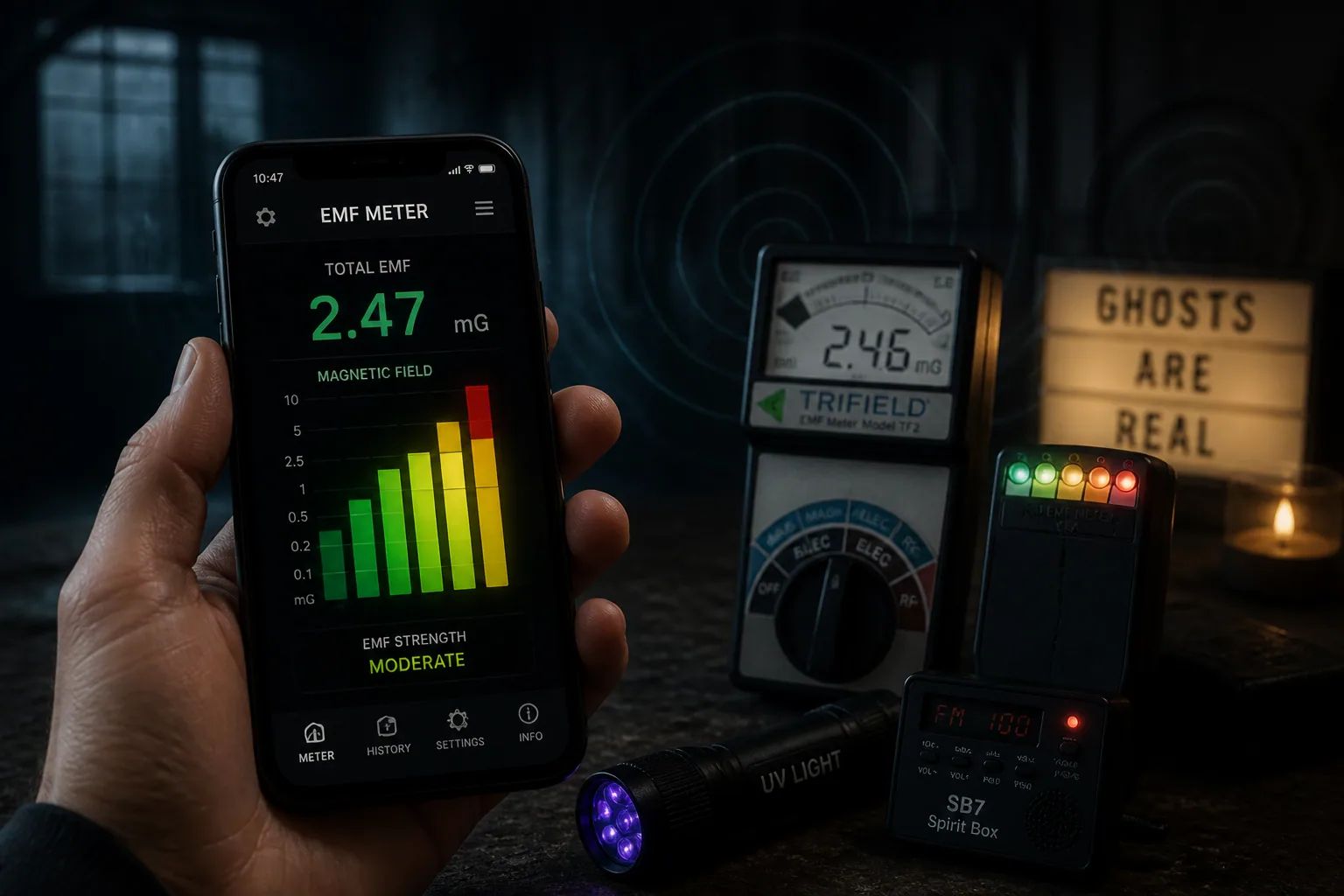
Smartphone EMF Apps: What They Can and Can’t Actually Detect
Smartphone EMF apps are popular for a reason. They feel instant, portable, and easy to use, which makes them especially appealing in ghost hunting, apartment checks, and casual tech experiments. Open an app, wave your phone around, and you get numbers that seem scientific enough to trust at first glance. The problem is that most of these apps are not measuring the broad range of electromagnetic fields people think they are. In most phones, the real sensor doing the work is the magnetometer, a component built mainly for compass and navigation functions, not for serious EMF analysis.
That distinction matters a lot. A phone can sometimes react to nearby magnets, speakers, wiring, or other ferromagnetic objects, but that does not mean it can accurately detect Wi-Fi, cellular radiation, dirty electricity, or the full spectrum of electromagnetic interference. In this article, we will break down what smartphone EMF apps actually measure, why readings can become misleading, and how to use them more intelligently in investigations. If you want a ghost hunting app that leans into the experience while still using the phone’s real hardware, you can also look at https://findthe.app/ectify-fc72z0.
Why Smartphone EMF Apps Are So Popular in Ghost Hunting
Ghost hunting has always lived at the intersection of curiosity, atmosphere, and uncertainty. That is one reason smartphone EMF apps have become so common. They make investigations feel interactive, and they give users something immediate to watch while exploring a location. A sudden spike on screen feels dramatic, especially in a dark hallway or an old house where every sound seems amplified.
There is also a practical reason these apps spread quickly: almost everyone already owns a smartphone. Instead of buying dedicated equipment, hobbyists can download an app and start testing right away. For social media creators, that simplicity is even more appealing. A live EMF graph, a quick scare reaction, or a session recap can make content more engaging than a static walkthrough.
But popularity should not be confused with precision. Smartphone apps are often used because they are accessible, not because they are accurate substitutes for professional instruments. That is where the confusion starts, especially when users assume a spike means a paranormal event rather than a normal sensor response.
What Your Phone’s Magnetometer Actually Measures
The key component behind most smartphone EMF apps is the magnetometer. In simple terms, it is a sensor that measures magnetic field strength and direction along three axes: X, Y, and Z. Research on magnetometers notes that smartphone versions are typically 3-axis Hall effect or magnetoresistive sensors designed primarily for navigation and compass features, not for complex electromagnetic field detection. Source: https://magnetometerx.com/en/learn/types-of-magnetometers/
This sensor is very good at detecting the Earth’s magnetic field, which typically ranges from about 25 to 65 microteslas. That range sits comfortably within what a smartphone magnetometer can register. Source: https://www.emfprotectionpros.com/can-i-use-my-phone-to-detect-emf/
What that means in practice is straightforward. Your phone can detect relative changes in magnetic field strength. If you bring it near a magnet, a speaker, a metal object that disturbs the field, or certain kinds of wiring, the sensor may respond. That response can be useful if you are trying to locate a stud, compare field changes, or do a basic experiment. It is not the same thing as measuring all forms of EMF.
This is also why phone-based metal detector apps work best with ferromagnetic materials like iron and steel. They are much less effective with non-ferromagnetic metals such as gold, silver, copper, or aluminum because those materials do not create the same magnetic disturbance. Source: https://en.techfokus.rs/smartphone-metal-detector-how-it-works/
The Types of EMF a Smartphone Cannot Detect
This is where many users get tripped up. A smartphone magnetometer does not measure everything that people casually call EMF. It is not a general-purpose radiation meter, and it cannot reliably detect the most commonly discussed sources in home investigations.
First, smartphone apps cannot truly detect radiofrequency radiation from Wi-Fi routers, cellular signals, Bluetooth devices, or smart meters. The reason is simple: consumer phones do not have the dedicated RF sensors needed to measure those fields properly. Source: https://www.emfprotectionpros.com/can-i-use-my-phone-to-detect-emf/
Second, they are poor tools for AC magnetic fields from household wiring and appliances. These fields are tied to alternating current at 50 or 60 Hz, and the magnetometer is calibrated mainly for static or slow-changing magnetic fields, not for the full behavior of grid-frequency emissions. Dedicated meters are designed for that job, not phone compass hardware. Source: https://www.emfprotectionpros.com/can-i-use-my-phone-to-detect-emf/
Third, dirty electricity cannot be measured by a smartphone app. Dirty electricity refers to high-frequency voltage transients on wiring, and those signals are simply outside the magnetometer’s measurement range. Source: https://www.emfprotectionpros.com/can-i-use-my-phone-to-detect-emf/
So if someone points a phone at a router and claims the app is measuring Wi-Fi radiation, that is almost certainly an overstatement. The app may be reacting to nearby magnetic interference, device movement, or even the phone itself, but that is very different from a true RF reading.
Why App Readings Often Seem More Dramatic Than They Are
One of the biggest reasons smartphone EMF apps feel convincing is that they turn ordinary fluctuations into dramatic visual events. A small change in sensor output becomes a dramatic spike, vibration, alarm, or flashing number. The design itself encourages the user to interpret normal variation as meaningful activity.
That effect is amplified by the fact that magnetometer readings are sensitive to many unrelated factors. The phone’s own battery, speakers, internal wiring, and metal frame can influence the sensor. Nearby metal objects, a thick case, a magnetic mount, or even the orientation of the device can shift the reading. Research on app accuracy notes that these internal and external factors can create misleading fluctuations or false positives. Source: https://emfadvice.com/emf-apps-accuracy/
In a ghost hunting setting, this can become especially persuasive. You walk into a room, the number changes, and the atmosphere already makes the moment feel loaded. But a change in the display does not automatically mean a paranormal cause. It may simply reflect how the phone is being held, where it is pointed, or what is nearby.
A good rule is to treat a smartphone reading as a relative indicator, not an absolute measurement. It can show that something changed, but not necessarily what changed or why.
Common Sources of False Positives During Investigations
False positives are common when investigators rely too heavily on phone apps. A few of the biggest culprits are easy to overlook.
Magnetic phone accessories are a major one. Cases with magnets, magnetic rings, car mounts, and snap-on accessories can distort readings immediately. Even a small magnet hidden in a case can keep the sensor elevated the entire time, making the app seem unusually active.
Metal architecture can also create trouble. Reinforced walls, metal studs, electrical boxes, pipes, appliances, speaker systems, and metal furniture can all affect the magnetic environment around the phone. In older buildings, it is common to see plenty of environmental noise that has nothing to do with anything unusual.
Orientation matters as well. Because the magnetometer measures in three axes, turning the phone can change the displayed values even if nothing in the room has changed. If the app does not clearly explain this, a user may mistake movement-based variation for field activity.
Calibration issues are another source of confusion. Some apps rely on a quick figure-eight calibration routine, but many users skip it or do it poorly. If the sensor is not calibrated properly, the display may drift or behave inconsistently.
Finally, some apps are simply designed to exaggerate. They may add sound effects, sudden alert thresholds, or unstable scaling that makes normal background variation look like a dramatic spike. That is fun for entertainment, but it reduces trustworthiness.
Smartphone Apps vs. Professional EMF Meters
The gap between smartphone apps and professional meters is bigger than many people expect. Professional EMF meters are built with dedicated sensors for specific tasks. They can separately measure electric fields, magnetic fields, and radiofrequency radiation, and they often provide frequency response data, calibration details, and defined uncertainty levels. That gives the user a much clearer picture of what is actually present.
By contrast, a smartphone app often gives one broad-looking number derived from a magnetometer that was never meant to assess the full EMF environment. Reports comparing apps with calibrated equipment have noted that phone apps can significantly underestimate RF levels and misread appliance-related activity. Source: https://www.reddit.com/r/shieldyourbodyfromemf/comments/1sbo37r/most_phone_emf_detector_apps_are_basically/
This does not mean phone apps are useless. It means they have a narrow role. They are good at showing relative magnetic changes, quick educational demonstrations, and light scanning in low-stakes situations. They are not reliable for health risk assessment, compliance checks, or anything where accurate field strength matters.
If you are trying to determine whether a location has a real environmental issue, professional equipment gives you a far more stable foundation. If you are trying to build atmosphere, document a session, or explore patterns over time, a phone app can still be useful as a companion tool.
How to Choose a Better EMF App
Not all EMF or ghost hunting apps are equally useful. A better app is not necessarily the one with the loudest effects. It is the one that is honest about what sensor it uses and what it can actually measure.
Look for apps that clearly state they rely on the built-in magnetometer. If an app claims to detect Wi-Fi radiation, cellular EMF, or every kind of paranormal energy with no explanation of hardware, that is a red flag. A trustworthy app should be transparent about limitations.
You should also look for clean readouts, stable scaling, and easy calibration. An app that lets you see raw or near-raw magnetic changes is often more valuable than one that automatically dramatizes every fluctuation. If the interface makes every tiny change look supernatural, it may be designed more for entertainment than observation.
Session logging can also help. Time stamps, history panels, and notes are more useful than flashy alarms because they let you compare what happened across different moments and conditions. That is one reason apps like Ectify can be appealing for ghost hunting sessions, since they combine real-time sensor use with recording and session history in one place.
Tips for Getting More Reliable Readings From Your Phone
If you do use a smartphone EMF app, there are a few simple habits that can reduce bad data.
Start by removing anything magnetic from the phone, including cases or accessories that might interfere with the sensor. Then calibrate the magnetometer if the app offers that option. Do this away from large metal objects if possible.
Next, keep the phone orientation consistent. If you test the same room twice, try to hold the device the same way both times. That makes comparisons more meaningful.
It also helps to test the environment in a controlled sequence. For example, note the reading in the middle of the room, then near a speaker, then near an appliance, then away from those objects. Compare the changes instead of focusing on a single spike.
Finally, keep notes. Write down where the phone was, what direction it faced, whether a case was installed, and what else was running in the room. Good note-taking often explains more than the app itself.
How to Supplement App Data With Other Tools and Techniques
The best investigations combine multiple forms of observation. A phone app can be one piece of the puzzle, but it should not be the only piece.
Start with environmental checks. Look for wiring, routers, Bluetooth devices, appliances, mirrors, metal fixtures, HVAC systems, and magnetic accessories. Many apparent anomalies disappear once the physical environment is mapped properly.
If EMF is truly important to the investigation, pair your phone with a dedicated meter. That gives you a more reliable way to test for electric fields, magnetic fields, and RF sources separately. It also helps you verify whether a phone app is responding to real changes or just internal noise.
Audio and visual documentation help too. Recording a session, taking still images, and noting exact room locations can make later review much more useful. If a reading appears at the same time as a sound or movement, you have more context to interpret it.
For ghost hunting hobbyists, this layered approach matters because paranormal claims are difficult to evaluate with one tool alone. The more you can separate sensor data, environmental sources, and personal observation, the less likely you are to confuse a normal fluctuation with something extraordinary.
When a Phone Is Good Enough, and When You Need Real Equipment
A smartphone is good enough when your goal is exploration, education, or entertainment. It can help you notice magnetic changes, test simple hypotheses, or add a dynamic element to a ghost hunting session. It is also useful for first-look scans in low-risk settings where precision is not critical.
A smartphone is not good enough when the result needs to be trusted as a technical measurement. If you care about RF exposure, wiring issues, dirty electricity, appliance emissions, or serious environmental assessment, you need real equipment designed for those tasks. If you are making decisions about health, property conditions, or professional reporting, an app alone is not enough.
The simplest way to think about it is this: a phone app can tell you that something changed, but not with enough confidence to tell you exactly what changed. For ghost hunting, that may be part of the fun. For measurement, it is a serious limitation.
Used wisely, smartphone EMF apps can add curiosity and atmosphere to an investigation. Used carelessly, they can create the illusion of evidence where there is only sensor noise. The difference usually comes down to understanding what the phone is actually measuring, and what it is not.
