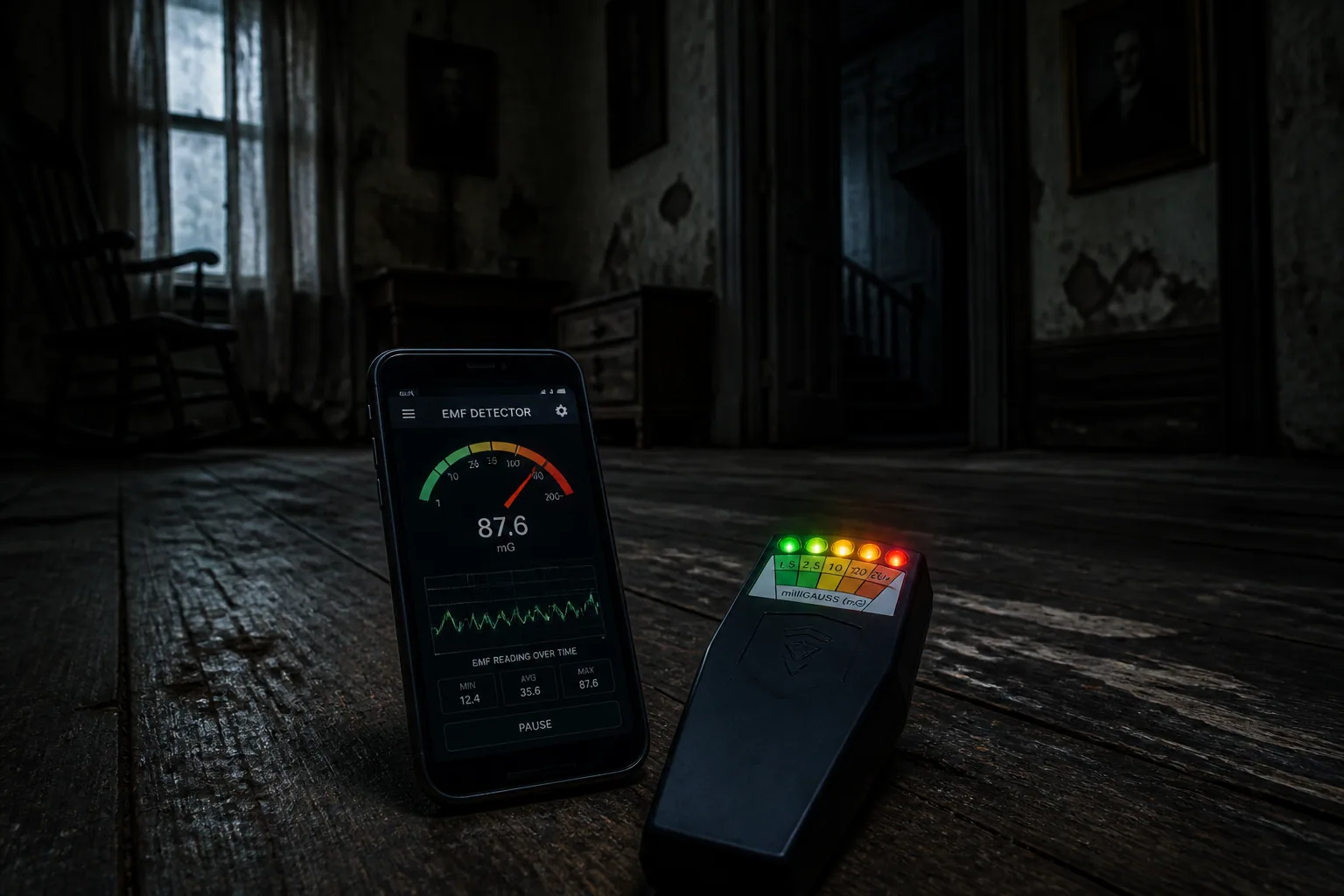
Smartphone vs Dedicated EMF Meters: What Ghost Hunters Really Need to Hunt Evidence Wisely
If you spend enough time in paranormal groups, you will eventually see the same debate come up again and again: can a smartphone app really replace a dedicated EMF meter? The short answer is that it can help in some situations, but it is not the same tool. For ghost hunting, that distinction matters. EMF readings are often used as part of an evidence trail, so knowing what your device is actually measuring is just as important as knowing how to use it.
A lot of beginners start with a phone because it is convenient, familiar, and already in their pocket. That makes sense. But convenience can also create a false sense of confidence. A phone app may show a spike that feels dramatic in the moment, yet the spike might be coming from a metal case, nearby wiring, or even the phone itself. On the other hand, a dedicated meter can separate different kinds of fields and give you much more context. If you want to hunt evidence wisely, not just react to numbers on a screen, it helps to understand both tools clearly.
Why EMF Tools Matter in Modern Ghost Hunting
EMF meters became popular in paranormal investigations because investigators wanted a way to notice changes in the environment that were not obvious to the eye. In theory, a sudden EMF change might suggest nearby wiring, an appliance, or some other hidden source. In ghost hunting, people often interpret those changes as a possible sign of unusual activity. Even if you are skeptical, EMF tools can still be useful for eliminating ordinary explanations and documenting conditions in a location.
The problem is that EMF is not one simple thing. Magnetic fields, electric fields, and radio frequency signals behave differently, and they do not all point to the same kind of source. That is why the tool you choose changes the kind of information you can collect. A device that only sees one piece of the puzzle can be helpful, but it should not be treated like a full environmental scan.
How Smartphone EMF Detection Actually Works
Most smartphone EMF apps rely on the phone’s built-in magnetometer, the same sensor used for compass and navigation features. This sensor is designed to detect magnetic fields, usually shown in microtesla or milliGauss. In practice, that means your phone can notice static magnetic fields and some slowly changing magnetic influences, such as Earth’s magnetic field or a nearby ferromagnetic object. Google’s Science Journal help describes magnetometer-based measurements in this same general way, and EMF Protection Pros explains that phone sensors are mainly useful for magnetic field changes, not for electric fields or RF radiation. See: https://support.google.com/sciencejournal/answer/9160299?hl=en and https://www.emfprotectionpros.com/can-i-use-my-phone-to-detect-emf/
That is an important limitation for paranormal use. If a room has hidden wiring, a device emitting RF, or another source that does not produce a strong magnetic signature, the phone may miss it completely. In other words, the app can look active while ignoring the most relevant source in the room. Research and user comparison tests have also suggested that phone apps can underreport exposure compared with calibrated meters, especially for non-magnetic sources or weak RF fields, sometimes by a wide margin.
What Dedicated EMF Meters Measure That Phones Cannot
Dedicated EMF meters are built to measure more than one type of field. Many can measure magnetic fields, electric fields, and RF fields separately. That means they can help you identify whether a signal is coming from a power line, wall wiring, an appliance, WiFi, a cellular source, or another environmental emitter. The International Wilderness Medicine and Wildlife organization notes that different EMF meters are designed for different field types, and many are purpose-built to detect AC electromagnetic fields and RF sources. Source: https://iwmw.org/types-of-emf-meters/
This is where the gap between phone apps and standalone meters becomes very clear. A phone magnetometer is not designed to measure the full electromagnetic environment. It cannot properly identify RF hotspots, and it does not separate electric and magnetic components the way a dedicated meter can. For paranormal investigators, that means a phone can be a rough indicator, but a dedicated meter gives you much better evidence handling because it tells you what kind of field changed and often by how much.
Another major advantage is orientation and axis handling. Many professional meters use tri-axis measurement, which helps reduce errors caused by how the device is held. Phone magnetometers can be more sensitive to position, angle, and movement, so the same spot may produce different numbers just because you rotated the phone. That is not ideal when you are trying to document a stable reading during a quiet investigation.
Phone Apps vs Standalone Meters: Accuracy, Sensitivity, and Limits
When comparing a phone app to a standalone meter, the biggest issue is not just accuracy in the abstract. It is what each tool is accurate at measuring. A phone can be reasonably good at detecting static or slowly changing magnetic fields, but it is much less useful for AC magnetic fields, electric fields, and RF energy. A dedicated meter is usually more sensitive and more specific across those categories, especially if it is calibrated and designed for field work.
That difference matters because ghost hunting often happens in older buildings where wiring, appliances, and structural metal can create confusing signals. A phone may interpret those as interesting spikes, but without knowing what type of field is present, you are working blind. Dedicated meters also tend to include shielding or filtering that makes them more reliable in noisy environments, which can improve credibility when you share results with others or use them in recorded content.
There is also the issue of consistency. Some app tests have shown large discrepancies between phone-based readings and professional meters, especially when the source was not a strong magnetic field. That does not mean phone apps are useless. It means they are not broad-spectrum instruments, and they should not be treated as proof of paranormal presence on their own.
When Smartphone EMF Readings Are Good Enough
There are times when a smartphone app is perfectly acceptable for ghost hunting. If your goal is to do a quick sweep of a location, check for sudden magnetic disturbances near obvious metal objects, or look for wiring behind drywall, a phone app can be a useful first pass. The Earth’s magnetic field itself usually sits somewhere around 25 to 65 µT, so your phone will always show a baseline even in a normal room. If a reading rises meaningfully above that baseline, especially close to metal, it can tell you that something magnetic is happening nearby. Reference: https://www.geomag.bgs.ac.uk/education/smartphones.html
This is why smartphones can be useful for screening, not confirming. They are convenient, fast, and easy to bring into a session without extra gear. For beginners, that can be enough to learn how readings behave in different rooms and how quickly numbers can change when you move from one corner to another. If you are filming content or doing casual investigations, that level of insight may be all you need for the moment.
If you want an app-oriented experience that still feels immersive, a tool like Ghost Detector: Ectify can be a practical bridge. It uses your phone’s built-in magnetometer for real-time EMF detection while also adding session recording and paranormal-style features, which makes it convenient for social sharing and casual exploration. You can learn more here: https://findthe.app/ectify-fc72z0
The Most Common False Positives That Trick Beginners
False positives are where smartphone EMF apps tend to cause the most trouble. The first major source is the phone itself. Internal electronics, sensors, cases with metal components, and even accessories can create noise or distort the magnetic reading. EMF Protection Pros notes that a phone’s own components and its environment can interfere with measurements, and user comparisons have reported inconsistent behavior in real-world testing.
The second common source is nearby metal. Ferromagnetic materials like iron, nickel, and steel can distort local magnetic fields and produce spikes on a magnetometer app. Non-ferrous metals such as copper or aluminum behave differently and usually do not create the same kind of magnetic distortion. That means a sudden spike in an old building may be caused by a nail in the wall, a steel beam, or another mundane source rather than anything paranormal.
The third issue is orientation. If you move the phone, tilt it, or hold it near a different part of the room, the reading can change simply because of how the sensor is aligned. Nearby wiring, outlets, appliances, and even electromagnetic components inside nearby devices can also confuse the signal. If you do not control these variables, your EMF log can look much more dramatic than the environment really is.
Side-by-Side Field Tests: Phone App vs Professional Meter
The clearest way to understand the difference is to compare the tools side by side in the field. Imagine three common situations. In the first, you sweep a hallway with a phone app and see a small rise in magnetic values near a metal doorframe. A dedicated meter may show that the increase is localized and tied to ferromagnetic material, which is useful information. The phone was not wrong, but the professional meter gave you context the phone could not.
In the second situation, you check a bedroom wall suspected of hiding wiring. A phone app may show almost nothing unusual because the source is not a strong static magnetic object. A dedicated meter, especially one designed to pick up low-frequency magnetic or electric fields, may detect a real issue. This is the kind of miss that can lead a beginner to overlook ordinary explanations and blame a reading pattern on a paranormal event.
In the third situation, you investigate a room with strong WiFi or other RF sources. The phone magnetometer may appear calm even if the room has a lot of RF activity, because it is not built to measure that part of the spectrum. A dedicated meter can identify the RF environment much more accurately. That distinction is critical if your investigation style depends on ruling out modern electronics before making any claims.
How to Calibrate Your Phone and Improve Reading Reliability
If you are going to use a smartphone for EMF detection, spend a little time making it as reliable as possible. First, remove or minimize metal cases and magnetic accessories. Second, calibrate the compass or magnetometer if your phone allows it, since many sensors drift or become less stable over time. Third, test the phone in a known quiet area so you understand its baseline before entering the investigation site.
It also helps to keep your test method consistent. Hold the phone the same way each time, move at the same speed, and record the same locations from session to session. If you can, compare the phone’s values to a known reference source, such as a fixed appliance or a stable area of the building, so you can see whether the app behaves predictably. The more repeatable your method, the easier it becomes to spot true anomalies versus sensor noise.
Calibration will never turn a phone into a professional meter, but it can reduce sloppy readings and improve confidence in quick scans. For casual investigators, that may be enough to make the data useful in a practical sense. For serious documentation, it should still be treated as a preliminary tool.
Best Practices for Recording Cleaner Paranormal Evidence
If your goal is to create evidence that other people can actually evaluate, then method matters as much as the meter itself. Start by logging the exact location, time, and environmental conditions whenever possible. Note nearby power sources, electronics, and anything metal-heavy in the area. If you are using a phone app, make a note of the model, the app version, and whether the reading was taken with the same orientation each time.
Avoid moving too quickly through a room, because sudden changes can be caused by motion and sensor orientation rather than the environment. Try to isolate the area before taking a reading. Turn off nonessential electronics if you have permission to do so. If you are investigating with others, have one person hold the device while the rest stay still so you reduce accidental interference.
It also helps to cross-check. Do not rely on EMF alone. Pair it with audio notes, video, temperature observations, and a clear floor plan if possible. That way, if a spike appears, you can compare it against the rest of the session instead of treating it as a standalone statement about the paranormal.
When It’s Time to Upgrade to a Dedicated EMF Meter
There is a point where a phone app stops being enough. If you are regularly investigating locations, producing paranormal content, or trying to present your findings with professionalism, a dedicated EMF meter is worth the investment. That is especially true when you need to measure RF sources, detect low-frequency fields near wiring, or reduce the chance of obvious false positives. OSHA’s electromagnetic field guidance also reflects the broader reality that field measurement is a serious technical task, not just a visual reading on a screen. Source: https://www.osha.gov/radiofrequency-and-microwave-radiation/electromagnetic-field-memo
A dedicated meter is also the better choice when credibility matters. If you are sharing results with a team, a client, or an online audience, the tool you use influences how your evidence is received. A calibrated, purpose-built instrument looks more trustworthy because it is designed for measurement rather than convenience. That does not guarantee paranormal proof, of course, but it does make your documentation stronger.
Choosing the Right Tool for Your Budget and Investigation Style
Your best choice depends on how seriously you investigate and what you want the device to do. If you are a beginner who wants to learn the basics, a smartphone app is a low-cost way to start. It lets you practice environmental awareness, understand magnetometer behavior, and get comfortable recording readings. If you mainly create social content or do occasional exploratory sessions, that may be enough to get started.
If you investigate more often, or if you want to eliminate electrical and RF interference with more confidence, move up to a dedicated EMF meter. Look for tri-axis measurement, clear field separation, and calibration options if your budget allows. Those features will help you make fewer assumptions and gather better evidence. In simple terms, the more your work depends on accuracy, the more you should favor the tool that can actually measure the full range of relevant fields.
A smart approach is to think of the phone as a screening device and the dedicated meter as the verification device. Used that way, both tools have a place in your kit. The mistake is expecting the phone to do the same job as a calibrated instrument.
Final Verdict: Evidence Wisely, Not Just Conveniently
For ghost hunters, the real question is not whether a smartphone can detect something. It can. The real question is whether it can detect the right thing with enough reliability to support your evidence. In many cases, the answer is no. Phone magnetometer apps are useful for quick magnetic scans, broad awareness, and casual investigation, but they are limited, noisy, and easy to misread. Dedicated EMF meters are better when you need to separate magnetic, electric, and RF fields, reduce false positives, and build a more credible case.
So the wisest path is to match the tool to the task. Use your phone when you want convenience and a rough look at magnetic disturbances. Use a dedicated meter when you want serious data, better specificity, and results you can stand behind. In paranormal work, that balance is what turns a dramatic reading into something closer to real evidence.
