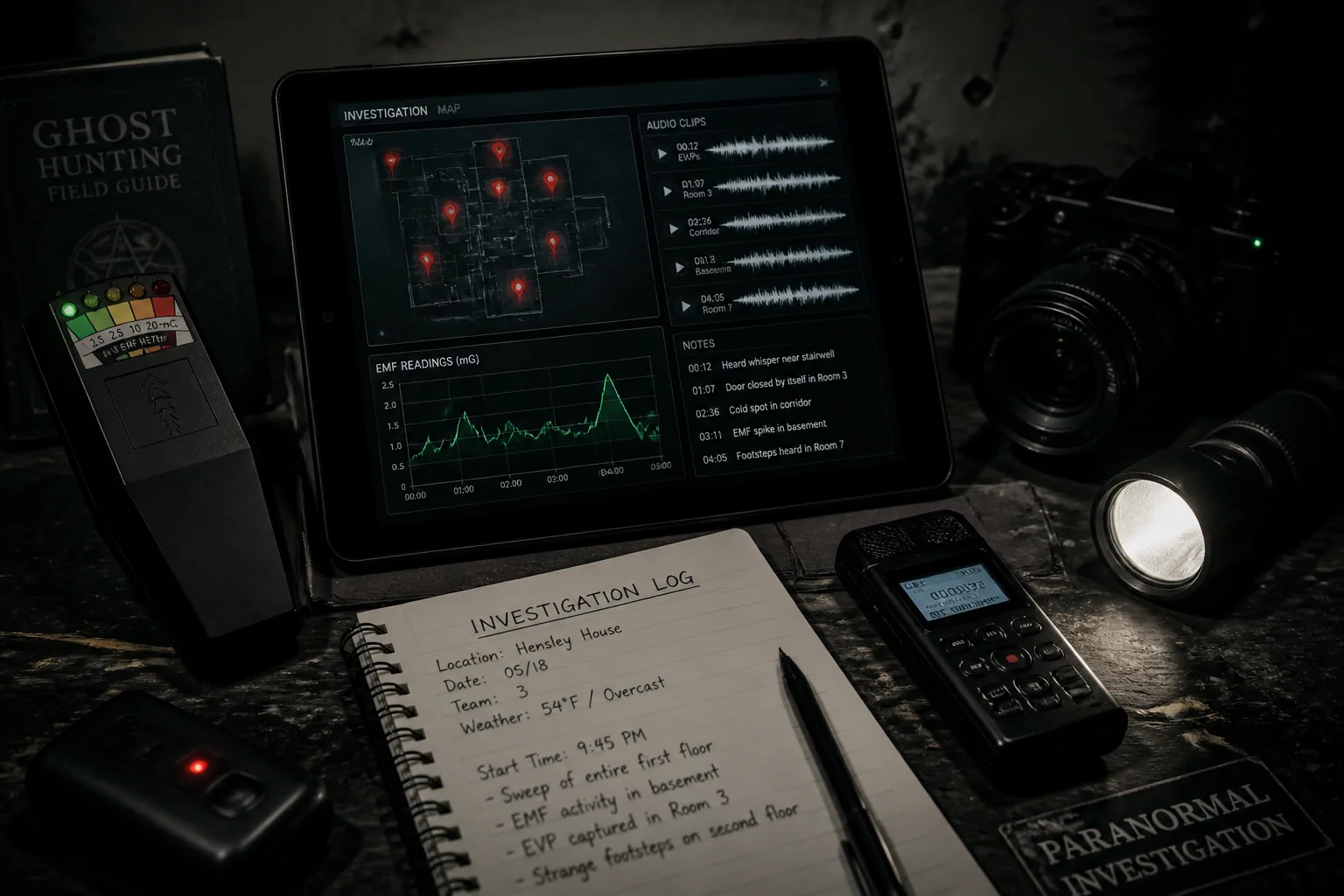
Spectral Evidence: How to Build a Paranormal Investigation Archive with Maps, Data, and Media
If you have ever finished a ghost hunt with a camera roll full of clips, a voice recorder packed with whispers, a few handwritten notes, and a sensor app showing strange spikes, you already know the problem: paranormal evidence is easy to collect and hard to trust later if it is not organized. A real archive changes that. Instead of a pile of disconnected files, you get a searchable record of what happened, where it happened, when it happened, and what else was happening in the environment at the same time.
That matters whether you investigate for fun, create content for YouTube, or publish reports for a research group. A clean archive helps you compare cases, revisit old hotspots, and separate a strong lead from a coincidence. It also makes your work easier to share with other investigators, because people can follow the evidence trail instead of just watching a spooky highlight reel.
And if you want a simple way to start capturing sessions in a more structured way, a mobile tool like Ghost Detector: Ectify can help you record EMF activity, spirit-box responses, and session history in one place: https://findthe.app/ectify-fc72z0
Why Every Paranormal Investigator Needs a Real Archive
A paranormal archive is not just storage. It is an evidence system. When a case is organized well, you can answer basic questions fast: Which location produced the strongest EMF spikes? Did the EVP happen before or after the temperature drop? Was the audio recorded near the same doorway where motion was seen on video? Without structure, those questions turn into guesswork.
A strong archive also protects your credibility. If someone asks how a clip was recorded, what device was used, or whether the audio was edited, you should be able to point to the original file, the metadata, the sensor log, and the notes from that session. That does not prove a paranormal claim on its own, but it does show that your process is consistent and reviewable.
It also helps with long-term pattern recognition. Many investigators focus on the drama of a single night, but meaningful insights often come from repeated observations across multiple sessions. A real archive lets you compare locations, seasons, weather conditions, room layouts, and device behavior over time.
What to Capture During a Session: Data, Media, and Context
The best archive starts with capturing the right things in the field. At minimum, each session should include raw media, sensor readings, and context notes. Raw media means unedited photos, video, and audio. Sensor readings can include EMF, temperature, humidity, motion alerts, or any other device data you use. Context notes should describe the setup, the room, who was present, what was said, and what changed during the investigation.
Try to think in layers. The media shows what was recorded. The sensor data shows what the device detected. The notes explain what the team observed in real time. When these layers line up, you can investigate the same event from multiple angles instead of relying on memory alone.
Do not overlook environmental context either. Weather, power usage, nearby traffic, HVAC cycles, and building activity can all affect readings and perception. If you are documenting a spike or a strange sound, it helps to know whether a heater turned on, a door opened, or another team member walked past the device.
A useful habit is to create a session log with a start time, end time, location name, device list, team members, and a short summary of the objective. That single document becomes the anchor point for everything else in the archive.
Creating a Consistent Tagging System for EMF, EVP, and Environmental Events
Tags are what make an archive searchable. Without them, you are stuck skimming files manually. With them, you can filter for EMF spikes, EVP moments, spirit-box responses, or environmental changes in seconds. The key is to standardize your labels so every session uses the same language.
For EMF events, use a tag format that records intensity, duration, and location if possible. For example, you might tag an event as EMF-Spike, EMF-Sustained, or EMF-Anomaly, then add a short note like doorway, hallway, or attic corner. If your app or spreadsheet supports custom fields, include numerical values as well.
For EVP documentation, one helpful approach is to classify clips by clarity. Research guidance commonly uses Class A for clear and unaltered voices, Class B for sounds that need processing, and Class C for ambiguous audio that may be interpretive. That kind of classification helps you stay honest about confidence levels and makes review easier for collaborators.
Environmental tags should be just as consistent. Temperature-Drop, Humidity-Shift, Motion-Detected, Light-Change, and Sound-Interruption are all useful examples. If several things happen at once, tag all of them, then note which one seems primary and which ones are supporting conditions.
The goal is not to create a perfect scientific taxonomy overnight. The goal is to reduce ambiguity. A later review should not require you to decode your own shorthand.
Using Maps to Plot Hotspots, Routes, and Repeated Activity
Maps turn a stack of sessions into a spatial story. If you log geolocation data for each investigation, you can plot where events happened and see whether certain rooms, buildings, or outdoor areas keep producing the same kind of activity. This is where an archive becomes more than storage. It becomes analysis.
At a simple level, you can mark each session on a map with pins for the location, then add notes for hotspots such as staircases, basements, doorways, or a particular hallway. If your team moves through a site in a fixed route, map that route too. Repeated paths can reveal whether certain readings appear only when investigators pass through specific spaces.
If your tools allow it, embed geolocation and time data directly into media metadata so files can be tied back to the exact place and moment they were captured. Research on geotagging notes the value of including GPS coordinates, time and date, device model, and environmental tags in metadata, which makes reconstruction and mapping much easier. More on that can be found here: https://en.wikipedia.org/wiki/Geotagging
You can also compare patterns across locations. Maybe one site has recurring EMF activity near old wiring, while another consistently produces EVPs in a small doorway alcove. Over time, maps help you distinguish repeatable activity from one-off excitement.
How to Sync Timestamps Across Audio, Video, Sensor Logs, and Notes
One of the biggest problems in paranormal documentation is misaligned timing. A video might show a door move at 9:14, while the audio note says the whisper happened at 9:16, and the EMF spike log is using a different clock altogether. When timestamps do not match, evidence becomes harder to evaluate.
The best fix is to standardize time before the session begins. Set all devices to the same time source if possible, and use a consistent format like ISO-8601 in logs and exports. That gives you a clean, sortable timeline that is easier to compare across tools and platforms.
Timestamped transcripts are especially useful for audio and video review. Tools that synchronize text with media let you click a line in the transcript and jump to the exact point in the recording, which saves a huge amount of time during analysis. This is particularly helpful for EVP review, because you can annotate what was heard, who was present, and what else was happening nearby. A practical example of synced transcription workflows is described here: https://www.maxqda.com/help-mx22/transcription-audio-video/new-timestamps
When building your archive, make timestamp alignment part of the workflow. If a clip is important, add the event time, the start time of the file, and the approximate moment of the relevant occurrence. That three-part approach makes cross-checking much easier.
Best Practices for File Naming, Metadata, and Folder Structure
A good file naming system should tell you what a file is before you open it. That is why consistent names matter so much. A practical format is date, location, event type, and file type. For example: 2026-06-14_HauntedHouse_EMF-Spike_MP4. This kind of naming makes sorting and searching much easier, especially when you have hundreds of files from multiple cases.
Folder structure should follow the same logic. Many investigators do well with a top-level folder for the year, then a folder for each location, then subfolders for raw media, logs, edited exports, and reports. The important thing is consistency. If every session lives in the same structure, you can move quickly from raw evidence to final documentation.
Metadata is the next layer. Tools such as ExifTool or MediaInfo can help you read, edit, or batch process file details like creation date, GPS, device settings, and other embedded information. That matters because metadata can preserve context that would otherwise be lost when files are copied or shared. More about metadata tools is available here: https://fast.io/resources/video-metadata-editor-change-modify-tags/
If you are working with large media archives, it is worth thinking about lifecycle management too. Research on media archiving recommends keeping active investigations on fast storage, then moving completed cases to colder, cheaper storage later. That way your current work stays easy to access while older sessions remain preserved for long-term review. See the storage strategy discussion here: https://www.zmanda.com/blog/media-company-petabyte-backup-strategies/
Backing Up and Exporting Your Paranormal Evidence Safely
Backups are not optional if your archive matters to you. A common standard is the 3-2-1 backup rule: keep at least three copies of your files, store them on at least two different kinds of media, and keep one copy off-site. That approach helps protect you from drive failure, accidental deletion, theft, and local disasters. A straightforward overview of that rule is available here: https://tovstudiophoto.com/photographer-cloud-backup-strategy/
For paranormal investigators, this usually means a working copy on your computer, a local backup on an external drive or NAS, and a cloud copy stored off-site. Cloud services often used for large archives include Backblaze B2, Wasabi, AWS Glacier or Deep Archive, and Google Coldline because they balance durability, cost, and retrieval speed. A comparison of those options is discussed here: https://datastorage.com/articles/the-best-cloud-storage-providers-for-video-media-archives-2025-guide/
It also helps to verify file integrity regularly. Hash checksums such as MD5 or SHA-1 can reveal corruption or tampering by confirming that a file has not changed since it was stored. For evidence work, that matters a lot, because you want to know that a clip reviewed later is identical to the original capture.
When exporting for social media or collaborators, keep a raw master untouched and generate separate working copies. That way you can make highlights, captions, or edits without risking the original evidence set.
Turning Structured Evidence Into Stronger Stories and More Credible Reports
A well-built archive does more than preserve files. It gives you a stronger narrative. When your evidence is structured, you can turn a messy session into a clear report that shows how the investigation unfolded from start to finish. That makes it easier to create credible social media content, YouTube videos, and formal research summaries.
Structured evidence also helps you avoid overclaiming. Instead of saying something happened because it felt strange, you can show the sequence of events. A temperature change happened first, then the team heard a sound, then the recorder captured an unexplained voice, then the camera showed movement in the hallway. That timeline is much easier for viewers and peers to follow.
For public content, the archive also makes editing easier. You can pull together clips that match a specific topic, location, or evidence type without rewatching every file from scratch. For research groups, it supports collaboration because others can inspect the original context rather than relying only on your summary.
In other words, a good archive makes your story better because it makes your evidence clearer.
How to Retroactively Organize Old Investigations Into a Searchable Archive
If your older investigations are scattered across phones, memory cards, external drives, and chat apps, do not try to fix everything in one giant pass. Start by collecting what exists and then rebuild the archive from the evidence you already have. Old files often contain more context than people realize, especially if they still include timestamps, creation dates, or location data.
Begin by grouping files by investigation date or location. Then use batch tools to extract metadata from old media and align events chronologically. Research on metadata workflows notes that existing timestamps, sensor logs, and media history can be used to reconstruct timelines for older investigations. A practical reference for that kind of metadata extraction and geotagging workflow is here: https://www.exiftool.org/geotag.html
Once the timeline is rebuilt, add tags in stages. First identify obvious items like video, audio, and stills. Then mark events such as EMF spikes, EVP candidates, spirit-box responses, and environmental shifts. After that, add confidence notes so you can distinguish confirmed observations from uncertain interpretations.
Old cases are also a good place to create a retroactive summary sheet. Include the location, date, devices used, best evidence, and any caveats. Even if the original session was undocumented, a rebuilt archive can make it usable again.
Common Mistakes That Make Paranormal Evidence Hard to Trust
The biggest mistake is inconsistency. If one session is carefully logged and the next is just a loose collection of clips, the archive becomes uneven and difficult to compare. Consistency in naming, tagging, timestamps, and folder structure is what makes the whole system work.
Another common problem is editing too early. If raw media is overwritten or only finished highlights are saved, you lose the ability to review what happened before the edit. Always keep the original files.
A third mistake is mixing interpretation with documentation. Your archive should distinguish between what was observed, what was measured, and what was inferred. That separation is especially important for EVP, where classification and context matter more than dramatic framing.
Finally, many investigators forget to back up the archive until something is already lost. By then, recovery is often incomplete. A working archive should be protected from the start, then maintained over time with the same discipline you would use for any valuable research library.
If you treat your investigations like real data, your archive will become one of your strongest tools. It will help you find patterns faster, collaborate more easily, and tell better stories without losing the integrity of the original evidence.
