Spectral Storytelling: How to Turn Ghost Hunts Into Social Media Stories People Actually Watch
Great ghost content is rarely great because something spooky happened. It works because the creator knew how to tell the story of what happened. A good paranormal post has structure, momentum, and a clear emotional payoff. It gives viewers a reason to stay, a moment to anticipate, and a detail they can talk about after the clip ends. That is what turns a raw investigation into something people actually watch, share, and remember.
If you are an amateur or semi-pro ghost hunter, the raw footage from a session is only the beginning. The real skill is choosing which EMF spike matters, which EVP deserves a close listen, which shadow can support the mood, and which silence is doing more work than any jump scare. When you frame a hunt like a story instead of a data dump, your content becomes stronger without becoming fake.
Why Great Ghost Content Is Really Great Storytelling
Paranormal viewers are not just watching for proof. They are watching for progression. They want to see a location, understand why it matters, feel the tension build, and then decide for themselves whether the strange moment at the end means something. That is why the best ghost content usually follows the same basic rules as any other narrative. It introduces a place, establishes uncertainty, then delivers a payoff that feels earned.
This matters even more on social platforms, where attention is fragile. A clip that simply says, “Here is an EMF reading,” is easy to skip. A clip that says, “We were told this room was empty, then the meter spiked right after we asked a question” gives the audience context, stakes, and a reason to keep watching. The evidence may be the same, but the story around it changes everything.
Storytelling also protects your credibility. If you present every strange noise as definitive proof, viewers get skeptical fast. If you show the investigation process honestly, including what you ruled out, your audience is more likely to trust the moments that genuinely feel unexplained.
Finding the Story in a Single Investigation Session
You do not need a full series arc to make a compelling paranormal story. A single investigation session already contains the ingredients for one. The trick is to identify the moment when ordinary curiosity turns into real tension. That may be the first EMF spike in a dead hallway, a spirit-box response that seems oddly specific, or a sudden sound that interrupts an otherwise quiet room.
To find the story, review the session as if you were editing a mini documentary. Ask three questions. What was the setup? What changed? What was the strongest unresolved moment? If you can answer those clearly, you already have a narrative spine. From there, your edits should support the story rather than simply chronicle the night in order.
This is where your notes matter. If you remember that the temperature dropped before the audio anomaly, or that the EMF meter reacted only after you stepped near an old electrical panel, that context helps you shape the sequence without exaggerating it. Good ghost storytelling is not about inventing mystery. It is about spotlighting the parts of the session that naturally create it.
The Three-Part Paranormal Arc: Setup, Tension, Payoff
Almost every effective ghost story can be broken into three parts: setup, tension, and payoff. In setup, you establish the place, the claim, and the question. In tension, you bring in the first signs that something may be happening. In payoff, you show the most compelling moment and let it land.
Setup should be short but clear. Tell viewers where you are, why the location is known for paranormal activity, and what you are trying to investigate. Tension begins when evidence starts behaving unusually. Maybe the EMF reading jumps when no one is near the source, or a spirit box answer appears to match your question. Payoff is the clip that makes people pause, replay, or comment. It does not have to be full confirmation. It only has to feel like a meaningful turn.
A strong arc keeps viewers from feeling like they are trapped in endless setup. It also helps with editing because you can cut away anything that does not move the story forward. If a long corridor walk adds no new information, it can go. If a five-second reaction shot shows real fear or surprise, it stays.
How to Use Timestamps, Notes, and Session History to Pick Your Best Moments
The best paranormal editors are often the best note-takers. Timestamps let you return to the exact second a spike, response, or sound occurred. Notes help you remember what was happening in the room at the time. Session history helps you compare repeated patterns across locations and nights, which can make a story feel more grounded and more credible.
If you use an app that tracks your sessions, those records become part of your storytelling workflow. You can identify the most active segments, review which rooms produced the strongest reactions, and build a sequence that highlights the best moments instead of forcing the entire night into one video. That is especially useful when you are deciding what becomes a short clip and what becomes a longer recap.
For example, if a 12-minute investigation contains one clear EVP at 03:14, a visible EMF change at 05:42, and an unexplained shadow at 08:20, you do not need to treat all three equally. You can use the timestamped moments to build a clip around the strongest beat, then support it with a small amount of setup and aftermath. That is how you turn raw session data into a watchable story.
A tool like Ghost Detector: Ectify can help here because it records your session history, captures EMF activity in real time, and saves your audio so you can revisit key moments later: https://findthe.app/ectify-fc72z0
Editing EVP and Spirit-Box Audio for Clarity Without Faking Evidence
Audio is where paranormal content gains or loses trust very quickly. If a response is buried in noise, viewers may miss it. If you overprocess the clip, they may feel manipulated. The goal is clarity, not invention. Preserve the original recording first, then create a cleaner version for the audience.
Good EVP practice starts before editing. Use a recorder with low self-noise, capture in as quiet an environment as possible, and tag obvious ambient sounds during the session so you can rule them out later. That advice lines up with technical guidance from UK Paranormal eXperience, which recommends preserving original audio, using noise reduction, equalization, and amplification carefully, and checking spectral views to spot possible artifacts or voice-like anomalies: https://ukpx.org/2025/10/12/electronic-voice-phenomena-evp-best-practices-and-technical-guidance/
When you edit, think in layers. First, remove distracting background hiss only enough to improve intelligibility. Then use EQ to reduce muddy frequencies and emphasize the range where the voice seems to live. If the EVP is still hard to hear, create a second version with subtle amplification, but always keep the original file archived. If you want viewers to trust you, do not hide the process.
It also helps to classify the result honestly. Clear, unedited responses can be presented as stronger evidence. Audio that needed processing should be described as enhanced for clarity. Anything that remains ambiguous should stay labeled as uncertain. That kind of transparency is more persuasive than overclaiming every breath or static burst as a message.
Using Low-Light Footage, Sensor Screens, and Visual Anomalies to Build Suspense
Ghost hunts are visually difficult by nature, and that is part of the appeal. Dark rooms, grainy hallways, and shaky handheld footage all create tension when used carefully. But low visibility should not become an excuse for sloppy visuals. If you want viewers to stay engaged, you need to make the image legible enough to support the story.
For filming in low light, technical guidance from Videolyser and Edición de Video Pro points toward fast lenses, larger sensors, manual ISO control, and a post-production workflow that starts with noise reduction before exposure and color correction. They also mention tools like Neat Video, DaVinci Resolve, and Topaz Video AI for cleaner results: https://www.videolyser.de/artikel/die-besten-kameraeinstellungen-low-light-aufnahmen
In practice, the visuals that work best are often the simplest. A sensor screen lighting up in darkness. A steady shot of an empty doorway just before a sound occurs. A brief glimpse of a shadow that is not easy to explain. These moments become stronger when the viewer understands the context and can actually see the important detail. Avoid excessive filters that make everything look artificially haunted. Keep the image eerie, but readable.
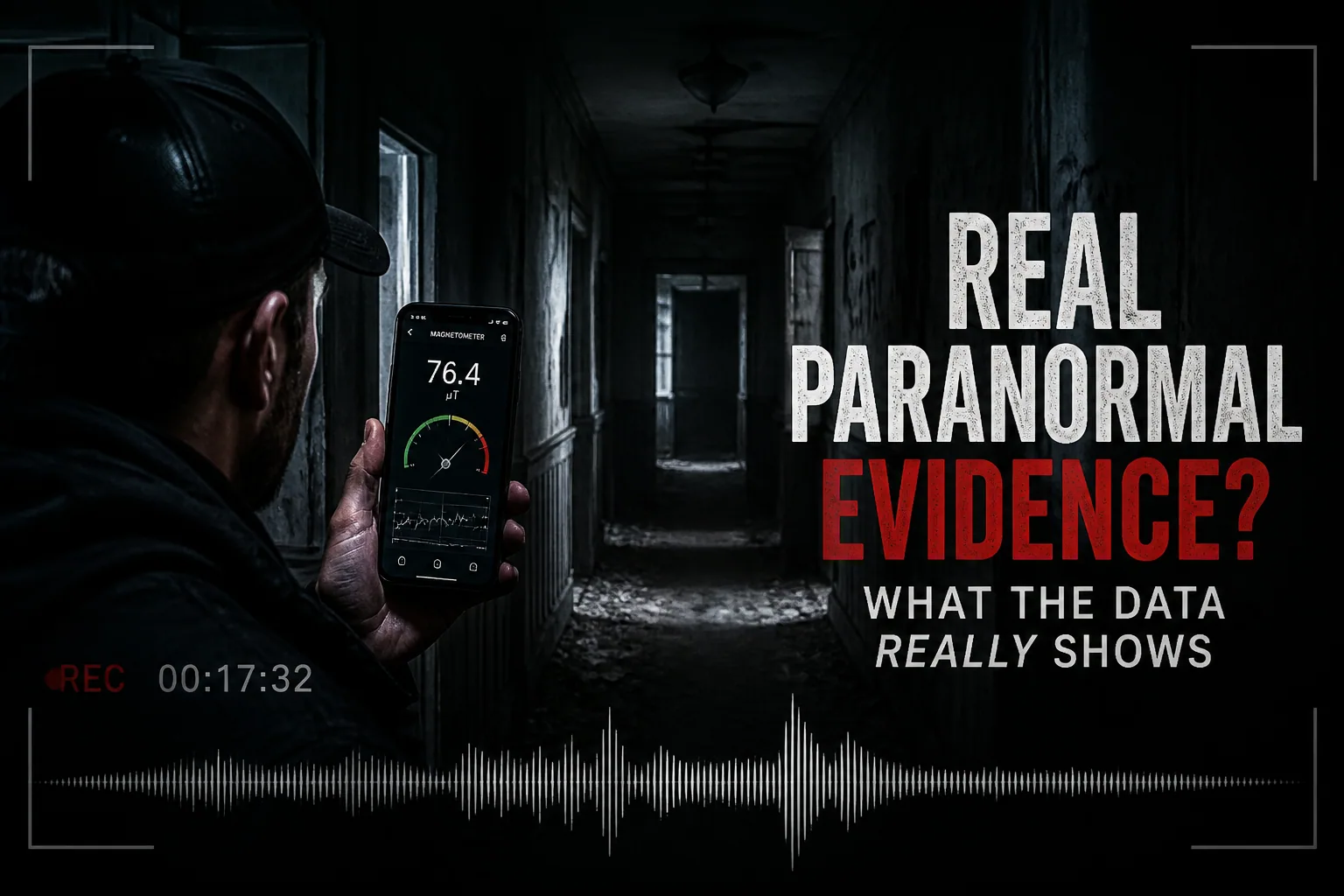
If your footage includes app-based sensor readings or EMF screens, treat them as evidence graphics, not decoration. Let the reading stay onscreen long enough to be understood. Zoom only when needed. Add captions that explain the timing, such as “Spike happened right after we asked the second question”. That approach feels more honest and helps the viewer follow the sequence of events.
How to Create Hooks That Stop the Scroll on TikTok, Reels, and YouTube Shorts
Your opening has one job: make the viewer curious immediately. On short-form platforms, you cannot afford a slow introduction. The best paranormal hooks begin with the most interesting moment and then rewind just enough to give it meaning. Start with the spike, the whisper, the reaction, or the line that makes people stop and ask, “What happened here?”
Platform behavior matters here. Research from InstantViews suggests that Instagram Reels performs best with 15 to 30 second clips, that TikTok engagement tends to peak in the 21 to 34 second range, and that YouTube Shorts between 15 and 30 seconds can achieve about 40% higher completion rates than 45 to 60 second videos. InstantViews also notes that the ideal structure is hook in the first 0 to 3 seconds, context by 10 seconds, buildup through about 25 seconds, and payoff by 30 to 34 seconds: https://instantviews.net/optimal-clip-length-platforms
That means your hook should do one of three things. Show the evidence first. Make a direct claim. Or raise a question that can only be answered by watching the rest of the clip. Examples include: “We heard this voice after nobody was in the room,” “Watch the EMF reading when I ask the third question,” or “This shadow only appears in one frame.”
A strong hook is not hype for its own sake. It is a promise that the clip will deliver a specific piece of information. When your promise matches the payoff, viewers trust you more and are more likely to return.
Best Video Length, Caption Styles, and Thumbnail Ideas for Paranormal Content
Short clips dominate discovery, but they are not always the best format for community building. TechRT reports that videos under one minute can see around 66 percent completion rates, while The Content Labs Q1 2026 Creator Engagement Report found that longer videos in the 90 to 179 second range can drive about 86 percent greater engagement per view than clips under 15 seconds. In other words, short clips get attention, while longer edits can deepen loyalty and discussion.
A practical approach is to use both. Create a 20 to 35 second version for discovery and a 90 to 180 second version for deeper context. The short version should focus on one moment. The longer version can include the setup, the evidence, and a brief explanation of what else happened in the session. This lets you serve different audience behaviors without changing the core story.
Captions should support the tension without overexplaining it. Keep on-screen text brief and specific. Use timestamps, room labels, question prompts, and short context lines. Good captions guide the viewer through the evidence. Bad captions repeat what they already see or try too hard to convince them. For thumbnails, choose one frame with a clear emotional or visual cue: a surprised face, a glowing sensor screen, or a dark doorway with a visible anomaly. The image should suggest a question, not answer everything at once.
Atmosphere vs. Authenticity: Sound Design That Enhances Without Misleading
Atmosphere matters. If your clip sounds flat, the tension disappears. But sound design can easily cross the line into manipulation if it implies evidence that was never recorded. The safest approach is to enhance mood without altering the facts. That means keeping your original EVP intact, avoiding fake footsteps or fabricated voices, and using ambient layers only when they do not change the meaning of the scene.
You can still create a strong atmosphere with honest tools. Room tone, slight volume balancing, and careful cuts between moments can make a clip feel more immersive without inventing new evidence. If you add a sound effect to emphasize a transition, make sure it is clearly a stylistic choice and not presented as part of the investigation. The audience can enjoy cinematic editing as long as it does not misrepresent the session.
A useful rule is this: if the sound changes what the viewer believes actually happened, it should be avoided or clearly disclosed. If it only helps them hear and feel what already happened, it is usually acceptable. In paranormal content, trust is part of the suspense.
Ethical Ghost Content: Labeling Dramatizations and Respecting Real Experiences
Ethics are not a side note in ghost storytelling. They are what keeps your content credible over time. UK Paranormal eXperience recommends classifying EVPs by clarity, with Class A being clear without edits, Class B needing processing, and Class C remaining unclear even after edits. It also stresses that reenactments should be labeled formally and that speculative conclusions should be disclosed as such, not presented as certainty: https://ukpx.org/2025/10/12/electronic-voice-phenomena-evp-best-practices-and-technical-guidance/
That standard is useful for all kinds of paranormal content. If you recreate a moment because the original footage was unusable, say so. If you are interpreting a sound rather than proving it, say so. If a location has a tragic history, treat it with respect instead of turning it into clickbait. People engage more deeply when they feel the creator is honest about what is known, what is inferred, and what is unknown.
This also applies to comments and titles. A title can be dramatic without being deceptive. “We captured a strange response in the old hallway” is stronger ethically than “PROOF OF A GHOST” when proof has not been established. Viewers are often more forgiving of uncertainty than of exaggeration.
A Simple Content Workflow for Turning Every Hunt Into Multiple Social Posts
One investigation can fuel several posts if you organize it properly. Start by logging the session in real time with timestamps and brief notes. Mark your strongest moments during capture, then review the full recording once the session is over. From that material, identify one short hook clip, one deeper recap, and one behind-the-scenes post that explains how you approached the evidence.
A practical workflow looks like this. First, isolate the strongest 5 to 15 second moment. Second, cut a 20 to 35 second version with a clear setup and payoff for TikTok or Reels. Third, make a slightly longer version for YouTube Shorts or a feed post with more context. Fourth, extract a still image or sensor screenshot for a captioned post. Fifth, save any interesting audio or timestamped observations for future compilation content.
Using session history makes this easier over time. Instead of treating each hunt as a one-off, you build a portfolio of patterns, recurring rooms, repeat evidence types, and the moments that consistently get audience reaction. That kind of library helps you make better stories faster and keeps your content from feeling repetitive.
Final Checklist: Before You Upload Your Next Paranormal Story
Before you post, check the story, the evidence, and the ethics. Do you have a clear hook in the first three seconds? Is the context understandable by ten seconds? Does the clip build tension and end with a moment worth watching? Did you preserve the original audio and avoid overstating what the evidence proves? Have you labeled any reenactments, dramatizations, or speculative conclusions clearly?
Also review the format. Is the clip length suited to the platform? Is the caption helping the viewer follow the moment instead of confusing them? Does the thumbnail suggest intrigue without misleading the audience? If the answer to all of these is yes, your paranormal post is much more likely to perform well and still hold up to scrutiny.
Ghost hunts make better social content when they are treated like stories with structure, not just footage with noise. When you combine careful logging, honest editing, and platform-aware pacing, even a single strange night can become a sequence of compelling posts that people actually want to watch.
