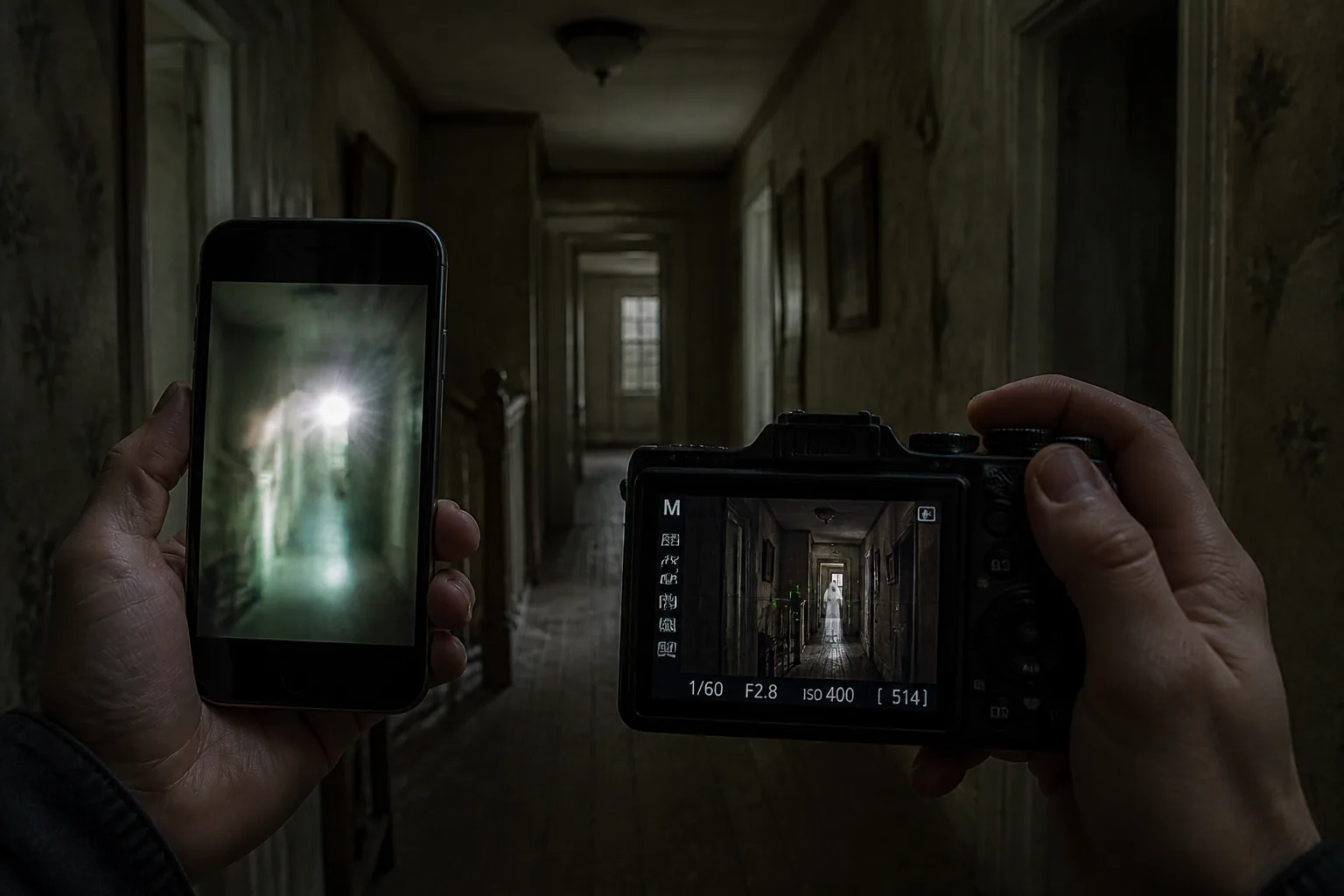
Spirit Photography Secrets: How Camera Settings and Composition Shape Paranormal Perception
Paranormal photos can feel shocking in the moment and unconvincing a few minutes later. That is exactly why spirit photography is so easy to misread. A dim hallway, a hurried flash, a shaky hand, or a bright light just outside the frame can turn an ordinary scene into something that looks deeply unsettling. At the same time, a genuinely unusual image can get dismissed because the camera settings made it look messy, noisy, or distorted. If you want better evidence, you need to understand how the camera itself shapes what people think they are seeing.
This guide breaks down the most common camera and phone factors that create eerie-looking photos in low light. We will look at sensor type, ISO, shutter speed, focus, lens choice, composition, and the usual false positives like flare, dust, reflections, and motion blur. The goal is not to talk you out of investigating. The goal is to help you capture cleaner images, spot fake-outs faster, and share stronger evidence online with more confidence.
Why Paranormal Photos Look Convincing or Completely Fake
A paranormal image often lands in one of two extremes. It looks so strange that people immediately call it proof, or it looks so messy that nobody trusts it at all. Both reactions make sense. Human vision is already good at finding patterns in shadows, so when a photo contains noise, blur, or bright artifacts, our brains often turn those random shapes into faces, figures, or floating lights. This is a classic example of pareidolia, which is why responsible image review matters so much in ghost hunting.
Low-light photography is especially tricky because the camera is working with very little information. To compensate, the device may boost ISO, slow the shutter, open the aperture, or sharpen in post-processing. Each of those choices can introduce visual effects that look supernatural even when the scene is completely ordinary. That is why a credible spirit photo is not just about what was captured. It is also about how it was captured.
Phone vs Camera: What Gear Works Best in Low-Light Investigations
A modern smartphone can absolutely be useful in paranormal investigations, especially if it lets you document scenes quickly and share results fast. Phones are convenient, always available, and often better than people expect in casual night shooting. They also make it easier to record short clips, compare moments, and post content from the field without waiting until later.
Dedicated cameras still have major advantages when you want more control. You usually get larger sensors, better manual settings, stronger lens options, and more predictable behavior in low light. That extra control matters because many ghostly-looking effects are created by the camera reacting to darkness, not by anything in the room. If you are trying to reduce false positives, a camera with manual exposure controls can be a big step up.
That said, phones are not automatically inferior. Newer devices use advanced computational photography to reduce noise, brighten shadows, and stabilize detail. The catch is that those same algorithms can also create smearing, sharpening halos, and strange texture cleanup that make evidence harder to interpret. If you use a phone, the key is consistency. Use the same device, the same app, and the same settings whenever possible so your results are easier to compare.
If you want a phone-based tool for investigation sessions, a natural pairing is Ghost Detector: Ectify, which turns your smartphone into a more immersive ghost hunting companion. You can learn more here: https://findthe.app/ectify-fc72z0
CCD vs CMOS Sensors: Does Sensor Type Change the Evidence?
Sensor type does influence how a camera behaves in the dark, though not always in the simple way people expect. Historically, CCD sensors were known for producing lower noise in dim conditions, while early CMOS sensors were often noisier. Research notes from MPB and Automate explain that modern CMOS sensors, especially back-illuminated or scientific CMOS designs, now often match or exceed CCDs in read noise and quantum efficiency. In other words, old assumptions about CCD always being better are no longer reliable.
For paranormal photography, the practical takeaway is this: the specific sensor implementation matters more than the label alone. A modern CMOS sensor in a good phone or camera can produce cleaner low-light images than an older CCD-based device. What you should watch for is how the sensor handles darkness, not the brand myth around it. Noise performance, dynamic range, and low-light sensitivity will influence whether a shadow stays believable or turns into a grainy blob that people mistake for a presence.
Sensor heating also matters. Long exposures can raise dark current, which creates random bright pixels and blotches. In simple terms, the longer the sensor stays active in darkness, the more likely it is to generate little specks or patches that look like unexplained activity. This becomes especially relevant during night investigations, when people take repeated long-exposure shots and then wonder why the images seem full of strange lights.
ISO, Shutter Speed, and Exposure: The Settings That Create or Kill Ghostly Effects
ISO is one of the biggest reasons paranormal photos look eerie. Raising ISO makes the sensor more sensitive to light, so the photo becomes brighter in dark conditions. The tradeoff is digital noise. As ViewBug and PetaPixel explain, higher ISO introduces visible grain, bright speckles, and colored noise that can be mistaken for mysterious energy or tiny floating entities. The image may look dramatic, but dramatic does not mean paranormal.
Shutter speed is the other major factor. A long shutter speed collects more light, which is useful at night, but any movement during the exposure causes blur, streaks, semi-transparent shapes, or ghost-like trails. That movement can come from the camera operator, a person walking through frame, a breeze moving foliage, or even handheld shake. Long exposures can look haunted because they are literally recording motion over time, not a frozen instant.
A good rule for investigators is to avoid pushing both ISO and shutter speed to extremes unless you have a reason. If the camera is set to high ISO and long exposure at the same time, you are building a photo that almost invites false positives. It may still capture something useful, but it will also amplify every small flaw in the scene. If possible, test several exposures rather than relying on one dramatic shot.
Focus and Depth: How Missed Focus Turns Normal Scenes into Apparitions
Out-of-focus images create a lot of paranormal confusion. When the camera fails to lock focus in low light, small particles near the lens, distant reflections, or moving subjects can turn into soft glowing discs or strange smudges. A large aperture makes depth of field shallower, so anything outside the focus plane becomes blurry faster, including dust or moisture in the air.
This is one reason orbs are so often overcalled. A particle close to the lens can be completely ordinary, but if the camera cannot focus well in the dark, it becomes a bright circular shape instead of a recognizable speck. That does not automatically mean every orb is fake, but it does mean the burden of proof is higher than many people think. Check the focus point before you decide the photo is evidence.
Manual focus or focus lock can help, especially in repeatable investigation setups. If your device keeps hunting in the dark, try focusing on a known object first, then reframe without changing distance too much. This reduces the chance that the camera will turn random particles into floating anomalies.
Lens Flare, Reflections, and Dust Orbs: The Most Common False Positives
Lens flare is one of the most convincing fake ghost effects in photography. It happens when a bright light enters the frame, or even just sits near the edge of it, and reflects between internal lens elements. The result can be polygonal shapes, circular spots, streaks, or a washed-out haze that looks almost intentional. In a dark hallway or abandoned building, that kind of artifact can easily be mistaken for a luminous spirit form.
Reflections are just as deceptive. Glass, polished surfaces, mirrors, framed pictures, phone screens, and even glossy paint can create secondary images that seem to appear in impossible places. Because paranormal investigators are often shooting in cluttered, poorly lit environments, reflections frequently sneak in unnoticed. If the image seems too perfect or too centered, check for a reflective surface before assuming it is something unusual.
Dust orbs are probably the most common false positive of all. Backscatter occurs when flash or strong light hits dust, pollen, moisture, or insects that are very close to the lens. Because those particles are out of focus, they show up as round or oval bright blobs. This is why a photo full of glowing circles can look supernatural while being completely mundane. A clean lens, no flash control shots, and a quick look at the air conditions can solve a lot of mysteries immediately.
Motion Blur and Rolling Shutter: When Movement Mimics the Paranormal
Motion blur can make a person, animal, curtain, or handheld camera movement look like a translucent figure. If the shutter remains open while something moves across the scene, the camera records a streak instead of a solid object. That streak can resemble a misty presence or a partial body shape, especially in black-and-white images or heavily compressed social posts.
Rolling shutter is another modern digital quirk. Many sensors do not capture the whole frame at once. Instead, they scan it line by line. If the camera or subject moves quickly, the result can be bent edges, warped shapes, or strange slanted distortions. Those distortions can be dramatic in short clips and still frames, and they are easy to misread when you are excited in the moment.
When reviewing evidence, ask a simple question: could something in motion explain the shape? If the answer is yes, slow down and re-shoot from a steadier position. Often the supernatural look disappears as soon as the motion stops.
Composition Tricks That Reduce Misleading Shapes and Shadows
Good composition is not just about making a photo look nice. In paranormal work, it helps reduce visual confusion. A cluttered frame filled with odd angles, shiny surfaces, broken furniture, and overlapping shadows gives your brain more chances to invent patterns. Cleaner framing makes it easier to identify what is actually in the scene.
Try to keep your horizon level and your subject centered only when needed. Avoid pointing at random bright lights, reflective windows, or mirrored surfaces unless they are part of your test. Leave some space around the area of interest so later viewers can tell whether a bright spot came from the room or from the edges of the lens. The more context you include, the easier it is to verify what happened.
It also helps to think like a skeptic while you shoot. If a shadow looks figure-like, change your angle. If a bright spot appears, step sideways and take another photo. If the effect disappears with a small change in perspective, it was probably a camera artifact or environmental reflection rather than a stable anomaly.
Artifact vs Anomaly: What a Typical Camera Error Looks Like
A useful habit is to separate artifacts from anomalies. An artifact is a known byproduct of the camera system or scene conditions, such as noise, flare, dust, blur, purple fringing, or reflection. An anomaly is something you cannot explain yet, even after checking those common causes. That distinction does not prove something paranormal, but it does help you avoid jumping too quickly to conclusions.
Typical camera errors often have patterns. Noise tends to cluster in shadows and dark areas. Lens flare often lines up with bright light sources. Orbs often stay near the lens and look soft-edged or uniformly round. Purple fringing often appears around high-contrast edges or bright points of light. If the effect matches one of these patterns, it deserves skepticism first.
True anomalies, if they exist in a given photo, should be less dependent on simple camera behavior. They should ideally appear across multiple frames, from different angles, with consistent exposure and solid documentation. Even then, caution is important. The more extraordinary the claim, the more evidence you need.
How to Capture Cleaner, More Credible Evidence with a Phone
If a phone is your main investigation tool, you can still improve results a lot with a few habits. First, clean the lens before every session. A smudge on a phone lens can create haze, flare, and strange soft circles that are easy to misread. Second, avoid leaning on fully automatic settings when you can control them. Auto modes may brighten shadows in ways that hide detail or exaggerate noise.
Third, keep flash use intentional. Flash can reveal detail, but it also creates backscatter and reflections. Take paired shots when possible, one with flash and one without, so you can compare what changes. Fourth, record short bursts or multiple frames from the same spot. If a shape appears only once, it may be a one-off artifact. If it appears repeatedly under the same conditions, it deserves a closer look.
Whenever the app allows it, save RAW files or the highest quality image format available. RAW files preserve more data and are less aggressively processed than JPEGs, which makes later review more reliable. This matters a lot if you are planning to share evidence publicly or compare it with others.
Quick Validation Steps Before You Post a Paranormal Photo
Before posting, do a fast but disciplined review. Start by checking the EXIF data for ISO, shutter speed, aperture, and focus information. These settings often explain most strange-looking images right away. Next, compare the suspect image with nearby frames. If the effect is only present once, think about motion, glare, or a momentary light source.
Then look for obvious environmental causes. Was there a flashlight, a car headlight, a reflective picture frame, a window, dust in the air, or moisture on the lens? If yes, test whether that explains the image. Finally, ask whether the photo still looks strange after you view it in a raw, unfiltered state. Heavy editing, social media compression, and contrast boosts can all make a harmless image look far more mysterious than it really was.
These checks do not kill the excitement. They make your evidence stronger. If an image survives skeptical review, it becomes much more interesting because you have already ruled out the easiest explanations.
A Simple Field Checklist for Better Spirit Photography
Use a repeatable checklist every time you investigate. Keep your lens clean. Stabilize your camera or phone. Take a control shot of the area without flash, then repeat with flash only if needed. Record your settings so you can review them later. Watch for reflective surfaces, moving lights, insects, dust, and moisture. Take multiple frames from the same position and from a second angle if something unusual appears.
Most importantly, slow down. A rushed photo is much more likely to produce artifacts than a careful one. The best paranormal images are not the ones that look the strangest at first glance. They are the ones that still make sense after you examine every ordinary explanation. If you train yourself to spot camera quirks in the field, you will waste less time chasing false ghosts and more time finding the images that actually deserve attention.
