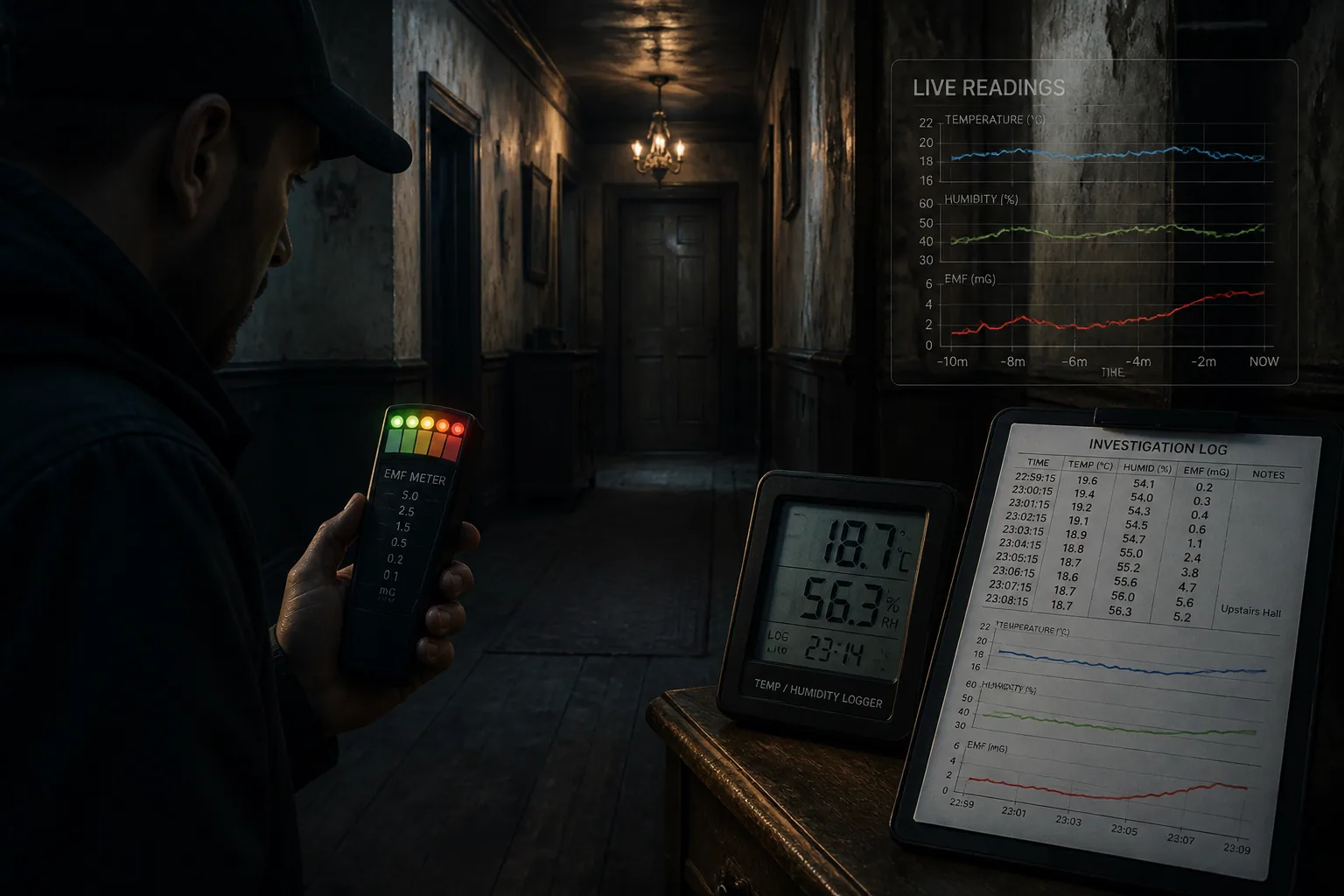
Temperature, Pressure & EMF: Interpreting Environmental Data During Your Ghost Hunts
A lot of beginner ghost hunting starts with collecting numbers. You bring a temperature meter, a pressure reading, a humidity monitor, and an EMF detector, then you hope the equipment will tell you when something unusual is happening. But the real skill is not just collecting data, it is interpreting it properly. Without context, a spike is just a spike. A cold reading is just a cold reading. A pressure drop is just a pressure drop.
If you want to move from guessing to analysis, you need to understand what normal looks like in the location you are investigating. That means building a baseline, comparing every reading to the room’s usual behavior, and checking whether several sensors are changing together or whether one device is simply picking up a mundane source. Research on haunt-type experiences also suggests caution here: a review in Frontiers found that common ambient variables such as lighting, air quality, temperature, infrasound, and electromagnetic fields show mostly null, inconsistent, or weak correlations with ghostly reports, which is another reason to treat environmental data as evidence to interpret carefully rather than as automatic proof of anything paranormal. https://pubmed.ncbi.nlm.nih.gov/32595577/
Why Environmental Data Matters in Modern Ghost Hunting
Environmental data matters because it helps you ask better questions. Instead of asking, “Did the meter spike?” you start asking, “What changed, when did it change, and what else was happening at the same time?” That shift alone makes your investigations much stronger. It reduces confirmation bias, helps you rule out obvious causes, and gives you a way to compare one night of activity with another.
It also keeps you honest. Ghost hunting environments are full of variables: heating systems cycling, aging wiring, open windows, moving people, weather fronts, and even your own gear. A room may feel strange, but if the temperature, humidity, and pressure are all changing because the building is breathing with the weather, then the experience may be environmental rather than anomalous. Good data lets you separate atmosphere from event.
The Difference Between Raw Readings and Useful Evidence
Raw readings are just numbers on a display. Useful evidence is a pattern with context. For example, seeing an EMF spike near a wall tells you very little on its own. Seeing the same EMF spike at the exact moment a breaker panel cycles, a phone receives a signal, or someone steps closer to the meter tells you a lot more.
The same is true for temperature. A two-degree drop sounds impressive until you learn that someone opened a window, an air vent kicked on, or the room naturally cooled with the nighttime air. A useful reading is not just a change, it is a change you can connect to a specific place, time, and possible cause.
This is why investigators should think in terms of correlations, not isolated hits. The strongest moments are usually the ones where temperature, pressure, humidity, EMF, audio, and investigator notes all point in the same direction. An isolated blip can be interesting, but a synchronized cluster is much more worth your attention.
How to Establish Baseline Readings for a Location
Before an investigation really begins, you need baseline readings. In practice, that means taking systematic measurements of temperature, humidity, pressure, and EMF throughout the location before you start reacting to anything unusual. The goal is to learn the location’s normal behavior under that exact set of conditions, not just to get a random snapshot.
A useful baseline sweep should be done room by room, with consistent equipment, fixed positions, and clear timestamps. Take readings near entrances, hallways, windows, electrical areas, and central points in each room. If possible, repeat the process at roughly the same time of night on different dates. That matters because a building can behave very differently at 8 p.m. than it does at 1 a.m.
It also helps to compare your indoor baseline with outside conditions. Guidance from Pacific Paranormal notes that nighttime temperature, humidity, and barometric shifts are often mistaken for cold spots, and recommends comparing indoor readings to hourly meteorological data, such as from the National Weather Service. https://www.pacificparanormal.com/index.php/menu-btn-team-resources/133-baseline-readings
A location normal is the typical range a space falls into when nothing unusual is happening. That range is often wider than beginners expect. In a long-term NIST study of an occupied house, indoor relative humidity ranged from about 20% to 70%, while temperatures ranged from about 21 °C to 27 °C under normal seasonal change. That means a reading that feels dramatic may still be part of ordinary building behavior. https://www.nist.gov/publications/continous-measurements-air-change-rates-occupied-house-one-year-effect-temperature-wind
Pressure is just as important. A house, hospital, hotel, or old school does not exist in a vacuum. Weather fronts, ventilation systems, leaks, open windows, and air exchange all change the pressure story inside a building. In the same NIST study, opening windows raised the air-change rate from an average of about 0.65 ACH to as high as 2 ACH for long periods, and up to 3 ACH for short intervals. Attic fans could add around 1 ACH. In other words, a simple airflow change can reshape the indoor environment very quickly. https://www.nist.gov/publications/continous-measurements-air-change-rates-occupied-house-one-year-effect-temperature-wind
EMF baselines are equally critical. Many indoor EMF spikes come from mundane sources such as bad wiring, breaker panels, appliances cycling on and off, dimmer switches, fluorescent ballasts, Wi-Fi routers, or mobile phones. Ghost hunting guides repeatedly point out that these are among the most common false-positive sources. The lesson is simple: if a location already has hotspots near wiring, outlets, or panels, you need to know that before you treat a spike as unusual. https://ghostlyactivities.com/ghost-hunting-with-electromagnetic-fields/
A good baseline is not one reading. It is a map.
Best Practices for Timestamping and Logging Every Change
If you do not timestamp your data carefully, you lose much of its value. The most useful investigations are the ones where every meaningful change is recorded with time, room, device, and observer notes. That way, when you review the session later, you can line up the readings against audio, video, movement, and environmental events.
Use consistent time settings across all your devices before the investigation starts. If your camera, audio recorder, EMF meter, and logging app are not synchronized, your analysis becomes messy very quickly. Even a small offset can make a real correlation look like a coincidence or make an ordinary event seem mysterious.
Your log should include the exact room, the sensor used, the reading, any visible or audible event, and any investigator action. For example: 11:24 p.m., east hallway, EMF rose from 1.2 to 4.8 mG, investigator moved toward the meter, HVAC fan started, no audio anomaly. That level of detail is what turns raw data into something you can actually review.
Tools, Apps and Spreadsheet Formats That Make Analysis Easier
A simple spreadsheet is often enough for most investigations, especially if you keep it structured. Create columns for timestamp, location, temperature, humidity, pressure, EMF, audio note, visual note, and investigator movement. Then sort the data later by room or by time. The point is not to make the sheet fancy, but to make it readable and searchable.
Some investigators prefer apps because they can be faster in the field, especially if the app supports session history, timestamps, and exportable logs. Tools like this are useful because they reduce the chance of forgetting to write something down in the moment. A session history feature is especially helpful when you want to compare a new investigation to what happened on previous nights.
If you want one example of a smartphone-based tool that supports session tracking and EMF-style activity logging, Ghost Detector: Ectify turns your device into a ghost hunting companion and keeps session history with timestamps. It can be useful as part of a broader logging workflow: https://findthe.app/ectify-fc72z0
How to Cross-Reference Multiple Sensors for Stronger Correlations
One reading can mislead you. Two or three readings together can reveal a pattern. That is why cross-referencing matters so much. If temperature drops, pressure shifts, humidity changes, and an EMF spike happens at nearly the same time, the event deserves much closer attention than a single sensor reading would on its own.
Cross-referencing also helps you see what kind of change you are really dealing with. A temperature drop with no pressure or humidity change may suggest a localized airflow source. A pressure change with a humidity shift may point to ventilation or a weather front. An EMF spike with no environmental change at all may suggest wiring, an appliance, or your own equipment. The more sensors you have, the easier it is to narrow down what is happening.
The key is not to chase every coincidence. It is to look for repeated overlaps in the same spot, at the same time, under similar conditions. One odd moment can happen anywhere. A repeatable pattern is where the investigation gets interesting.
What Counts as a Meaningful Change and What Does Not
A meaningful change is one that is large enough, fast enough, localized enough, and repeatable enough to matter. A tiny fluctuation that appears everywhere in the building is usually just environmental noise. A noticeable change that stays confined to one room, one hallway, or one patch near a source is more worthy of review.
Context matters a lot here. Indoor humidity can vary widely over a year, and temperature ranges can shift naturally with season and occupancy. So if you are investigating a historic house on a humid summer night, a modest rise or drop may be perfectly normal. The same reading could mean something very different in a tightly controlled space with sealed windows and stable HVAC behavior.
EMF is similar. A sudden meter jump is not automatically meaningful if it happens right beside a phone, router, extension cord, or dimmer switch. A change becomes more meaningful when you can show that the usual suspects were absent, the reading persisted, and other sensors or observations lined up with it.
Common False Positives: HVAC, Wiring, Weather and Human Activity
Some of the most common false positives in ghost hunting are extremely ordinary. HVAC cycles can create temperature swings, pressure movement, and airflow that feel eerie in an empty room. Old wiring can create EMF spikes near walls and ceilings. Appliances can turn on and off without anyone noticing. Weather fronts can shift pressure and humidity across a whole site. People moving through the space can create drafts, body heat changes, and EMF interference from carried devices.
Open windows deserve special attention. They can dramatically increase air exchange rates and change the whole feel of a room, especially in older buildings. If you get a cold spot near an open window or a pressure dip in a hallway that connects to outside air, that is a strong environmental explanation to test first.
Human activity also matters more than many investigators expect. A phone in a pocket, a radio on a belt, a flashlight battery, or simply standing too close to a meter can alter the reading. Paranormal Response Network notes that EMF meters often respond to investigator-carried devices and environmental RF sources, and that tri-axis or broadband meters can help distinguish ambient from directional or time-based spikes. https://www.paranormalresponsenetwork.org/research/environmental-intelligence/emf-rf-interference
How to Rule Out Ordinary Environmental Causes Step by Step
Ruling out mundane causes is one of the best habits you can develop. Start with the simplest explanation first. Check for open windows, vents, nearby appliances, panels, and wiring. Then look at weather data, HVAC schedules, room occupancy, and your own movement. If the anomaly still remains, move to the next layer of testing.
A good process might look like this: first, confirm the timestamp. Second, check whether any investigator was moving, speaking, or handling gear at that moment. Third, inspect the immediate area for sources like outlets, switches, or vents. Fourth, compare the reading to your baseline and to neighboring rooms. Fifth, compare it with outdoor conditions and building systems. This methodical approach helps you avoid jumping to conclusions.
The point is not to explain everything away. The point is to eliminate what can be explained so that the few remaining moments are genuinely worth deeper attention.
Mini Case Studies: Explainable Spikes vs Truly Odd Patterns
Case study one: a hallway EMF spike appears every time investigators walk past a particular wall. On review, the pattern lines up with an electrical box behind the drywall. The reading is real, but it is not paranormal. Because the team logged location and timing carefully, the source could be identified without debate.
Case study two: a room shows a brief temperature drop and a pressure shift, but only when a nearby window is cracked open during the investigation. Once the window is sealed, the readings stabilize. Again, the data was useful because it exposed the cause rather than creating a mystery.
Case study three: an unexplained event remains after review. In a closed room with no HVAC cycle, no open window, no visible wiring issue, and no investigator movement, the team records a small temperature dip, a slight pressure change, and a simultaneous audio anomaly at the same timestamp. That does not prove anything paranormal, but it does make the event worth retaining as unresolved rather than dismissing it as random noise.
This is where disciplined logging pays off. Many supposedly strange events become explainable once the data is reviewed carefully. The genuinely odd moments are the ones that survive that process.
A Smarter Review Process for Your Next Investigation
After the investigation, do not start by watching the scariest clip first. Start by reviewing your logs. Build a simple timeline of what happened in each room, then compare sensor spikes to audio, video, and investigator notes. Ask whether the same change happened elsewhere in the building. Ask whether the event matched a known building system or environmental condition. Ask whether it repeated under similar conditions on another night.
That review process is what turns ghost hunting from impression-based storytelling into a repeatable method. It will not remove the mystery from every session, and that is fine. In fact, the discipline often makes the remaining unknowns more interesting because you have already ruled out the obvious ones.
If you develop the habit of baseline sweeps, timestamped logging, multi-sensor comparison, and careful false-positive testing, you will become much more confident in what you keep and what you discard. And that confidence is one of the most useful tools a ghost hunter can have.
