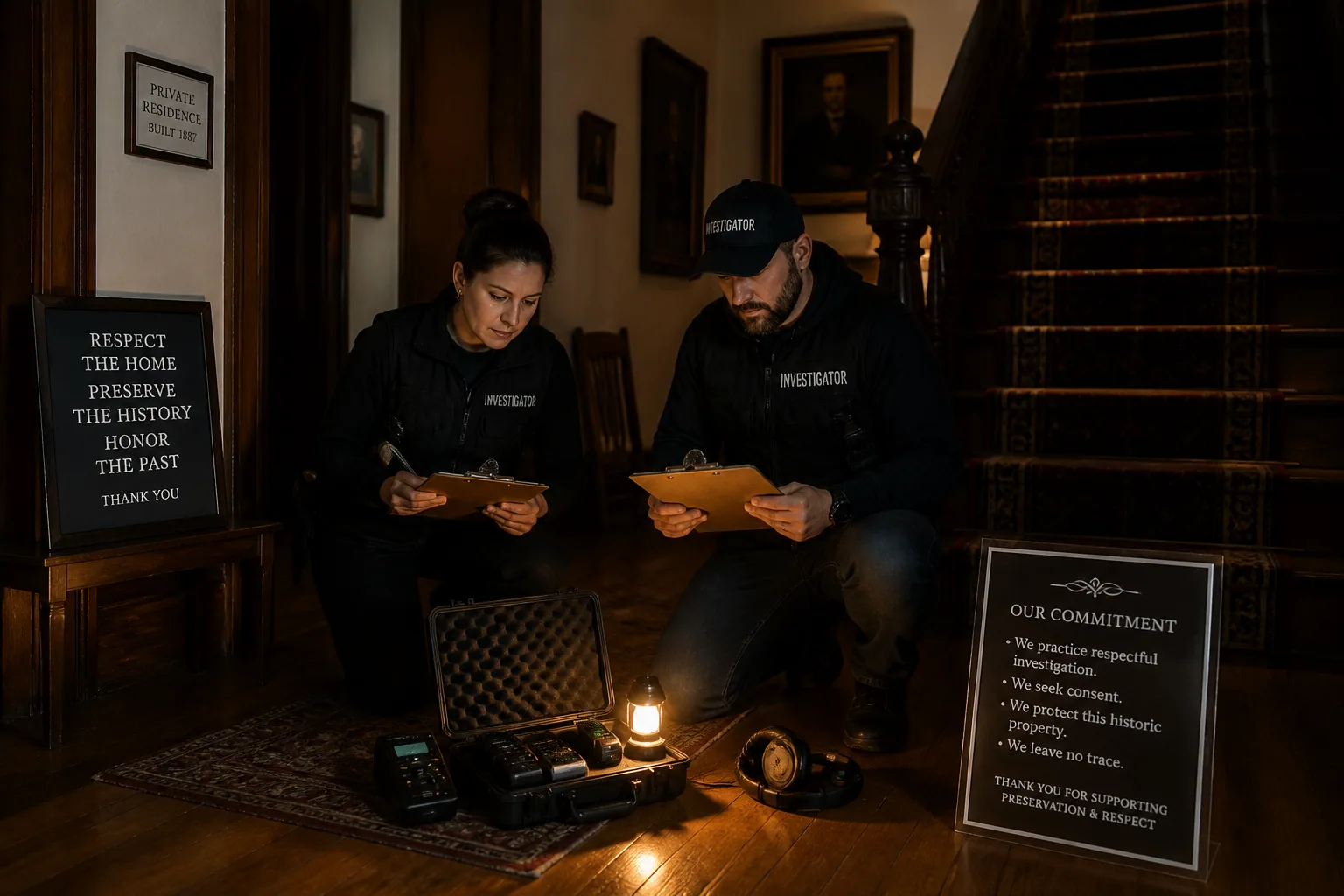
The Hidden Ethics of Paranormal Investigation: What Every Ghost Hunter Should Know
Paranormal investigation is often framed as a search for proof, a race to capture the best EVP, the strongest EMF spike, or the most dramatic footage. But for any investigator who wants to be taken seriously, ethics matter just as much as evidence. In fact, they may matter more. A responsible ghost hunt is not only about what you find, but how you behave while looking for it. That means protecting privacy, getting informed consent, avoiding harm, and resisting the urge to turn every unsettling moment into a sensational story.
For new and intermediate investigators, this is where the real work begins. You are not just entering locations and setting up equipment. You are interacting with people who may be frightened, grieving, vulnerable, or deeply convinced that something is wrong in their home. You may also be working in historic or culturally significant places that deserve care and restraint. And if you use tools like Ghost Detector: Ectify, the way you present your findings should be honest and proportionate, not exaggerated for attention. The goal is simple: make paranormal research more credible, respectful, and trustworthy.
Why Ethics Matter in Paranormal Investigation
Ethics are not an optional extra in ghost hunting. They shape the trust people place in your team, the safety of the people you interview, and the credibility of every claim you make. If you handle a case carelessly, you can increase fear, damage relationships, invade privacy, or even cause someone to misinterpret normal experiences as signs of danger. In a field already criticized for exaggeration, that kind of damage is hard to undo.
There is also a mental health dimension that investigators should not ignore. Research involving 4,402 UK adults found that paranormal belief alone was not necessarily harmful, but profiles combining high paranormal belief with elevated psychopathological traits, such as depression and schizotypy, were associated with significantly lower well-being: https://pmc.ncbi.nlm.nih.gov/articles/PMC9263512/ That does not mean belief is a problem. It means investigators should be thoughtful about how they speak, because a careless explanation can magnify distress rather than reduce it.
Other studies suggest that haunted environments can intensify anxiety in believers. In research conducted in a supposedly haunted abandoned village, participants who already believed in the paranormal showed increases in stress, suggestibility, and fatigue after the visit, with place-specific paranormal attributions accounting for a meaningful share of those stress changes: https://www.sciencedirect.com/science/article/pii/S0169204621001468 If an investigation can raise stress simply through expectations and framing, then ethics are not theoretical. They are part of the outcome.
The Most Common Ethical Mistakes Ghost Hunters Make
One of the biggest mistakes is confirming what the client already fears without first checking for ordinary explanations. Another is treating every nervous reaction, sleep problem, or unexplained noise as evidence of a haunting. A third is sharing names, addresses, photos, or recordings without clear permission. These errors may seem small in the moment, but they can create lasting harm.
There is also a common tendency to overperform certainty. Many teams feel pressure to sound dramatic, especially online, but saying that something is haunted when you do not know that it is can mislead the audience and the client at the same time. Ethical investigators should explore all plausible, non-paranormal explanations first, as emphasized by the Anomaly Response Network code of ethics: https://anomalyresponse.com/Ethics-Code That approach is not dismissive. It is disciplined.
Another recurring error is ignoring the emotional context of the case. Some clients are curious. Others are frightened. Some may be dealing with trauma, grief, sleep disruption, or longstanding anxiety. A good investigator notices the difference and adjusts accordingly. The goal is never to win the conversation. The goal is to help without causing more distress.
Working With Vulnerable Clients Without Causing Harm
When someone contacts a paranormal team, they are not always just asking for an investigation. They may be asking for reassurance, validation, or a sense of control. That is why investigators should avoid turning vulnerable clients into content, and avoid speaking to them as if every concern is proof of a supernatural event. A calm, respectful approach can be more helpful than any dramatic reveal.
Researchers have also noted that intense fears of ghosts or haunted homes can be a distinct anxiety problem for some people, with severe disruption to sleep and social functioning. A Frontiers in Psychiatry article described what it calls a phobia of the supernatural, including cases that had been present since childhood: https://www.frontiersin.org/journals/psychiatry/articles/10.3389/fpsyt.2018.00590/full This is another reason to avoid mocking a client or pushing them toward a frightening narrative. Fear is not entertainment when it is happening to a real person.
It is also worth remembering that some beliefs and fears are connected to earlier experiences of diminished control, including trauma. Research has linked diminished control in childhood with higher paranormal belief later in life: https://www.sciencedirect.com/science/article/pii/S0191886906002868 That does not mean every client has trauma, but it does mean some discussions require care. You do not need to diagnose anyone. You do need to listen without pressure, and refer people to appropriate professional support when concerns go beyond a paranormal investigation.
Informed Consent, Privacy, and Recording Rules
Informed consent should happen before any investigation begins. People need to understand what you will do, what kinds of tools you may use, what you will record, and what risks or discomforts may arise. The Canadian PPRI Ethical and Professional Standards state that participants should be informed about the nature of the investigation, the risks, and the claims of hauntings before signing any consent or release forms: https://www.ppri.net/about/about-us/learn-more/ That is a practical baseline, not a formality.
Privacy matters just as much. Clients and witnesses may share personal details, family tension, health concerns, or experiences they do not want broadcast publicly. Ghost PRO’s Code of Ethics explicitly emphasizes strict respect for client privacy and confidentiality: https://www.ghostpro.org/equipment_procedures/GP Code of Ethics n Conduct.pdf If you are recording audio, video, or interviews, make sure people know exactly what will be saved, who will have access, and whether anything may be posted later.
This is where a simple rule helps: if you would be uncomfortable seeing the recording shared without your permission, do not share someone else’s. That applies to faces, voices, home layouts, family objects, addresses, and even small details that can identify a place. Ethical investigations are built on trust, and trust disappears quickly when recordings are treated like social media props.
Legal Duties vs Moral Responsibilities on Private and Historic Property
It is easy to confuse legal access with moral permission. But just because a place is accessible does not mean you are ethically entitled to investigate it. On private property, the rule is straightforward: ask permission first. The Anomaly Response Network recommends seeking property owner permission, ideally in writing, before entering or investigating private premises: https://anomalyresponse.com/Ethics-Code If you cannot explain why your presence is allowed, you should not be there.
Historic and public sites create another layer of responsibility. You may be legally allowed to visit a location, but still have a duty to avoid disruption, trespass into restricted areas, or disturb staff, visitors, or preservation efforts. A responsible investigator understands that preserving a site is more important than chasing an exciting moment. Access is a privilege, not a trophy.
The same principle applies to safety. If a location is unstable, poorly lit, contaminated, or restricted for public protection, an investigation should not turn into an excuse to ignore hazards. Ethical investigators respect barriers, follow site rules, and leave no trace behind. A good case is one that leaves the property and the people involved unharmed.
Protecting the Dignity of Historical and Cultural Locations
Some places are more than allegedly haunted. They are part of a community’s memory, heritage, or identity. That means investigators should treat them with dignity, not as backdrops for a dramatic reveal. Many ethical codes include respect for culturally significant and historic sites, along with care for the physical location and avoidance of damage or disturbance. Ghost PRO’s code reflects that kind of responsibility: https://www.ghostpro.org/equipment_procedures/GP Code of Ethics n Conduct.pdf
This matters because the way a team behaves on site affects public perception. Loud behavior, disrespectful jokes, careless touching of artifacts, or staged reactions can make the entire field look unserious. More importantly, those actions can violate the trust of communities that value the site for reasons far beyond ghost stories. A respectful investigator asks what the place means to other people before deciding how to behave in it.
Bias, Belief, and Mental Health in Haunting Reports
Every investigator brings bias into the room. Belief in the paranormal can shape interpretation, memory, and attention. So can fear, fatigue, expectation, and group pressure. Ethical ghost hunting requires a willingness to question your own assumptions before you question a client’s experience. That does not mean rejecting belief. It means refusing to let belief replace judgment.
This is especially important when a witness is anxious or highly suggestible. In haunted settings, context itself can change how people feel and what they think they notice. The study on the abandoned village showed that believers experienced greater stress and suggestibility after the visit, reinforcing how environment and expectation interact: https://www.sciencedirect.com/science/article/pii/S0169204621001468 If the setting can influence perception so strongly, investigators should avoid feeding a narrative that every sound or sensation confirms the worst fear.
A respectful investigator also avoids acting like a mental health professional unless they are one. If a person describes panic, sleep loss, intrusive fear, or long-term distress, the best response may be to slow down, document carefully, and encourage support from appropriate licensed professionals when necessary. Paranormal teams are not there to diagnose. They are there to observe responsibly.
How to Interview Witnesses Respectfully and Responsibly
Good interviewing is one of the most underrated skills in paranormal work. Start by letting the witness tell their story in their own words, without interruption or correction. Ask open-ended questions. Avoid leading phrases like, “Did you feel a dark presence?” or “Was the room freezing right before it moved?” Those questions may produce dramatic answers, but they do not produce reliable ones.
Instead, ask what happened, when it happened, who was present, what was observed directly, and what else was going on at the time. Separate interpretation from observation. If someone says, “It felt evil,” note that as a feeling, not as proof of an evil force. Ethical interviews preserve the person’s experience while keeping the investigation grounded in what can actually be verified.
You should also be mindful of tone. A witness who feels judged may shut down, while a witness who feels encouraged may exaggerate. The best approach sits in the middle: calm, patient, and neutral. The more respectfully you listen, the more accurate the information you are likely to receive.
Using Apps, Sensors, EVPs, and Video Without Misleading People
Tools are helpful, but tools do not speak for themselves. EMF readings, audio captures, motion sensors, and video clips all require context. If you use Ghost Detector: Ectify, for example, you can turn your smartphone into a real-time investigation tool, record sessions, and review your history later using the app’s built-in features: https://findthe.app/ectify-fc72z0. That can be useful for documentation, but it should never replace critical thinking.
Ethical use means describing what the device actually measures, what the limits are, and what else could explain the reading. A spike is a spike. A noise is a noise. A response-like pattern is not necessarily a message from beyond. If you present a result, make sure the audience understands whether it is raw data, a possible anomaly, or a subjective interpretation.
This matters even more with recordings and EVPs. Editing, selective clipping, dramatic captions, and overconfident narration can easily turn ordinary noise into a false certainty. If you want your work to be respected, show the whole context whenever possible, and do not imply more than the evidence supports. Honesty is not less exciting. It is just more credible.
Avoiding Sensational Claims, Fear-Based Content, and Clickbait Evidence
Sensationalism is tempting because fear gets attention. A thumbnail with a shadowy figure, a clipped scream, or a claim that a location is the most haunted place on earth can bring views faster than a careful explanation ever will. But the long-term cost is credibility. If you repeatedly exaggerate, your audience will learn not to trust your strongest claims.
Paranormal Hunters’ Code emphasizes honesty and integrity, urging investigators to present findings truthfully without sensationalism or misrepresenting observations: https://www.paranormalhunters.org/code-of-conduct That principle should shape titles, voiceovers, social posts, and team discussions alike. If you are unsure whether something is strong evidence, say so. If a clip is ambiguous, call it ambiguous.
Fear-based content can also backfire on the people involved. A client who is already uneasy may become more distressed after seeing their home described in alarming terms. A visitor may leave with stronger anxiety than they had before. Ethical storytelling should inform and engage without manufacturing panic.
How to Create an Ethical Code for Your Paranormal Team
Every team should write its own code of ethics. Keep it short enough that people will actually use it, but specific enough that it guides real decisions. Start with the essentials: obtain permission, get informed consent, protect privacy, respect property, avoid damage, document honestly, and acknowledge uncertainty. Add rules for social media, client confidentiality, and evidence review.
Then decide how your team will handle difficult situations. What happens if a client becomes distressed? Who has authority to stop a session? How will you handle minors, private homes, or requests not to publish details? What standards will you use before sharing a clip online? If those answers are written down ahead of time, your team is far less likely to make a bad decision in the moment.
A useful code of ethics is not just a public statement. It is an internal habit. Revisit it after every investigation. Update it when a problem occurs. The best ethical teams do not assume they are already responsible. They build responsibility into the way they work.
A Practical Ethics Checklist for Every Investigation
Before each case, ask a few simple questions. Do we have permission to be here? Has everyone involved given informed consent? Do we know what we are recording, storing, and possibly sharing? Are we protecting names, addresses, and personal details? Have we considered normal explanations before paranormal ones? Are we avoiding behavior that could increase fear or distress?
You should also ask whether the location needs special care. Is it historic, culturally sensitive, or physically fragile? Are there safety hazards or restricted zones? Are we prepared to leave the site as we found it? And finally, are we being honest about what our evidence does and does not show? If the answer to any of those questions is no, the investigation is not ready.
Ethics do not weaken paranormal research. They strengthen it. They make teams safer, findings more defensible, and clients more likely to trust you. And they help ensure that the stories people tell about your work are not just about what you found, but how respectfully you searched.
