The Hidden World of Paranormal Frequency: How Ultrasound, Infrasound & RF Create Ghostly False Positives
A lot of paranormal investigations focus on what can be seen, heard, or captured on a device. But some of the most convincing ghostly moments start with something much less obvious: hidden frequencies. Ultrasound, infrasound, and radio frequency signals can all slip under the threshold of normal perception while still affecting people, cameras, phones, recorders, spirit boxes, and EMF-style tools. That means a strange spike, a voice-like artifact, or a sudden feeling of unease may have a natural cause that is easy to miss if you are not testing for it.
This matters because the modern haunted location is rarely silent. It is usually full of HVAC fans, wiring, routers, cell signals, appliances, pipes, lighting, and structural vibrations. When those signals interact with human perception and consumer electronics, they can create exactly the sort of evidence investigators tend to label paranormal too quickly. Better frequency awareness does not ruin the mystery. It simply helps you separate the noise from the genuinely unusual.
Why Hidden Frequencies Matter in Paranormal Investigations
Paranormal tools often respond to the environment in ways investigators do not fully control. A phone microphone may capture a distorted hum. A spirit box may jump across live radio. An EMF app may react to magnetic fields from wiring or electronics. A person in the room may feel watched, unsettled, or nauseous because of an inaudible low-frequency source rather than anything supernatural. Once you understand that, many classic “hits” become less mysterious and more complicated in a useful way.
Research on infrasound is especially relevant here. The Psi Encyclopedia explains that infrasound sits below about 20 Hz, which is generally below human hearing, yet it can still be sensed through body resonance and vibration. It has also been associated with nausea, unease, and visual illusion. A 2026 study summarized by The Guardian reported that inaudible infrasound from old pipes and ventilation systems raised cortisol, increased irritability, and dampened mood in volunteers, even when they could not reliably tell when the sound was present. That is exactly the kind of effect that can make a location feel haunted before any device even comes into play. Source: https://psi-encyclopedia.spr.ac.uk/articles/infrasound/ and https://www.theguardian.com/science/2026/apr/27/spooky-feelings-in-old-houses-may-be-caused-by-boiler-sounds-study-suggests
Ultrasound Explained: Sounds Above Human Hearing
Ultrasound refers to sound frequencies above roughly 20 kHz, beyond the upper limit of normal human hearing. Britannica notes that ultrasound spans the range above that threshold, and many devices and systems use it intentionally. Dog whistles, pest repellents, and ultrasonic cleaners can produce frequencies in the 20 to 100 kHz range. Some animals can hear these signals well, even when humans cannot. Britannica: https://www.britannica.com/science/ultrasonics
The tricky part for paranormal work is that not hearing something does not mean it is not there. Some people, especially younger listeners, may notice more of the high end of the spectrum than others, while age can reduce sensitivity to upper frequencies. In practical terms, two investigators standing in the same hallway may have very different awareness of the same ultrasonic source. That can create disagreement about whether a room feels normal or charged, even though the difference is just physiology and equipment exposure.
Ultrasound can also be indirectly relevant because some high-intensity exposures have been associated with headaches, tinnitus, nausea, and fatigue, especially near industrial equipment. So if a location has ultrasonic machinery, pest control devices, or specialized cleaners nearby, the atmosphere may feel off in ways that are easy to mistake for paranormal activity.
Infrasound Explained: The Low-Frequency Effects You May Feel but Not Hear
If ultrasound hides above hearing, infrasound hides below it. Frequencies under about 20 Hz are generally not perceived as ordinary sound, but they can still be felt as pressure, vibration, or body discomfort. That is why a building with a rumbling boiler, a large ventilation fan, a pipe resonance, or a distant industrial source can produce a disturbing sensation without any obvious audible noise.
The classic case in this area is Vic Tandy. In the 1980s, he experienced cold spots and apparitions in a lab, only to later trace the issue to a newly installed extractor fan that emitted infrasound near 19 Hz, close to the resonant frequency of the human eye. The result was visual illusion, not haunting. This story remains one of the best reminders that “seeing something” during an investigation can still have a physical explanation. References: https://en.wikipedia.org/wiki/Vic_Tandy and https://en.wikipedia.org/wiki/Infrasound
More recent reporting has echoed the same theme. A TechRadar piece in 2026 described data center hums, including low- and high-frequency components, as causing dizziness, nausea, vertigo, and sleep disruption among nearby residents. Whether in a mansion, hospital, office, or basement, the lesson is consistent: low-frequency energy can shape human experience in strong ways even when it is not loud, dramatic, or immediately obvious. Source: https://www.techradar.com/pro/dizziness-nausea-vertigo-and-sleep-disruption-the-undetectable-hum-of-ai-data-centers-is-making-local-residents-sick
What Phones, Apps, and Recorders Can Actually Detect
A major source of confusion in paranormal work is assuming that a device has “heard” something supernatural when it has really just reacted to an environmental signal. Phones and recorders are not neutral observers. Their microphones, gain circuits, software filters, and internal electronics shape what they capture. A low hum can become a clipped distortion. A faint radio bleed can sound like a whispered syllable. A sudden change in background noise can be compressed into a sharp, suspicious artifact.
That is why apps and handheld tools can be useful, but only if you understand their limits. A smartphone magnetometer may detect local magnetic fluctuation, but it is not a universal ghost detector. Microphones may capture audio, but they do not tell you whether a sound is caused by air movement, radio bleed, mechanical resonance, or a claimed paranormal source. Recorders can preserve evidence, yet they can also preserve interference with equal fidelity.
This is where products like Ghost Detector: Ectify can fit into the process in a careful way. If you want to explore sessions with real-time EMF-style readings, spirit box activity, and recorded history in one place, you can use it as a structured capture tool while still treating every spike as a question rather than a conclusion: https://findthe.app/ectify-fc72z0
Why Device Limitations Create Confusion and False Confidence
Many false positives come from overtrusting the display. A number jumps, a waveform changes, or a word appears in a spirit box feed, and the investigator immediately interprets it as meaningful. But consumer devices often amplify uncertainty rather than reduce it. The more a tool is designed for quick excitement, the easier it is to mistake correlation for evidence.
ASSAP has discussed how electrical interference, magnetic fields, and recorder artifacts can shape paranormal sound recordings. Similarly, Paraghosts notes that high electromagnetic fields can interfere with recorder circuitry and create hums, clicks, or voice-like distortions. In other words, the device itself may contribute to the anomaly. Sources: https://www.assap.ac.uk/articles/detail/analysing-evp-and-paranormal-sound-recordings and https://www.paraghosts.com/how-electromagnetic-fields-influence-evp-recordings-in-paranormal-investigations/
That does not mean recordings are worthless. It means evidence has to survive more than one explanation. If a voice appears only when a Wi-Fi router is active, or only near a power cable, or only when a spirit box is sweeping a live radio band, you are looking at a system response, not necessarily a message from beyond.
RF Interference 101: Wi-Fi, LTE, GSM, Bluetooth, and Broadcast Signals
Radio frequency, or RF, is everywhere. Wi-Fi, LTE, GSM, Bluetooth, broadcast radio, and many smart devices all use parts of the RF spectrum. These signals are not usually heard as sound by people, but they can absolutely affect electronics and audio workflows. In a paranormal setting, that means phones, scanners, recorders, spirit boxes, and even some EMF-style tools may react to RF contamination without anyone realizing it.
Spirit boxes are especially important here. As Haunted Hosts explains, these devices rapidly scan AM and FM bands, often every 10 to 50 milliseconds per frequency step, which means they are literally pulling fragmented audio from live broadcasts. Words that seem responsive may actually be random pieces of radio programming, shaped by confirmation bias or pareidolia. Source: https://hauntedhosts.com/library/explainers/what-is-a-spirit-box-and-how-does-it-work/
That is why a spirit box response can feel uncanny while still being entirely explainable. If a location sits near a cell tower, a router, a smart hub, or a strong broadcast antenna, the RF environment may be rich enough to create unpredictable artifacts. A seemingly perfect answer can appear because the device is sweeping through a noisy field, not because a ghost is choosing vocabulary.
How HVAC, Plumbing, Appliances, Wildlife, and Buildings Generate Strange Readings
Many haunted places have one thing in common: they are old, busy, or mechanically complex. HVAC systems create low-frequency hums and airflow noise. Pipes and boilers can produce infrasound-like vibrations. Refrigerators, microwaves, LED drivers, and electrical wiring all add their own electromagnetic and acoustic signatures. Even the structure itself can resonate when temperature, airflow, and load change throughout the day.
Ars Technica has highlighted how infrasound can be a key factor in alleged hauntings, pointing toward rumbling pipes rather than spirits. Ghostly Activities also notes common RF and EMF sources such as wiring, routers, smart home devices, and nearby towers. Source: https://arstechnica.com/science/2026/04/that-spooky-sensation-likely-due-to-rumbling-pipes-not-spirits/ and https://ghostlyactivities.com/ghost-hunting-with-electromagnetic-fields/
Wildlife can contribute too. Birds, rodents, bats, and insects may create intermittent sounds or movement that gets misread in a tense environment. Add a hollow staircase, metal ducts, old glass, or loose panels, and a small vibration can turn into a dramatic noise trail. In many cases, the “haunting” is really an interaction between a sensitive building and an over-alert human nervous system.
When RF Mimics EMF Spikes, Spirit Box Responses, and Audio Anomalies
RF contamination can look like a dramatic EMF spike on a phone app or handheld sensor, especially when the device is not well shielded. It can also leak into audio as whining, ticking, buzzing, or digital chatter. In spirit box sessions, it may seem like an intelligent response because fragments of speech are present. In reality, the device may simply be passing through real radio content in a disjointed way.
This is why investigators should be cautious when a session gets more active near modern electronics. A nearby router may cause a spike. A cell phone in a pocket may generate noise. Bluetooth gear, wireless mics, and smart lighting can all add contamination. If the evidence disappears when the electronics are powered down or moved away, the case for a paranormal source gets weaker quickly.
The important takeaway is not that RF always ruins investigations. It is that RF can create the illusion of structure where there is only interference. The mind is excellent at building meaning from fragments, and paranormal work is especially vulnerable to that effect.
Famous and Real-World Cases of Hidden Frequencies Mistaken for Hauntings
The Vic Tandy case is the most famous example because it is so clean: a frightening experience, a physical investigation, and a mechanical cause that explained the haunting. But it is far from the only pattern. Across many locations, investigators eventually find that pipes, fans, old ventilation, or electrical issues were driving the atmosphere the whole time.
The broader scientific and media coverage around infrasound has been useful because it shows how ordinary infrastructure can produce deeply unsettling effects. The Guardian summary of the 2026 Frontiers study, for example, emphasized that people may feel worse in the presence of inaudible low-frequency sound without identifying it as sound at all. That makes these sources especially dangerous for paranormal interpretation, because the emotional response is real even when the cause is mundane.
This is exactly why “we all felt something” is not enough on its own. Shared discomfort can come from the building, not the entity. Shared excitement can come from a noisy device. Shared surprise can come from a radio sweep. Real-world cases repeatedly show that once the hidden frequency source is found, the haunting evaporates, but the evidence of poor environmental control remains.
How Investigators Proved the Cause: Testing Methods That Changed the Story
Good investigations do not just record anomalies. They test them. When you suspect hidden frequencies, the goal is to identify whether the effect is tied to location, device position, time of day, power state, or a specific piece of equipment. Start by mapping the room. Note where HVAC vents, pipes, outlets, routers, appliances, and metal structures are located. Then repeat the same recording setup under controlled conditions.
A simple method is to run baseline sessions with all nonessential electronics off, then repeat with them on one by one. Compare audio, EMF readings, and subjective reports. If a spike appears only near a router, or only when a fan turns on, that is a strong clue. If an anomaly disappears when the recorder is moved a few feet, you may be dealing with local interference or resonance rather than a persistent phenomenon.
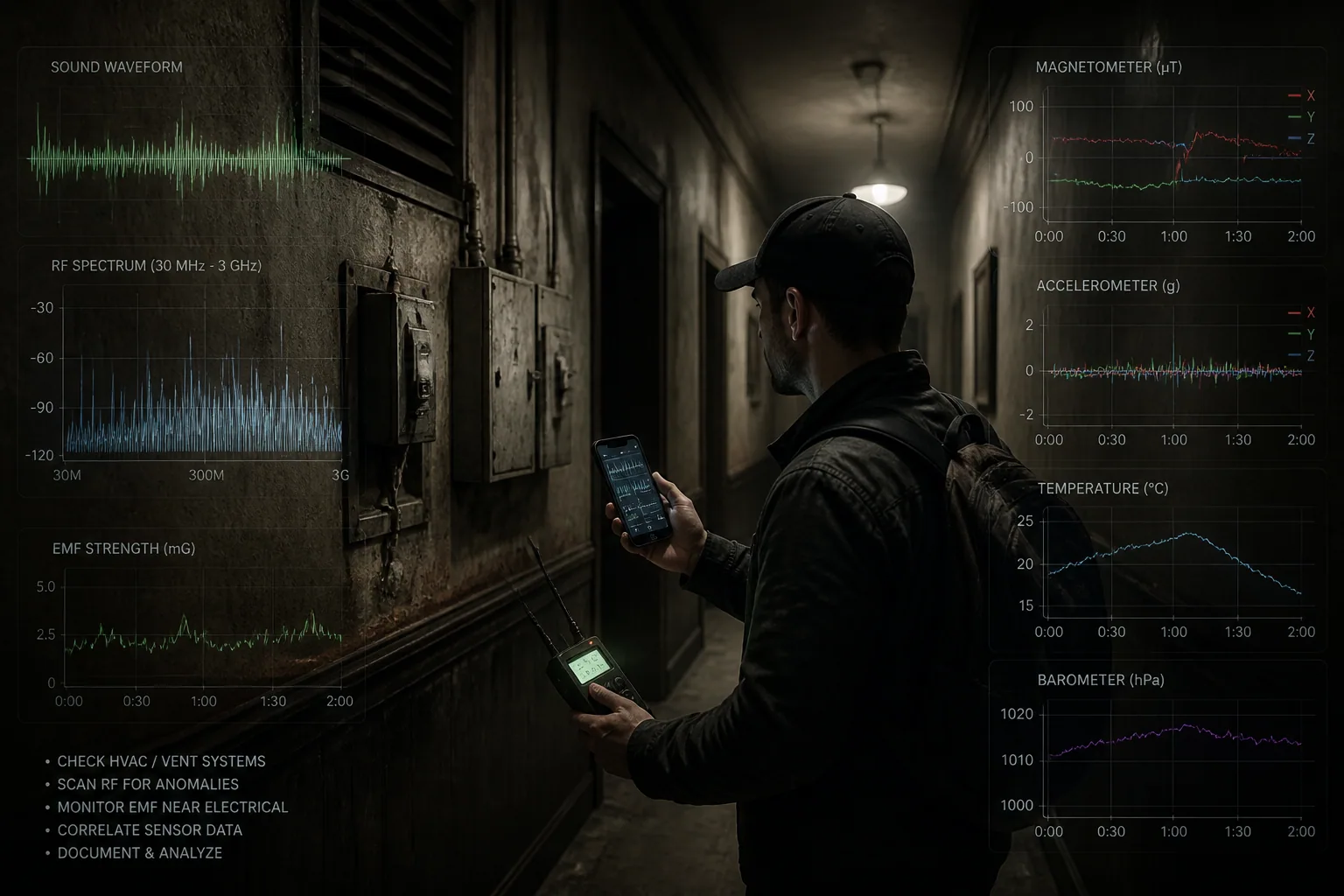
For especially stubborn cases, investigators can add external tools such as a separate audio recorder, a spectrum analysis app, a basic RF meter, and a thermometer or pressure monitor. The key is triangulation. If only one tool sees the event, be careful. If multiple independent tools detect the same pattern under the same conditions, you have something far more interesting.
Using Ectify More Carefully: How to Read Spikes, Glitches, and Voice-Like Artifacts
If you use Ectify during sessions, the best approach is to treat the app as a session log rather than an oracle. Real-time EMF readings, spirit box responses, and recorded audio can all be valuable, but each one needs context. Ask what else was happening at the moment of the spike. Was a phone nearby? Was Wi-Fi enabled? Did someone step beside a wall conduit or a ventilation grille? Did the room temperature change? Was the speaker volume altered? Those details matter more than the spike itself.
Voice-like artifacts should be reviewed slowly and repeatedly, ideally with the location notes beside them. If a phrase only appears during RF-heavy sections, it may be a radio fragment. If the same word pattern appears in different places whenever the device sweeps through live bands, that is a pattern worth understanding before interpreting. Session history is useful here because it lets you compare nights, rooms, and device states instead of relying on memory.
The biggest mistake is turning every anomaly into a narrative. Better practice is to label it first: ambient noise, device artifact, RF bleed, EMF fluctuation, movement, or unknown. Only after that should you decide whether it remains interesting. That discipline preserves the truly strange data and reduces self-deception.
Best Practices for Reducing False Positives in the Field
A cleaner investigation begins before the session starts. Turn off unnecessary electronics. Put phones in airplane mode when possible. Keep wireless accessories to a minimum. Avoid standing directly beside routers, power strips, large appliances, or metal ducting when taking readings. If the building allows it, test at different times of day so you can compare HVAC load and occupancy patterns.
Also pay attention to human factors. Fatigue, expectation, fear, and excitement all change what people think they hear or feel. In a tense environment, pareidolia becomes much more likely. A faint slice of radio speech can become a named voice. A pressure shift can become a cold spot. A momentary hum can become a presence. Good fieldwork assumes that perception is fallible and records accordingly.
Keep notes on weather, nearby traffic, machinery cycles, elevator use, plumbing activity, and local broadcasts if relevant. If you can reproduce a sound or spike by recreating the conditions, you are already much closer to understanding the site. That is not less exciting. It is better evidence.
Recommended Settings, Sensors, and Add-On Gear for Better Signal Isolation
If you want cleaner data, use the simplest gear that solves the problem. A separate audio recorder with known gain settings can be more reliable than a multitool app trying to do everything at once. A basic RF detector can help identify wireless contamination, while a thermometer, barometer, or vibration monitor can reveal environmental changes that line up with anomalies.
When using smartphone-based tools, keep the device as isolated as possible from active communication channels. Disable nonessential radios if your session design allows it. Use a consistent mounting position instead of hand-holding the phone when possible, because motion can create its own noise and magnetic fluctuation. If you are comparing sessions, keep the same settings so that one night’s evidence is actually comparable to the next.
The best gear is the gear you can interpret confidently. A cleaner, slower, more controlled recording setup is usually more valuable than a flashy one. That is especially true when hidden frequencies are part of the story.
A Skeptic’s Checklist: How to Tell Environmental Noise from Something Truly Unusual
Before you call something paranormal, ask a few blunt questions. Was there an obvious mechanical source nearby? Could the sound have come from HVAC, plumbing, or appliances? Was the device near a router, phone, or wireless accessory? Did the same effect repeat when the environment changed? Did multiple tools detect the same thing independently, or only one? Was the “response” visible in the raw data, or only after interpretation?
If the answer to any of those questions is uncertain, slow down. Try to reproduce the event. Change one variable at a time. Move the recorder. Power down electronics. Take a baseline in another room. Use a separate sensor. The more disciplined the process, the less likely you are to mistake a frequency artifact for a paranormal event.
That skepticism is not a debunking posture. It is a quality-control method. Paranormal evidence is strongest when it survives ordinary explanations, not when it depends on ignoring them.
Final Takeaway: Better Frequency Awareness Makes Better Paranormal Evidence
The hidden world of paranormal frequency is not just a theory about technical interference. It is a practical reminder that the environment is always speaking, even when we cannot hear it directly. Ultrasound can sit above hearing, infrasound can sit below it, and RF can pass through the room as invisible contamination that changes what devices and people experience. Together, they can make a location feel intensely haunted while remaining entirely natural.
That does not mean every anomaly has a mundane answer. It means the best investigations are the ones that understand the environment well enough to rule out the easy mistakes. When you test carefully, record consistently, and treat every spike as something to explain rather than celebrate, you end up with stronger evidence and fewer illusions. In paranormal work, that is a real advantage.
