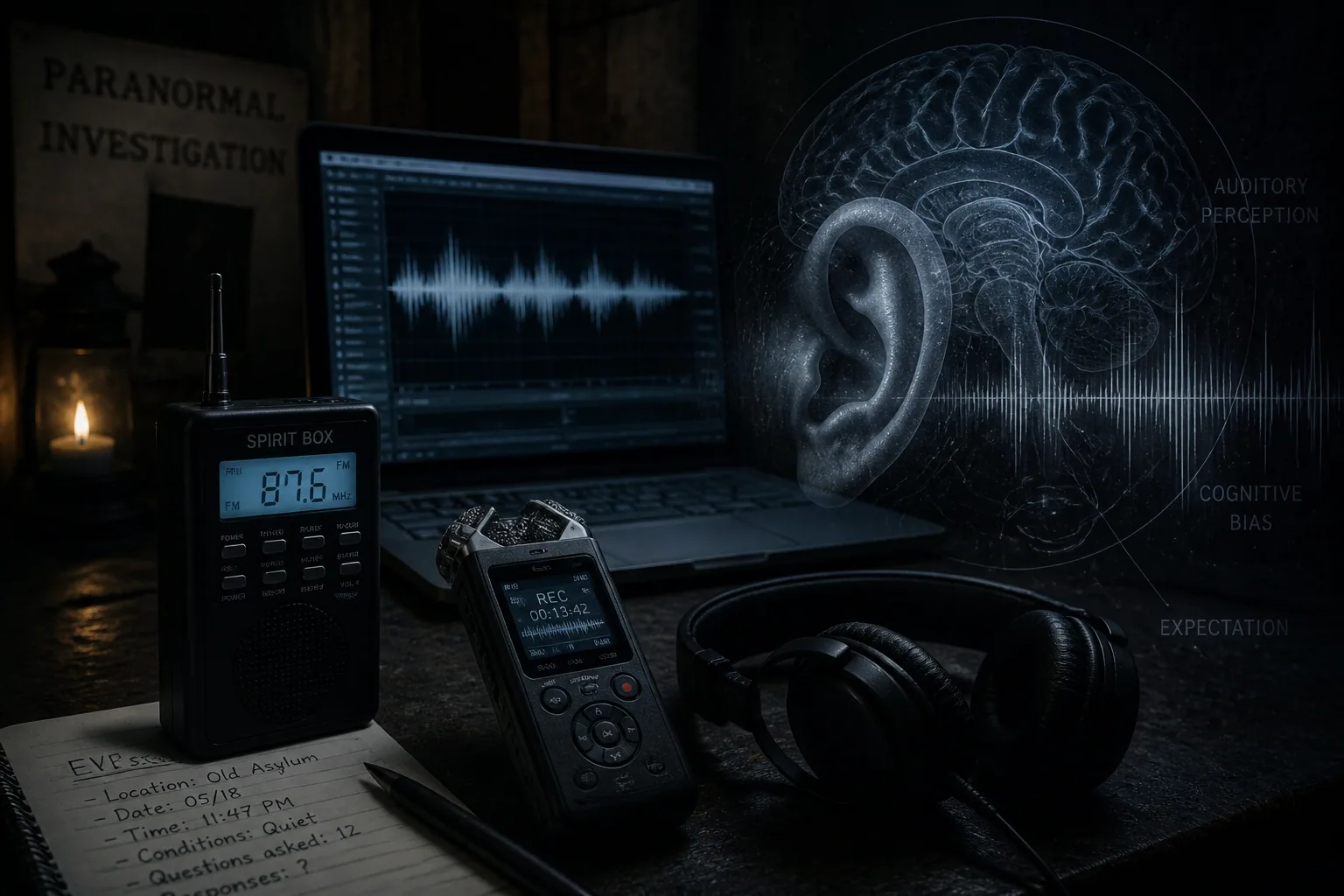
The Illusion of Voice: How Auditory Bias Shapes Spirit Box and EVP Results
Spirit box sessions and EVP recordings can be genuinely unsettling. A burst of static, a half-buried syllable, or a phrase that seems to answer your question can feel like powerful evidence in the moment. But a lot of what makes these moments convincing is not necessarily paranormal at all. It is the way the human brain works: it searches for patterns, fills gaps, and often leans toward meaning even when the signal is messy or incomplete.
That does not mean investigators are foolish for hearing something. It means audio evidence is especially vulnerable to bias. If you want stronger paranormal work, the goal is not to stop investigating voices. The goal is to make sure you are not accidentally creating them through expectation, suggestion, or sloppy review habits. That is where a more careful approach can make a huge difference.
Why Spirit Box and EVP Voices Feel So Real
Spirit box scans and EVP files are almost designed to trigger certainty. They often contain fragments, noise, rapid transitions, and incomplete words. The brain hates incomplete information, so it tries to resolve ambiguity as quickly as possible. In a haunted setting, that process becomes even stronger because the investigator is already primed to listen for something unusual.
A sound does not need to be perfectly clear to feel real. If a fragment resembles a word you were already expecting, your mind can lock onto it immediately. Once that happens, the voice feels distinct, even if another listener hears something completely different. This is one reason audio evidence can seem more convincing than it really is in the moment.
The problem is not only the sound itself. It is also the context. A dark building, a quiet room, a tense group, a question just asked, and a device scanning through radio-like fragments all create conditions where people are more likely to interpret noise as speech.
Auditory Pareidolia: When the Brain Turns Noise into Words
Auditory pareidolia is the tendency to hear meaningful speech or messages in ambiguous sound. It is the audio version of seeing a face in clouds or a shape in wallpaper. The brain is trying to organize chaos into something recognizable, and speech is one of the most powerful patterns it can detect.
Research on paranormal-style listening shows how strong this effect can be. In Nees and Phillips’ study on auditory pareidolia, participants told their task was paranormal were significantly more likely to report hearing voices in both true EVP and degraded speech than participants who were told they were simply evaluating noisy recordings. The same audio, different framing, different results. That is a huge warning sign for investigators who rely too heavily on expectation-driven sessions. Source: https://onlinelibrary.wiley.com/doi/abs/10.1002/acp.3068
The same study also found very low agreement about what the voices actually said. Even when listeners heard the same recording, they often reported different messages. That matters because strong evidence should not depend on one person’s interpretation alone. If five people hear five different things, the audio may be ambiguous rather than communicative.
A follow-up study replicated the priming effect and again found that paranormal expectation increased the number of voices people reported hearing in ambiguous stimuli. Agreement on the exact content remained low. Source: https://pmc.ncbi.nlm.nih.gov/articles/PMC9473424/
Confirmation Bias and the Power of Expectation
Confirmation bias is the tendency to notice and remember information that supports what we already believe while ignoring information that does not. In paranormal audio work, this can be especially dangerous because investigators often begin with the assumption that a response may be present. Once that assumption takes hold, ambiguous audio starts to look meaningful much faster.
Expectation can work like a filter. If you ask, “Is anyone here?” and then hear a brief burst that sounds vaguely like “yes,” your mind may immediately promote that sound to evidence. But if you expected silence, you might never have noticed it at all. This is why the same recording can feel like proof to one person and meaningless noise to another.
Research on healthy individuals with high scores in schizotypy or paranormal belief measures shows they are more likely to report voices in ambiguous auditory stimuli even when no actual speech is present. That does not mean belief invalidates perception, but it does show that prior mindset changes what people think they hear. Source: https://pmc.ncbi.nlm.nih.gov/articles/PMC3712258/
A useful takeaway for investigators is simple: the more you want to hear a response, the more careful you need to be about how you test for it.
Famous Listening Experiments That Reveal How Easily We Mishear
Many people remember the Laurel and Yanny debate because it showed just how unstable speech perception can be. The same audio clip led different listeners to hear different words, depending on frequency sensitivity, attention, and what they were primed to expect. It was not a paranormal clip, but it demonstrated a very paranormal lesson: perception is not a perfect recording of reality.
That example is useful because EVP interpretation often works the same way. A recording may contain a mix of frequencies, distortion, and background hum. One listener hears a name, another hears a warning, and a third hears nothing at all. Each person may be sincere, but sincerity is not the same as accuracy.
This is where investigators can learn a lot from simple listening experiments. Play a degraded audio clip to several people without telling them what you think it says. Then ask each person to write down what they hear before discussing it. You will usually notice how much interpretation varies, even among people listening carefully. That variation is exactly why independent review matters.
Another helpful point comes from research on auditory perceptual completion, which shows that the brain can interpolate missing or masked sounds under certain conditions. In other words, if parts of a signal are covered by noise or silence, the brain may still experience the sound as complete. That is relevant to distorted EVP because a broken fragment may feel whole even when the recording itself is incomplete. Source: https://pmc.ncbi.nlm.nih.gov/articles/PMC12356370/
How Leading Questions Create False Paranormal Responses
The way you ask questions can shape the audio you think you get back. Leading questions such as “Did you say follow us?” or “Are you the child we heard earlier?” practically invite a response that matches the prompt. Once the group expects an answer, everyone starts listening harder for evidence that one occurred.
That is one reason live spirit box sessions can be especially vulnerable to false positives. The investigator asks a question, the scanner sweeps through noise, and somebody hears a fragment that seems to fit. The match feels meaningful because the question narrowed the range of possible interpretations. If the question had been neutral or absent, the same sound might not have seemed important at all.
Self-generated expectations can also be misread as external voices. Neuroimaging research on the misattribution of self-generated speech shows that the brain uses different mechanisms when monitoring speech we produce versus speech from others. That means inner speech, anticipatory thought, and hearing your own expected answer can blur together under the right conditions. Source: https://pubmed.ncbi.nlm.nih.gov/15884023/
A good rule is to ask fewer questions, keep them neutral, and avoid repeating a question until someone announces they heard something. Repetition can train the group to hear the most convenient answer rather than the most accurate one.
Building Better Sessions with Blind and Control Methods
If you want your evidence to hold up, build sessions that protect you from your own expectations. Blind methods are one of the easiest upgrades you can make. For example, have one person handle the device while another writes down observations without knowing what question was asked, what the target location is, or what the session hypothesis might be.
Control sessions matter too. Run the same device in a similar environment when you are not actively investigating. If you are using a spirit box style app, compare a live session with a control session where the same audio conditions are present but no paranormal narrative is being built around the result. This helps you distinguish ordinary pattern recognition from something more unusual.
You can also use sham questions. Ask questions in one session, then in another session ask nothing at all but keep the same recording setup. If voices still seem to appear at the same rate, the device and environment may be generating the effect rather than an unseen communicator.
This is also where tools like Ghost Detector: Ectify can be useful as a session-management aid, especially because it lets you record sessions and revisit them later with timestamps and history in one place: https://findthe.app/ectify-fc72z0
Why Baseline Recordings Matter More Than Most Investigators Think
Baseline recordings are one of the most underrated parts of audio investigation. Before asking for anything paranormal, record the environment as it is. Let the room breathe. Capture the HVAC hum, distant traffic, electrical noise, and the natural acoustic profile of the space. If a voice-like sound appears later, you need to know whether that kind of artifact is already part of the location.
Without baseline audio, investigators often treat every strange fragment as exceptional. But many buildings produce recurring noises that sound speech-like once they are filtered, boosted, or heard at a quiet volume. A baseline gives you a reality check. It tells you what the space normally sounds like when nothing is being prompted.
A strong baseline should be taken before the session starts, during the session if possible, and after the session ends. That way you can compare changes over time. If a supposed EVP only appears in a noisy, post-question segment and never during baseline capture, you still do not have proof of anything paranormal, but you at least have a more defined anomaly to examine.
The more controlled your baseline, the easier it becomes to separate environmental noise from potentially interesting events.
Best Practices for Reviewing Audio Without Contaminating Results
Post-investigation review is where many false positives are born. Once someone says, “I hear it here,” the whole group starts listening for the same thing. That is why review should be structured and slow rather than casual and conversational.
First, listen to the recording once with no commentary. Do not pause every few seconds to debate what you heard. Mark only the spots that immediately stand out. Then go back and review those timestamps separately. This keeps one loud opinion from shaping the entire analysis.
Second, avoid watching waveforms first if you are trying to judge whether a sound is actually speech. Visual patterns can trick the brain into hearing detail that is not really present. Listen before you look whenever possible.
Third, do not discuss interpretations until each reviewer has written an independent note. Independent review reduces group pressure and makes it easier to see whether a supposed voice is actually consistent across listeners.
Using Transcripts, Timestamps, and Independent Group Checks
A transcript is only useful if it reflects what was heard before anyone else influenced the listener. That means each team member should transcribe suspected audio independently. No hints, no suggestions, no shared guesses. Just raw notes, time markers, and the exact wording each person thinks they heard.
Once everyone has submitted notes, compare the results. If multiple listeners independently report the same phrase at the same timestamp, that is more interesting than a single person’s confident interpretation. Even then, it is still not proof of paranormal communication, but it is a more defensible observation.
If the transcripts vary wildly, treat the clip as ambiguous. Do not force agreement where none exists. Low agreement is itself a finding. It tells you the recording may be more suggestive than communicative.
This method also creates a useful paper trail. Timestamped, independently generated notes are much stronger than a memory-based claim made hours or days later. Memory gets edited quickly. Notes taken in the moment do not.
What Stronger, More Credible EVP Evidence Actually Looks Like
Stronger EVP evidence is not necessarily the loudest or most dramatic clip. It is the one that survives skepticism. That means it should have clear provenance, an identifiable time, supporting context, and as little interpretive drift as possible.
Good evidence usually has several features. It was recorded with a known setup. The environment was documented. Baseline audio exists. The suspected anomaly can be located precisely. Multiple listeners can review it independently. And the interpretation is not dependent on someone telling you what it is supposed to say.
Even then, the claim should stay modest. Say what the clip shows, what listeners reported, and what controls were used. Do not oversell an ambiguous fragment as a confirmed voice from beyond. Careful language makes evidence more credible, not less.
In practice, the best paranormal evidence is often the evidence that still looks interesting after you have tried your hardest to disprove it.
How Skeptical Methods Can Improve Paranormal Investigating
Skeptical methods do not have to kill the mystery. They simply make sure the mystery is real enough to be worth studying. When you use controls, blind reviews, baselines, and independent transcripts, you are not becoming closed-minded. You are making your work harder to fool.
That is a good thing for everyone. Believers get cleaner evidence. Skeptics get a better reason to take results seriously. And investigators learn to separate atmosphere from anomaly. The process becomes more disciplined, less performative, and more useful.
You will probably still get eerie results. Some sessions will still produce uncanny fragments that feel personal or responsive. But if you have stronger methods in place, those moments become easier to evaluate honestly. Instead of asking, “Did something talk back?” you can ask, “What exactly was captured, under what conditions, and can someone else hear the same thing?”
Final Takeaway: Reducing Bias Without Killing the Mystery
The goal is not to drain paranormal investigation of its atmosphere. The goal is to make sure atmosphere does not become evidence by accident. Auditory pareidolia, confirmation bias, and expectation can make almost any noisy recording seem alive. That is why a disciplined workflow matters so much.
If you want stronger EVP and spirit box results, keep the mystery but control the method. Record baselines. Use blind review. Avoid leading questions. Transcribe independently. Compare notes only after everyone has committed to their own interpretation. Those habits will not guarantee a paranormal answer, but they will give you something far more valuable: evidence that stands up better to scrutiny and teaches you more about what was really captured.
