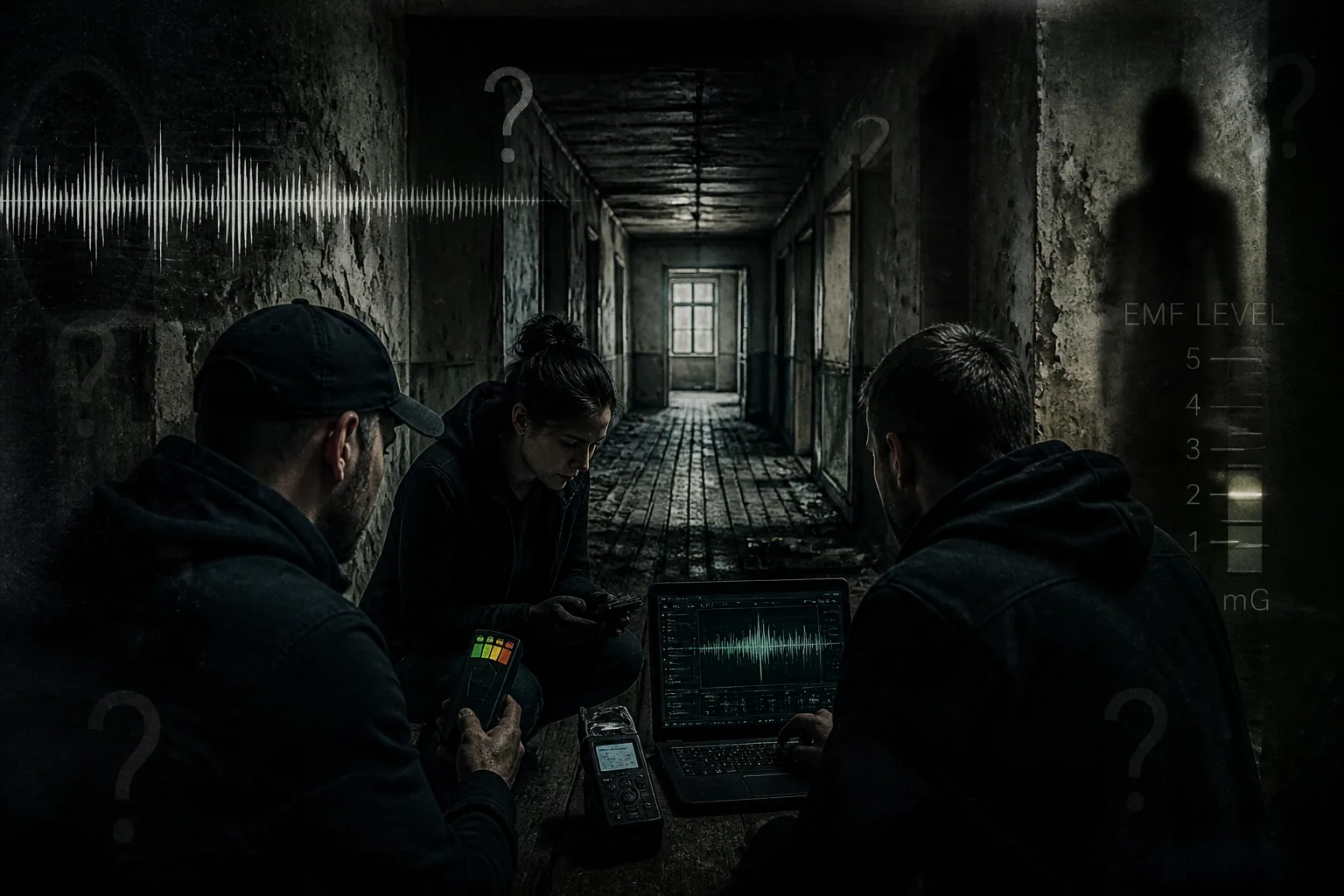
The Psychology of Ghost Hunting: Why We Want to Believe and How It Shapes What We Record
Ghost hunting feels exciting for a reason. It sits at the intersection of fear, curiosity, storytelling, and the human desire to make sense of the unknown. When a flashlight flickers, a voice appears in a noisy EVP clip, or an EMF meter jumps for a second, it can feel like the moment every investigator is waiting for. But what we notice, what we remember, and what we finally label as evidence is not just about the location or the equipment. It is also about the mind behind the investigation.
That is what makes paranormal content so compelling. The best ghost hunts do not only explore haunted places. They reveal how expectation, emotion, and group dynamics shape perception in real time. If you understand that psychology, you can become a better investigator, a more credible creator, and honestly, a more interesting one too.
Why Ghost Evidence Feels Convincing in the First Place
A lot of paranormal evidence feels persuasive because it arrives in a context that already encourages meaning. Dark rooms, old buildings, strange sounds, and tense silence all raise our alert level. Once our brain is primed to look for a presence, even small ambiguities can start to feel loaded. A creak becomes a footstep. A burst of static becomes a response. A shadow becomes a figure.
This is not proof that people are dishonest. It is a normal feature of perception. The brain is built to detect patterns quickly, even when the information is incomplete. In survival terms, it is often better to make a fast guess than to miss something important. Ghost hunting turns that same instinct into entertainment and investigation at the same time.
Psychologically, the strongest evidence is often not the clearest signal, but the one that comes after anticipation. If everyone in the room is already on edge, the next tiny anomaly feels much bigger than it would in daylight, with no story attached to it.
The Emotional Pull of Belief, Fear, and Meaning-Making
Belief matters because fear changes attention. When people are scared, they scan harder for threats, and they also become more likely to interpret uncertainty as meaningful. In paranormal settings, that can create a feedback loop. The more intense the atmosphere, the more every sound and movement seems significant, and the more significant it feels, the more intense the atmosphere becomes.
Meaning-making is part of why ghost hunting endures. People do not just want a scare. They want a story. A haunted hallway feels richer when it seems to connect to a tragedy, a lingering spirit, or a local legend. That story gives shape to what would otherwise be random sensory noise.
Research on contextual mediation during hauntings found that in 843 reports, contextual factors such as time of day, emotional state, and environmental conditions appeared in 99.2% of cases, and more than half of the experiences matched those contexts. In other words, what people felt was often deeply connected to the situation they were already in rather than to a mysterious external force alone. See Harte et al. here: https://journals.sagepub.com/doi/10.2466/pms.2000.91.2.451
Confirmation Bias: Finding What You Expect to Find
Confirmation bias is one of the biggest reasons ghost evidence feels real. If you go into a building expecting activity in the attic, you are more likely to notice unusual sounds from above, and more likely to dismiss quiet sounds that do not fit the story. If you believe a room is active, a quick spike on the EMF meter may become stronger evidence in your mind than it really is.
This works in both directions. You can miss disconfirming details just as easily as you can overvalue supportive ones. A draft from an open vent, a reflection from a moving car, or a phone interference issue can all be overlooked if the team already decided the location is haunted.
Confirmation bias is also why repeat investigations can be misleading when no one controls for prior expectations. Once a place gains a reputation, every future visitor arrives carrying that reputation with them. The location does not have to change much for the interpretation to change dramatically.
Pareidolia and Pattern Recognition in Audio, Video, and Photos
Pareidolia is the tendency to perceive meaningful patterns in ambiguous stimuli, like faces in clouds or voices in static. It is one of the most important psychological mechanisms in ghost hunting because so much paranormal media is built on incomplete information. Grainy footage, low-light video, muffled audio, and distorted radio noise all invite the mind to complete the pattern.
That is why an EVP clip can sound obvious to one person and meaningless to another. The mind fills gaps automatically. Once a fragment resembles a word or phrase, the listener’s expectations help lock it in. A similar thing happens with shadowy images, where the brain can transform a moving blur into a human shape if the setting already encourages that interpretation.
The expectation effect is not theoretical. In a PLOS ONE study with 61 participants, people who were primed to expect ghost voices reported hearing voice-like stimuli in ambiguous audio more often than those who were not primed. The same study also found little agreement between what individuals said they heard and what paranormal investigators claimed the EVP said, which shows how much interpretation shapes the final result. Source: https://pmc.ncbi.nlm.nih.gov/articles/PMC9473424/
This is especially important for creators who rely on clips. The more compressed, noisy, or edited the audio, the easier it becomes for viewers to hear what they expect to hear. The phenomenon is real, even if the spirit is not necessarily there.
Suggestibility and the Power of Leading Questions During Investigations
Ghost hunting often relies on conversation, but conversation can easily become suggestion. If an investigator asks, “Did you hear that woman whispering?” or “Was that you touching the wall?” the question itself shapes the answer. People naturally want to cooperate, especially in a group setting, and they may start searching their memory for details that match the prompt.
Suggestibility is even stronger when the group is tired, scared, or highly invested in a result. A person who is uncertain may adopt the interpretation suggested by the most confident voice in the room. That does not mean they are lying. It means uncertainty is socially contagious.
Research on pseudo-psychic demonstrations found that people who believe in the paranormal or score high in suggestibility are more likely to interpret ambiguity as meaningful and feel amazed regardless of whether the event is presented as a trick or genuine spirit communication. That is a reminder that the frame around an experience often matters as much as the experience itself. Source: https://www.sciencedirect.com/science/article/pii/S0191886903001028
How EMF Readings, Spirit Boxes, and EVP Clips Get Psychologically Framed
EMF meters are a perfect example of how equipment can feel more authoritative than it is. A spike looks objective. It feels numerical, measurable, and technical. But many spikes have mundane causes, including faulty wiring, nearby electronics, Wi-Fi routers, natural geomagnetic activity, or stray currents from building materials. Without controls, a spike is just a spike. It is not automatic evidence of a spirit. More on that here: https://hauntedhosts.com/library/explainers/what-is-an-emf-meter-and-why-do-ghost-hunters-use-them/
A detailed EMF guide also warns that handheld meters can produce artifacts from orientation, human motion, or nearby wiring, which means the device can react to how it is held and moved. Reliable interpretation requires baseline readings, reproducibility, and ruling out known sources. That same guide is here: https://hauntedhosts.com/library/explainers/what-is-an-emf-meter-and-why-do-ghost-hunters-use-them/
Spirit boxes and EVP generators are psychologically potent for a similar reason. They produce fragmented, suggestive output that invites the listener to impose meaning. Once the brain starts searching for a relevant phrase, it can connect nearly any burst of noise to the current question. The device becomes a meaning machine, and the meaning often comes from the investigator, not the signal.
That does not mean these tools are useless for content. It means they should be treated as sources of ambiguity, not automatic proof. The moment you recognize that distinction, your recordings become more honest and, paradoxically, more interesting.
Group Dynamics: How Teams Reinforce Shared Interpretations
Ghost hunts are often social experiences, and group dynamics matter a lot. In a team, one person’s interpretation can quickly become the group’s interpretation. If the first investigator says, “I heard a knock,” the others are primed to listen for the next knock, even if the original sound was ambiguous.
This creates a shared reality effect. People begin to align their perception with the dominant narrative in the room. When the team is excited, tired, or frightened, that alignment happens even faster. The more confident the leader sounds, the more likely the group is to accept the explanation.
This is one reason why careful teams separate observation from interpretation. It is useful to record exactly what each person noticed before discussing what it might mean. Once the group starts converging on a story, individual impressions become harder to recover.
Folklore, Pop Culture, and the Stories That Shape Paranormal Expectations
A haunted site is never just a physical space. It is also a story people bring with them. Folklore tells you what kind of ghost to expect. Pop culture tells you what a haunting is supposed to look and sound like. Movies, television, and social media have trained audiences to expect whispers, cold spots, footsteps, shadows, and dramatic emotional responses.
Recent sociological work on ghost criminology found that narratives about violence or trauma at a site can increase reports of anomalous sensations and moral weight, even when the actual history is held constant. The story itself shapes what people feel. That matters because paranormal interpretation is often built on context before any evidence is collected. Study link: https://link.springer.com/article/10.1007/s11186-025-09676-6
If a location is said to be cursed, abandoned, or the site of a tragedy, people arrive with expectations already formed. They are more likely to interpret ordinary discomfort as paranormal significance. In practice, lore can be as influential as light levels or temperature.
Real Cases Where Environmental Causes Were Mistaken for the Paranormal
Many haunting reports can be traced to ordinary environmental causes once someone takes the time to test them. Drafts can create moving curtains, slamming doors, or temperature shifts that feel unnatural in the moment. Plumbing can generate bangs and knocks. Building settling can produce footsteps or tapping. Electrical issues can trigger EMF devices. Reflections, headlights, and passing cars can create flashes or shadows that seem human when viewed from the wrong angle.
This is where good investigations become more interesting, not less. A mystery that resolves into ventilation, wiring, or acoustics does not ruin the experience. It improves the credibility of the team and helps separate genuine anomalies from mistakes.
A strong investigation is not one that avoids explanations. It is one that actively looks for them before deciding something paranormal happened. That is what makes the remaining unknowns more meaningful.
How to Stay Neutral Without Losing the Excitement of Ghost Hunting
Neutrality does not mean skepticism so intense that you cannot enjoy the hunt. It means building habits that protect your judgment while keeping your curiosity alive. The goal is not to kill the thrill. The goal is to make sure the thrill does not decide the conclusion for you.
A neutral investigator still asks exciting questions. They just delay certainty. Instead of saying, “That was definitely a spirit,” they say, “That is an interesting anomaly, and we need to test it.” That small shift changes everything.
This approach also makes your content stronger. Viewers can feel the difference between a creator who is trying to convince them and one who is genuinely exploring possibilities. Authenticity usually lands better than overclaiming.
If you want a mobile-friendly way to capture sessions while keeping the experience immersive, Ghost Detector: Ectify can help you record and review your hunts in one place: https://findthe.app/ectify-fc72z0
Practical Bias-Reduction Methods: Journals, Blind Reviews, and Controls
One of the simplest ways to reduce bias is to keep an expectation journal before the investigation. Write down what you think will happen, which rooms you expect to feel active, what evidence you are most likely to notice, and what you think the history of the location implies. Later, compare those expectations with what actually happened. This makes hindsight bias much harder to hide.
Blind audio review is another powerful tool. If possible, have someone listen to recordings without telling them where the clip came from or what was supposedly heard. If the interpretation changes drastically when the context is removed, that tells you the context was doing a lot of the work.
Control recordings are equally important. Record the same room when no one is speaking, moving, or asking questions. Check whether the sound or EMF behavior still appears under the same conditions. If it does, you may have found a repeatable environmental pattern rather than an isolated paranormal event.
A simple practical checklist can help: document time, weather, room temperature, device settings, nearby electronics, and who was speaking. Then compare anomalies against these variables. The more information you gather, the less likely you are to mistake coincidence for contact.
What More Authentic Paranormal Content Looks Like Today
More authentic paranormal content does not need to be boring. In fact, it often becomes more compelling when it shows the process of doubt. Viewers trust creators who show how they ruled things out, what they were unsure about, and where the evidence remained ambiguous.
That kind of transparency creates suspense without exaggeration. Instead of presenting every sound as proof, the creator invites the audience into the investigation. The result feels more real because it respects uncertainty.
Modern audiences are also getting better at spotting over-edited, overclaimed evidence. A clip that simply says, “Here is what happened, here is what we checked, and here is what we still cannot explain,” often performs better in the long run than a sensational one that falls apart under scrutiny.
The best content does not abandon wonder. It just pairs wonder with discipline.
Conclusion: Better Psychology Makes Better Investigations
Ghost hunting will always involve ambiguity. That is part of the appeal. But ambiguity becomes much easier to handle when you understand the psychology behind it. Expectation can shape audio perception. Suggestion can shape group consensus. Fear can intensify pattern recognition. Folklore can make a room feel haunted before a single reading is taken.
Once you see those forces clearly, you do not lose the thrill of paranormal investigation. You gain a better one. You start noticing not just what might be happening in a location, but also what is happening in the minds of the people inside it.
That is the real lesson. Better psychology makes better investigations, and better investigations make more credible, more engaging, and more memorable ghost stories.
