The Science Behind Feeling a Presence During Ghost Hunts
That sudden sensation that someone is standing behind you can feel intensely real during a ghost hunt. The room goes quiet, the light gets low, the air feels colder, and your mind starts filling in the blanks. For many investigators, this is one of the most unsettling parts of paranormal work because it does not always come with a clear visual or audible event. It is just a feeling. And yet that feeling of presence can be powerful enough to change the entire direction of a session.
The good news is that science has a lot to say about why this happens. Psychology, neuroscience, and environmental research all suggest that haunted settings can prime the brain to misread ambiguous cues, especially when fear, uncertainty, and sensory deprivation are involved. In other words, many ghost hunt sensations may be real experiences without being paranormal causes.
What Does It Mean to Feel a Presence?
A feeling of presence, often shortened to FoP, is the sense that another being is nearby even when no one is visible. People may describe it as an intruder in the room, a figure just outside their field of vision, or a vague but unmistakable awareness that they are not alone. It can happen in homes, hospitals, abandoned buildings, and especially during paranormal investigations when expectations are already high.
Importantly, this sensation is not limited to ghost stories. A review of 72 empirical studies found that felt presence is also associated with sleep disorders, narcolepsy, epilepsy, neurodegenerative disease, and certain brain lesions, particularly in temporal regions. Those findings suggest that the brain can generate presence sensations when its normal prediction and self-monitoring systems are disrupted. Source: Roballo & Delgado, https://www.ovid.com/journals/dream/fulltext/10.1037/drm0000113~analysis-of-the-empirical-research-on-the-feeling-of
Why Ghost Hunts Prime the Brain for Unusual Perception
Ghost hunts are almost designed to make ordinary perception harder. They often happen in darkness, with limited background noise, unfamiliar architecture, and a constant expectation that something may happen. That combination matters because the brain does not passively record reality. It actively predicts what should be there and then updates those predictions using sensory input. When the environment is uncertain, the brain leans harder on expectation.
This is one reason investigators often report a strange presence just after a creak, an unexplained draft, or a change in equipment readings. The event itself may be small, but in a tense setting it becomes meaningful. Once fear rises, attention narrows and the brain becomes more willing to interpret ambiguity as threat. A virtual reality study on fear and presence found that subjective fear predicted stronger feelings of presence more closely than heart rate or skin conductance alone, showing that what we feel can matter as much as what our bodies measure. Source: https://pmc.ncbi.nlm.nih.gov/articles/PMC11182719/
What Lab Studies Reveal About Haunted Sensations
Researchers have directly tested some of the same conditions people encounter during ghost hunts. In the Haunt Project, 79 participants were exposed to complex electromagnetic fields, infrasound, both, or neither inside a specially constructed chamber. The setup also included typical haunted-location cues such as dim light and a cool temperature. Under the EMF and infrasound conditions, participants reported mild anomalous sensations, including a sense of presence, dizziness, and strange smells. Source: https://www.sciencedirect.com/science/article/pii/S0010945208001299
That does not prove a supernatural cause. What it does show is that the right combination of environmental conditions can make people notice unusual internal and external sensations. In another recent study, 36 participants were exposed to around 18 Hz infrasound at 75 to 78 dB. Even when they could not consciously detect it, the exposure increased cortisol and made people feel more irritable, sad, and uncomfortable. Source: https://pmc.ncbi.nlm.nih.gov/articles/PMC13158192/
The point is not that every basement hum or flicker creates a ghostly event. The point is that some environmental factors can alter mood, arousal, and perception in ways that make a haunting feel more convincing than it really is.
Sensory Deprivation, Darkness, and the Brain’s Need to Fill Gaps
Darkness does more than reduce visibility. It changes how the brain processes threat. One study found that fear-related physiological reactions were stronger at night than in comparable dark conditions during the daytime, which suggests that darkness plus context can intensify fear responses. Source: https://www.sciencedirect.com/science/article/pii/S0167876015001713
A recent lab study also showed that longer periods in darkness and silence increase the likelihood of reporting a feeling of presence. In that study, 126 people spent time under sensory deprivation conditions, and 30 minutes of darkness and silence led to more FoP reports. Uncertainty about whether someone might enter made the effect even stronger. Source: https://sciety.org/articles/activity/10.31219/osf.io/8xzyv_v1
This makes sense from a cognitive standpoint. When sensory input gets thin, the brain does not simply switch off. It starts predicting more aggressively. Small sounds become meaningful. A shift in temperature feels intentional. A shadow at the edge of vision looks agent-like. In a haunted setting, the mind may interpret this unfinished information as evidence that something or someone is there.
Environmental Triggers: EMF, Infrasound, and Temperature Shifts
Ghost hunters often focus on three classic triggers: electromagnetic fluctuations, low-frequency sound, and sudden cold spots. Science suggests a mixed picture here. EMF and infrasound are not magic ingredients, but under some conditions they can contribute to unease, bodily discomfort, and odd perceptions.
The Haunt Project found mild anomalous experiences in EMF and infrasound conditions, but that still leaves the question of whether the sensations came from the fields themselves or from what participants expected to happen. A critical review of electromagnetic hypersensitivity found that most double-blind studies do not confirm that actual EMF exposure causes symptoms such as feeling watched or sensing a presence. Instead, beliefs, anxiety, and expectation appear to play a much stronger role. Source: https://pmc.ncbi.nlm.nih.gov/articles/PMC7201940/
Temperature changes are another common trigger. Cold spots are frequently reported in alleged haunted locations, but objective measurements are rare. When temperature drops are measured, they can often be explained by air movement, thermoregulation, drafts, or other ordinary physical processes. A sudden chill may feel paranormal, but in most cases it is a clue to examine the environment more carefully rather than a conclusion in itself. Source: https://psi-encyclopedia.spr.ac.uk/articles/cold-spots/
In practice, this means that a true investigation should not stop at the sensation. It should ask what changed in the environment right before the sensation appeared.
How Expectation, Fear, and Suggestibility Shape What You Notice
Expectation is one of the strongest forces in paranormal perception. If you enter a location believing it is haunted, every noise, temperature shift, and flicker is filtered through that belief. This does not mean you are lying or imagining everything. It means your brain is doing what brains do: trying to make sense of incomplete data as quickly as possible.
Fear makes this process stronger. In a tense state, the brain prioritizes possible threats over neutral explanations. A slight movement in the corner of your vision becomes an intruder. A random smell becomes a message. A sensation in your peripheral awareness becomes a presence. That is especially true when people are tired, isolated, or already primed by stories from other investigators.
Suggestibility also matters. If one person says they feel watched, others may begin scanning for the same sensation. In a group setting, emotional cues spread quickly. That is why recording who noticed what, and when, can be just as important as recording any audio or sensor spike.
Why Believers and Skeptics Can Both Misread Ambiguous Signals
It is easy to think only believers are vulnerable to misinterpretation, but skeptics can fall into the same trap for a different reason. A believer may over-attribute a sensation to the paranormal, while a skeptic may under-attribute a meaningful environmental cue because it seems too ordinary. In both cases, the issue is not honesty. It is interpretation under uncertainty.
Ambiguous stimuli are exactly the kind of input the brain struggles with. A faint pressure change, a low hum, or a brief shadow can support very different stories depending on what you already think is happening. That is why good investigation method matters more than personal confidence. The more ambiguous the signal, the more important it is to separate observation from conclusion.
The strongest approach is to treat every sensation as a data point first. Only later should you decide whether it supports a paranormal explanation. This is where careful notes, consistent lighting conditions, and environmental monitoring become essential.
Using Ectify and Sensor Data to Cross-Check Your Experience
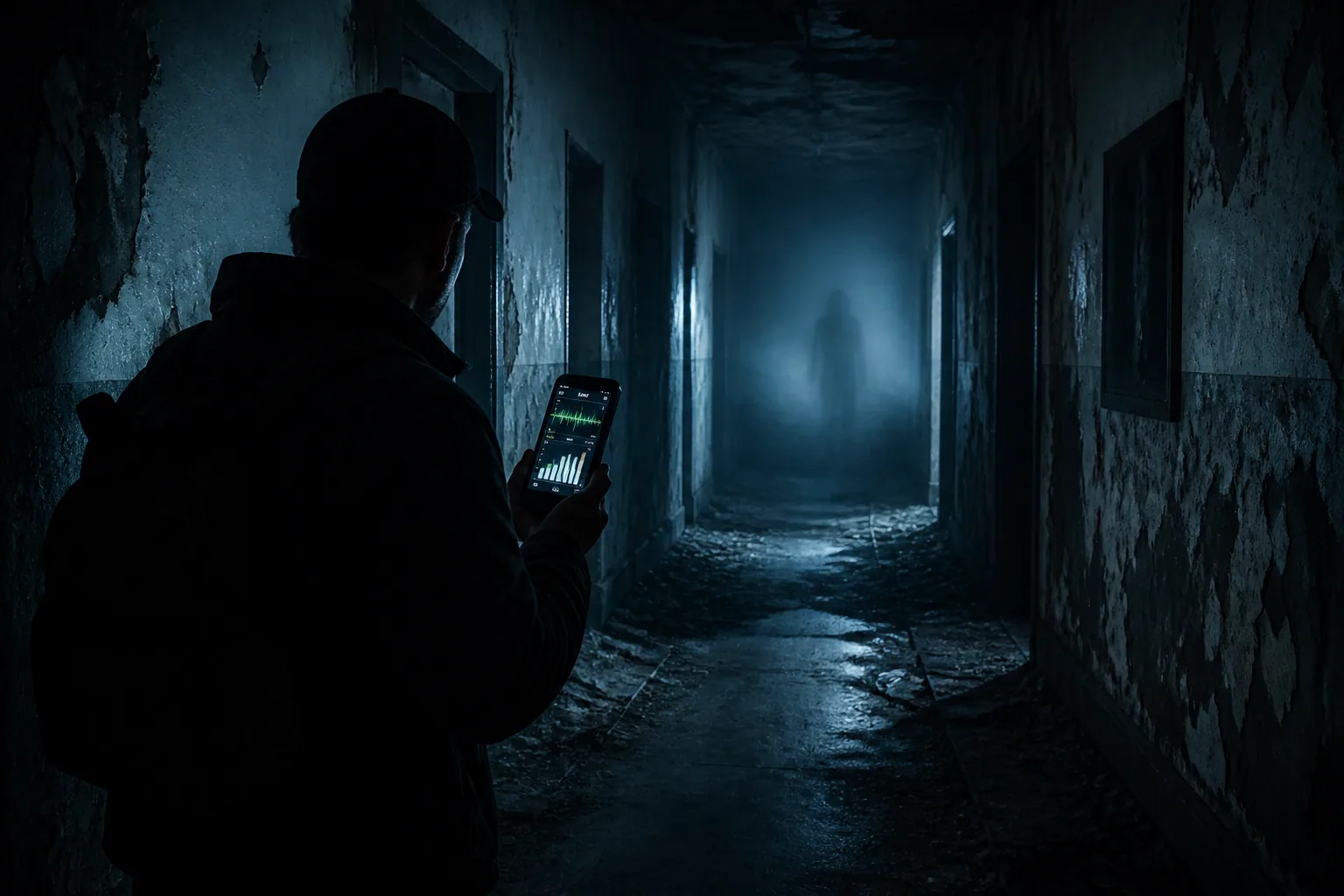
One of the smartest ways to avoid jumping to conclusions is to compare your subjective experience with objective readings. If you suddenly feel a presence, check what was happening with EMF, audio, time, temperature, and group activity at that exact moment. A tool like Ghost Detector: Ectify can help by turning your smartphone into a session tracker with real-time EMF detection and session history so you can review spikes and compare them against what you felt in the moment. You can learn more here: https://findthe.app/ectify-fc72z0
That does not mean the app can tell you whether a haunting is real. It means it can help you build a better investigation record. If a feeling of presence always appears during high anxiety, after long periods in silence, or next to a known draft, that pattern matters. If it appears alongside an unexplained sensor change after environmental causes are ruled out, that is also worth noting. Either way, the data keeps the conversation grounded.
Practical Grounding Techniques for Paranormal Investigators
When you start to feel unnerved, grounding helps keep the investigation honest. First, pause and name what you are experiencing. Say out loud whether it is a sound, a chill, a pressure sensation, or a general feeling of presence. Labeling the sensation creates distance between the raw experience and the story your mind wants to attach to it.
Second, check the basics. Are you tired, dehydrated, hungry, or overstimulated? Are you in a room with poor airflow, uneven floorboards, or echoes that could explain the sensation? Simple body state and environmental checks often reveal a more ordinary source than the one fear first suggests.
Third, document everything immediately. Write down the time, location, who was present, what was said, what equipment was active, and what changed in the environment. The more precise the record, the easier it becomes to separate a one-time scare from a repeatable pattern.
Finally, use short reset breaks. Step into better light, breathe slowly, and re-enter with a clearer baseline. A grounded investigator is usually a better investigator.
How to Tell the Difference Between a Meaningful Event and a Mental Misfire
A meaningful event is not automatically paranormal, and a mental misfire is not automatically fake. The question is whether the event can be reproduced, checked, and explained with available evidence. If a sensation appears only when you are alone in darkness, after a long session, or after someone suggests something scary, it deserves a skeptical review. If it happens repeatedly under controlled conditions with documentation, it deserves deeper analysis.
Some helpful questions include: Was there a change in temperature, airflow, or noise? Did anyone else notice the same thing independently? Was the room dark or quiet enough to amplify expectation? Were you already primed by the location history? These checks do not kill the mystery. They make it stronger by removing the easy mistakes.
The key is to avoid treating intensity as proof. A sensation can feel profound and still arise from a very human combination of fear, suggestion, and environmental cues.
What Science Can Explain and What It Still Can’t
Science explains a great deal about why ghost hunts feel haunted. Darkness can intensify fear. Silence and sensory deprivation can generate presence sensations. Infrasound may raise discomfort and negative mood. EMF exposure often looks less important than belief and expectation. Sleep-related phenomena, neurological conditions, and body-mapping errors can all create a sense that another being is nearby.
What science cannot do yet is close every case. Human perception is messy, and not every strange event will be fully captured by current instruments or theories. That is why the best investigators stay open-minded without becoming careless. They respect experience, but they also respect method. They ask what happened, what changed, and what can be ruled out before they decide what remains.
In the end, feeling a presence during a ghost hunt is often less about a spirit entering the room and more about the brain trying to make sense of a high-stakes, low-visibility environment. That does not make the experience boring. It makes it fascinating. And with careful observation, grounded technique, and sensor data to back you up, you can explore the uncanny without confusing it with certainty.
